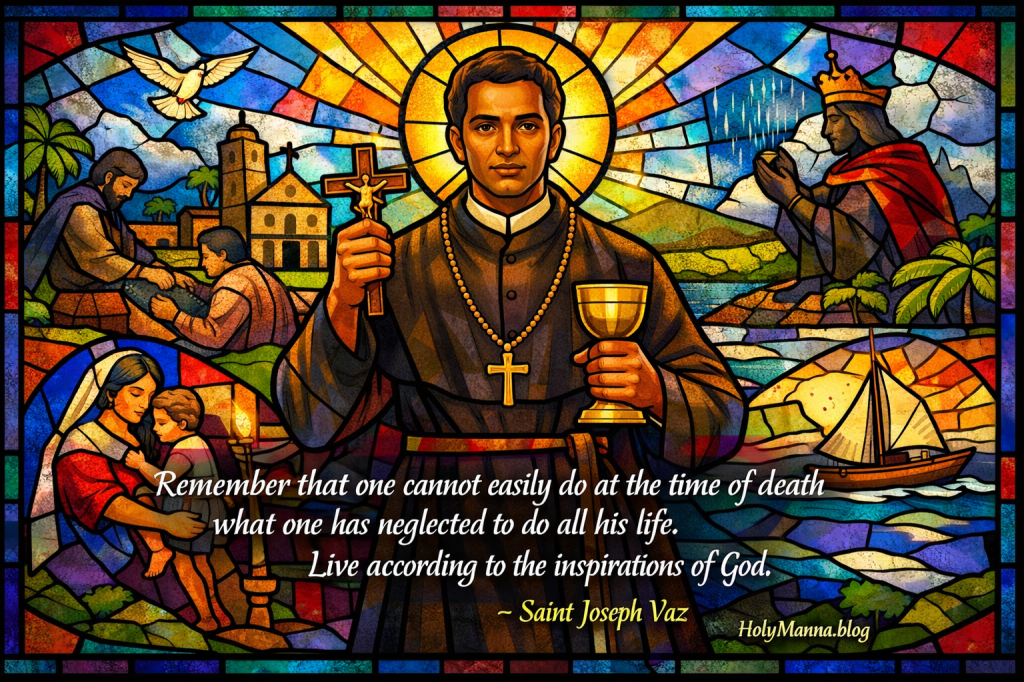
The Apostle of Sri Lanka
Saint Joseph Vaz is one of those saints who makes modern excuses sound small. He is remembered as the Apostle of Sri Lanka because he rebuilt Catholic life when the Church was being hunted and Catholics were forced underground. He did not do it with political influence, money, or protection. He did it the Catholic way, through prayer, sacrifice, catechesis, and relentless love for the Eucharist and confession. His story matters because it proves that when everything is stripped away, the Church still stands on grace, truth, and saints who refuse to abandon souls.
His canonization highlights something deeply Catholic. Holiness is not only personal virtue, because holiness is missionary. Saint Joseph Vaz put his life on the line so ordinary families could return to Mass, receive absolution, baptize their children, and live the full Catholic life instead of a watered down survival version of it. This is the kind of witness that echoes The Gospel of Matthew and its insistence that love of God must become love in action.
From Goa’s Shores to a Missionary Heart
Joseph Vaz was born on April 21, 1651, in Goa, in a local Catholic family shaped by deep faith and the realities of life in that era. His early formation was serious and disciplined. He studied languages and the humanities, then moved into philosophy and theology, and he was ordained a priest in 1676. Even as a young priest, he gained a reputation for preaching well and guiding people patiently in confession. That is a theme that never leaves his life, because he was not a flashy personality and he did not rely on charisma. He was a shepherd who wanted souls close to Christ.
His faith did not stay academic, because it became intensely personal and deeply Marian. Catholic tradition remembers him making a strong act of belonging to the Blessed Virgin Mary, described in devotional language as becoming her servant. That Marian trust shows up later in everything he did, because missionaries do not keep going for decades on personality alone. They keep going because they believe Heaven is real, grace is real, and Mary truly leads souls to Jesus.
Before he ever reached Sri Lanka, he was sent to Canara in southwestern India to care for Catholics who had been neglected and scattered. This mission shaped him in a lasting way. He strengthened communities through catechesis, encouraged local leadership, and helped organize Catholic life so that it could endure hardship and isolation. He learned early that the Church survives storms when the laity are formed and when the sacraments are protected and treated with reverence.
The Beggar Priest and the Miracles of Mercy
In 1687, Father Vaz entered Sri Lanka, and Catholic memory emphasizes the daring simplicity of his approach. Because Catholic worship was restricted under Dutch Calvinist rule, he arrived quietly, poor, and often described as disguised as a beggar. He was not trying to be clever for its own sake. He was choosing to become small so Christ could remain present among a persecuted people.
He began locating hidden Catholic communities and restoring sacramental life. This meant celebrating Mass in secret, hearing confessions in private homes, baptizing children who had grown up without clergy, and strengthening marriages and families. His ministry was the opposite of comfortable, because it demanded constant movement and careful discretion. He also worked to anchor the faith long term through prayer and instruction, not just emergency sacraments. A missionary who only performs rites without forming minds and hearts leaves people fragile, and he refused to leave them fragile.
Catholic tradition preserves striking moments that show how God used him in extraordinary ways. The most famous is the rain miracle connected to Kandy. During a severe drought, the king is said to have challenged Father Vaz to pray publicly for rain. After his prayer, rain reportedly came, and that event opened doors for greater trust and freedom to minister. Catholics do not treat this like a cheap story, because it is remembered as a sign of God’s providence and a reminder that prayer is real and miracles are possible.
Another defining moment came during a smallpox outbreak. While fear made people withdraw, Father Vaz cared for the sick with hands on charity, the kind of mercy that looks like The Gospel of Matthew lived out in real time. This was not just spiritual comfort, because it was courageous service. He became known as a priest who would risk his life to protect the vulnerable, and that kind of love tends to soften hearts and open doors for the Gospel.
A Faith That Would Not Break
Saint Joseph Vaz faced the kind of pressure that modern Christians rarely experience. He was watched, denounced, and accused, and at one point he was imprisoned in Kandy after being suspected of political motives. Yet the Church remembers that his holiness did not shrink behind bars. He remained faithful, continued to witness to Christ, and gradually earned trust through integrity and service. In time, Kandy became a base for wider missionary outreach rather than a dead end.
He also endured quieter hardships that break most people. He traveled across difficult terrain for years, often without security, often dependent on the charity of others, always carrying the weight of souls who needed the sacraments. He worked in a climate of uncertainty where any public Mass could lead to arrests, and where every mission trip carried real risk. He also resisted the temptation of ego. Catholic tradition notes that when there were efforts to raise him to higher ecclesial office, he resisted that path and kept his focus on mission. That refusal reveals the heart of a true servant, because he wanted souls, not status.
His life fits the Catholic understanding of white martyrdom. He died daily to comfort, reputation, safety, and control. That kind of martyrdom is not dramatic, but it is extremely holy. It also reminds Catholics today that sacrifice is not reserved for ancient arenas, because it happens in faithful perseverance, even when it is hidden.
A Holy Death and a Church Rebuilt
Saint Joseph Vaz died on January 16, 1711, in Kandy after decades of intense missionary labor. By the end of his life, Catholic sources describe a remarkable restoration of Catholic presence across Sri Lanka. He helped reestablish widespread communities, strengthened families, formed catechists, and built up churches and chapels. This was not merely survival, because it was rebuilding rooted in the sacraments and in lived devotion.
His strategy was deeply Catholic. He did not treat the faith like a private set of ideas, because he worked to restore the full life of the Church. That includes the Eucharist, confession, baptism, catechesis, Marian devotion, and a disciplined moral life rooted in grace. He also worked to make sure Catholics could pray and learn even when priests were scarce. His emphasis on instruction and formation fits the wisdom of The Catechism which teaches that faith is both gift and responsibility, meant to be received and handed on with clarity and love.
In Sri Lanka, his memory is tied to places where the faith survived persecution and grew again. His impact was not only spiritual but cultural, because he helped shape the identity of Sri Lankan Catholicism as resilient, Eucharistic, and willing to suffer rather than abandon Christ. His life teaches that the Church becomes strong when the faith becomes truly rooted, not merely inherited by habit.
A Legacy That Keeps Multiplying
Devotion to Saint Joseph Vaz continued long after his death, both in Sri Lanka and in Goa. Over time, the Church examined his life and the testimonies of his holiness, and his cause advanced through the careful discernment the Church applies to canonization. He was beatified in 1995 and canonized in 2015, which was a major moment of joy for Sri Lankan Catholics who had long honored him as a spiritual father.
The miracle most commonly associated with his beatification involves a medically serious pregnancy complication in 1938. After prayers seeking his intercession, the crisis reportedly resolved and a child was born safely. Catholics see miracles like this in a sober way. They are not meant to entertain. They are meant to confirm that God is living, that the saints intercede, and that Heaven remains involved in the suffering of families on earth.
A well known saying attributed to him captures his urgency and spiritual realism. “Remember that one cannot easily do at the time of death what one has neglected to do all his life. Live according to the inspirations of God.” This is the kind of line that cuts through procrastination and calls a soul back to seriousness. It is also a reminder that holiness is built through daily choices, not last minute heroics.
The Saint Who Teaches Courage
Saint Joseph Vaz teaches that Catholic life is built through fidelity, not trendiness. His example challenges the temptation to treat the Church like an accessory that can be picked up or put down. He reminds every Catholic that the Eucharist is worth sacrifice, confession is worth humility, and prayer is worth time. He also shows that courage does not need theatrics, because it needs conviction rooted in grace.
His life offers practical lessons that fit ordinary life. He formed people through catechesis because he understood that strong Catholics are made, not assumed. He trusted Mary because Marian devotion strengthens purity, perseverance, and obedience to Christ. He served the sick because love becomes believable when it costs something. He refused personal ambition because mission demands humility, and he worked patiently because God often builds saints slowly.
How would life change if the sacraments were treated as the real treasure they are, rather than as optional extras? That question lands differently after reading about a priest who crossed oceans and risked prison just to bring the Eucharist and absolution to forgotten Catholics. His witness invites every Catholic to return to the basics with renewed seriousness, and to live the faith publicly through charity, integrity, and perseverance.
Engage with Us!
Share thoughts and reflections in the comments below, because the Church grows when Catholics encourage each other with real stories of courage and grace.
- Where does the faith feel most pressured or silenced in everyday life, and what would it look like to respond with Saint Joseph Vaz’s calm courage?
- Which sacrament has been most life-giving lately, and how can it be approached with greater reverence and consistency?
- How can devotion to Mary be practiced in a way that genuinely leads deeper into prayer, purity, and trust in Jesus?
- Who is one person right now that needs quiet Christian charity, and what practical act of mercy can be offered this week?
May Saint Joseph Vaz strengthen every soul to love the Church without embarrassment and to practice the faith without compromise. Keep walking forward with trust, keep choosing repentance and mercy, and keep doing everything with the love and mercy Jesus taught us, because that is the path that changes homes, parishes, and the world.
Saint Joseph Vaz, pray for us!
Follow us on YouTube, Instagram and Facebook for more insights and reflections on living a faith-filled life.

 Holy Manna!
Leave a comment