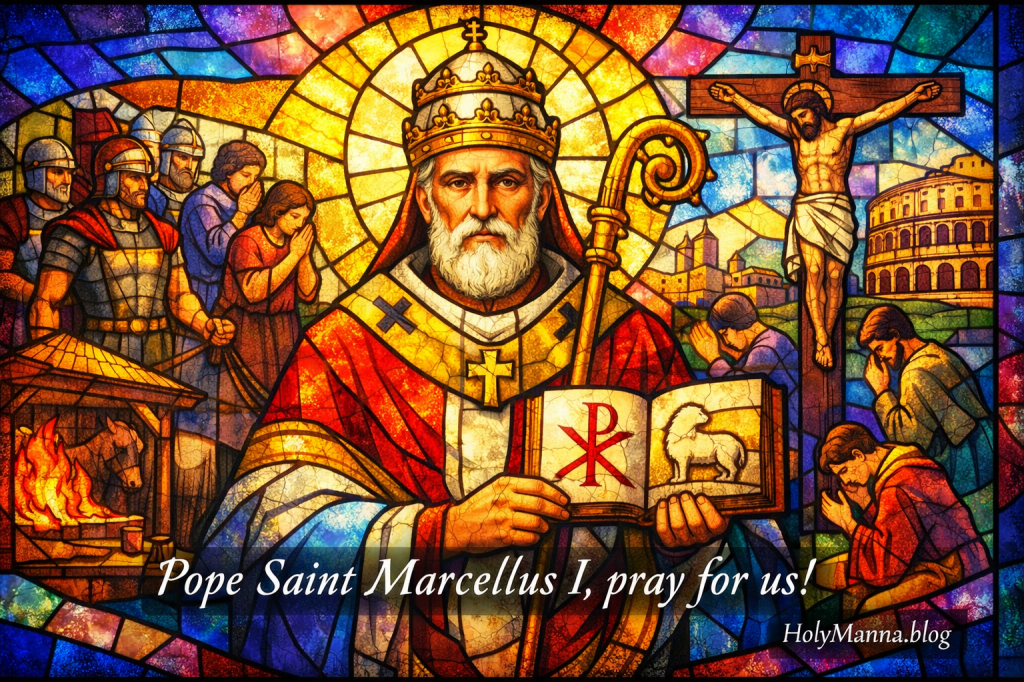
The Pope Who Rebuilt the Church After the Storm
Pope Saint Marcellus I is remembered as the kind of shepherd God raises up when the Church is trying to stand again after being knocked down. His pontificate was brief, but it landed in one of the most delicate moments in early Christian history. Rome had just endured the Diocletian persecution, a time when believers were threatened, scattered, and sometimes forced into heartbreaking decisions. When pressure eased, the Church did not simply return to normal. The community came back wounded, divided, and unsure how to move forward together, and that is exactly where Marcellus’ steady courage matters.
The Church honors him as a saint and commemorates him on January 16. He is often called a martyr because his fidelity as pope, his suffering, and his death after exile are inseparable from the conflict surrounding the faith and the discipline of the Church. His legacy is not flashy, but it is deeply Catholic. It is about rebuilding, protecting the sacraments, and guiding sinners back home without pretending the road home has no cost.
A Quiet Beginning in a Loud and Violent World
Almost nothing certain is known about Marcellus’ early life, family, or upbringing, and it is important to respect that silence rather than fill the gaps with imagination. The lack of information is not a weakness in the story. It is a reminder that holiness does not depend on having a dramatic biography. In the early centuries, many details simply were not recorded, especially when Christians lived under threat and the Church’s public life was frequently disrupted.
What is clear is the world Marcellus stepped into. The Roman Empire was not a neutral place for Christians, and the persecution under Diocletian left deep wounds in the Body of Christ. Many believers remained faithful and suffered for it, while others fell under pressure by offering pagan sacrifice, surrendering sacred books, or publicly renouncing Christ to save themselves. These fallen Christians were often called the lapsi. When the worst threats eased, a painful question rose immediately: How can the Church welcome the fallen back without pretending that denial of Christ is harmless? Marcellus became known for choosing the Catholic path that insists grace is real and mercy is offered, but conversion is not optional. He is remembered for holding the Church together when emotions were raw and unity felt impossible.
Rebuilding Rome with Courage
Marcellus’ work as pope focused on restoring normal Catholic life after a time when normal life had been torn apart. Christian worship and community structure had been disrupted, burial practices were affected, and pastoral care needed clarity. Tradition credits him with reorganizing pastoral life in Rome through local church centers often called tituli, ensuring that ministry and penitential practice were handled with stability and consistency. Even when later sources are careful about specific details, the Catholic memory remains steady on the big picture. Marcellus worked to rebuild the Church’s order after persecution, and he did it as a shepherd, not as a politician.
This kind of holiness is easy to overlook because it looks like administration, but it is really a form of charity. Order in the Church protects souls. Clear discipline protects the sacraments. A consistent path to reconciliation protects unity. Marcellus understood that people do not heal when the Church becomes vague. People heal when the Church offers a real way back, with truth that sets the heart free and mercy that restores peace.
When the Flock Turns on the Shepherd
No reliable record preserves miracle stories performed by Marcellus during his lifetime in the way many saints are remembered. That absence should not disappoint anyone because Catholic tradition does not treat miracles as the only proof of holiness. The deeper miracle is often perseverance in charity, especially in leadership, especially under pressure. Marcellus lived in a world where Christians were traumatized, divided, and tempted toward extremes, and it takes real grace to insist on mercy without turning it into permissiveness.
His importance lies in what he defended. He defended the integrity of the sacraments and the Church’s unity. He defended the truth that repentance is not an optional accessory to faith, but a normal part of Christian life. How often is the modern heart tempted to ask for forgiveness while still clinging to the same sin? Marcellus quietly challenges that mindset by showing that real reconciliation involves humility, conversion, and the willingness to be made new by grace.
When Church Conflict Becomes Public Suffering
The controversy around penance did not stay private. It erupted into unrest and violent division. Some who had lapsed resented being required to do real penance, and factions battled over what Christian life would look like after persecution. Ancient testimony remembers the period as marked by severe conflict, and one striking line describes the chaos as “Sedition, murder, war, discord, and quarrels”. That memory is sobering, but it also clarifies why saints are needed. Saints are the ones who stay faithful when the temperature rises and when unity is tested.
Because the unrest affected public order, Emperor Maxentius exiled Marcellus. Catholic sources agree on this core fact, even when they treat certain details of later stories with caution. Some later traditions describe humiliating forced labor connected to stables, and this memory helps explain why Marcellus is honored as a patron of stablemen, horses, and those who care for them. Even if later centuries embellished certain images, the Catholic point remains firm. He paid a real price for protecting the Church’s discipline and unity, and he died after exile as a witness to Christ.
A Cross That Would Not Burn
After his death, Marcellus was buried in the Catacomb of Priscilla on the Via Salaria, among the early Christian dead whose graves became places of prayer and memory. Over time, devotion to him became strongly linked to the Roman church known as San Marcello al Corso. Tradition connects that church to early Christian memory and to the idea that the Church often survived through the faithfulness of ordinary believers who opened homes and offered protection.
Miracles attributed to Marcellus after death are not commonly recorded as direct healings in the early centuries, but Catholic devotion connected to his Roman church became especially famous through a crucifix venerated there. This crucifix became known in Roman Catholic memory for surviving a destructive fire when much of the church was destroyed. The faithful received that survival as a sign that God sustains His people even when everything seems to burn. Later Roman devotion carried the crucifix in public times of prayer during plague, and popular memory connected those acts of faith with relief from disease. What does it say about God’s heart that He keeps drawing His people back to prayer in moments of fear? In that way, the saint’s legacy continued through the life of the Church, through penance, public prayer, and renewed trust in Christ.
As for verified quotations from Marcellus himself, none are securely preserved. That fits his role in the Church’s story. His witness was not a collection of writings, but the rebuilding of a battered community through clarity, discipline, and pastoral courage.
A Catholic Blueprint for Mercy with Courage
Pope Saint Marcellus I offers a lesson that feels almost tailor-made for modern Catholics. The Church does not help sinners by pretending sin is not serious. The Church helps sinners by telling the truth and offering the medicine of grace. Repentance is not meant to crush anyone. Repentance is meant to free the soul from illusion and reopen the heart to joy. Penance is not earning forgiveness, because forgiveness is always a gift. Penance is the training of the heart to live differently once forgiveness has been received.
A practical way to live his example is to approach confession with maturity. Confession is not a panic room for the perfect, and it is not a shame chamber for the broken. Confession is an encounter with the Lord who heals, who calls sin what it is, and who restores the sinner with mercy. Marcellus also teaches that unity in the Church matters enough to suffer for. Real unity is not the unity of pretending everyone is right. Real unity is the unity of shared conversion to Christ and shared reverence for the sacraments.
This story also speaks to families and friendships. When people fall, they need mercy, but they also need clarity. Supporting someone does not mean cheering on excuses. Supporting someone means walking with them toward repentance and healing. Where might the Lord be calling for more gentle clarity and more courageous mercy today? Marcellus shows how to hold that line without hatred, without theatrics, and without losing hope.
Engage with Us!
Readers are invited to share thoughts and reflections in the comments below, especially about how reconciliation and repentance are understood in everyday Catholic life.
- What does true repentance look like in a culture that often wants forgiveness without conversion?
- When has God used a difficult season to rebuild faith in a more mature and honest way?
- What practical step can be taken this week to pursue unity without sacrificing truth?
- How can Catholics speak about confession and penance in a way that feels hopeful rather than shame driven?
May Pope Saint Marcellus pray for the Church in every age, especially when unity feels fragile and truth feels costly. Keep walking in faith with steady courage, and do everything with the love and mercy Jesus taught, so that hearts are healed, families are strengthened, and the Church shines with the calm strength of the Gospel.
Pope Saint Marcellus I, pray for us!
Follow us on YouTube, Instagram and Facebook for more insights and reflections on living a faith-filled life.

 Holy Manna!
Leave a comment