The Quiet Giant of the Desert
Saint Paul the Hermit, also known as Paul of Thebes, is honored in Catholic tradition as the first great hermit of the Christian desert. His significance is not that he founded an order or preached to crowds, but that he proved a soul can belong totally to God in hiddenness without losing joy. The Church treasures witnesses like this because they reveal what is true for every baptized Christian: holiness is real, grace is enough, and God can be loved above everything else. This story also keeps modern believers from confusing holiness with visibility, because God often does His deepest work where no one is watching.
Most of what is known about Saint Paul comes through the ancient witness of Saint Jerome, who wrote a biography that shaped Christian memory of this saint. Catholic tradition receives that account as a spiritual portrait that teaches trust in God, perseverance in prayer, and detachment from the world, even while acknowledging that the story is told in a hagiographic style meant to edify the faithful. This fits beautifully with what The Catechism teaches about hermits, that they live in “the silence of solitude” through prayer and penance for the praise of God and the salvation of the world, as described in CCC 920-921. Saint Paul’s life is like a living commentary on those lines, because he shows what it looks like when God becomes the center and everything else falls into place.
From Persecution to Providence
According to the tradition preserved by Saint Jerome, Paul was born in Egypt and faced danger as a young man during a time of persecution. He fled not because he lacked courage, but because the world around him had become spiritually and physically unsafe, and the story includes betrayal connected to family wealth. That detail matters because it reminds every believer that sin can wound even the closest relationships, but God can still draw a soul into freedom and peace. In Paul’s case, what began as escape became a lifelong calling.
Paul’s conversion is not presented as a dramatic public moment with applause and instant clarity. It is presented as a steady yes to God that deepened over time, which is a very Catholic way of understanding conversion. At first he ran to survive, but then he stayed because he discovered a deeper life that the world could not give, and the desert became a place of purification. The Catechism teaches that conversion is a continual work of the heart, a daily turning back to God in repentance and renewal, and that truth is captured well in CCC 1430. Paul is most known for embracing a life that made no sense to the world but made perfect sense to Heaven, because he chose to live as if God is truly real, truly near, and truly enough.
Bread in the Wilderness
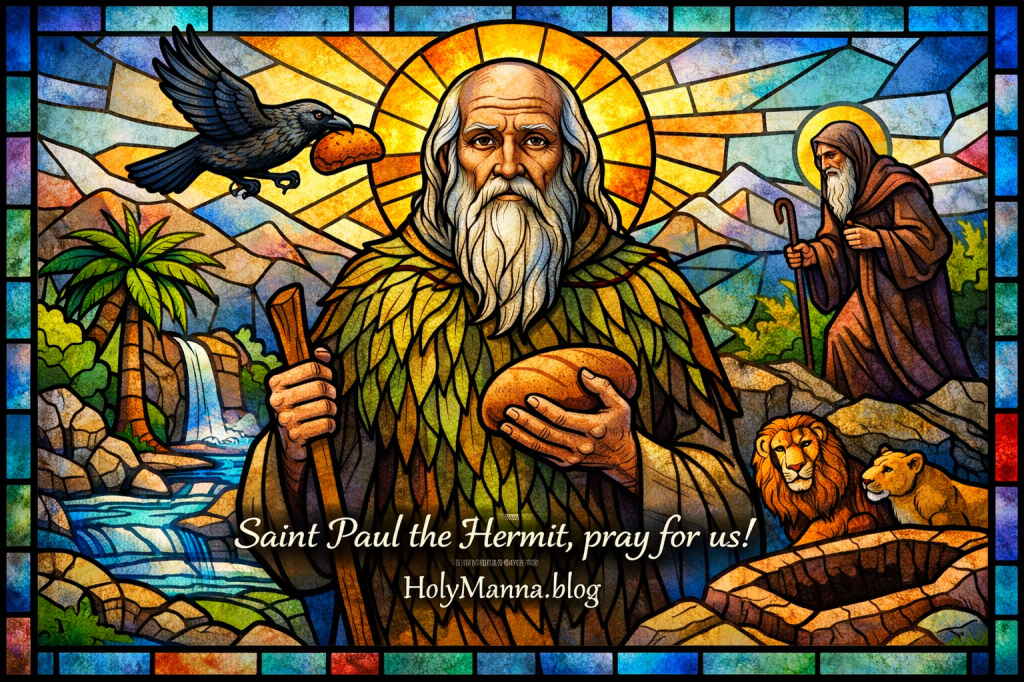
The tradition describes Paul’s hermitage with concrete details that make his witness feel real and not merely symbolic. He is said to have lived in a cave near a spring of water and a palm tree, and he is remembered wearing a garment woven from palm leaves. This underlines his radical poverty and simplicity, but it also shows something deeper: Paul did not build his identity on comfort, status, or possessions. He chose a life where the heart could cling to God without competing loyalties, and that is a lesson modern life constantly challenges.
The most famous miracle associated with Saint Paul during his life is the raven that brought him bread. This story is told to preach divine providence, not sentimental nature love, because it echoes the Lord’s teaching that the Father cares even for the birds and will not abandon His children, as seen in The Gospel of Matthew Mt 6:26. When Saint Anthony the Great was guided to find Paul, the raven brought more bread than usual, as if Heaven itself marked the moment and quietly preached the message: God provides. Paul’s gratitude comes through in a line preserved in the tradition: “For sixty years a crow has brought me everyday a half a loaf of bread… since you are here, Christ has doubled His soldiers’ rations.” This is the spirituality of daily bread and daily trust, which is exactly what Christians ask for every time they pray the Our Father.
Hidden Fidelity
Saint Paul is not remembered as a martyr who died by executioners, but his life still carries the weight of a kind of long martyrdom. Solitude, hunger, heat, cold, and the daily struggle to persevere in prayer are not small sacrifices, and they require real courage and real humility. The Church has always recognized that suffering can become an offering when it is united to Christ, and the desert life makes that offering steady and tangible. Paul’s witness shows that holiness is not primarily about heroic moments, but about faithful endurance in ordinary hours that nobody else sees.
The desert also represents spiritual warfare, because it is where illusions die and where the heart confronts its weakness without distractions. The Catechism is honest about this reality, teaching that prayer demands effort and spiritual battle, because distractions and discouragement do not vanish simply because someone wants to be holy, as described in CCC 2725 and CCC 2733. Paul’s endurance teaches that faithfulness is often repetitive and quiet, like breathing, but it is powerful in the eyes of God. His victory is not that he avoided suffering, but that he stayed faithful without bitterness, and that kind of steady fidelity is exactly what builds saints in every generation.
The Lions’ Grave
Catholic tradition remembers Saint Paul’s death with signs that point believers toward the communion of saints and the reality of eternal life. Saint Anthony is said to have seen Paul received into glory, which strengthens hope and reminds the faithful that the goal is not comfort in this world, but union with God forever. The account also includes the famous image of two lions helping to dig Paul’s grave when Anthony lacked tools, and this is remembered as a sign that creation itself honors a man who belonged wholly to the Creator. The point is not that the desert became safe and easy, but that God can reveal His glory even through the harshness of the wilderness.
Another meaningful detail in the tradition is Paul’s request for a cloak associated with Saint Athanasius, a great bishop and defender of the faith. This matters because it shows Paul was not rejecting the Church or inventing his own spirituality. He lived in solitude, but he remained spiritually united to the Church’s faith and shepherds, and that is a crucial Catholic point. Authentic holiness is never individualistic, because it always remains connected to Christ and His Church, even when a person’s vocation is hidden from the world.
Bringing the Desert Into Everyday Life
Saint Paul the Hermit can feel distant, but his message is extremely practical for ordinary Catholics trying to live faithfully in a noisy world. Modern life trains the mind to be restless and hungry for constant stimulation, and Paul’s life exposes that hunger for what it is: a craving that only God can satisfy. He shows that peace does not come from getting everything under control, because peace comes from surrendering to the Father and learning to trust His care. This is the kind of interior freedom that makes a person stable, calm, and hard to shake, even when life gets chaotic.
Saint Paul also teaches detachment in a way that lines up cleanly with Catholic teaching. The Catechism warns that comfort and abundance can dull the soul and it praises the freedom of the poor in spirit, which is captured well in CCC 2544. Paul’s poverty was not self-hatred or rejection of creation, because it was a love choice that cleared space for deeper prayer and deeper dependence on God. A desert spirit can be lived without leaving home, and it can look like a serious daily prayer rule, guarded use of screens, custody of the eyes, fasting done with humility, and small sacrifices offered without announcing them. It can also look like staying close to the sacraments, confessing sins regularly, and choosing God’s will over comfort, because hidden holiness still shapes the world.
Engage with Us!
Share thoughts and reflections in the comments below.
- What kind of noise or distraction most often steals prayer and peace, and what boundary could help protect a daily “desert” with God?
- Where is God inviting deeper trust in His providence, especially around money, food, time, or anxiety about the future?
- What is one hidden sacrifice that could be offered this week for the salvation of souls, even if nobody notices it?
- How does Saint Paul’s solitude challenge the way faith is lived in public, online, or at work?
Keep going with confidence, because God does not need a spotlight to sanctify a soul. Live a life of faith, stay close to Jesus in prayer, and do everything with the love and mercy He taught, especially the hidden things, because Heaven sees and rewards what the world forgets.
Saint Paul the Hermit, pray for us!
Follow us on YouTube, Instagram and Facebook for more insights and reflections on living a faith-filled life.

 Holy Manna!
Leave a comment