A Desert Father Who Still Fathers Souls
Saint Macarius the Great, often called Macarius the Egyptian or Macarius the Elder, is one of the great Desert Fathers the Church points to when it wants to remember what Christianity looks like when it is lived without excuses. He belongs to that early generation of saints who stepped away from the noise of the world, not because they hated people, but because they wanted to love God with an undivided heart and then love their neighbor with a purified one. The Roman Martyrology honors him as an abbot formed in the tradition of Saint Anthony and praises him as a man celebrated for his life and miracles. That kind of praise is not sentimental, because the Church venerates sanctity only when it is rooted in real conversion and real fidelity.
Macarius matters in Catholic tradition because he helped shape the spiritual DNA of monastic life in Egypt through humility, discernment, and perseverance in prayer. His influence was not rooted in popularity or novelty, but in interior freedom that came from repentance and steady communion with God. He is remembered because he teaches that holiness is not about drawing attention, but about becoming faithful in hidden places. His life still speaks to Catholics today because the same Gospel that formed the desert still forms homes, workplaces, and parishes.
From Ordinary Fields to a Radical Gospel
Catholic tradition places Macarius’ birth in Egypt around A.D. 300, and it presents him as a man shaped by simple labor before he was shaped by solitude. That background matters because it keeps his sanctity grounded in reality, not in fantasy. He was not a man floating above ordinary life, but a man who knew routine, fatigue, and discipline. When he withdrew into the desert, it was a deliberate choice to seek God with seriousness, not a dramatic escape from responsibility.
One well known episode preserved in Catholic hagiography shows his character with striking clarity. He was falsely accused of grave sin and publicly shamed, and he endured that humiliation with patience instead of retaliation. Even while the accusation stood, he supported the woman materially until the truth came to light, which made his innocence clear and exposed the lie. The point of this story is not scandal, but the Beatitudes lived out in real time, where meekness becomes strength and mercy becomes victory.
His conversion was not a single emotional moment, but a life turned steadily toward God. The desert made it harder to hide from the heart’s wounds and temptations, and that is exactly why the saints went there. Macarius stepped into that hard simplicity so the Gospel could go deeper. In a culture that loves quick fixes, his early life teaches that real transformation usually happens through perseverance.
Scetis and the School of the Heart
Macarius is most known for his spiritual fatherhood in the Egyptian desert, especially in the region called Scetis. Catholic sources describe how many monks lived in separate cells during the week and gathered for worship on Saturdays and Sundays, which created a balance of solitude and communion. This was not a DIY spirituality where every man made up his own path. It was a way of life held together by prayer, obedience, counsel, and the shared life of the Church.
From a Catholic perspective, it matters that Macarius was ordained a priest so the monks could receive the sacraments. The desert fathers did not treat the Eucharist as optional or treat the Church as an accessory. Their withdrawal was meant to purify the heart, not to replace the sacramental life. His priesthood served a community that was growing and hungry for grace, and his leadership helped keep monastic life rooted in worship rather than in pride.
His teaching was known for being both demanding and merciful. He called people to real repentance, but he also understood that harshness does not heal the human heart. He trained disciples to watch their thoughts, practice sobriety, and lean on prayer with humility. His legacy from Scetis is a reminder that holiness is not built on intensity alone, but on steady fidelity.
The Wonders God Worked Through a Humble Monk
Saint Macarius is important because he shows what interior freedom looks like when it is forged through repentance and prayer. The desert fathers understood spiritual combat with a realism that still helps Catholics today, because temptation did not disappear with modern technology. Catholic tradition also associates miracles with him, and the Church’s memory of these wonders is meant to point back to Christ rather than to distract from Him. The Roman Martyrology itself speaks of his miracles, which reflects how deeply his reputation for sanctity shaped Christian memory.
Among the most striking accounts repeated in Catholic sources is the miracle in which Saint Macarius confronted a man denying the resurrection of the body. When this error began to trouble the faithful, Macarius went with the man to a cemetery and, after praying, he commanded a dead man to rise or to answer, and God granted the sign. The dead man spoke to confirm the truth, making it unmistakably clear that the Lord who created the body is also able to restore it, and the heresy collapsed under the weight of reality. Afterward, Macarius told the dead man to rest again until the resurrection, showing that the miracle was never about spectacle, but about strengthening faith in what the Church professes. These stories are handed down as signs that the Lord confirms His people and that His power is real, even when the world doubts. They also underline an important Catholic principle: miracles do not replace faith, but they can support faith when God chooses to act in that way. In the life of Macarius, wonders are always framed as fruits of humility, not as trophies of personal greatness.
His spiritual counsel is also preserved through short sayings that remain famous precisely because they are simple and practical. He is often quoted for reminding disciples that prayer does not need to be theatrical: “In prayer, you need not use many or lofty words.” Another humble petition is also remembered in the tradition: “Lord, show me mercy as thou knowest best.” Those lines sound plain until someone tries to live them daily, with sincerity, perseverance, and trust.
Exile for the Faith
Macarius was not martyred, but he did suffer for the truth in a way that shaped the Church’s memory of him. The fourth century was marked by the Arian crisis and political turmoil, and Catholic tradition records that Macarius faced persecution and exile under Arian aligned pressure connected to imperial power. He was pushed out, not because he was rebellious, but because he remained faithful to the Church’s confession of Christ. That kind of suffering is easy to overlook because it does not end in blood, but it is still a real sharing in the Cross.
His endurance matters because it shows a mature kind of faith. He did not treat hardship as proof that God had abandoned him, and he did not use suffering as an excuse to become bitter. Catholic sources also recount that even in exile, his witness bore fruit through conversions, which is a recurring pattern in Church history. God often turns what looks like a defeat into a mission field, and He often uses patient fidelity to win hearts.
This section of his life also teaches that holiness is rarely convenient. A person does not have to be a martyr to practice a total gift of self. The slow martyrdom of patience, obedience, and perseverance can be just as demanding, especially when it comes without applause.
A Living Legacy
After Macarius died around A.D. 390, his influence did not fade because his holiness was never built on personality or popularity. The Church continues to venerate him because his example remains fruitful, and because his name stands like a landmark in the tradition of Christian prayer. Not every saint has a widely detailed catalog of posthumous miracles recorded in the same way across every century. With Macarius, the most visible continuation of grace is the way his witness keeps calling souls to repentance, simplicity, and perseverance in prayer.
His legacy also includes an important Catholic caution about writings attributed to him. Catholic sources acknowledge that various works circulated under his name, including homilies, but attribution is complex, and not everything traditionally connected to “Macarius” can be assigned with certainty. That careful approach is a gift because it keeps devotion anchored in truth rather than legend. Even so, his spiritual teaching remains clear through the tradition that preserves his sayings and the memory of his life.
The communion of saints is not only about relics and shrines, even though those can be powerful signs. It is also about how God continues to use holy examples to heal minds, redirect desires, and strengthen courage. Macarius’ “after death” fruit is found in the souls that learn to pray more honestly and live more humbly because of his witness. That is a real grace, and it is one the Church treasures.
Saint Macarius’ Lessons for a Noisy Age
Saint Macarius is a gift for modern Catholics because his message is not complicated, but it is demanding in the right way. He teaches that prayer becomes strong when it becomes humble, and that repentance becomes real when it becomes consistent. The Catechism teaches that prayer is a battle and that perseverance requires humility, trust, and a purified heart, which is why the desert fathers remain so relevant. In that sense, Macarius becomes a lived commentary on CCC 2725 to 2745, because his entire life shows what it looks like to keep praying when feelings are dry and temptations are loud. His example also connects naturally with the Church’s esteem for the eremitic witness and radical prayer as described in CCC 920 to 921.
A practical way to imitate him is to simplify prayer and make it more frequent. Short prayers throughout the day can train the heart to turn toward God instead of toward anxiety, resentment, or lustful distraction. Another way is to practice silence when emotions are hot, because not every thought deserves to become a sentence. Macarius also offers a hard but freeing lesson about reputation, because a heart that is enslaved to praise and crushed by insults is not yet resting in Christ.
This is not desert spirituality meant only for monks. It is Catholic sanity for anyone who wants to be serious about heaven in an age of constant noise. When a man learns to pray simply, repent quickly, and forgive generously, peace starts to take root, and family life begins to change. That is the kind of holiness that spreads quietly and lasts.
Engage with Us!
Share thoughts and reflections in the comments below. Honest conversations build up the Body of Christ, especially when people are trying to grow in prayer and holiness.
- What is the biggest distraction or temptation that keeps prayer from being simple and faithful right now?
- Where is God inviting a more humble response, especially when life feels unfair or insulting?
- What would it look like to pray one short, sincere prayer throughout the day and mean it every time?
- How can Saint Macarius’ example help build a more peaceful home, a cleaner conscience, and a steadier spiritual life?
Saint Macarius proves that holiness does not need hype to be real. Keep choosing prayer, keep choosing repentance, and keep choosing mercy, because Christ never refuses a humble heart. Live a life of faith, and do everything with the love and mercy Jesus taught us.
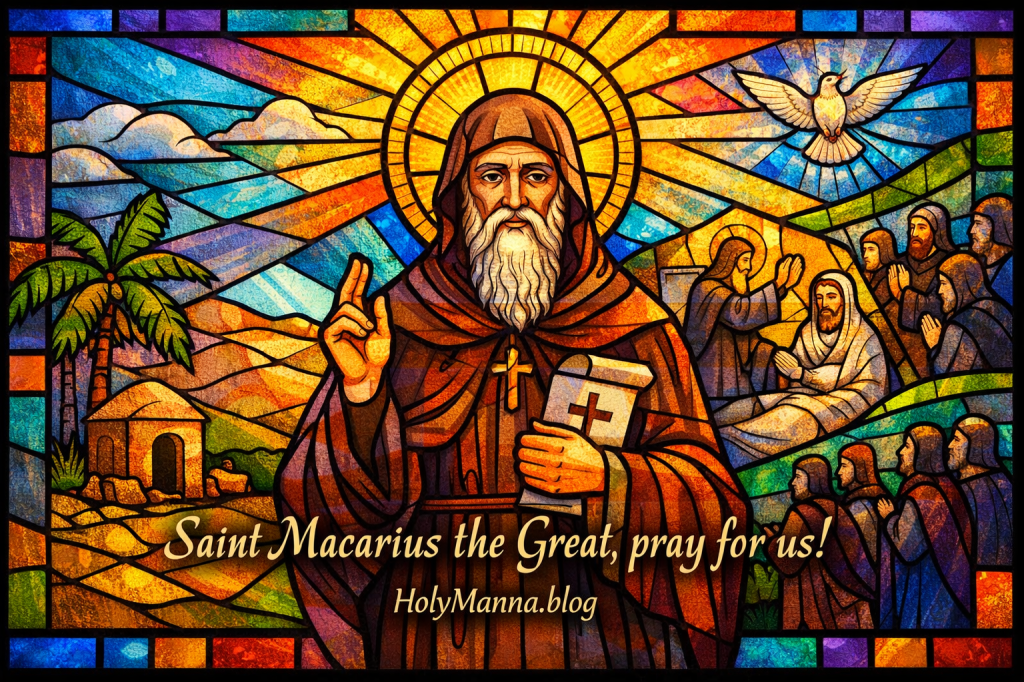
Saint Macarius the Great, pray for us!
Follow us on YouTube, Instagram and Facebook for more insights and reflections on living a faith-filled life.

 Holy Manna!
Leave a comment