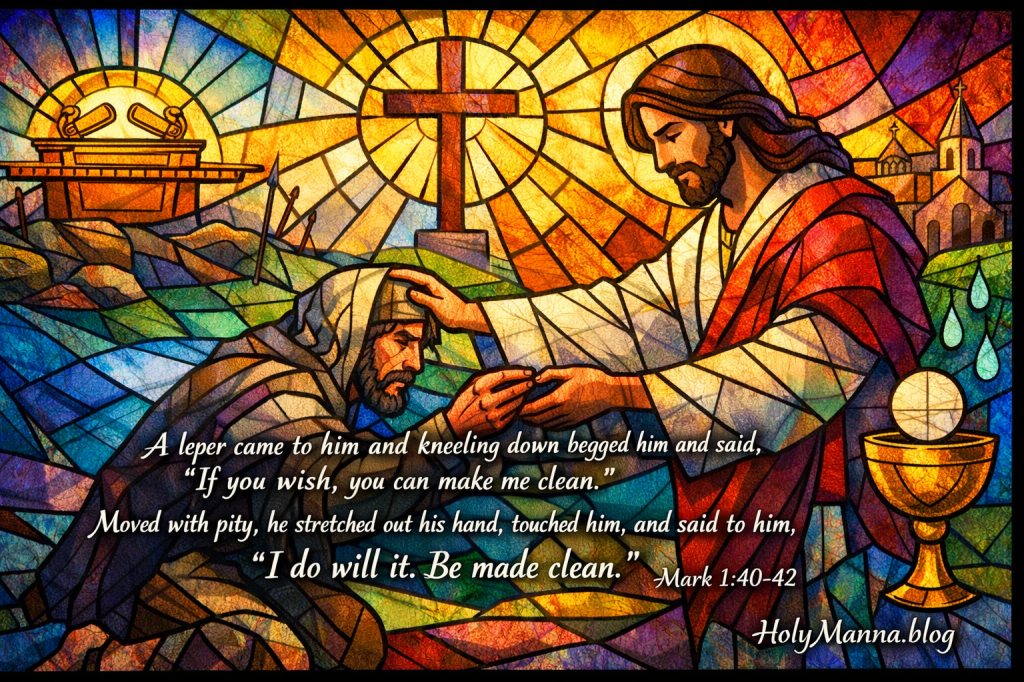
Thursday of the First Week in Ordinary Time – Lectionary: 308
Stop Treating God Like a Charm and Surrender
There are days when life feels like a loss on the battlefield, a long season of unanswered prayer, or a lonely sickness that keeps a person on the outside looking in. Today’s readings speak straight into that reality, not with shallow optimism, but with the kind of truth that can steady a soul. The central theme tying everything together is this: God’s presence is not something to use, control, or “bring along” for a win. God’s presence is a covenant gift to receive with humility, repentance, and trust, especially when defeat, shame, or suffering has exposed how fragile human strength really is.
In the First Reading from 1 Samuel 4:1-11, Israel faces the Philistines and suffers a crushing defeat. Instead of examining hearts, turning from sin, and seeking the Lord with sincerity, the elders reach for the Ark of the Covenant as if it were a guarantee, a sacred object that can be deployed to force a better outcome. The Ark was truly holy, not because it was magic, but because it signified the living God’s covenant presence among His people. That historical detail matters, because it shows the danger of confusing a holy sign with a controllable weapon. The catastrophe that follows is a sobering reminder that God is not manipulated, and that external religion without interior conversion collapses under pressure.
That interior ache spills right into today’s Responsorial Psalm, Psalm 44:10-11, 14-15, 24-25, 27, which gives language to believers who feel abandoned and mocked. This is covenant prayer at its most honest. The psalm dares to cry out, “Awake! Why do you sleep, O Lord?” and “Why do you hide your face?” It is not blasphemy. It is the prayer of a people who still belong to God, who still speak to Him, who still expect mercy because they know His character. The Church keeps this kind of psalm on the lips of the faithful to teach that suffering is not a reason to stop praying, but a reason to pray more truthfully.
Then the Holy Gospel from The Gospel of Mark 1:40-45 brings the answer to that cry in the flesh and blood tenderness of Jesus Christ. A leper approaches the Lord, not demanding control, but surrendering the outcome with trust: “If you wish, you can make me clean.” Jesus responds with a mercy so concrete it shocks the senses: He reaches out and touches the untouchable. In the religious world of Israel, leprosy meant exclusion, ritual uncleanness, and distance from community worship. Christ does not merely pronounce healing from afar. He bridges the gap with His own hand, showing that holiness is not fragile, and mercy is not afraid of human misery.
Taken together, these readings prepare the heart for a simple but life changing question. Is God being treated like a tool for the plan, or being loved like the Lord of the covenant? The Word today invites a shift from superstition to faith, from spiritual bargaining to repentance, and from anxious control to humble confidence that Christ still wills to cleanse, restore, and bring His people home.
First Reading – 1 Samuel 4:1-11
When the Ark Becomes a Shortcut Instead of a Covenant
This passage lands like a spiritual gut check because it shows how easily God’s people can confuse sacred proximity with saving faith. Israel is in crisis. The Philistines are a real military threat, and the Israelites are fighting from a place of fear and instability during the era when judges and priests led the nation, long before the kingship was established. Shiloh is the religious center where the Ark of the Covenant rests, and Eli’s household is supposed to represent holy leadership. The problem is that the nation’s worship has been drifting, and Eli’s sons, Hophni and Phinehas, have become symbols of religious corruption in 1 Samuel. That background matters because it explains why Israel’s solution is not repentance, but a kind of religious maneuver.
The Ark is not a magical object. It is the sign of the Lord’s covenant presence, the visible reminder that the God of Israel is enthroned in holiness and binds Himself to His people by promise. But in today’s reading, the elders treat the Ark like a battlefield advantage, as if the holy thing can force a holy outcome. This fits perfectly with today’s theme: God’s presence is a covenant gift to receive with humility and obedience, not a tool to control results.
1 Samuel 4:1-11 – New American Bible (Revised Edition)
Defeat of the Israelites. 1 At that time, the Philistines gathered for an attack on Israel. Israel went out to engage them in battle and camped at Ebenezer, while the Philistines camped at Aphek. 2 The Philistines then drew up in battle formation against Israel. After a fierce struggle Israel was defeated by the Philistines, who killed about four thousand men on the battlefield. 3 When the troops retired to the camp, the elders of Israel said, “Why has the Lord permitted us to be defeated today by the Philistines? Let us fetch the ark of the Lord from Shiloh that it may go into battle among us and save us from the grasp of our enemies.”
Loss of the Ark. 4 So the people sent to Shiloh and brought from there the ark of the Lord of hosts, who is enthroned upon the cherubim. The two sons of Eli, Hophni and Phinehas, accompanied the ark of God. 5 When the ark of the Lord arrived in the camp, all Israel shouted so loudly that the earth shook. 6 The Philistines, hearing the uproar, asked, “What does this loud shouting in the camp of the Hebrews mean?” On learning that the ark of the Lord had come into the camp, 7 the Philistines were frightened, crying out, “Gods have come to their camp. Woe to us! This has never happened before. 8 Woe to us! Who can deliver us from the power of these mighty gods? These are the gods who struck the Egyptians with various plagues in the desert. 9 Take courage and act like soldiers, Philistines; otherwise you will become slaves to the Hebrews, as they were your slaves. Fight like soldiers!” 10 The Philistines fought and Israel was defeated; everyone fled to their own tents. It was a disastrous defeat; Israel lost thirty thousand foot soldiers. 11 The ark of God was captured, and Eli’s two sons, Hophni and Phinehas, were dead.
Detailed Exegesis
Verse 1 “At that time, the Philistines gathered for an attack on Israel. Israel went out to engage them in battle and camped at Ebenezer, while the Philistines camped at Aphek.”
Ebenezer will later become a place of victory and gratitude in 1 Samuel 7, but here it is a place of loss. The geography matters because it highlights a real historical conflict. The Philistines were organized, aggressive, and technologically formidable for Israel at this stage, and Israel is learning that faith cannot be reduced to national bravado.
Verse 2 “The Philistines then drew up in battle formation against Israel. After a fierce struggle Israel was defeated by the Philistines, who killed about four thousand men on the battlefield.”
This is a blunt moment of humiliation. Scripture does not hide Israel’s defeats because God uses them to purify His people. A loss like this is meant to provoke examination of conscience, not panic-driven strategies.
Verse 3 “When the troops retired to the camp, the elders of Israel said, ‘Why has the Lord permitted us to be defeated today by the Philistines? Let us fetch the ark of the Lord from Shiloh that it may go into battle among us and save us from the grasp of our enemies.’”
The elders begin with a real theological question, because they recognize the Lord’s providence. Then they pivot into a dangerously distorted plan. The phrase reveals the heart problem: the Ark is treated as if it automatically guarantees victory. The elders do not say, “Let us humble ourselves and return to the Lord,” but instead, “Let us fetch the Ark so that it may save us.” This is how superstition is born, even among believers, when sacred things are treated like leverage rather than signs that call for conversion.
Verse 4 “So the people sent to Shiloh and brought from there the ark of the Lord of hosts, who is enthroned upon the cherubim. The two sons of Eli, Hophni and Phinehas, accompanied the ark of God.”
The title “the Lord of hosts” emphasizes God’s sovereign power, not Israel’s control. The mention of the cherubim evokes the holiness of God’s throne and the sacredness of the Ark as a covenant sign. The detail about Hophni and Phinehas is chilling. Corrupt ministers escort the holiest sign in Israel’s worship, and Scripture is quietly showing that ritual nearness without moral fidelity is spiritually deadly.
Verse 5 “When the ark of the Lord arrived in the camp, all Israel shouted so loudly that the earth shook.”
The people mistake excitement for faith. Noise can feel like confidence, but it is not the same as repentance. A shaken earth does not necessarily mean a shaken heart. This is a warning for any generation that confuses religious intensity with obedience.
Verse 6 “The Philistines, hearing the uproar, asked, ‘What does this loud shouting in the camp of the Hebrews mean?’ On learning that the ark of the Lord had come into the camp,”
Even Israel’s enemies understand that something religious is happening. The Philistines interpret the Ark through their pagan assumptions. That sets up the irony: outsiders fear the Ark more rightly than Israel reverences the Lord.
Verse 7 “The Philistines were frightened, crying out, ‘Gods have come to their camp. Woe to us! This has never happened before.’”
They speak in the plural because they do not know the one true God. Their fear is real, but it is not faith. The passage exposes how easy it is to believe in divine power in a vague way, while still missing the covenant relationship that the Lord actually desires.
Verse 8 “‘Woe to us! Who can deliver us from the power of these mighty gods? These are the gods who struck the Egyptians with various plagues in the desert.’”
They remember Israel’s salvation history, but they misunderstand it. Notice the confusion: they attribute the plagues to “gods,” and they mix details, because in Exodus the plagues strike Egypt and the wilderness becomes the setting of Israel’s testing. Scripture is showing that spiritual memory without truth becomes distortion. Israel should know better, but Israel is acting no better.
Verse 9 “‘Take courage and act like soldiers, Philistines; otherwise you will become slaves to the Hebrews, as they were your slaves. Fight like soldiers!’”
Fear becomes motivation. The Philistines encourage each other with pride and survival. This sets up a painful reversal: Israel thinks the Ark guarantees dominance, while the Philistines decide to fight harder.
Verse 10 “The Philistines fought and Israel was defeated; everyone fled to their own tents. It was a disastrous defeat; Israel lost thirty thousand foot soldiers.”
The scale of defeat explodes. The text is forcing a conclusion: the Ark cannot be used like a weapon, and God will not be treated as a mascot. When the people try to turn covenant into control, the result is not protection but exposure.
Verse 11 “The ark of God was captured, and Eli’s two sons, Hophni and Phinehas, were dead.”
This is the darkest line in the reading. The capture of the Ark is not proof that God is weak. It is proof that God is holy. He will not be domesticated. The death of Eli’s sons is also a moment of divine judgment, because their priestly corruption has been defiling worship. The passage shows that God cares about reverence and integrity, not just religious appearances.
Teachings
This reading is a classic biblical warning against superstition and presumption, which remain live temptations even for faithful Catholics who love the sacraments and devotions.
The Catechism defines superstition with surgical clarity: CCC 2111 says, “Superstition is the deviation of religious feeling and of the practices this feeling imposes. It can even affect the worship we offer the true God, e.g., when one attributes an importance in some way magical to certain practices otherwise lawful or necessary.” The Israelites in this scene are doing exactly that. They take something holy and treat it as if it works mechanically, detached from repentance and obedience.
The Catechism also names the deeper spiritual trap as presumption. CCC 2092 says, “There are two kinds of presumption. Either man presumes upon his own capacities (hoping to be able to save himself without help from on high), or he presumes upon God’s almighty power or his mercy (hoping to obtain his forgiveness without conversion and glory without merit).” Israel’s move with the Ark has that second flavor. It is a way of hoping for victory without conversion.
This is also an important moment in salvation history because it clarifies how God relates to signs. The Ark is truly sacred, but it is not God Himself. It is a covenant sign that demands a covenant response. When the people treat the sign as the source of salvation, they drift toward idolatry of the instrument. That is why this reading pairs so powerfully with today’s Gospel, where a man approaches Jesus with humility and trust rather than trying to seize power.
Reflection
This reading is not mainly about ancient warfare. It is about what happens when faith becomes transactional. Many good Catholics fall into a subtle version of this when prayer becomes bargaining, when sacramentals become lucky charms, or when religious routines become a substitute for real conversion of life. The Lord is not scandalized by weakness, but He is serious about truth. He wants a living relationship, not spiritual tactics.
A practical step is to examine what the heart reaches for when life feels out of control. If the instinct is to grasp at a devotion while refusing to repent, then the reading is offering a course correction. Another practical step is to reconnect external practices to interior surrender. That means praying like a son and daughter, not like a customer. That means receiving the sacraments with reverence, gratitude, and the intention to obey what God reveals.
Where has prayer started to feel like a way to control outcomes instead of a way to trust the Lord? Is there any area of life where repentance has been delayed while asking God to fix the consequences anyway? If God removed every external comfort for a season, would faith still cling to Him, or would it collapse into fear and frustration?
Responsorial Psalm – Psalm 44:10-11, 14-15, 24-25, 27
When the Heart Hurts and Still Refuses to Let Go of God
This psalm gives words to a moment every believer eventually faces, the moment when God’s people feel rejected, defeated, and publicly humiliated. In Israel’s prayer tradition, lament is not a breakdown of faith. Lament is what faithful people do when life collapses and there is nowhere else to go but the Lord. Psalm 44 is prayed from inside the covenant, which means the speaker is not treating God like a distant force or a lucky charm. The psalm is speaking to the living Lord with a bold honesty that only love dares to use.
That is why this psalm fits today’s theme so well. After Israel’s defeat in 1 Samuel 4:1-11, the temptation is either to manipulate God with religious tactics or to walk away in bitterness. This psalm models a third way. It refuses superstition, but it also refuses despair. It lays the humiliation on the altar, and it begs for mercy. It also prepares the heart for the Gospel, because Christ is the answer to this cry. The leper in The Gospel of Mark 1:40-45 is living this psalm in the flesh: suffering, excluded, and yet approaching the Lord with trust.
Psalm 44:10-11, 14-15, 24-25, 27 – New American Bible (Revised Edition)
10 But now you have rejected and disgraced us;
you do not march out with our armies.
11 You make us retreat before the foe;
those who hate us plunder us at will.14 You make us the reproach of our neighbors,
the mockery and scorn of those around us.
15 You make us a byword among the nations;
the peoples shake their heads at us.24 Awake! Why do you sleep, O Lord?
Rise up! Do not reject us forever!
25 Why do you hide your face;
why forget our pain and misery?27 Rise up, help us!
Redeem us in your mercy.
Detailed Exegesis
Verse 10 “But now you have rejected and disgraced us; you do not march out with our armies.”
This line describes the painful experience of God’s felt absence. Israel’s identity was shaped by the memory that the Lord fought for them, especially in the Exodus and the conquest. When victory disappears, it feels like rejection. Scripture includes this because authentic prayer is allowed to name what the heart experiences, even when the mind knows God remains faithful.
Verse 11 “You make us retreat before the foe; those who hate us plunder us at will.”
The psalmist does not sugarcoat the humiliation. Retreat, plunder, and helplessness are the language of a people exposed. This connects directly to today’s First Reading, where military defeat reveals a deeper spiritual problem. The verse also teaches that suffering can strip away illusions, including the illusion that external religious signs guarantee worldly success.
Verse 14 “You make us the reproach of our neighbors, the mockery and scorn of those around us.”
Here the pain is social and communal. Shame is not only defeat, but being laughed at by the people next door. In a culture where honor and public reputation mattered deeply, mockery cut hard. This verse also speaks to Christians who experience ridicule for living the faith. The psalm gives permission to bring that sting to God rather than turning cold or combative.
Verse 15 “You make us a byword among the nations; the peoples shake their heads at us.”
This expands the humiliation beyond local neighbors. Israel is supposed to be a witness among the nations. Now the nations see weakness and shake their heads. This verse has a spiritual edge: when God’s people fall, the world mocks not only them, but their God. That is why repentance and humble fidelity matter, because the Lord’s name is tied to His people’s witness.
Verse 24 “Awake! Why do you sleep, O Lord? Rise up! Do not reject us forever!”
This is the thunderclap of lament. It is not polite, and it is not faithless. It is covenant boldness. The psalm is not denying God’s power. It is appealing to God’s character. Saints have long read this kind of cry as pointing forward to Christ, because the Lord who seems asleep is the Lord who will rise. The Church prays this because it trains the heart to keep calling on God even when emotions say He is silent.
Verse 25 “Why do you hide your face; why forget our pain and misery?”
In Scripture, God’s face represents favor, communion, and blessing. To feel that God hides His face is to feel cut off. This verse is especially important for spiritual life because many believers interpret dryness and suffering as abandonment. The psalm teaches a better response. It turns the feeling into prayer, and it asks God directly for help instead of surrendering to self-pity or cynicism.
Verse 27 “Rise up, help us! Redeem us in your mercy.”
This is the final movement, and it is the key. The psalm does not demand a reward. It begs for redemption based on mercy. That lands directly on today’s theme. God is not controlled, but He is merciful. The proper posture is not manipulation, but humble petition. This also harmonizes with the leper’s faith in the Gospel: he does not claim a right, but he trusts Christ’s will and compassion.
Teachings
This psalm teaches what The Catechism calls the battle and humility of prayer. It is not sentimental spirituality. It is faith in a storm.
The Catechism is very direct about prayer as struggle. CCC 2725 says, “Prayer is both a gift of grace and a determined response on our part. It always presupposes effort. The great figures of prayer of the Old Covenant before Christ, as well as the Mother of God, the saints, and he himself, all teach us this: prayer is a battle.” This psalm is a battle prayer. It is what it looks like to keep turning toward God when circumstances scream the opposite.
This psalm also models confident, childlike boldness, which is exactly what the Lord wants from His people. CCC 2730 says, “The battle of prayer is inseparable from the ‘spiritual battle’ necessary to act regularly according to the Spirit of Christ: we pray as we live, because we live as we pray.” When life is messy, prayer becomes messy too, but it remains real. This is why the Church does not censor laments. She hands them to the faithful as medicine.
The psalm’s final plea, “Redeem us in your mercy,” also echoes the Church’s core teaching on hope and trust in God’s goodness. CCC 2090 says, “When God reveals Himself and calls him, man cannot by his own powers respond fully to the divine love. He must hope that God will give him the capacity to love Him in return and to act in conformity with the commandments of charity.” This is what the psalm is doing. It is hoping in mercy, not in human strength.
Saint Augustine is also helpful here because he often read the psalms as the voice of Christ and His Body, the Church. This psalm’s cry is not only ancient Israel. It becomes the voice of suffering Christians, and ultimately it is answered in Christ who enters human abandonment and rises in victory.
Reflection
This psalm is for anyone who is tired of pretending everything is fine. It is also for anyone who has been tempted to stop praying because prayer feels pointless. The psalm does not teach believers to fake it. It teaches believers to bring the whole truth to God, including shame, confusion, and the feeling of rejection.
A practical way to live this is to pray with honest sentences instead of polished speeches. God is not offended by humble honesty. Another practical step is to end prayer the way this psalm ends. Even if the heart feels dry, it can still choose to ask, “Redeem us in your mercy.” That keeps prayer rooted in trust rather than in emotional performance.
This also helps when temptation shows up after disappointment. When life hurts, it becomes easy to grab control, to manipulate outcomes, or to numb the pain. This psalm calls the soul back to the only sane place, which is the Lord’s mercy.
When life feels humiliating or confusing, does prayer become more honest, or does it disappear? Is the heart treating God like a vending machine, or like a Father who can handle the truth? What would change if the next difficult moment became an invitation to pray this line with real faith: “Rise up, help us! Redeem us in your mercy.”
Holy Gospel – The Gospel of Mark 1:40-45
The Touch That Restores What Shame and Sin Have Stolen
This Gospel lands like a direct answer to the ache running through today’s readings. In the First Reading, Israel tries to bring God into the battle as if holiness could be carried like a weapon. In the Psalm, God’s people cry out from humiliation and pain. Now, in The Gospel of Mark, the living God comes close in the flesh, not as a tool to control, but as a Savior who cleanses and restores.
To understand the weight of this moment, it helps to remember what leprosy meant in Jewish life. In the Old Testament, the “leper” was not only sick. He was ritually unclean and forced into separation, which meant exclusion from community life and worship, in line with the purity laws of Leviticus 13 to 14. That separation carried a heavy social stigma, because uncleanness touched everything. People feared contamination, and the leper often carried the shame of being treated like a walking danger sign.
This is why the leper’s approach to Jesus is so powerful. He does not try to manipulate Jesus. He does not demand a result. He kneels and places the outcome under the Lord’s freedom with a faith that is both humble and confident. That posture becomes the model for today’s theme. God’s presence is not seized or deployed. God’s presence is received with trust, and it transforms the one who comes close.
Mark 1:40-45 – New American Bible (Revised Edition)
The Cleansing of a Leper. 40 A leper came to him [and kneeling down] begged him and said, “If you wish, you can make me clean.” 41 Moved with pity, he stretched out his hand, touched him, and said to him, “I do will it. Be made clean.” 42 The leprosy left him immediately, and he was made clean. 43 Then, warning him sternly, he dismissed him at once. 44 Then he said to him, “See that you tell no one anything, but go, show yourself to the priest and offer for your cleansing what Moses prescribed; that will be proof for them.” 45 The man went away and began to publicize the whole matter. He spread the report abroad so that it was impossible for Jesus to enter a town openly. He remained outside in deserted places, and people kept coming to him from everywhere.
Detailed Exegesis
Verse 40 “A leper came to him and kneeling down begged him and said, ‘If you wish, you can make me clean.’”
This is one of the clearest prayers of faith in the Gospels. The leper believes Jesus is able, but he also respects Jesus’ will. That is the opposite of superstition. It is surrender. The phrase “make me clean” is important because the goal is more than physical relief. Cleanness means restored communion, restored dignity, restored worship, and restored belonging.
Verse 41 “Moved with pity, he stretched out his hand, touched him, and said to him, ‘I do will it. Be made clean.’”
This is the heart of the Gospel. Jesus is not repulsed. He is moved with compassion. The touch matters. Under the law, touching the unclean could render someone unclean. Jesus reverses the direction. Holiness does not retreat from misery. Mercy moves toward it. This verse also reveals the Lord’s authority. He does not ask permission from impurity. He commands it to leave. The words “I do will it” reveal that God is not reluctant to heal and cleanse. He is willing.
Verse 42 “The leprosy left him immediately, and he was made clean.”
Mark emphasizes immediacy to show the power of Christ. This is not a slow improvement. This is a divine act. It also points to a deeper truth: when Jesus cleanses, He actually cleanses. He does not offer vague encouragement. He restores reality. This prepares the heart to trust that Christ’s grace is not symbolic. It is effective.
Verse 43 “Then, warning him sternly, he dismissed him at once.”
The stern warning can feel surprising, but it fits the pattern in The Gospel of Mark often called the “Messianic secret.” Jesus is not trying to build a hype machine. He is forming faith, not crowds. He is also guarding the proper meaning of His mission, because people could reduce Him to a wonder worker and miss the Cross.
Verse 44 “Then he said to him, ‘See that you tell no one anything, but go, show yourself to the priest and offer for your cleansing what Moses prescribed; that will be proof for them.’”
This verse is deeply Catholic in spirit because it shows Jesus honoring the legitimate religious authority established in the law. Under Leviticus 14, the priest did not cause the healing, but the priest verified it and facilitated reintegration into worship and community. Jesus is not anti institution. He is fulfilling the law rightly. He also wants a real witness to be established through the proper channels. This is a reminder that personal experience and public worship belong together. The Lord heals, and then He restores the healed person into communion.
Verse 45 “The man went away and began to publicize the whole matter. He spread the report abroad so that it was impossible for Jesus to enter a town openly. He remained outside in deserted places, and people kept coming to him from everywhere.”
This is a mixture of joy and disobedience. The man cannot contain his excitement, but he ignores Jesus’ command. The result is ironic and revealing. The cleansed man can now move freely, but Jesus is pushed to the outskirts. The One who restores outsiders takes the outsider’s place. This is a quiet preview of the Cross, where Jesus will bear exclusion, shame, and uncleanness, not His own, but ours, in order to bring His people back into communion with God.
Teachings
This Gospel displays the heart of Christ and the meaning of His miracles. Jesus heals because the Kingdom of God is breaking in, and because He has come to save the whole person, body and soul.
The Catechism teaches that Christ’s compassion and healings are signs of salvation. CCC 1503 says, “Christ’s compassion toward all who suffer goes so far that he identifies himself with them: ‘I was sick and you visited me.’ His preferential love for the sick has not ceased through the centuries.” That is exactly what is happening when Jesus touches the leper. He does not love from a safe distance.
The Catechism also explains why the Church cares so much about the sick and about healing. CCC 1504 says, “Often Jesus asks the sick to believe. He makes use of signs to heal: spittle and the laying on of hands, mud and washing. The sick try to touch him, ‘for power came forth from him and healed them all.’ And so in the sacraments Christ continues to ‘touch’ us in order to heal us.” This connects beautifully with today’s theme. The Lord is not controlled by objects, but He truly uses visible signs to communicate grace, and He invites faith rather than superstition.
There is also a strong teaching here on obedience and right worship. Jesus commands the healed man to go to the priest and offer what Moses prescribed. This shows continuity, not rebellion. The Lord honors the law’s rightful role while fulfilling it. It also foreshadows the Church’s sacramental life, where Christ heals and restores, and that restoration is lived in communion, not in isolation.
The saints also help interpret this scene spiritually. Saint Bede the Venerable often reads leprosy as an image of sin’s disfiguring effect and the need for cleansing and reintegration. That does not mean illness is always caused by personal sin, but it does mean the condition becomes a powerful symbol for what sin does to communion, and what Christ’s mercy restores.
Reflection
This Gospel invites a very practical shift in prayer and spiritual life. The leper approaches Jesus with a sentence that can reshape a person’s whole relationship with God: “If you wish, you can make me clean.” That prayer is strong because it is confident without being controlling. It trusts Christ’s power, and it submits to Christ’s will. That is mature faith.
A good step today is to bring the places of shame into the light, because shame loves secrecy. Sin loves secrecy too. This Gospel says Jesus is not afraid of what feels “unclean.” He moves toward it with mercy. Another step is to practice obedience in small things, because the healed man’s joy is real, but his disobedience creates confusion and limits Jesus’ public ministry. Love for Christ is not proven only by excitement. It is proven by obedience.
This reading also encourages confidence in the Lord’s willingness. Many people believe Jesus can heal, but they quietly doubt that He will. The Gospel answers that doubt with the words of Christ Himself: “I do will it.” He wills to cleanse, to forgive, and to restore. That is why confession is never meant to feel like humiliation. It is meant to feel like being touched by mercy and restored to communion.
Where is the heart still carrying shame that Jesus wants to cleanse? Is prayer shaped more by control and bargaining, or by the leper’s humble confidence in Christ’s will? After receiving grace, is obedience taken seriously, even in the details, or is enthusiasm being used as a substitute for doing what Christ asks?
From Religious Control to Real Communion
Today’s readings offer a strong, freeing message for anyone who has ever tried to hold life together by gripping tighter. In 1 Samuel 4:1-11, Israel reaches for the Ark as if the holy sign of God’s presence could be used to force a victory. The result is devastating, not because God is weak, but because God is holy. He will not be treated like a tool, and He will not let His people confuse outward religion with a converted heart. The Ark is sacred, but it is not a shortcut. It is a covenant sign that calls for repentance, humility, and obedience.
Then Psalm 44:10-11, 14-15, 24-25, 27 gives language for the ache that follows defeat. It refuses superficial spirituality and teaches the faithful how to pray when God feels distant. It dares to cry, “Awake! Why do you sleep, O Lord?” and it ends where real prayer always ends, not in manipulation, but in trust: “Redeem us in your mercy.” That is the sound of covenant faith under pressure, still speaking to God because the relationship is real.
Finally, The Gospel of Mark 1:40-45 shows what that mercy looks like in person. A leper approaches Jesus without bargaining, without entitlement, and without pretending. He offers a prayer that belongs on every Catholic’s lips: “If you wish, you can make me clean.” Jesus responds with the tenderness of the Kingdom, reaching out and touching the untouchable, then speaking the words every wounded heart longs to hear: “I do will it. Be made clean.” The Lord does not merely fix a problem. He restores communion. He brings the excluded back into worship and belonging.
The invitation today is simple and strong. Stop treating God like an emergency lever, and start treating Him like the Lord of the covenant. Bring the real mess into prayer, not a polished version. Ask for mercy with humility. Receive grace with gratitude. Then live the obedience that protects and deepens that grace. Anyone can shout when the Ark arrives, but the saints learn to trust when the battlefield is still loud and the outcome is still unknown.
Let today be a turning point. Let prayer become honest again. Let repentance become practical again. Let confession become normal again. Let the Eucharist be received with reverence, not routine. Christ still touches what is unclean, and He still restores what has been isolated by sin, fear, or shame. Keep coming to Him with the leper’s humble confidence, and keep praying with the psalm’s stubborn hope, because the Lord still wills to cleanse, redeem, and make His people whole.
Engage with Us!
Share your reflections in the comments below, because the Word of God comes alive when believers talk about it honestly and help each other apply it in real life.
- First Reading, 1 Samuel 4:1-11: Where has the heart been tempted to treat holy things like a shortcut to control outcomes instead of a call to repentance and trust? What is one concrete step that can be taken today to respond to God with deeper obedience rather than spiritual bargaining?
- Responsorial Psalm, Psalm 44:10-11, 14-15, 24-25, 27: When life feels humiliating, confusing, or painful, does prayer become more honest or does it fade away? What would change if the soul prayed today’s cry with sincerity, “Rise up, help us! Redeem us in your mercy.”?
- Holy Gospel, The Gospel of Mark 1:40-45: What is one area of life where shame, fear, or sin has created distance, and how can it be brought to Jesus with the leper’s humble confidence, “If you wish, you can make me clean.”? After receiving grace, what is one way to practice obedience in the details, not just enthusiasm in the moment?
Keep walking forward in faith, even when the battle feels loud and the answers feel slow. Let every prayer be honest, let every repentance be practical, and let every act of love be real. Go live today with the mercy of Jesus in mind, because the world does not need religious performance, it needs faithful hearts doing everything with the love Christ taught.Sacred Heart of Jesus, we trust in You!
Immaculate Heart of Mary, pray for us!
Saint Michael the Archangel, defend us in battle!
Follow us on YouTube, Instagram and Facebook for more insights and reflections on living a faith-filled life.

 Holy Manna!
Leave a comment