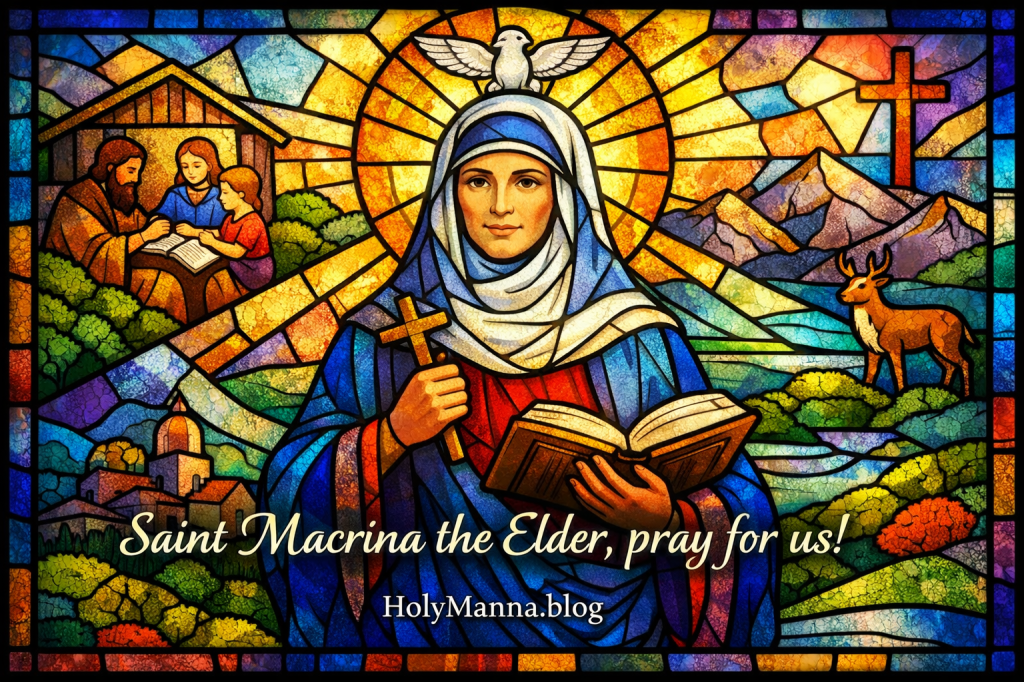
The Grandmother Who Guarded the Flame of Faith
Saint Macrina the Elder is one of those saints whose holiness stayed mostly hidden, but whose impact still echoes through the Church. She lived in a time when being openly Christian could cost a family their safety, their home, and their future. She is honored as a confessor because she suffered for Christ during persecution and remained faithful without being killed. Her significance is even bigger when it is remembered that her steady, homegrown faith helped form the spiritual foundation of saints who later defended the truth about Jesus Christ and the Holy Trinity.
This is a powerful reminder that God loves to build His Church through ordinary faithfulness. The Church calls the family the “domestic Church,” because the home is meant to be a place where prayer, virtue, and Catholic truth are learned and practiced in daily life. That mission is not a side project, because the faith is meant to be received, lived, and handed on with clarity and courage. This is exactly the kind of hidden strength praised in The Catechism of the Catholic Church and the Church’s teaching on the family’s role in the life of faith, especially CCC 1655-1658.
A Faith Worth Risking Everything For
Saint Macrina the Elder came from Neocaesarea in Pontus, a region marked by the early Christian memory of Saint Gregory Thaumaturgus, the missionary bishop associated with the evangelization of that area. Catholic tradition preserves that her faith was tied to that earlier inheritance, which matters because it shows how the Gospel is handed down like a treasure rather than invented from scratch. The Catholic faith is not built on private opinions or shifting cultural winds, because the Church safeguards what she has received from Christ and the apostles. That living transmission is what the Church calls Sacred Tradition, inseparable from Sacred Scripture, and entrusted to the Church’s teaching authority, as explained in CCC 75-83.
Although modern readers often want detailed biographies, early saints are sometimes known more through what they faithfully passed on than through what they personally wrote down. Macrina’s early life is not preserved with many personal anecdotes, but the outline is still clear and meaningful. She belonged to a Christian world where fidelity was tested, where persecution was not theoretical, and where teaching the faith in the home required real courage. That kind of background forms a saint who understands that Christ is worth everything.
A Domestic Church That Formed Saints
What Macrina the Elder is most known for is her role as a grandmother and teacher of the faith in her family. Her home helped shape the spiritual and doctrinal formation of Saint Basil the Great and Saint Gregory of Nyssa, among others, at a time when the Church would soon face intense theological conflict. This is not just a sweet family detail, because those saints became key defenders of orthodox Catholic teaching about God. Macrina’s influence shows how deeply the Church depends on families who take Catholic formation seriously and refuse to treat religion like a hobby.
Saint Basil the Great spoke plainly about the role of his grandmother in handing on the faith he received. His testimony is especially valuable because it is direct and grounded in his lived experience of being formed by her. “I was brought up by my grandmother, the celebrated Macrina, who taught me the words of the blessed Gregory.” “I was brought up by my blessed grandmother Macrina and by my mother.” Those lines capture something Catholics need to remember today, because the Church does not only grow through pastors and theologians. The Church also grows through grandmothers and mothers who patiently teach the truth and model prayer, exactly as described in CCC 2221-2226.
Providence in the Wilderness
Catholic tradition does not preserve a long catalog of public miracles performed by Macrina the Elder as if she were traveling from town to town working wonders. Instead, the miracle story connected with her life is more biblical and more quietly striking. Ancient testimony about Basil’s family during persecution describes years of hiding and deprivation, with God providing what was necessary to survive. This tradition includes the image of providential provision in the wilderness, including the story of wild game appearing as if offered for their sustenance during those years of hardship.
That kind of miracle fits the way God often works in Scripture, where divine help is not always flashy but always faithful. Sometimes the Lord changes the circumstance, and sometimes He supplies strength, food, protection, and endurance right in the middle of the storm. The miracle is not only the provision itself, but the grace to remain faithful when fear and fatigue could have crushed the soul. Christian hope is not wishful thinking, because it is trust anchored in God’s promises, especially when the path forward feels uncertain, as described in CCC 1817-1821.
Persecution, Exile, and Courage
Macrina the Elder lived through an era when imperial power could turn violently against Christians. During the persecutions associated with Diocletian, she and her husband fled and endured serious hardship. The Church honors her as a confessor because she bore suffering for Christ and did not abandon the faith under pressure. This matters because it highlights a form of witness that is easy to overlook, namely the daily endurance that stays loyal to Jesus when there is no applause and no quick rescue.
The Church teaches that martyrdom is the supreme witness to the truth of the faith, but suffering for Christ without death is still real participation in that witness. Macrina’s story challenges modern comfort-seeking religion by showing that fidelity has always had a cost. Her courage also shows that God’s protection sometimes looks like the strength to keep going rather than the absence of trials. This is the kind of faithful witness described in CCC 2473-2474.
Remembered for the Fruits
After her death, Catholic tradition does not emphasize widely documented posthumous miracles or major pilgrimage sites tied specifically to her name. Her veneration is rooted more in the holy fruit that followed from her life and the credible testimony of saints formed in her family. Sometimes God glorifies saints with dramatic signs, and sometimes He glorifies them through what their fidelity produces over generations. In Macrina’s case, the fruit is unmistakable, because the Church received towering defenders of the faith from the spiritual soil of that home.
This is a beautiful illustration of the communion of saints, where holiness is never isolated. God works through relationships, families, and spiritual inheritance to build up the Church in ways that only become obvious later. Macrina’s legacy encourages trust that hidden fidelity matters, even when it feels small. The Church’s understanding of the saints’ role in encouraging the faithful is expressed clearly in CCC 2683.
Faith That Gets Handed Down
Saint Macrina the Elder calls Catholics to take spiritual inheritance seriously and to stop treating formation like an optional upgrade. The faith is meant to be received with gratitude, lived with courage, and handed on without embarrassment. A Catholic home becomes stronger when prayer is steady, Sunday Mass is protected, and children learn that truth is worth sacrifice. This is not about being intense for its own sake, because it is about giving Jesus what He deserves and giving the next generation what they need.
Her example can be lived in practical ways that do not require a dramatic life change. A home can begin to look more like a domestic Church through consistent prayer, meaningful conversations about God, and simple habits of charity and self-control. Her story also encourages perseverance when faith feels socially inconvenient, because compromise is never the path to freedom. How can the home become more clearly a place where Jesus is loved, obeyed, and talked about naturally this week? A life of steady fidelity builds saints in ways that are often invisible until years later, and the Church’s teaching on family life and vocation supports this mission in CCC 2204-2206.
Engage with Us!
Start by inviting readers to share their thoughts and reflections in the comments below. The Church becomes stronger when Catholics help each other live the faith with honesty and hope.
- Where is God asking for steady faithfulness instead of a dramatic breakthrough?
- What is one concrete habit that could make the home more clearly a domestic Church this week?
- Who needs patient Catholic witness in the family right now, even if it feels like nothing is changing?
- When life feels unstable, what does trusting God for daily bread look like in a real and practical way?
- How does Saint Macrina’s hidden holiness challenge the way success and influence are measured?
May Saint Macrina strengthen every Catholic home with courage, prayer, and consistency. Keep living the faith with steady love, and keep doing everything with the love and mercy Jesus taught, because nothing offered to Him is ever wasted.
Saint Macrina the Elder, pray for us!
Follow us on YouTube, Instagram and Facebook for more insights and reflections on living a faith-filled life.

 Holy Manna!
Leave a comment