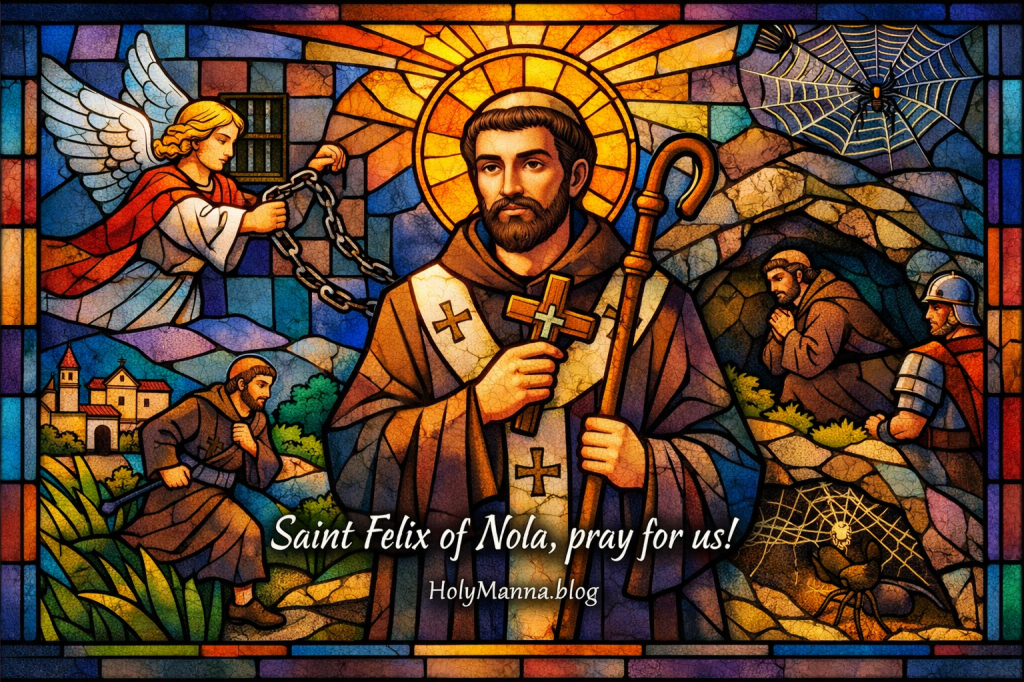
When a Spider Web Became a Fortress
Saint Felix of Nola is honored by the Church as a third century priest and confessor, remembered for courageous fidelity during persecution and for a life that stayed stubbornly simple. He is not celebrated because he built a platform or left behind a library of writings. He is remembered because he lived like the Gospel was true, especially when it cost him comfort, safety, and status. Catholics have loved his story for centuries because it holds together courage without aggression, humility without weakness, and poverty embraced as love rather than endured as resentment.
His witness also fits the Catholic understanding of holiness as something concrete and daily. The Catechism teaches that the moral life is shaped by virtue and strengthened by grace, and the saints show what that looks like when it is lived out with consistency. Saint Felix’s life points straight toward Christ by showing how faith becomes visible through charity, perseverance, and humble obedience.
From Inheritance to Holiness
Catholic tradition presents Felix as a man from the region of Nola who did not cling to what he had. After his father died, he is remembered for giving away much of his inheritance to the poor and choosing a simpler path that kept his heart free. That decision matters because it shows a conversion that is not only emotional. It is moral and practical, the kind of reordering the Church calls for when she speaks about detachment and love of neighbor.
Felix became a priest and served closely with Saint Maximus, the bishop of Nola. In a time when the Church could be targeted, the bond between bishop and clergy mattered for unity and the care of souls. Felix’s early life looks like the steady formation of a man who could be trusted when pressure arrived, because he had already learned how to surrender what the world calls security.
Providence in Chains
Saint Felix is remembered for a priestly ministry marked by ordinary faithfulness and extraordinary providence. During persecution he was arrested and imprisoned, and tradition speaks of a dramatic deliverance in which an angel freed him so he could bring aid to Bishop Maximus, who was suffering in hiding. Catholics recognize this pattern from The Acts of the Apostles, where God sometimes intervenes in striking ways to preserve His servants for the mission He has given them.
Another beloved account tells of Felix escaping his pursuers when a spider spun a web across the entrance to his hiding place, making it look untouched. Catholics repeat this story not because the spider is the point, but because providence is the point. A saying often attributed to Saint Paulinus of Nola captures the lesson behind the story: “When God helps us, a spider’s web becomes a protecting wall; and without His help, a wall is no more protection than a spider’s web.”
His deeper miracle, though, was not a single escape. His deeper miracle was a lifetime of charity that did not turn off when life became dangerous. He is remembered as a priest who stayed close to the poor and lived with simplicity, proving that love for Christ is never meant to be theoretical.
Tested by Persecution, Crowned by Perseverance
Felix lived in an era often associated with the persecution under Emperor Decius, when Christians could be pressured to deny the faith and public leadership in the Church could become a danger. Bishop Maximus went into hiding, and Felix was seized in his place. Catholic accounts describe harsh treatment and imprisonment, and tradition adds episodes of concealment and endurance that highlight how God sustained believers in violent seasons.
Felix is honored as a confessor because he suffered for Christ without being executed. This matters in Catholic tradition because it teaches that holiness is not only for those who die in the arena. The heart that remains faithful under threat, humiliation, and loss also offers a real witness. That is why a line from Saint Paulinus is often repeated when Catholics talk about Felix’s courage: “Martyrdom without bloodshed is enough … if mind and faith are ready to suffer.”
After persecution eased, Felix is remembered for refusing the honor of becoming bishop when the people wanted to elevate him. He urged them to choose another priest senior to him, which reveals humility that protects the Church from ambition. His refusal of status was not a rejection of responsibility, but a choice to remain a servant in the place God had already given him.
A Shrine That Keeps Speaking
Catholic devotion to Saint Felix did not fade when he died. His memory became strongly rooted around Nola and the surrounding area, and his burial place became associated with prayer, pilgrimage, and favors received through his intercession. Saint Paulinus of Nola helped strengthen devotion to Felix and made his witness widely known, helping the faithful see that a simple priest could become a powerful example across generations.
This connects directly to Catholic teaching on the Communion of Saints. CCC 956 teaches that the saints do not stop loving the Church when they die, and their intercession remains part of the Church’s living communion. Catholics do not treat saints like lucky charms. Catholics honor God’s work in them, ask for their prayers, and imitate their virtues so that Christ becomes more visible in everyday life.
Simple Virtues That Change Everything
Saint Felix is a strong patron for anyone trying to live the faith without turning it into a performance. His life teaches that courage is often quiet, humility is often hidden, and charity is often inconvenient. A Catholic who wants to imitate Felix does not need to wait for persecution to practice the same virtues. There are daily opportunities to keep integrity when it costs something, to choose generosity when money feels tight, and to serve without needing praise.
Felix also teaches trust in providence without becoming passive. He worked, served, and sacrificed, and he relied on God’s protection when human strength ran out. That balance is deeply Catholic because the Lord asks for cooperation with grace, not control of outcomes. Staying close to the sacraments, practicing regular confession, and choosing concrete works of mercy are simple ways to live this out with consistency. How is the Lord asking for deeper trust right now, and what would it look like to respond with steady obedience instead of anxiety?
Engage with Us!
Share thoughts and reflections in the comments below. Saint Felix has a way of challenging comfortable faith while still offering real hope for anyone who wants to be faithful in ordinary life.
- Where is trust in God being tested right now, and what would it look like to respond with steady Catholic faith instead of anxiety?
- What is one concrete act of generosity that could be done this week that actually costs time, comfort, or money?
- Is there any area of life where recognition or status is being chased, and how can humility be chosen instead?
- When hardship hits, is the first instinct to complain, to control, or to pray, and what needs to change?
- Who needs patient charity right now, especially someone difficult, and how can that charity be offered without excuses?
Keep walking in faith with courage and calm. Live close to the sacraments, stay loyal to prayer, and do everything with the love and mercy Jesus taught, because that is the road the saints walked, and it is the road that leads home.
Saint Felix of Nola, pray for us!
Follow us on YouTube, Instagram and Facebook for more insights and reflections on living a faith-filled life.

 Holy Manna!
Leave a comment