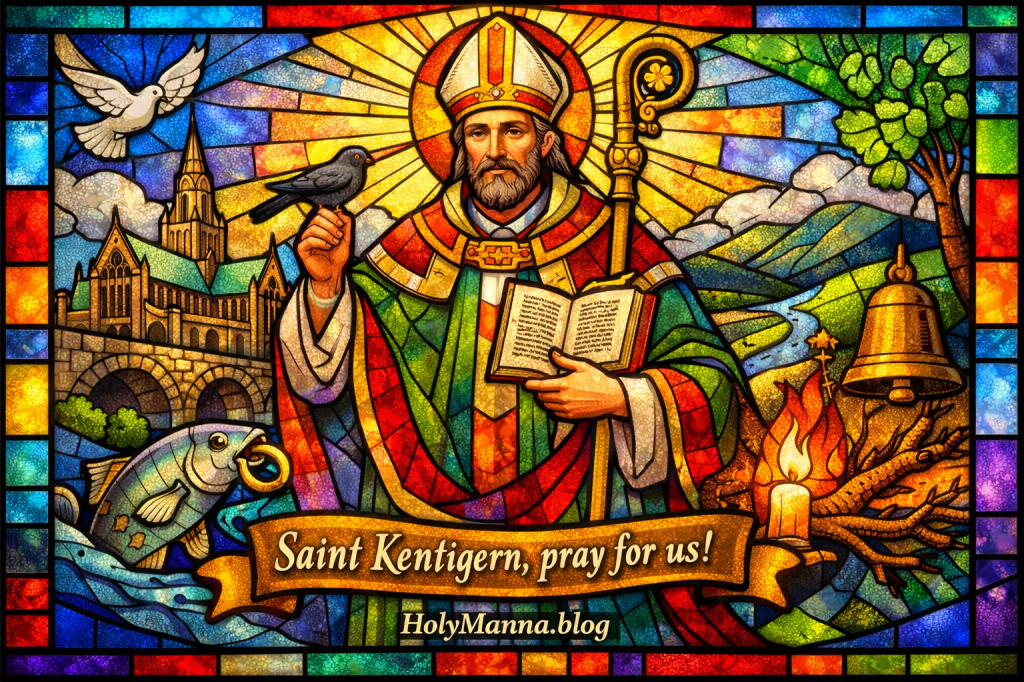
A Shepherd for Scotland’s Early Church
Saint Kentigern, better known in Scotland as Saint Mungo, is remembered as a missionary bishop closely tied to the early Church at Glasgow. He belongs to that first wave of saints who strengthened Christian life in a time when politics shifted quickly and the faith still needed deep roots in local communities. Much of the detail about his life comes through later ancient biographies and long loved tradition, but the Catholic center of his story remains steady: he preached Jesus Christ, formed disciples, and shepherded a growing Church with patience and courage.
This is why the Church keeps saints like Mungo close to the heart. The saints are not spiritual trivia or background decoration for old cathedrals. They are proof that grace can transform a human life into a living witness of the Gospel, which is exactly how The Catechism describes holiness as God’s work in His people. No verified writings or direct quotations from Saint Kentigern survive with certainty, so the words most associated with him come from tradition rather than from his own preserved texts.
A Heart Trained for God
Catholic tradition remembers Kentigern’s early story as dramatic and painful, marked by family conflict and social shame. His mother is often named Thenaw or Theneu, and the tradition emphasizes that his beginning was not “neat” by worldly standards. That detail matters spiritually, because it shows the kind of mercy God loves to reveal: the Lord is able to bring holiness out of a wounded start, and He is never limited by a person’s past.
Tradition also links his upbringing to Saint Serf, who is remembered as a spiritual guide who formed him in discipline and prayer. It is in this context that Kentigern receives the affectionate name “Mungo,” commonly understood as “dear one” or “my dear friend.” Even when historians debate timelines for early medieval saints, Catholic devotion can still receive the core lesson with confidence: God raises up saints by forming the heart through prayer, obedience, and steady conversion, just as The Catechism teaches about ongoing repentance and renewal in the Christian life.
Building a Church by Preaching and Prayer
Saint Kentigern is most known for missionary work around the River Clyde and for founding a Christian community at a place associated with modern Glasgow. Tradition connects his mission with a Christian king of Strathclyde, often named Rhydderch Hael, who supported his work and helped the Church take root publicly. The point is not political glory, but pastoral reality: a bishop preaching, baptizing, teaching, and gathering people into Christian life where they actually lived.
Catholic tradition also preserves a wider reach to his ministry, including a period connected to Wales and to saints such as Saint David, along with the founding of a monastic community at Llanelwy later associated with Saint Asaph. It also remembers his relationship with Saint Columba, which matters because it highlights unity among the early evangelists. A healthy Catholic perspective notices that saints do not compete for attention, because the goal is never self-promotion. The goal is the Church’s mission, which The Catechism describes clearly in the call to evangelize and to make disciples of all nations, CCC 849–856.
Signs of Grace
Catholic tradition surrounds Saint Mungo with miracle stories that have been cherished for centuries, especially because they became part of Glasgow’s Christian imagination. These accounts are best received as Catholics receive miracles in general: not as entertainment, but as signs meant to strengthen faith and point hearts toward God. Miracles are never supposed to replace the sacraments or become superstition, because the purpose of signs is to lead people closer to Christ and to trust His saving power, CCC 547–550.
One beloved tradition says a bird connected to Saint Serf was killed by jealous classmates, and Kentigern restored it to life through prayer and the sign of the cross. Another famous tradition tells of a queen falsely accused, with a ring lost and used as evidence against her, and the ring being recovered from inside a fish so that her innocence is made clear. Other traditions often grouped with these include a story of rekindling a monastery fire with a branch and a bell associated with worship and pastoral ministry. These four signs are often remembered through a simple rhyme that has helped generations keep the story close: “Here is the bird that never flew. Here is the tree that never grew. Here is the bell that never rang. Here is the fish that never swam.”
Exile, Opposition, and the Strength to Begin Again
Saint Kentigern’s story includes serious opposition and disruption, including traditions of exile during backlash against the Christian mission. This is not unusual in the history of evangelization, because the Gospel challenges idols and exposes sin, and resistance often follows. What makes the saint shine is not that hardship appeared, but that he did not allow hardship to poison the soul. He continued to preach, build up Christian life, and serve wherever Providence placed him, then returned to strengthen the Church again when he was able.
Saint Mungo is not remembered as a martyr who died by execution for the faith. He is remembered as a confessor and missionary bishop who endured hardship, kept working, and finished his life in fidelity. That is a powerful encouragement for modern Catholics who may not face a public trial but still face pressure, discouragement, and temptation. Perseverance is a grace worth praying for, and steady conversion is part of real Christian life, as The Catechism teaches about ongoing repentance and the daily turning of the heart back to God, CCC 1427–1433.
A Tomb, a Cathedral, and a City That Kept Praying
After his death, devotion to Saint Kentigern remained closely tied to Glasgow, with tradition holding that he was buried where the cathedral later stood. Over time, pilgrimage and veneration grew around his memory, which shows something deeply Catholic about how the Church lives across generations. Catholics do not treat saints as dead heroes locked in the past. The saints are alive in Christ, and the faithful can ask their intercession because the Church is one family in the communion of saints, CCC 956–957.
A city’s public memory often preserves a spiritual instinct even when the culture forgets the faith that formed it. A traditional civic prayer associated with Glasgow captures what many Catholics recognize as the heart of Saint Mungo’s legacy, even if it is not a verified quotation from his own writings: “Lord let Glasgow flourish through the preaching of thy word and praising thy name.” That line is a reminder that a city truly flourishes when worship is restored, truth is preached, and people live like God is real. A saint’s shrine and a cathedral’s history should always lead back to that same goal: deeper love for the Eucharist, real repentance, and concrete charity.
Living Like Mungo
Saint Kentigern’s life is not mainly about romance or nostalgia. It is about mission, and it is about building Christian life patiently in a real place among real people who had real problems. That is the kind of holiness that still matters right now, because the Church grows the same way today: through prayer, sacraments, preaching, and the quiet courage of believers who refuse to drift. If Saint Mungo teaches anything practical, it is that the faith must be lived publicly and personally, not hidden and not postponed.
A good imitation of his spirit begins with the basics done seriously. Sunday Mass needs to be non-negotiable, confession needs to be normal, and prayer needs to be steady enough to survive busy weeks. Evangelization then becomes more natural, because the heart is filled with what it is trying to share. Jesus’ command is still the Church’s marching orders in The Gospel of Matthew, and it is worth hearing with fresh attention: “Go therefore and make disciples of all nations.” Mt 28:19. How does that command challenge daily habits and daily priorities right now?
Engage with Us!
Share your thoughts and reflections in the comments below. What part of Saint Kentigern’s story stayed in your mind, and what might the Holy Spirit be asking for right now? Saints like Mungo are not meant to stay locked in history, because their lives are meant to provoke conversion today. Which virtue seems most needed right now, perseverance, courage, or deeper trust in God’s mercy?
- Where has perseverance been hardest lately, and what would it look like to stay faithful without growing bitter?
- What is one concrete way to treat home, work, or friendships as a mission field this week?
- Where has faith grown cold, and what step toward confession, prayer, or the sacraments would help rekindle it?
- How can devotion to the saints become more Christ-centered, leading to deeper love for the Eucharist and real works of mercy?
Keep walking forward in faith, even when it feels slow. Keep choosing repentance over comfort and courage over compromise, because grace grows through faithful habits and humble surrender. Keep doing ordinary things with real love, and let everything be shaped by the mercy Jesus teaches.
Saint Kentigern, pray for us!
Follow us on YouTube, Instagram and Facebook for more insights and reflections on living a faith-filled life.

 Holy Manna!
Leave a comment