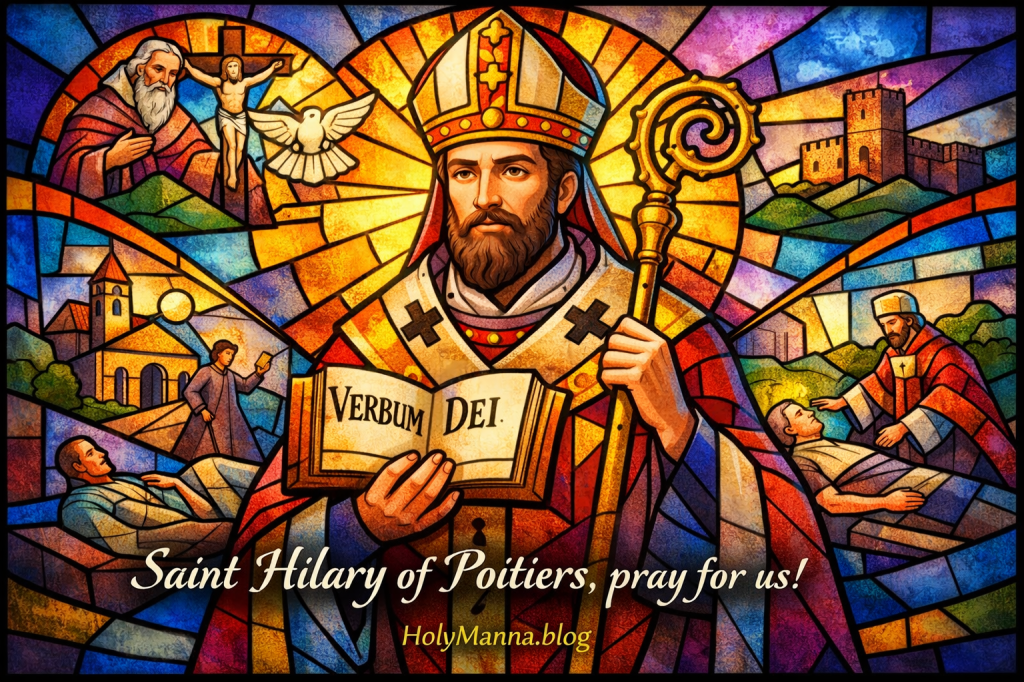
A Lion Hearted Bishop for the Trinity
Saint Hilary of Poitiers is one of those saints who shows up exactly when the Church needs courage and clarity. He lived in the fourth century, when the Arian crisis was shaking the Christian world and many voices were trying to water down the truth about Jesus Christ. Hilary stood firm and preached what the Church has always confessed: the Son is not a creature, not a super-angel, and not a lesser god, but true God from true God.
This is not just history for scholars. It is the heart of Catholic life. The Catechism teaches that the central mystery of the Christian faith is the Most Holy Trinity, and Hilary spent his life guarding that mystery so ordinary believers could worship God in truth. When the world gets fuzzy about who Jesus is, faith gets weak fast. Hilary’s witness is a wake up call to keep the Creed strong in the mind and even stronger in the heart.
A Search for Truth That Ended at the Baptismal Font
Hilary was born in Poitiers in Gaul, in what is now France, into a noble family and was not raised Christian. He was educated, thoughtful, and serious about truth, which is exactly why his conversion matters. He came to believe because he encountered the living God in Scripture and discovered that God is not an idea, but a Father who reveals Himself and saves.
Catholic tradition also remembers that Hilary was married and had a daughter, and the local Church of Poitiers venerates his daughter, Saint Abra. That detail matters because it highlights something Catholics sometimes forget: God calls saints out of real life, not out of fantasy. He was a man with responsibilities, relationships, and a public reputation, and then Christ claimed his whole life.
Not long after his baptism, Hilary was chosen as Bishop of Poitiers. That kind of election tells a lot. The faithful recognized both his holiness and his strength. He stepped into leadership right as doctrinal confusion was spreading, so his episcopate became a mission of teaching, protecting the flock, and refusing to let the faith be rewritten by politics.
A Shepherd Who Taught with Scripture and Fire
Hilary was not a bishop who hid behind vague spiritual language. He went straight to Scripture, straight to the Creed, and straight to the truth about the Father and the Son. He taught that baptism itself is a public confession of the Trinity, because Christ commands baptism in the name of the Father, and of the Son, and of the Holy Spirit in The Gospel of Matthew. Hilary understood that if the Son is not fully divine, then the whole Christian life becomes a religious costume.
His most famous work is On the Trinity, and it is not cold debate. It is the kind of teaching that sounds like prayer because it comes from faith. He wrote, “God knows not how to be anything other than love, he knows not how to be anyone other than the Father.” This line connects doctrine and devotion, because the Trinity is not an abstract puzzle. The Trinity is the love of God revealed, and that love is the foundation of everything.
Hilary also taught believers how to read the Old Testament as Christians, especially the Psalms, which are the Church’s prayer book. He wrote, “All the things that are said in the Psalms should be understood in accordance with Gospel proclamation.” That fits perfectly with the Catholic way of reading Scripture, where the Old Testament is understood in the light of Christ as taught in The Catechism and reflected throughout the liturgy.
The Church’s liturgical tradition also remembers that God confirmed Hilary’s witness with miracles during his exile, including the raising of a man from the dead. This detail is not presented as a spectacle. It is a sign that Christ remains Lord even when His servants are pushed out, silenced, or punished for telling the truth.
The Quiet Heroism of a Confessor
Hilary’s suffering did not end with theological arguments. It turned into exile. He opposed Arian influence at councils, and the political powers of his day did not appreciate a bishop who would not play along. He was condemned and exiled to Phrygia, far from his people, far from home, and surrounded by pressure to compromise.
Exile is a slow kind of persecution. It tries to break a man down through distance, isolation, and exhaustion. Hilary endured it with faith and discipline. He kept writing, kept teaching, and kept defending the truth that the Son is fully God. His exile became spiritually fruitful, because some of his greatest work was produced in that season of suffering.
Hilary prayed like a Catholic who knew what was at stake. In a concluding prayer from On the Trinity, he wrote, “Obtain, O Lord, that I may keep ever faithful to what I have professed.” That is the prayer of every believer who wants to stay loyal when the pressure turns up, when the crowd turns, and when faith stops being socially convenient.
Hilary was not martyred by execution, but the Church still honors him as a confessor, meaning he suffered for the faith and remained steadfast. That kind of witness is a strong reminder that holiness is not always dramatic. Sometimes it is simply refusing to lie about Jesus.
The Saint Who Keeps Helping
After Hilary’s death, devotion to him grew, especially in Poitiers, where his tomb became a place of prayer and veneration. Catholic tradition preserves accounts of healings and signs through his intercession, especially in the centuries that followed. Stories passed down in early Christian memory describe the sick being restored, the blind receiving sight, and those suffering from severe illness being helped after praying at his shrine.
Some traditions describe healings from diseases like leprosy and the restoration of a withered hand. These accounts are offered as testimony to God’s mercy, not as a replacement for the Gospel. The point is always the same: Christ is alive, and the communion of saints is real. Catholics do not treat saints like spiritual celebrities. Catholics ask saints to pray, because those who die in Christ remain united to the Church and intercede for the faithful as taught in The Catechism.
Poitiers remained closely associated with Hilary’s memory, and the faithful continued to honor him as a bishop who defended the faith and as a spiritual father who still helps his people through prayer.
How to Live Like Hilary
Saint Hilary’s message hits home today because the world still tries to reduce Jesus. Sometimes it sounds polite, like calling Him a wise teacher. Sometimes it sounds trendy, like saying doctrine does not matter. Either way, it pushes the same lie: that Jesus does not need worship, only admiration. Hilary’s life cuts through that confusion and points back to the faith the Church guards and proclaims in The Catechism.
A practical way to imitate Hilary is to take the Creed seriously. It should never be treated like background noise at Mass. It should be prayed with attention, believed with confidence, and defended with charity. Another practical way is to read Scripture like a Catholic and let the Psalms become daily prayer again, especially when they are read in the light of the Gospel, just as Hilary taught.
When faith feels pressured, Hilary’s prayer can become a personal habit. He wrote, “Obtain, O Lord, that I may keep ever faithful to what I have professed.” That prayer trains the soul to stay steady when the culture demands compromise.
Hilary also teaches that courage and charity belong together. He fought error without abandoning the Church, and he suffered without turning bitter. That is a serious model for anyone trying to stay faithful in noisy times.
Engage with Us!
Share thoughts and reflections in the comments below.
- When is it easiest to treat Jesus like a wise teacher instead of worshiping Him as Lord and God?
- What part of the Creed feels most “alive” right now, and what part needs more attention and understanding?
- How can faithfulness look more like Saint Hilary this week, especially in conversations where truth feels unpopular?
- What is one simple way to honor the Trinity daily, in prayer, at work, or in family life?
Keep walking forward in faith. Keep learning the truth. Keep loving people with patience. Most of all, keep doing everything with the love and mercy Jesus taught, because holiness is never only about being right. Holiness is about belonging to Christ completely and letting His grace transform the heart.
Saint Hilary of Poitiers, pray for us!
Follow us on YouTube, Instagram and Facebook for more insights and reflections on living a faith-filled life.

 Holy Manna!
Leave a comment