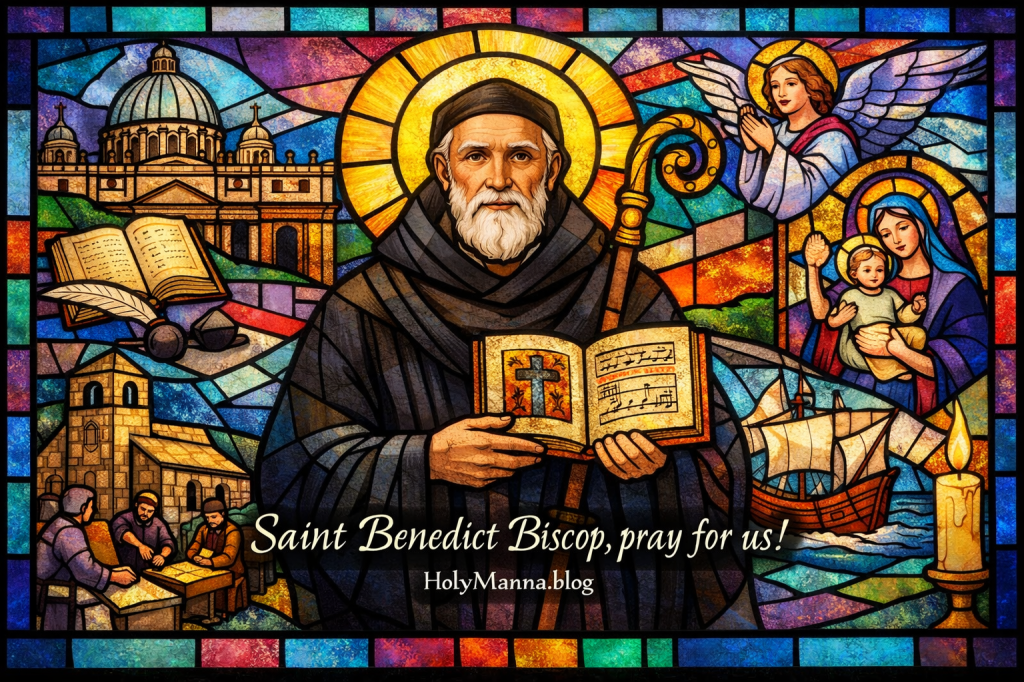
The Saint Who Taught England to Pray and See Christ
Saint Benedict Biscop was an Anglo Saxon nobleman turned Benedictine abbot who helped give the English Church a deeper Catholic identity through unity with Rome, reverent worship, and serious Christian learning. He founded the twin monasteries of Saint Peter at Wearmouth and Saint Paul at Jarrow, and he poured his life into making them places where the faith could be lived with stability and passed on without compromise. His legacy is not flashy, but it is massive, because he understood that renewal begins when worship is ordered, doctrine is protected, and beauty is used to lift the heart to God.
This kind of life reflects what The Catechism teaches about the Church’s unity and the purpose of the liturgy as the work of Christ and His Body, not a private invention of individuals. It also echoes the Church’s confidence that sacred signs and sacred beauty can lead the faithful into deeper contemplation of the Lord, especially when so many hearts are distracted and tired.
From Noble Privilege to Pilgrim Discipline
Benedict was born into a noble Northumbrian family and served in the household of a king, which meant status, security, and influence. Still, he chose to leave that life behind, and that choice reveals a serious conversion. He did not merely add prayer to comfort. He rearranged his life around seeking God, and he went on pilgrimage to Rome while still a young man. Catholic sources emphasize that he returned to Rome multiple times, and those journeys formed him in the wider life of the Church.
Rome gave him a deeper sense that Catholic faith is bigger than any one culture or personality, and that unity with the Church is not a limitation but a gift. He also spent time at Lérins, a famous monastery in Gaul, where he took the monastic habit and the name Benedict. This step matters because it shows he wanted conversion that was concrete and structured. Benedictine life trains a person through prayer, work, and obedience, and it turns scattered energy into steady holiness that holds up under pressure.
Building a Catholic World
Saint Benedict Biscop is most known for founding Wearmouth and Jarrow, but he should not be remembered only as a man who built buildings. He built a Catholic environment. He knew that if the liturgy is reverent, the community is stable, and the mind is nourished by truth, then holiness becomes more possible for ordinary people.
He brought craftsmen from the continent to build stone churches in a Roman style, and he introduced glass windows through skilled workers who could install them and teach the craft locally. That was not vanity. It was a way of honoring God with lasting beauty and giving the faithful a visual reminder that worship is sacred. Catholics understand this instinct because the Word became flesh, and the Church uses visible signs to communicate invisible realities. Benedict also filled his churches with images that taught the faith. In an age when many people could not read, sacred art preached, helping people contemplate Christ, the Blessed Virgin Mary, the Apostles, and the mysteries of salvation. This fits the Church’s teaching on sacred images and their role in devotion and worship, especially as described in CCC 1159–1162.
He cared about sound as much as sight. He worked to form his monasteries in Roman chant and liturgical discipline, bringing a skilled teacher from Rome to train the community. This reflects the Catholic conviction that sacred music serves the liturgy and forms the soul, as explained in CCC 1156–1158. He also gathered books with remarkable intensity and purpose, building a library that became a spiritual treasure for the Church in England. Catholic faith is not anti intellect, and the Church loves truth because Christ is Truth. Benedict’s library was not an academic flex. It was an act of charity toward future generations.
Quiet Holiness
When people hear the word miracle, they often expect dramatic healings or public wonders. The earliest Catholic accounts do not preserve a long list of showy miracles performed by Benedict Biscop. Instead, they highlight something more demanding and more relatable: a steady holiness that produces long term fruit. His “miracle” is the life he built, the worship he protected, and the formation he passed on, all of which strengthened the Church well beyond his lifetime.
His verified words show what drove him. When defending the rule and customs he established, he made it clear he was not building a personal brand. He was handing on what he had received, saying “I learnt it from seventeen monasteries…” That line is a strong example of Catholic fidelity, because Tradition is not a museum. It is a living gift guarded and handed on. He also warned the community not to choose an abbot for family prestige rather than virtue, saying “Beware, and never choose an abbot on account of his birth…” Those words remain a needed correction in every age, because the temptation to prioritize status over holiness never disappears.
Suffering United to Christ
Saint Benedict Biscop was not a martyr in the sense of dying violently for the faith, but he endured a long and humbling illness in his later years. Catholic memory emphasizes how he continued to encourage his monks and guard the monastery’s spiritual foundations even when his strength failed. He did not waste suffering by turning inward. He used suffering as a place of fidelity, which lines up with the Church’s teaching that Christ gives suffering a new meaning by uniting it to His Passion, as expressed in CCC 1505 and CCC 618.
Even near the end, he focused on the future of his community. He urged unity, peace, and leadership rooted in virtue. He also protected the monastery’s learning as something sacred, commanding that the community preserve its books, saying “The large and noble library… he commanded to be kept entire…” That is not the voice of a collector obsessed with objects. It is the voice of a spiritual father protecting the tools that form minds and souls. He died strengthened by the sacraments and received the Holy Eucharist as viaticum, a detail that fits the Church’s understanding of Christian death and the help the Lord gives at the threshold of eternity, as reflected in CCC 1680–1683.
A Legacy That Keeps Bearing Fruit
The posthumous story of Saint Benedict Biscop is not centered on famous miracle tales the way some saints are. Early Catholic sources focus more on his spiritual legacy than on dramatic healings at his tomb. His relics were venerated, and his memory remained tied to Wearmouth and Jarrow, places linked to the strengthening of Catholic monastic life and learning in England. There is also a notable sign described around the time of his passing that emphasizes peace and divine protection as he entered eternal life. Even without sensational stories, the Church recognizes sanctity by the pattern of a life, the fidelity of a death, and the fruit that continues after the person is gone.
His greatest “after death miracle” may be the simplest to see. The monasteries he founded continued to shape Christian culture, and they helped form minds and souls for generations. God used his steady obedience to light a lamp that kept burning when other lights went out.
Building a Life for Christ
Saint Benedict Biscop offers a clear message for modern Catholics who feel spiritually scattered. Faith does not grow well in chaos, and it rarely becomes strong by accident. It grows when life is organized around worship, truth, and disciplined habits that train the heart to choose God consistently. Benedict shows that unity with the Church matters, and he pursued communion with Rome not as politics but as Catholic reality.
He also shows that beauty is not optional when it serves worship. Sacred images, worthy churches, and reverent chant are not aesthetic hobbies. They are tools that help the heart pray and help the imagination submit to Christ. The Church has always known that beauty can move people toward God, especially when words feel distant. He also shows that learning is part of discipleship, because a Catholic who never studies will struggle to remain stable when challenged. Returning regularly to Scripture and to The Catechism builds spiritual resilience and keeps faith rooted in truth instead of trends.
How would daily life change if prayer and Sunday worship were treated as the center instead of an accessory? What would happen if the home became a place where beauty served holiness and not temptation? What kind of discipline would help the heart become more peaceful and more Catholic?
Engage With Us!
Share thoughts and reflections in the comments below. The best conversations happen when faithful Catholics encourage each other to live the Gospel with courage and consistency.
- What is one area of life that feels scattered right now, and what concrete step could bring it back under Christ’s order?
- How can the home become more like a small monastery, with prayer, Scripture, and peace shaping the atmosphere?
- What kind of sacred beauty helps the heart pray more deeply, such as chant, icons, stained glass, or silence?
- What is one Catholic habit of study that could strengthen faith this month, such as reading a Gospel slowly, studying The Catechism, or learning about a saint each week?
- How can suffering be offered more intentionally to Jesus this week, trusting that He can turn weakness into grace?
Saint Benedict Biscop proves that a life of faith is not built on moods. It is built on commitment. Keep showing up to prayer. Keep honoring the liturgy. Keep choosing beauty that points to God. Keep learning the faith with humility. Keep trusting Jesus in suffering, and do everything with the love and mercy Jesus taught us.
Saint Benedict Biscop, pray for us!
Follow us on YouTube, Instagram and Facebook for more insights and reflections on living a faith-filled life.

 Holy Manna!
Leave a comment