Monday of the First Week in Ordinary Time – Lectionary: 305
God’s Call in the Middle of Daily Life
Some days in the liturgy feel like they were stitched together to meet people exactly where they are, right in the mess of ordinary life, unanswered prayers, and work that never stops. Today’s readings connect around one central theme: God meets human emptiness with divine purpose, and the right response is conversion, gratitude, and a courageous yes.
In 1 Samuel 1:1-8, the scene is Shiloh, the early sanctuary of Israel before the Temple existed, where families made yearly pilgrimages to worship and offer sacrifice. This is the era before the kings, when Israel is spiritually unstable, and even the priesthood at Shiloh is troubled. In that setting, Hannah’s suffering is painfully personal. Her barrenness is not just a private sadness; in her culture it carries public shame, rivalry, and misunderstanding. Yet the most important detail is that she keeps going up to the house of the Lord. Her life feels “closed,” but her faith stays open.
Then Psalm 116:12-19 gives the language a wounded heart eventually learns to speak when God saves and sustains. It is not sentimental gratitude. It is covenant gratitude, the kind that makes vows, keeps them, and returns to worship with a real offering. The psalm’s praise fits perfectly with Hannah’s posture, because it shows what faithful endurance is meant to grow into: thanksgiving that turns into sacrifice.
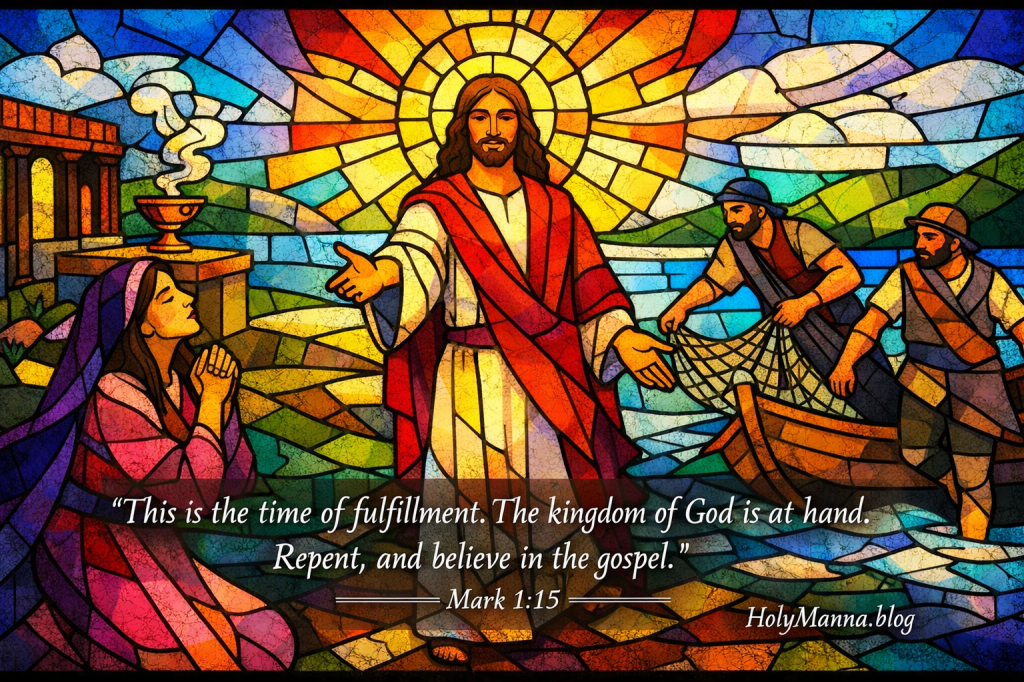
Finally, The Gospel of Mark 1:14-20 brings the climax. Jesus steps into history with urgency and authority, announcing, “This is the time of fulfillment. The kingdom of God is at hand. Repent, and believe in the gospel.” Then He calls fishermen in the middle of their work, and they drop their nets without negotiating terms. That is the same spiritual movement seen in Hannah and the psalmist, just sharpened and fulfilled. God does not only console the empty places. God transforms them into mission.
Where does life feel barren, stuck, or unfinished right now, and what would it look like to answer Christ’s call with trust instead of delay?
First Reading – 1 Samuel 1:1-8
A faithful family brings their sufferings to the Lord.
This opening scene of 1 Samuel lands in a messy, real part of Israel’s story, the later period of the Judges, when the people still worship at Shiloh, where the tabernacle stands and sacrifices are offered before the time of the Temple in Jerusalem. Elkanah’s yearly pilgrimage shows a family that stays close to the Lord’s worship even when things are imperfect, even when the priesthood itself is compromised, since Eli’s sons, Hophni and Phinehas, will soon be exposed as corrupt. Into that setting, Scripture introduces Hannah, a woman who is loved, faithful, and deeply wounded by infertility, which in that culture carried social shame and relentless misunderstanding. This reading fits today’s theme by putting a spotlight on what it feels like to bring unanswered sorrow into God’s presence, and to keep showing up anyway.
1 Samuel 1:1-8 – New American Bible (Revised Edition)
Elkanah and His Family at Shiloh. 1 There was a certain man from Ramathaim, a Zuphite from the hill country of Ephraim. His name was Elkanah, the son of Jeroham, son of Elihu, son of Tohu, son of Zuph, an Ephraimite. 2 He had two wives, one named Hannah, the other Peninnah; Peninnah had children, but Hannah had no children. 3 Each year this man went up from his city to worship and offer sacrifice to the Lord of hosts at Shiloh, where the two sons of Eli, Hophni and Phinehas, were ministering as priests of the Lord. 4 When the day came for Elkanah to offer sacrifice, he used to give portions to his wife Peninnah and to all her sons and daughters, 5 but he would give a double portion to Hannah because he loved her, though the Lord had closed her womb. 6 Her rival, to upset her, would torment her constantly, since the Lord had closed her womb. 7 Year after year, when she went up to the house of the Lord, Peninnah would provoke her, and Hannah would weep and refuse to eat. 8 Elkanah, her husband, would say to her: “Hannah, why are you weeping? Why are you not eating? Why are you so miserable? Am I not better for you than ten sons?”
Detailed Exegesis
Verse 1 – “There was a certain man from Ramathaim, a Zuphite from the hill country of Ephraim. His name was Elkanah, the son of Jeroham, son of Elihu, son of Tohu, son of Zuph, an Ephraimite.”
The genealogy is not filler. It roots this story in real people and a real place, and it quietly signals that what is about to happen is not just private drama, but part of God’s public plan for Israel. The mention of Ephraim locates the family in the hill country, and it also hints at the spiritual instability of the era, since Israel is still learning how to live as God’s covenant people without a king, often drifting, often needing renewal.
Verse 2 – “He had two wives, one named Hannah, the other Peninnah; Peninnah had children, but Hannah had no children.”
This single verse sets the tension that will dominate the household. Polygamy appears in the Old Testament as a tolerated practice in certain periods, but it is not God’s original design for marriage, and it often multiplies conflict and suffering. Hannah’s barrenness is presented plainly, without moral blame. The ache is real, and the wound is named without embarrassment.
Verse 3 – “Each year this man went up from his city to worship and offer sacrifice to the Lord of hosts at Shiloh, where the two sons of Eli, Hophni and Phinehas, were ministering as priests of the Lord.”
The annual pilgrimage matters. It shows covenant faithfulness and the rhythm of worship that forms a people over time. Shiloh is a sacred place in Israel’s memory, because the tabernacle is there. The title “Lord of hosts” underscores God’s kingship and power, especially fitting in a time when Israel’s leadership is shaky. The detail about Eli’s sons is also a warning: holiness is not guaranteed by clerical office. Still, Elkanah goes up to worship. Fidelity does not wait for perfect conditions.
Verse 4 – “When the day came for Elkanah to offer sacrifice, he used to give portions to his wife Peninnah and to all her sons and daughters,”
The sacrifices included a sacred meal, where the worshiper shared portions with his household. This was not only ritual, it was relational. Worship shaped family life, and family life showed up inside worship. The portions given to Peninnah and her children underline her visible fruitfulness, which will become the weapon she uses against Hannah.
Verse 5 – “but he would give a double portion to Hannah because he loved her, though the Lord had closed her womb.”
Elkanah’s love is real, but it cannot fix Hannah’s grief. The “double portion” is a public sign of honor and affection, yet it also may intensify the rivalry, because it highlights Hannah as favored even while she is childless. The line about the Lord closing her womb can feel harsh to modern ears, but within biblical language it emphasizes God’s providence over life and fruitfulness. It does not mean Hannah is cursed. It means her story will not be explained by biology alone. God is at work even when the heart cannot yet see how.
Verse 6 – “Her rival, to upset her, would torment her constantly, since the Lord had closed her womb.”
Suffering becomes sharper when it is mocked. Peninnah’s sin is not merely insensitivity. It is deliberate torment. Scripture is brutally honest about how people can weaponize blessings, and how envy can thrive even in someone who “has everything.” Hannah’s trial is not only infertility, but humiliation. Many people can endure pain more easily than they can endure being shamed for it.
Verse 7 – “Year after year, when she went up to the house of the Lord, Peninnah would provoke her, and Hannah would weep and refuse to eat.”
This verse shows the slow grind of repeated sorrow. It is not one bad day. It is year after year. The house of the Lord, the very place meant for consolation, becomes the place where Hannah’s wound is reopened. Her fasting is not presented as a spiritual technique here, but as grief so heavy that appetite disappears. This is the kind of suffering that makes prayer feel difficult, and yet it is precisely where God begins to do something new.
Verse 8 – “Elkanah, her husband, would say to her: ‘Hannah, why are you weeping? Why are you not eating? Why are you so miserable? Am I not better for you than ten sons?’”
Elkanah’s questions sound tender and clueless at the same time. He wants to comfort her, but he does not understand the particular sorrow she carries. His final question reveals a common temptation in close relationships: trying to replace someone’s deep desire with a different good. Love is not the problem here. Limits are. Even a good spouse cannot fill every longing. This is part of the reading’s quiet push toward God: only the Lord can meet the places no human being can reach.
Teachings
The Church reads moments like this as more than ancient family conflict. This is a lesson about worship, about persevering when prayer feels painful, and about bringing real suffering into God’s presence without pretending.
The pilgrimage to Shiloh is a reminder that God forms His people through public worship, sacrifice, and vows. The Catechism describes this Old Testament pattern in a way that fits Elkanah’s yearly journey: “For the People of God, the Temple was to be the place of their education in prayer: pilgrimages, feasts and sacrifices, the evening offering, the incense, and the bread of the Presence (‘shewbread’) all these signs of the holiness and glory of God Most High and Most Near were appeals to and ways of prayer. But ritualism often encouraged an excessively external worship. The people needed education in faith and conversion of heart; this was the mission of the prophets, both before and after the Exile.” (CCC 2581)
Shiloh is not the Temple yet, but it functions as that “school of prayer” for Israel. Even in a flawed era, God draws His people to Himself through worship, and He teaches them not to settle for the external, but to be converted in the heart.
This reading also brings up a hard truth about polygamy. Scripture records it, but it also shows its fruit: rivalry, humiliation, and heartbreak. The Church is clear that this is not God’s plan for marriage: “However polygamy is not in accord with the moral law. ‘[Conjugal] communion is radically contradicted by polygamy; this, in fact, directly negates the plan of God which was revealed from the beginning, because it is contrary to the equal personal dignity of men and women who in matrimony give themselves with a love that is total and therefore unique and exclusive.’” (CCC 2387)
Hannah’s pain is not only personal; it is also a consequence of a household structure that makes comparison and competition almost inevitable.
Finally, Hannah’s silent suffering prepares the way for one of Scripture’s great teachings on persevering prayer. Even though her actual prayer comes later in the chapter, the Church’s wisdom about prayer in tribulation already matches what Hannah is living in verses 1 to 8: “Filial trust is tested, it proves itself, in tribulation. The principal difficulty concerns the prayer of petition, for oneself or for others in intercession.” (CCC 2734)
Hannah is standing right at that threshold, where prayer feels costly and where trust is tested.
Saint John Chrysostom famously held up Hannah as a model of how to pray with focus and perseverance, not as performance, but as a heart poured out before God. Speaking about her persistence, he warns that it is possible to “pray” without truly standing before the Lord interiorly, and he praises Hannah’s attentiveness as prayer that is real, personal, and present. That is exactly where this reading is heading: God is drawing Hannah from heartbreak into a deeper kind of prayer that will bless all Israel.
Reflection
Hannah’s story hits home because it is so recognizable. It is not only about infertility. It is about any holy desire that remains unanswered, any wound that gets poked again and again, and any moment when the house of the Lord feels like the hardest place to walk into because that is where the ache feels loudest.
A lot of people drift from prayer when life hurts, not because they stopped believing, but because they are tired of hoping. Hannah shows a better way. She keeps going up. She keeps showing up in worship. She refuses to let bitterness be the final word, even when she cannot yet see an answer. That is the kind of faith that quietly matures into surrender.
In daily life, this reading invites a simple but demanding step: bring the real wound to God instead of hiding it behind a polite smile. It also calls for a serious examination of how other people’s suffering is handled. Peninnah’s cruelty is a warning against comparing, boasting, and using blessings as weapons. Elkanah’s clumsy comfort is a reminder that even well-meaning words can miss the mark when someone is grieving.
Where has sorrow started to make worship feel heavy instead of hopeful? Is there a habit of comparison that needs to be confessed, especially when someone else is carrying a cross that cannot be seen? What would it look like to keep showing up to Mass and prayer with honesty, even if the heart feels empty?
Responsorial Psalm – Psalm 116:12-19
The grateful heart returns to worship.
This psalm sounds like it comes from someone who has been rescued, not someone who is casually having a good day. It is part of a set of psalms that Israel prayed as songs of thanksgiving, often connected to major feasts and the public worship of God in Jerusalem. The setting in the text is unmistakably liturgical. Vows are paid “in the presence of all his people,” and praise happens “in the courts of the house of the Lord.” That matters for today’s theme, because it shows what faithful endurance is meant to mature into. Hannah’s suffering in 1 Samuel 1:1-8 is not wasted, and the disciples’ sudden obedience in Mark 1:14-20 is not reckless. Both are responses to God’s action. This psalm gives the Church words for that response: gratitude that becomes worship, and worship that becomes a life offered back to God.
Psalm 116:12-19 – New American Bible (Revised Edition)
12 How can I repay the Lord
for all the great good done for me?
13 I will raise the cup of salvation
and call on the name of the Lord.
14 I will pay my vows to the Lord
in the presence of all his people.
15 Dear in the eyes of the Lord
is the death of his devoted.
16 Lord, I am your servant,
your servant, the child of your maidservant;
you have loosed my bonds.
17 I will offer a sacrifice of praise
and call on the name of the Lord.
18 I will pay my vows to the Lord
in the presence of all his people,
19 In the courts of the house of the Lord,
in your midst, O Jerusalem.
Hallelujah!
Detailed Exegesis
Verse 12 “How can I repay the Lord for all the great good done for me?”
This is not a business transaction, because God cannot be repaid like a creditor. This is the astonishment of someone who realizes that mercy is bigger than effort. The question is really about love. When God saves, the heart starts asking how to respond in a way that is worthy, not how to respond in a way that is minimal.
Verse 13 “I will raise the cup of salvation and call on the name of the Lord.”
In Israel’s worship, the “cup” points to thanksgiving offered publicly, not privately. It is a concrete sign that gratitude does not stay inside the chest. For Catholics, the phrase “cup of salvation” naturally echoes the chalice at Mass, because the Lord uses a cup to give the New Covenant in his Blood. This verse trains the soul to stop treating gratitude as a mood and start treating it as worship.
Verse 14 “I will pay my vows to the Lord in the presence of all his people.”
A vow is a promise made to God, and it is meant to be fulfilled. The psalmist is not hiding devotion in private. He is publicly giving God what was promised, because faith is not only personal. It is also ecclesial. The presence of “all his people” highlights that worship is never just a solo project.
Verse 15 “Dear in the eyes of the Lord is the death of his devoted.”
This line does not mean death is pleasant. It means the death of the faithful is not meaningless, forgotten, or treated as disposable. God treasures the lives of his holy ones, and he also treasures their final act of surrender. This verse has always consoled Christians because it quietly insists that fidelity matters all the way to the end, even when the world does not notice.
Verse 16 “Lord, I am your servant, your servant, the child of your maidservant; you have loosed my bonds.”
The psalmist claims an identity. He belongs to the Lord, and he belongs to the Lord with a family history of faith, “the child of your maidservant.” This is covenant language. Then comes the testimony: God breaks bonds. These bonds can be enemies, injustice, sin, fear, addiction, or despair. The point is clear. Salvation is not self-help. Salvation is liberation given by God.
Verse 17 “I will offer a sacrifice of praise and call on the name of the Lord.”
Praise is called a sacrifice because real praise costs something. It costs pride, control, resentment, and the urge to complain as a lifestyle. The psalmist is not promising to talk about God. He is promising to offer something to God. This verse is a strong bridge to the Mass, where the Church offers praise to the Father united to the sacrifice of Christ.
Verse 18 “I will pay my vows to the Lord in the presence of all his people,”
The repetition is intentional. The psalmist wants no loopholes. Gratitude must become fidelity, and fidelity must be visible. This is the opposite of emotional Christianity, where people feel inspired one day and disappear the next. The psalm pushes toward steady follow-through.
Verse 19 “In the courts of the house of the Lord, in your midst, O Jerusalem. Hallelujah!”
The destination of the whole psalm is worship in God’s house, in the heart of God’s people. Jerusalem represents the place where God gathers his people for sacrifice and praise. For Christians, this points beyond geography to the Church’s liturgy, where God gathers his family around the altar. The final “Hallelujah” is not a throwaway line. It is the conclusion of a life rescued: praise is the final word.
Teachings
This psalm teaches that gratitude is meant to take a specific shape. It becomes praise, it becomes vows fulfilled, and it becomes public worship.
The Church speaks very directly about vows, which show up twice in this psalm. A vow is not a vague intention or a religious mood. It is a promise made to God that should be honored. The Catechism defines it clearly: “A vow is a deliberate and free promise made to God concerning a possible and better good which must be fulfilled by reason of the virtue of religion.” CCC 2102
That definition helps the psalm land in daily life. When a person tells God something like, “If you get me through this, there will be a change,” the point is not to bargain. The point is to let gratitude become fidelity.
The “cup of salvation” and the “sacrifice of praise” also fit deeply with Catholic worship. The Church does not treat the Eucharist as a mere symbol of gratitude, because Christ truly offers himself and draws his people into that offering. That is why The Catechism can say without hesitation: “The Eucharist is ‘the source and summit of the Christian life.’” CCC 1324
This psalm’s movement toward the courts of the Lord matches the Church’s instinct to return to the altar. When God loosens bonds, the right response is not just private relief. The right response is worship.
Saint Augustine helps make the “sacrifice of praise” concrete, because he constantly connects worship to a life offered. He teaches that the heart becomes a true offering when it clings to God in love, because that is what makes worship real and not performative. That is exactly what this psalm demands. It calls for praise that costs something and for promises that actually get fulfilled.
Reflection
This psalm challenges the modern habit of treating gratitude like a feeling that comes and goes. It teaches that gratitude should be practiced as a decision, and it should be anchored in worship. When God has carried someone through a hard season, the right response is not to move on as if nothing happened. The right response is to return to the Lord, to give thanks with the Church, and to live differently because mercy was received.
A practical way to live this psalm is to start naming the “great good” God has done, especially the kind that is easy to forget because it happened quietly. Then bring that gratitude into prayer before it evaporates. Another serious step is to examine promises made to God. Some promises were spoken in moments of desperation. Some were made in moments of clarity. This psalm says they matter, and they should be paid in the presence of God’s people, which is a strong reminder that Sunday Mass is not optional for a faithful heart. It is the natural home of thanksgiving.
What specific mercy has been received lately that deserves more than a quick “thanks” and a return to routine? Is there a promise made to God that has been delayed, minimized, or forgotten, even though the heart knows it should be fulfilled? If God has loosened bonds, what change in daily habits would prove that gratitude is real and not just emotional?
Holy Gospel – Mark 1:14-20
Jesus does not wait for perfect timing.
This passage comes right at the beginning of Jesus’ public ministry in The Gospel of Mark. The stage is Galilee, a region marked by ordinary labor, mixed populations, and daily survival under Roman rule. John the Baptist has been arrested, which signals that the world will resist God’s message, and it also signals that Jesus is stepping forward publicly to begin the decisive phase of salvation history. Mark moves fast because the Kingdom is urgent. Jesus does not simply offer spiritual advice. He makes an announcement that changes everything, and then he makes a demand that requires a decision. This fits today’s theme perfectly, because Hannah shows what it looks like to bring emptiness to God, Psalm 116 shows what it looks like to answer God with gratitude and worship, and the Gospel shows what it looks like when God answers back with a personal call. The Kingdom comes close, and the only sane response is repentance, faith, and obedience.
Mark 1:14-20 – New American Bible (Revised Edition)
The Beginning of the Galilean Ministry. 14 After John had been arrested, Jesus came to Galilee proclaiming the gospel of God: 15 “This is the time of fulfillment. The kingdom of God is at hand. Repent, and believe in the gospel.”
The Call of the First Disciples. 16 As he passed by the Sea of Galilee, he saw Simon and his brother Andrew casting their nets into the sea; they were fishermen. 17 Jesus said to them, “Come after me, and I will make you fishers of men.” 18 Then they abandoned their nets and followed him. 19 He walked along a little farther and saw James, the son of Zebedee, and his brother John. They too were in a boat mending their nets. 20 Then he called them. So they left their father Zebedee in the boat along with the hired men and followed him.
Detailed Exegesis
Verse 14 “After John had been arrested, Jesus came to Galilee proclaiming the gospel of God:”
John’s arrest is a sober reminder that preaching truth has a cost. The Kingdom does not arrive in a neutral world. Jesus comes right into a tense political and religious moment, and he proclaims the “gospel of God,” which means good news that originates in God and reveals God’s plan. Galilee is not the religious center like Jerusalem, which highlights a pattern in salvation history. God often begins great movements in places that look ordinary.
Verse 15 “This is the time of fulfillment. The kingdom of God is at hand. Repent, and believe in the gospel.”
“The time of fulfillment” means history has reached a decisive moment. God’s promises are converging in the person of Jesus. “The kingdom of God is at hand” means God’s reign is breaking in, not merely as an idea but as a living reality present in Christ. Then Jesus gives two commands that belong together. “Repent” means a real change of mind and life, not shallow regret. “Believe” means entrust the whole self to the gospel, not merely agree with it. This verse is the heartbeat of Christian conversion.
Verse 16 “As he passed by the Sea of Galilee, he saw Simon and his brother Andrew casting their nets into the sea; they were fishermen.”
Jesus calls people in the middle of ordinary work. Fishing in Galilee was not a hobby. It was hard labor that fed families and supported local commerce. The detail that they are “casting their nets” shows they are mid-task, which makes the call feel even more disruptive. Jesus sees them, which is more than noticing them. It is a personal gaze that initiates a new identity.
Verse 17 “Jesus said to them, ‘Come after me, and I will make you fishers of men.’”
The call is relational. Jesus does not say, “Go study a program.” He says, “Come after me.” Discipleship is following a person. Then he promises transformation. “I will make you” implies grace, formation, and change over time. “Fishers of men” means their work will become a mission of rescue, drawing people into God’s life. The phrase is not about manipulation. It is about salvation.
Verse 18 “Then they abandoned their nets and followed him.”
This is immediate obedience. The nets represent livelihood, identity, security, and plans. The fact that they abandon them shows that following Jesus is not one more activity added to life. It is a reordering of life. This verse also quietly exposes the difference between admiration and discipleship. Admiration watches Jesus pass by. Discipleship leaves the nets behind.
Verse 19 “He walked along a little farther and saw James, the son of Zebedee, and his brother John. They too were in a boat mending their nets.”
The pattern repeats, because Jesus is forming a community, not collecting individual spiritual experiences. James and John are mending nets, which suggests maintenance, preparation, and long-term planning. Jesus calls right into that long-term mindset. The Kingdom interrupts schedules, not because God disrespects human responsibility, but because God is offering a higher responsibility.
Verse 20 “Then he called them. So they left their father Zebedee in the boat along with the hired men and followed him.”
This is the most striking detail. They leave their father. This does not mean they stop loving him or dishonor him. It means Jesus’ call has a priority that surpasses even natural bonds. The mention of hired men suggests the family business is stable, so the decision is not forced by poverty. It is freely chosen. Discipleship costs something real.
Teachings
This Gospel is a foundation stone for Catholic life because it contains both the proclamation of the Kingdom and the pattern of vocation.
Jesus’ first words in Mark are a direct call to conversion. The Church teaches that this call is not optional and not temporary. It continues throughout the Christian life. The Catechism quotes this exact Gospel and explains the ongoing nature of conversion: “Jesus’ call to conversion and penance, like that of the prophets before him, does not aim first at outward works, ‘sackcloth and ashes,’ but at the conversion of the heart, interior conversion. Without this, such penances remain sterile and false; however, interior conversion urges expression in visible signs, gestures, and works of penance.” CCC 1430
That is Jesus’ meaning behind “Repent.” It is a real turning of the heart that eventually shows up in a changed life.
The Gospel also teaches that faith is not simply accepting religious statements. Faith is entrusting the whole person to Christ. The Catechism defines this with clarity: “Faith is first of all a personal adherence of man to God. At the same time, and inseparably, it is a free assent to the whole truth that God has revealed.” CCC 150
That is what Jesus means by “Believe in the gospel.” It is adherence, not vibes.
This passage is also a classic text for the Church’s understanding of vocation and the apostolic mission. Jesus calls, forms, and sends. The disciples become “fishers of men,” which the Church has always understood as the saving mission of evangelization. The Catechism describes how Christ continues this mission through the Church: “The Church is missionary by her very nature.” CCC 767
That means this Gospel is not only about Peter, Andrew, James, and John. It reveals what the Church is and what Christians are for.
Saint Gregory the Great preached that the apostles left visible things for invisible promises, and they did it quickly because the One calling them was trustworthy. The speed of their response is not reckless. It is the sanity of someone who recognizes a greater good. When Jesus calls, delay can become its own kind of refusal. The saints constantly warn that the heart gets trained by postponement, and postponement eventually becomes a habit.
Reflection
This Gospel forces a clean question. If Jesus walked into a normal workday and spoke the words, “Come after me,” would the response be immediate obedience or slow negotiation. Most people want the Kingdom without the interruption. Most people want grace without the surrender. Mark does not allow that kind of half-discipleship to feel comfortable.
A solid way to live this today is to focus on the two commands Jesus gives before he calls anyone by the sea. Repentance and belief come first. Repentance means naming sin without excuses and making concrete changes, even if pride gets bruised. Belief means trusting Jesus enough to obey him, even when feelings do not cooperate. Then the “nets” need to be identified. Nets can be obvious sins, but they can also be attachments that look harmless while quietly owning the heart. A net can be constant distraction, approval-seeking, resentment, control, or a comfort habit that keeps prayer shallow.
This Gospel also challenges the habit of saying, “Later.” Simon and Andrew do not say later. James and John do not say later. They follow. The Lord often gives grace in the moment of decision, not in the fantasy of a future self who will suddenly be more disciplined.
What net has become a security blanket that keeps discipleship comfortable but not real? Where has repentance been postponed because the heart wants to keep one foot in the boat? If the Kingdom is at hand right now, what step of obedience needs to happen today, not next week, not someday, but today?
When the Kingdom Comes Close
Today’s readings land like a single message delivered three different ways. God sees the empty places that people carry, God rescues and loosens bonds, and God calls for a response that is not casual. In 1 Samuel 1:1-8, Hannah walks into the house of the Lord carrying a wound that no one around her can fix, yet she keeps showing up for worship. That is the beginning of spiritual strength, because faithful prayer does not wait for life to feel easy. In Psalm 116:12-19, the heart that has been helped refuses to treat mercy like a passing moment. It asks, “How can I repay the Lord for all the great good done for me?” and it answers with worship, vows fulfilled, and a real sacrifice of praise. In Mark 1:14-20, Jesus makes it plain that the moment is now. “This is the time of fulfillment. The kingdom of God is at hand. Repent, and believe in the gospel.” Then he calls ordinary men in the middle of ordinary work, and they leave their nets because the King has stepped into their world.
This is what a mature Catholic life looks like in ordinary time. It brings real suffering to God instead of running away. It turns gratitude into worship instead of letting it fade into routine. It takes Jesus seriously when he says repent and believe, because discipleship is not an accessory. It is a new direction. The invitation today is simple, but it is not soft. Keep showing up like Hannah, especially when the heart is tired. Lift the cup like the psalmist, especially when God has carried someone through something hard. Drop the nets like the apostles, especially the nets that feel safe but quietly keep the soul stuck.
What would change this week if repentance became specific, worship became intentional, and Jesus’ call became the highest priority again? Let today be more than a reflection. Let it become a decision. Bring the empty place to the Lord, thank Him in a concrete way, and take one clear step of obedience that proves the Kingdom is not just “at hand” in theory, but welcomed in real life.
Engage with Us!
Readers are invited to share reflections in the comments below and to encourage one another with what the Lord is stirring up through today’s Word.
- First Reading, 1 Samuel 1:1-8: Where does life feel “closed” right now, and what would it look like to keep showing up to worship anyway, like Hannah did?
- Responsorial Psalm, Psalm 116:12-19: What specific mercy from the Lord deserves a concrete response of gratitude, prayer, and faithful follow through this week?
- Holy Gospel, Mark 1:14-20: What “net” needs to be dropped so repentance and discipleship can become real and immediate?
Keep walking in faith with a steady heart, and let every decision, conversation, and sacrifice be shaped by the love and mercy Jesus taught.
Sacred Heart of Jesus, we trust in You!
Immaculate Heart of Mary, pray for us!
Saint Michael the Archangel, defend us in battle!
Follow us on YouTube, Instagram and Facebook for more insights and reflections on living a faith-filled life.

 Holy Manna!
Leave a comment