The Desert Abbot Who Built a City of Mercy
Saint Theodosius the Cenobiarch is one of those saints who makes it impossible to pretend that faith is only private. He is remembered as a great abbot in the Holy Land and a father of cenobitic monasticism, which is the Christian life lived in common under obedience, prayer, and work. His title matters because “Cenobiarch” points to leadership that is not about control, but about forming souls into a family ordered toward God.
The Church honors him not only for his personal asceticism, but also for his public witness to Catholic truth. In his time, fidelity to the Church’s teaching about Jesus Christ carried real consequences. He endured suffering and exile because he refused to treat doctrine like a political negotiation. His life is a reminder that mercy without truth becomes shallow, and truth without mercy becomes harsh. In him, both were held together in a way that still challenges Catholics today.
A Heart Trained in Scripture and Obedience
Theodosius was born in Cappadocia around the year 423, raised in a Christian setting where the life of the Church shaped his imagination early. Catholic tradition describes him serving as a lector, which is fitting because his whole life looked like a long meditation on the Word of God proclaimed in the liturgy. A man who learns to love God’s Word publicly tends to learn how to obey God privately, even when obedience is costly.
As a young adult he left home to seek God more radically, traveling to the Holy Land with the seriousness of a pilgrim who knows he is chasing more than a holy experience. In the traditional accounts, he received encouragement from holy elders, and he placed himself under spiritual direction rather than trusting his own instincts. That choice says a lot, because genuine vocations grow in humility, and humility usually looks like obedience when nobody is watching.
Over time, he withdrew into the Judean desert, living in solitude and prayer for years. He did not treat the desert as a spiritual aesthetic, but as a battlefield against pride, distraction, and comfort. Even when admiration started following him, he tried to escape it, because he feared vanity like poison. That steady refusal of self promotion is part of his conversion story, since conversion is not only turning away from sin, but also turning away from the need to be noticed.
A Monastery That Looked Like the Gospel
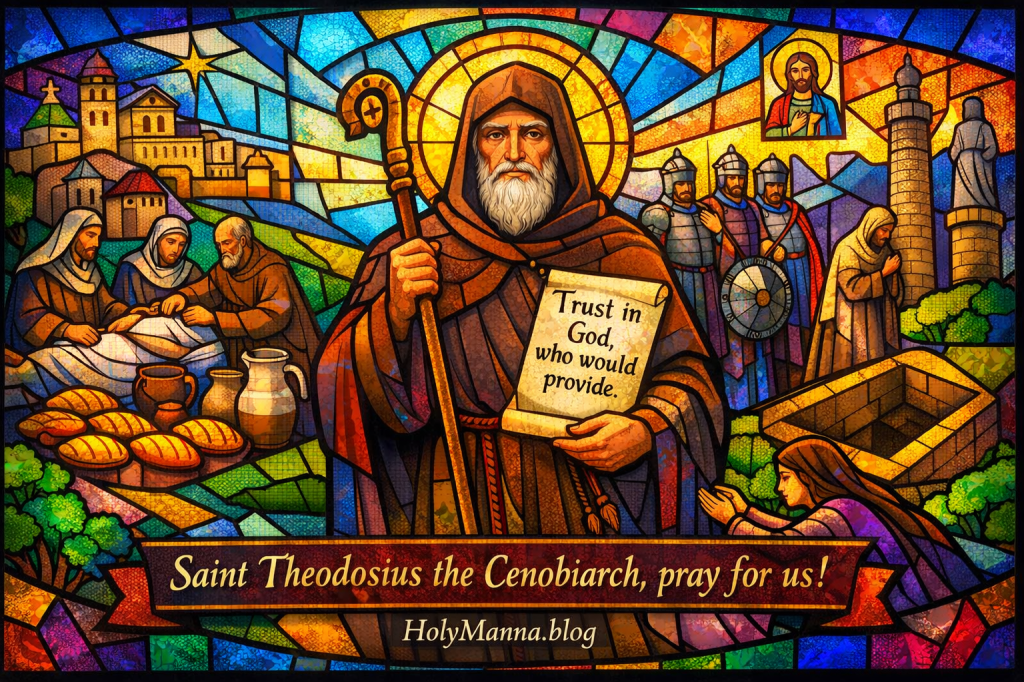
Theodosius did not set out to build an institution, but God brought souls to him anyway. Men began arriving who wanted to live under his guidance, and he formed them into a real community with prayer as the center and charity as the fruit. Catholic tradition describes his monastery becoming large and structured, and it was known for serious hospitality. There was care for pilgrims who arrived exhausted or poor, and there was organized support for the sick and the elderly. His holiness did not stay trapped in a cell, because it overflowed into mercy that looked like the corporal works of mercy in action, as taught in CCC 2447.
He also formed his monks with a blunt, fatherly realism about life and death. He had a grave prepared for the community, not to be dramatic, but to keep hearts awake. He challenged them with the kind of line that stays with a man all week: “The grave is made, who will first perform the dedication?” He wanted them to live like Catholics who actually believe eternity is real. This fits the Church’s steady teaching that death is the end of earthly pilgrimage and a summons to meet the Lord, as taught in CCC 1013.
His spirituality was not gloomy, but clear. Catholic tradition preserves another direct maxim from his formation of monks: “Continual remembrance of death is the foundation of religious perfection.” In a culture that avoids death talk, he teaches a healthier truth. Remembering death is not morbid when it leads to repentance, gratitude, and urgency to love well.
When God Multiplies Bread
The miracles associated with Theodosius highlight the way God often confirms a saint’s mission through mercy, not spectacle. During one Easter, the monastery reportedly lacked provisions and did not even have bread for the sacred offering. Theodosius refused panic and trained his monks to trust God’s providence, because fear is contagious and leaders must resist spreading it. He told them with calm confidence, “Trust in God, who would provide.” Soon after, Catholic tradition says that mules arrived unexpectedly, loaded with what was needed for the community.
Other accounts describe similar moments when crowds of guests arrived and supplies were low, yet the provisions were multiplied through his prayers so that people were fed. It is hard not to hear the Gospel echo, because Christ feeds the multitudes in The Gospel of Matthew 14:13 to 21. The point is not that a saint performs magic, but that God cares for His children and delights in strengthening faith through acts of mercy.
Catholic hagiography also tells of a striking healing. A woman suffering from what the source describes as a cancer was healed immediately after touching his garments. This again calls to mind the healing faith found in The Gospel of Mark 5:25 to 34, because saints do not replace Christ, they mirror Him. God sometimes allows their lives to reflect the Gospel in ways that wake people up and draw them back to repentance and trust.
Exiled for the Truth
Theodosius was not martyred by execution, but he carried the cross of a confessor, which is its own kind of martyrdom. His lifetime included fierce doctrinal conflict, especially pressures connected to errors about the person of Christ. These were not academic arguments, because they shaped whether people understood Jesus as fully God and fully man, which is at the heart of salvation itself.
When political pressure demanded compromise, he did not hide behind polite vagueness. Catholic sources describe him rejecting attempts to buy his silence, distributing offered money to the poor instead, because he refused to let injustice dress itself up as charity. When a heretical profession of faith was sent for him to sign, he answered with courage: “I am ready to lay down my life, rather than consent to an impious profession of faith.” That kind of backbone is not about being combative, but about loving Jesus enough to refuse lies about Him.
Catholic tradition also preserves his public defense of the great councils with words that sound severe to modern ears, but were meant to protect the faithful from confusion: “If any one receives not the four general councils as the four gospels, let him be anathema.” The point is not that councils replace Scripture, but that the Church defends Scripture’s true meaning when heresy twists it. Because of this firmness, Theodosius endured exile and suffering, and later returned to continue guiding his community into old age with patience and peace.
Graces That Continued
Saint Theodosius died around the year 529, after decades of fatherhood to his monks and mercy to pilgrims. Catholic sources speak of miracles connected to his burial and the continuing veneration of his memory, which reflects the Church’s conviction that the saints remain alive in Christ and continue to intercede for the faithful. The communion of saints is not sentimental language, because it is a real sharing in the life of Christ’s Body, where charity does not end at the grave.
A story preserved in Catholic hagiography tells of a military commander asking for his hair shirt as a relic and attributing victory to the saint’s intercession through that pledge. Whether a reader focuses on that detail or not, the Catholic instinct behind it is clear. God can grant help through the prayers of His saints, and the Church has long honored relics as tangible reminders of grace working in real bodies, in real history.
His monastery site near Bethlehem has remained part of Christian memory of the Holy Land. Places matter because the Incarnation happened in places, and the Church’s remembrance keeps the geography of salvation close to the heart. This memory also reminds believers that holiness is not abstract. Holiness is lived on real ground, in real hardship, with real neighbors.
Building a Monastic Spirit in Ordinary Life
Saint Theodosius is especially helpful for modern Catholics because he shows that holiness can be structured without becoming cold. He teaches that a life of prayer needs a rule, not because God is impressed by schedules, but because the human heart is easily scattered. He also proves that charity works best when it becomes concrete, organized, and consistent, especially when serving those who cannot repay it.
The Church praises consecrated life because it witnesses to the Kingdom and the evangelical counsels, as taught in CCC 914 to 933. Even so, the spirit behind his life can be lived by anyone who takes discipleship seriously. A home becomes more peaceful when prayer becomes regular, and a parish becomes healthier when truth is spoken clearly and mercy is offered generously. His remembrance of death is also a gift, because it cuts through excuses and invites confession, reconciliation, and a more intentional love.
When anxiety rises about money, time, or the future, his Easter miracle points back to the Father who knows what His children need. How would daily choices change if trust in providence became as real as the next bill or calendar reminder? Theodosius shows that trust is not passive, because it shows up in steady prayer, honest work, and open-handed mercy.
Engage with Us!
Share thoughts and reflections in the comments below, because saints are not meant to be admired from a distance. Saints are meant to be followed.
- Where has vanity crept into daily life, and what would it look like to flee it with humility like Saint Theodosius?
- What is one concrete work of mercy that can be practiced this week, in the spirit of his hospitality and care for the sick?
- How does remembering death, as the Church teaches in CCC 1013, change priorities and choices right now?
- What is one Catholic teaching that needs to be studied more seriously, so faith becomes steadier and less emotional?
- Where is God asking for deeper trust in providence, especially in times of scarcity or stress?
Keep walking forward in faith. Choose truth without fear, practice mercy without excuses, and do everything with the love and mercy Jesus taught us.
Saint Theodosius the Cenobiarch, pray for us!
Follow us on YouTube, Instagram and Facebook for more insights and reflections on living a faith-filled life.

 Holy Manna!
Leave a comment