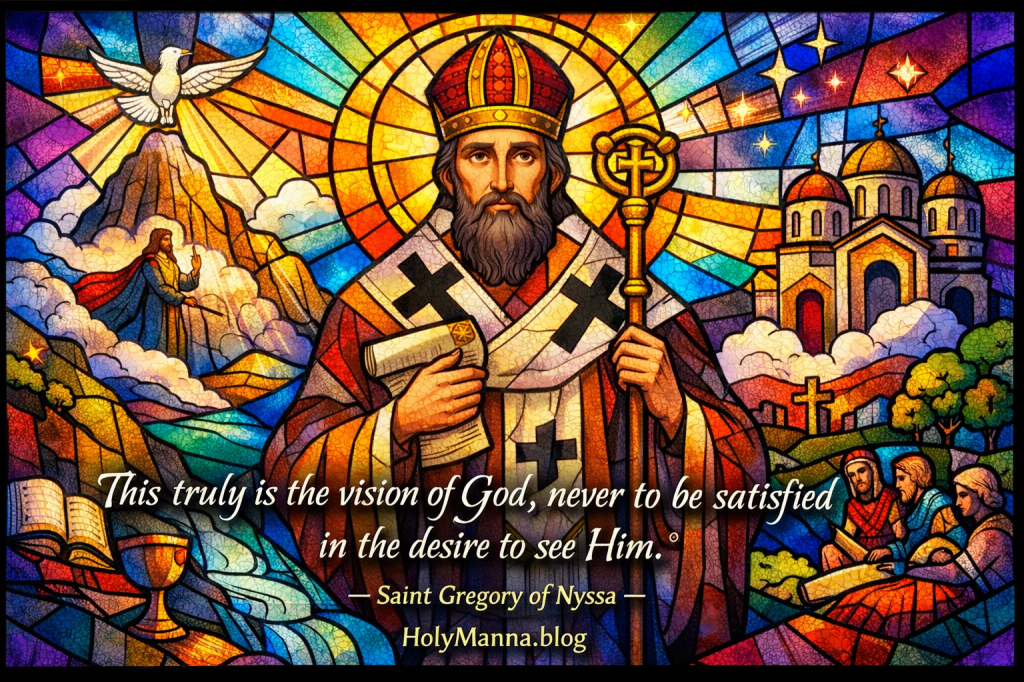
Climbing Into God’s Mystery Without Ever Stopping
Saint Gregory of Nyssa is one of those saints who wakes up a tired Catholic soul. He was a fourth century bishop and one of the great Cappadocian Fathers, remembered alongside Saint Basil the Great and Saint Gregory of Nazianzus. He lived when the Church was fighting for the truth about Jesus Christ against heresies like Arianism, which denied the full divinity of the Son. Gregory’s life mattered because he helped protect the Church’s confession that Jesus Christ is truly God, worthy of worship, and the only Savior of the world.
Gregory is revered not only because he defended doctrine, but because he showed what doctrine is for. Catholic teaching is never meant to be sterile information. It is meant to lead souls into holiness, prayer, and communion with God. He wrote with a depth that still forms the Church, especially in his vision of the spiritual life as a steady ascent toward God that never runs out of meaning. This fits beautifully with the Church’s teaching that salvation draws the baptized into God’s own life and makes them “partakers of the divine nature,” as taught in CCC 460.
A Saintly Household
Gregory was born in Cappadocia in Asia Minor in the fourth century, and he grew up in a Christian family known for extraordinary holiness. Several of his relatives are honored as saints, especially his brother Saint Basil the Great and his sister Saint Macrina the Younger. That kind of household does not form shallow disciples. It forms people who know that prayer is real, that truth matters, and that virtue is worth suffering for.
Even with that upbringing, Gregory’s path did not look instantly heroic. He was highly educated and trained in rhetoric, a respected profession in the ancient world. Catholic tradition also preserves that he likely lived a married life before fully entering episcopal service. That detail matters because it reminds ordinary Catholics that sanctity is not reserved for one background or one personality type. God calls people from different places and sanctifies them through surrender, patience, and obedience.
Over time, Gregory’s faith deepened and his gifts were redirected toward the Church. Under the influence of his family and the urgent needs of the Church during a doctrinal crisis, he accepted the call to become Bishop of Nyssa. It was not a glamorous assignment, and it came with real conflict. God often calls saints into difficult places because that is where grace becomes visible and where the heart becomes purified.
A Life That Taught the Soul to Grow
As Bishop of Nyssa, Gregory became a strong voice for Catholic truth, especially in the defense of the Nicene faith. The Church rejected Arianism because if Jesus is not truly God, then salvation collapses into wishful thinking. Gregory’s theological work helped guard the truth that the Son is consubstantial with the Father, fully divine, and the center of the Church’s worship and preaching. He also helped shape the Church’s spiritual imagination, teaching that the Christian life is not about winning arguments but about becoming holy.
Gregory’s mystical and spiritual teaching is especially powerful in his work Life of Moses. He presents Moses not only as a figure of the Old Testament, but as a living image of the Christian journey. Moses climbs the mountain, and the soul climbs toward God. Moses enters the cloud of mystery, and the soul learns reverent humility before the greatness of God. Gregory insists that as the soul grows, it begins to understand that God is always greater than what the mind can contain. That truth is not meant to frustrate anyone. It is meant to lead to adoration, trust, and deeper prayer.
Gregory’s best known spiritual theme is that holiness never stops growing. The soul can always love more, repent more deeply, and receive more of God’s life. He expresses that with a line that still hits hard: “The one limit of virtue is the absence of a limit.” He also teaches that God cannot be reduced to a concept or controlled by the intellect, which is why he can say something that sounds paradoxical but is deeply Catholic: “The true knowledge and the true vision of what we seek consists in not seeing.” This is the humility of worship. The mind does not stop working, but it stops pretending it can measure the infinite God.
Roman Catholic sources do not preserve a clear set of public miracles performed by Gregory during his lifetime in the way some saints are known for healings or extraordinary signs. His witness is remembered primarily through his fidelity as a bishop, his endurance under persecution, and the lasting fruit of his teaching. That is an important reminder that God’s power is often shown through steady faithfulness rather than dramatic moments.
Exile for the Truth
Gregory’s loyalty to Catholic truth came with a cost. During the political turmoil of his time, he was accused by opponents, arrested, and eventually removed from his see. He endured the humiliation of deposition and the pain of exile, which meant separation from his people and uncertainty about his future. This was not a symbolic persecution. It involved real danger and real suffering, and it tested whether faith was rooted in comfort or in Christ.
He endured these hardships without abandoning the faith. When the political climate changed, he returned to his diocese and was welcomed back. Gregory was not martyred in the strict sense, but he lived a kind of white martyrdom, the long obedience of suffering for truth. His story echoes the Church’s teaching that discipleship includes the Cross, and that the Christian learns to carry suffering with patience, trusting that God does not waste it.
Suffering also purified Gregory’s mission. He did not return hungry for revenge. He returned ready to shepherd, teach, and strengthen the Church. Saints often become calmer and more compassionate after suffering, because hardship either hardens a heart or makes it more like Jesus. Gregory chose the path of Christ.
A Legacy That Still Converts Hearts
Roman Catholic sources do not commonly highlight a large catalogue of posthumous miracles associated with Saint Gregory of Nyssa’s relics or a single famous pilgrimage site that defines his devotion. His veneration is real and longstanding, but the Church mainly honors him for the ongoing power of his life and teaching. In a very real sense, the lasting fruit of his doctrine and spiritual wisdom is a continuing grace for the Church.
His writings keep forming Catholics who want a serious spiritual life without pride or confusion. He teaches that desire for God is not meant to be shut down, but purified and aimed rightly. In Life of Moses, he captures that holy hunger with a line that speaks straight to the heart: “This truly is the vision of God, never to be satisfied in the desire to see Him.” This is not restless consumerism. This is the joy of love that keeps growing because God is infinite.
Gregory also teaches that the goal is not to collect facts about God, but to become a dwelling place for Him. That is why he can say with startling clarity: “It is not a question of knowing something about God but of having God within.” That line exposes a lot of modern Catholic weakness, where people can talk about theology but do not pray, do not repent, and do not actually let Christ reign in the heart.
Keep Moving Toward Christ
Saint Gregory of Nyssa is a perfect saint for anyone who feels spiritually stuck. He teaches that holiness is not a mood. Holiness is a direction, and that direction is always deeper communion with Jesus Christ. A Catholic who wants to grow does not wait for motivation. A Catholic builds a life that makes room for grace through prayer, repentance, and sacramental fidelity. The sacraments are not religious decorations. They are encounters with Christ and channels of divine life, as the Church teaches throughout The Catechism.
Gregory also helps Catholics keep humility about God. One trap is turning faith into raw emotion and confusing spiritual feelings with spiritual maturity. Another trap is turning faith into clever explanations and using knowledge as a substitute for conversion. Gregory teaches a better path. The mind serves the truth, the will chooses obedience, and the heart learns adoration. True spiritual growth produces humility, purity, and love of neighbor, not spiritual performance.
His teaching on endless growth also gives a balanced approach to the fight against sin. No Catholic should accept sin as normal, but no Catholic should despair when progress feels slow. The Christian life is a steady return to Christ, with confession, penance, prayer, and renewed discipline. Gregory’s vision helps Catholics keep going without getting complacent and without getting crushed by discouragement.
Finally, Gregory calls Catholics to see Christ in people, especially the poor. He refused to treat charity as a trend or a talking point. He treated it as obedience to Christ. He warned believers not to look down on the poor because of who they represent: “Do not despise them. They represent the Person of the Saviour.” That is the heartbeat of the Gospel and the Church’s teaching on the dignity of every human person.
Engage with Us!
Share thoughts and reflections in the comments below. What stands out most from Saint Gregory’s life and teaching?
- Where has the spiritual life started to feel finished or stalled, and what would it look like to pursue holiness again with patience and seriousness?
- How can prayer become more consistent and more humble, especially when pride, anger, or distraction starts running the day?
- Who are the poor in daily life, and what would change if they were treated as people who represent the Person of the Saviour?
- What is one thought, one word, or one habit that has been drifting away from Christ, and what is one concrete step that can bring it back into alignment?
Keep walking forward in faith with patience and courage. Keep praying, keep repenting, keep loving, and keep doing everything with the love and mercy Jesus taught us.
Saint Gregory of Nyssa, pray for us!
Follow us on YouTube, Instagram and Facebook for more insights and reflections on living a faith-filled life.

 Holy Manna!
Leave a comment