Saturday after Epiphany – Lectionary: 217
Let the Bridegroom Take Center Stage
Sometimes the spiritual life gets noisy, like everything is competing for attention at the same time. That is exactly why today’s readings feel so steady and so needed. They all point to one central theme: Christ the Bridegroom must increase, and every rival in the heart must decrease. That is the thread running through 1 John 5:14-21, Psalm 149, and The Gospel of John 3:22-30. The Church is being taught how to live after Epiphany, in the bright light of Christ’s revelation, when the question is no longer whether Jesus has come, but whether life is going to be arranged around Him.
The first reading from 1 John 5:14-21 speaks like a spiritual father closing a letter with urgency and tenderness. There is confidence in prayer, but it is not confidence in personal control. It is confidence that God hears when His children ask according to His will, and that love does not look away when a brother falls. John is also brutally clear about the battlefield. The world is under the power of the evil one, sin is real, and idols are not imaginary. That last line lands like a final warning from someone who knows how easily the heart drifts: “Children, be on your guard against idols.” It is a call to discernment, because the biggest threats are often the ones that look normal.
Then Psalm 149 answers with the Church’s proper posture in that battlefield. The faithful do not survive by anxiety or by obsessing over darkness. They survive by praise. The psalm is loud with worship, full of music and joy, because God takes delight in His people and lifts up the poor. Even the sharp imagery of a sword serves this larger truth. Worship is not a hobby for calm days. Praise is how the faithful stay loyal when temptation tries to rename idols as “needs” and when the world insists that power belongs to the loudest voice.
Finally, The Gospel of John 3:22-30 gives the human face of this whole message in John the Baptist. His disciples feel threatened because everyone is going to Jesus, and John responds with peace. He knows that everything is received from heaven, not seized by ego. He calls Jesus the Bridegroom and calls himself the friend who rejoices to hear the Bridegroom’s voice. Then he gives one of the cleanest lines in the entire Gospel for spiritual maturity: “He must increase; I must decrease.” That is the freedom of a man who has no idol of self to protect.
This is what today offers as a single invitation. Let prayer become more obedient, not more demanding. Let worship become more joyful, not more distracted. Let Christ become more central, not just one more item on a crowded shelf. What would actually change in daily life if the heart really believed that Jesus must increase, and everything else must take its proper place?
First Reading – 1 John 5:14-21
Holiness that does not play around
1 John is written to Catholics who were being shaken by confusion about Jesus and by moral compromise. Some voices were trying to make faith “spiritual” while disconnecting it from obedience, repentance, and real communion with the Church. So, Saint John speaks like a spiritual father who loves his people enough to be blunt. Today’s theme is all over this reading: true faith brings humble confidence before God, real protection from the Evil One, and a clean break with idols. This is exactly the posture of John the Baptist in the Gospel, and it is the kind of praise Psalm 149 is talking about, worship that is joyful, loyal, and ready to fight for what is true.
1 John 5:14-21 – New American Bible (Revised Edition)
14 And we have this confidence in him, that if we ask anything according to his will, he hears us. 15 And if we know that he hears us in regard to whatever we ask, we know that what we have asked him for is ours. 16 If anyone sees his brother sinning, if the sin is not deadly, he should pray to God and he will give him life. This is only for those whose sin is not deadly. There is such a thing as deadly sin, about which I do not say that you should pray. 17 All wrongdoing is sin, but there is sin that is not deadly.
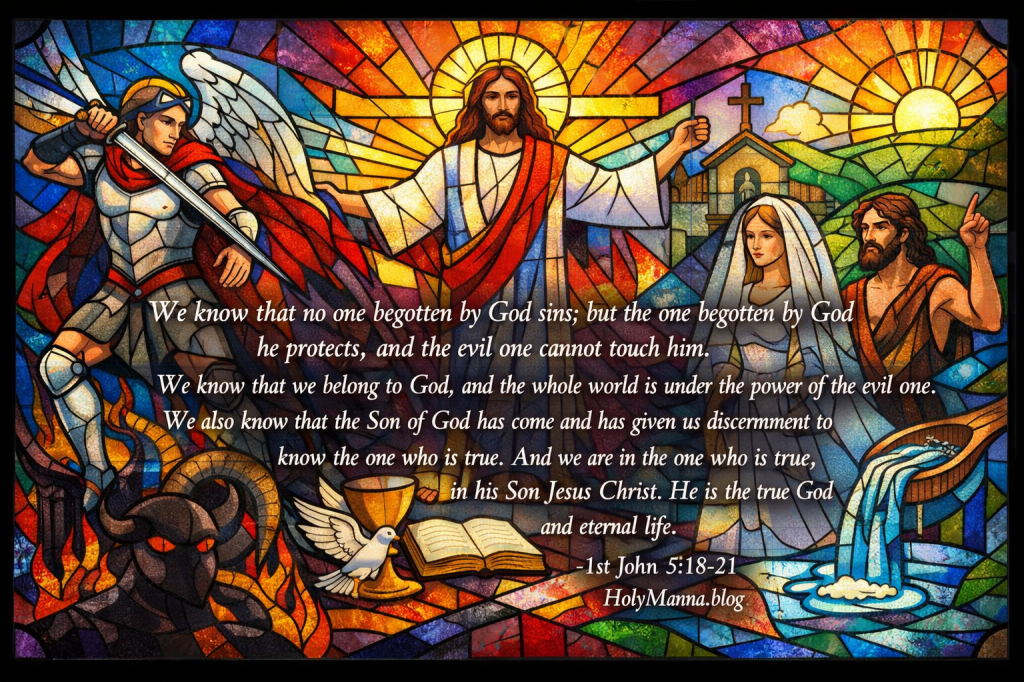
18 We know that no one begotten by God sins; but the one begotten by God he protects, and the evil one cannot touch him. 19 We know that we belong to God, and the whole world is under the power of the evil one. 20 We also know that the Son of God has come and has given us discernment to know the one who is true. And we are in the one who is true, in his Son Jesus Christ. He is the true God and eternal life. 21 Children, be on your guard against idols.
Detailed Exegesis
Verse 14 – And we have this confidence in him, that if we ask anything according to his will, he hears us.
This is not “manifesting,” and it is not treating God like a vending machine. Christian prayer is bold because God is Father, but it is also obedient because God is God. The key phrase is according to his will. The holiest prayers are not the loudest. They are the ones that keep saying, “Father, whatever brings me closer to You.”
Verse 15 – And if we know that he hears us in regard to whatever we ask, we know that what we have asked him for is ours.
John is not promising that every specific request will happen exactly as imagined. He is promising something deeper: if a person asks in union with God’s will, God truly answers. Sometimes the “yes” is the grace to endure, the strength to repent, or the courage to forgive. That answer is not smaller than the original request. It is usually better.
Verse 16 – If anyone sees his brother sinning, if the sin is not deadly, he should pray to God and he will give him life. This is only for those whose sin is not deadly. There is such a thing as deadly sin, about which I do not say that you should pray.
John brings prayer down to earth. Faith is not private. When a Christian sees another Christian falling, the first move is not gossip, shaming, or spiritual superiority. The first move is intercession. John also introduces the reality of deadly sin, which the Church has traditionally connected to what is later called mortal sin. John’s wording about not praying is not a ban on praying for hardened sinners. The Church always prays for the conversion of sinners. John is warning that some sin is so grave and so chosen that it leads toward spiritual death unless there is real repentance. Prayer must be paired with a real return to God.
Verse 17 – All wrongdoing is sin, but there is sin that is not deadly.
This protects Catholics from two opposite errors. One error says, “Sin is not a big deal.” The other error says, “Every sin means God is done with you.” John refuses both. All sin is ugly because it wounds love. But not every sin kills the life of grace in the soul. This is why the Church speaks carefully about mortal and venial sin.
Verse 18 – We know that no one begotten by God sins; but the one begotten by God he protects, and the evil one cannot touch him.
John is not claiming Christians never commit a sin. Earlier in the letter he says plainly that anyone who claims to be without sin is deceived. Here he means that a person truly reborn in God does not remain settled in sin as a lifestyle. Grace changes a person’s direction. John also says protection is real. The phrase the one begotten by God he protects points to Christ guarding the baptized, so the Evil One cannot lay claim to a soul that remains in Christ.
Verse 19 – We know that we belong to God, and the whole world is under the power of the evil one.
This is sobering, and it is meant to be. John is not saying creation is evil. He is saying the “world” as a system opposed to God is under a dark influence. There is a real spiritual battle. Christians cannot be naïve. A Catholic life has joy, but it also has vigilance.
Verse 20 – We also know that the Son of God has come and has given us discernment to know the one who is true. And we are in the one who is true, in his Son Jesus Christ. He is the true God and eternal life.
This is one of John’s clearest declarations about who Jesus is. Jesus does not only teach truth. Jesus brings people into the Truth because He is divine. The goal is not spiritual information. The goal is communion: we are in the one who is true. Discernment is a gift, but it is not just a feeling. It is the light to recognize Jesus as Lord, to recognize lies as lies, and to recognize idols even when they look respectable.
Verse 21 – Children, be on your guard against idols.
John ends with a spiritual alarm bell. After all the talk about prayer, sin, protection, and truth, he lands here because idols are the quiet doorway into disaster. An idol is anything that takes God’s place, even if it started as a good thing. John calls believers children because this is family talk. A loving father warns his kids when danger is nearby.
Teachings
Christian prayer is confident, but it is never entitled. The Church teaches that God is not manipulated, yet He truly invites His children to ask. The Catechism describes this humble freedom when it says, “Our Father knows what we need before we ask him, but he awaits our petition because the dignity of his children lies in their freedom.” CCC 2736. This fits John perfectly: ask boldly, but ask as a child who wants the Father’s will more than a personal agenda.
John’s command to pray for a brother who sins is pure Catholic instinct. Intercession is part of love. The Church says, “Intercession is a prayer of petition which leads us to pray as Jesus did.” CCC 2634. This is why Catholics pray for the living and the dead, why they offer Mass intentions, why they fast for someone’s conversion, and why they keep praying even when a person looks stuck.
John’s distinction between deadly and non-deadly sin lines up with the Church’s clarity about mortal and venial sin. The Catechism defines sin honestly: “Sin is an offense against reason, truth, and right conscience; it is failure in genuine love for God and neighbor.” CCC 1849. Then it explains why some sin is “deadly” in its effects: “Mortal sin requires full knowledge and complete consent.” CCC 1859. At the same time, the Church recognizes a real difference in gravity and culpability: “One commits venial sin when, in a less serious matter, he does not observe the standard prescribed by the moral law… or… without full knowledge or without complete consent.” CCC 1862. This matters because it protects souls from despair, and it also protects them from excuses.
John’s realism about the Evil One is also very Catholic. Spiritual warfare is not a movie theme. It is a daily reality. The Church is just as direct when it teaches, “In this petition, evil is not an abstraction, but refers to a person, Satan, the Evil One, the angel who opposes God.” CCC 2851. John’s promise that the evil one cannot touch him is not magic protection. It is the fruit of living in Christ through grace, prayer, and the sacraments.
Finally, John’s closing warning about idols lands like a last punch because it is a permanent temptation. The Church says it plainly: “Idolatry consists in divinizing what is not God.” CCC 2113. John is not only warning against pagan statues. He is warning against modern idols that blend in, like money, pleasure, status, political rage, control, and constant entertainment. Anything can become an idol if it becomes non-negotiable.
Reflection
A good Catholic life is not complicated, but it is serious. It starts with real prayer that aims at God’s will, not just personal comfort. A simple practice is to add one sentence to every petition: “If this draws the soul closer to You, let it be done.” That one habit turns prayer into discipleship.
This reading also invites a more mature way of dealing with other people’s sins. When someone falls, the first response should be hidden intercession. A decade of damage can start to heal because a friend quietly prays and offers a small sacrifice. That is not weakness. That is spiritual strength.
It also calls for honesty about sin. When a conscience is numb, everything feels “not that bad.” When a conscience is scrupulous, everything feels like mortal sin. John steadies both extremes. Confession should be normal, not dramatic. Repentance should be quick, not delayed. Grace should be guarded like treasure, not treated like a casual accessory.
Is prayer becoming more aligned with God’s will, or is it mostly a list of demands?
When someone else falls, does the heart turn first to intercession, or to commentary?
What is the one thing that tends to compete with God for loyalty, time, or emotional energy?
John’s last line is simple and strong for a reason. Guard the heart from idols, stay close to Christ, and the Evil One loses his grip. That is how the Son increases in a life, and everything false starts to decrease.
Responsorial Psalm – Psalm 149:1-6, 9
Praise that wakes the soul up
Psalm 149 comes from Israel’s worship life, where God’s people learned to remember who they were by singing together. It is one of the great Hallelujah psalms, meant to be sung in community, not muttered in isolation. By the time Jesus walked the earth, psalms like this had formed generations of believers to praise the Lord as King, not only when life felt easy, but especially when the world around them tempted them to fear, compromise, or forget. That fits perfectly with today’s theme. If Christ the Bridegroom must increase, then the heart has to be trained to rejoice in Him more than it rejoices in attention, control, comfort, or applause. This psalm shows what that training looks like: worship that is joyful, loyal, and spiritually alert.
Psalm 149:1-6, 9 – New American Bible (Revised Edition)
Praise God with Song and Sword
1 Hallelujah!
Sing to the Lord a new song,
his praise in the assembly of the faithful.
2 Let Israel be glad in its maker,
the people of Zion rejoice in their king.
3 Let them praise his name in dance,
make music with tambourine and lyre.
4 For the Lord takes delight in his people,
honors the poor with victory.
5 Let the faithful rejoice in their glory,
cry out for joy on their couches,
6 With the praise of God in their mouths,
and a two-edged sword in their hands,9 To execute the judgments decreed for them—
such is the glory of all God’s faithful.
Hallelujah!
Detailed Exegesis
Verse 1 – Hallelujah! Sing to the Lord a new song, his praise in the assembly of the faithful.
The psalm opens with worship, not with analysis. “New song” does not mean chasing novelty for its own sake. It means responding to God’s living deeds with a renewed heart. The key is the setting: the assembly of the faithful. Praise is not only personal devotion. It is the people of God, together, confessing that the Lord is worthy.
Verse 2 – Let Israel be glad in its maker, the people of Zion rejoice in their king.
Israel praises God as Maker and King. That is a direct challenge to idolatry, because idols cannot create and idols cannot save. Rejoicing in the King is not escapism. It is a public declaration that ultimate authority belongs to God, not to the world’s powers, and not to the shifting moods of the crowd.
Verse 3 – Let them praise his name in dance, make music with tambourine and lyre.
This verse gives permission for whole person worship. Faith is not only ideas in the head. It is love expressed through the body, voice, and art. When praise is sincere, it spills into celebration. That is not childish. That is biblical.
Verse 4 – For the Lord takes delight in his people, honors the poor with victory.
This is one of the most comforting lines in the psalm. God does not merely tolerate His people. He delights in them. He also honors the poor, which means the humble, the lowly, and the ones who know they need Him. God’s “victory” often looks like perseverance, conversion, and hope that refuses to die.
Verse 5 – Let the faithful rejoice in their glory, cry out for joy on their couches.
This is joy that follows people home. It is not just liturgy on a schedule. It is the faithful resting in the Lord’s goodness, carrying praise into ordinary places. Even in weakness, fatigue, or quiet evenings, there is still room to cry out for joy.
Verse 6 – With the praise of God in their mouths, and a two edged sword in their hands,
Praise and sword belong together here, which can sound surprising until it is read spiritually. The “sword” points to battle, but for the faithful it begins with worship. When the mouth is full of praise, the heart is less available to temptation. In Christian light, this also echoes the truth that the Word of God cuts through lies and exposes idols. Praise is not soft. Praise is strength.
Verse 9 – To execute the judgments decreed for them, such is the glory of all God’s faithful. Hallelujah!
This verse is about God’s justice, not personal revenge. The faithful do not seize judgment as if it belongs to them. They stand with God’s truth and trust God’s righteous order. The glory of the faithful is not domination. The glory of the faithful is belonging to the Lord and living in His light.
Teachings
The Church has always understood the psalms as a school of prayer. They teach Catholics how to speak to God with honesty, reverence, joy, and steadfastness. Praise is not a bonus prayer for good moods. Praise is the prayer that restores perspective, because it puts God back in the center. The Catechism says, “Praise is the form of prayer which recognizes most immediately that God is God.” CCC 2639. That is exactly what Psalm 149 does. It makes the soul say, “God is God,” before the day tries to say, “This problem is god,” or “This desire is god,” or “This approval is god.”
This psalm also shows that worship is not merely private. God is praised in the assembly because salvation creates a people, not just individuals. The Church teaches that adoration and worship belong to the virtue of religion, and that it is right to offer God public honor. The Catechism puts it plainly: “To adore God is to acknowledge him as God, as the Creator and Savior.” CCC 2096. When the Church sings and prays together, it is not performing. It is witnessing.
The strong imagery of the “two edged sword” has also been received carefully in Catholic tradition. The faithful are never being told to baptize anger or spiritualize cruelty. The New Testament constantly redirects the battle toward the interior life and toward spiritual weapons. Prayer itself is described as conflict against distraction and discouragement. The Catechism says, “Prayer is a battle.” CCC 2725. That short line explains a lot. Some days the most real warfare is refusing to give in to bitterness, lust, despair, or vanity. Praise becomes part of that battle because it breaks the spell of idols. It trains the heart to rejoice in God’s voice more than it rejoices in the world’s noise.
Saint Augustine loved this “new song” theme because it points to a converted life. He taught that the new song belongs to the new man, meaning the person made new in Christ. It is not about new lyrics. It is about a renewed heart that can finally sing without pretending.
Reflection
This psalm is a practical medicine for modern life because modern life is full of subtle idols. A person can wake up and immediately start serving the idol of urgency, the idol of image, or the idol of constant stimulation. Psalm 149 offers a different start: praise first. Praise does not deny problems. Praise simply refuses to let problems take the throne.
A simple step is to practice one deliberate act of praise each day that costs something small. It could be praying a psalm before checking a phone. It could be singing a hymn in the car even when the mood feels flat. It could be thanking God out loud for one mercy when the day feels unfair. These small acts train the soul to give Christ more space to increase.
The “sword” image is also worth taking seriously in a personal way. It invites discipline. The faithful person learns to cut off what feeds sin and to defend what feeds grace. That can mean setting clearer boundaries, choosing confession sooner, guarding what gets watched, and rejecting the kind of entertainment that makes idols feel normal.
What usually fills the mouth first each day, praise or complaint?
What would change in the home if worship became the first response instead of anxiety?
Which “idol” loses power when the heart deliberately praises God, even when it does not feel convenient?
When praise becomes steady, Christ increases quietly and powerfully. That is the kind of spiritual strength that carries joy into ordinary life and keeps the faithful standing when the world pushes in the opposite direction.
Holy Gospel – John 3:22-30
Real holiness is joyful humility
In the world of first century Judea, water was not only practical, but it was also deeply religious. Ritual washings were part of Jewish life, and the prophets had long used water as an image of purification and conversion. John the Baptist steps into that world as the final prophet before the Messiah, calling Israel to repentance and preparing hearts for the coming Kingdom. Now Jesus is publicly present, gathering disciples, and the crowds begin moving toward Him. That shift creates tension, because whenever God starts doing something new, the temptation is to make it a competition. This Gospel passage fits perfectly with today’s theme because it shows what it looks like when Christ increases and the ego decreases. John does not cling to influence. John rejoices that the Bridegroom has arrived, and that joy becomes a model for every Catholic who wants to guard the heart against idols and live in the truth.
John 3:22-30 – New American Bible (Revised Edition)
Final Witness of the Baptist. 22 After this, Jesus and his disciples went into the region of Judea, where he spent some time with them baptizing. 23 John was also baptizing in Aenon near Salim, because there was an abundance of water there, and people came to be baptized, 24 for John had not yet been imprisoned. 25 Now a dispute arose between the disciples of John and a Jew about ceremonial washings. 26 So they came to John and said to him, “Rabbi, the one who was with you across the Jordan, to whom you testified, here he is baptizing and everyone is coming to him.” 27 John answered and said, “No one can receive anything except what has been given him from heaven. 28 You yourselves can testify that I said [that] I am not the Messiah, but that I was sent before him. 29 The one who has the bride is the bridegroom; the best man, who stands and listens to him, rejoices greatly at the bridegroom’s voice. So this joy of mine has been made complete. 30 He must increase; I must decrease.”
Detailed Exegesis
Verse 22 – After this, Jesus and his disciples went into the region of Judea, where he spent some time with them baptizing.
The Lord is not a distant teacher. He walks with His disciples, forms them, and draws people into a life of conversion. The word “baptizing” here also points to the Lord’s mission moving into public view. The heart of the verse is presence and formation. Jesus spends time with His disciples, and ministry flows out of relationship, not performance.
Verse 23 – John was also baptizing in Aenon near Salim, because there was an abundance of water there, and people came to be baptized.
John continues his preparatory mission. The mention of abundant water grounds this in real geography and real crowds, not mythology. Spiritually, it also reminds readers that grace meets people in concrete places and ordinary signs. God uses water, voices, and real human witnesses to draw souls toward repentance.
Verse 24 – For John had not yet been imprisoned.
This line quietly signals that the clock is moving toward persecution. John’s witness will cost him. That matters because it shows that humility is not weakness. John’s willingness to decrease is not merely a personality trait. It is a costly obedience that will eventually lead to martyr-like suffering.
Verse 25 – Now a dispute arose between the disciples of John and a Jew about ceremonial washings.
This is a cultural flashpoint. Jews were familiar with ritual purifications, and questions about water were often questions about holiness, authority, and identity. The dispute also shows how easily religious practice can become an argument instead of a path to God. When people obsess over status and comparison, even sacred things get twisted into rivalry.
Verse 26 – So they came to John and said to him, “Rabbi, the one who was with you across the Jordan, to whom you testified, here he is baptizing and everyone is coming to him.”
John’s disciples are feeling threatened. They measure success by crowd size, and they treat Jesus as a competitor rather than the fulfillment of everything John preached. This is a familiar temptation. Even good religious work can become an idol when someone starts needing to be noticed, needed, or in control.
Verse 27 – John answered and said, “No one can receive anything except what has been given him from heaven.”
John resets the entire conversation. Gifts, influence, and fruitfulness are received, not seized. That one sentence destroys envy, pride, and insecurity in a single move. It also teaches a Catholic view of vocation. Each person receives a mission from God, and peace comes from fidelity to that mission, not from comparing it to someone else’s.
Verse 28 – You yourselves can testify that I said that I am not the Messiah, but that I was sent before him.
John reminds them of his identity. He is not the Savior. He is the precursor. This is spiritual clarity, and it is lifesaving. A person who forgets this starts living like a messiah, taking on burdens that belong to Christ and craving praise that belongs to God.
Verse 29 – The one who has the bride is the bridegroom; the best man, who stands and listens to him, rejoices greatly at the bridegroom’s voice. So this joy of mine has been made complete.
The wedding image is richly Jewish and deeply theological. The “best man” is the friend who prepares the way, protects the joy of the bridegroom, and then steps back. John’s joy is complete because his entire mission was to bring others to Christ. This is what pure ministry looks like: joy that comes from hearing Christ’s voice and seeing people drawn to Him, not from being the main character.
Verse 30 – He must increase; I must decrease.
This is the signature line of Christian humility. John does not say, “It would be nice if He increased.” He says, “He must.” This is not self-hatred. This is truth. When Jesus increases in a soul, everything becomes more ordered, more free, and more joyful. When the ego increases, idols multiply and peace disappears.
Teachings
The Church sees John the Baptist as the immediate forerunner of Christ, sent to prepare the Bride for the Bridegroom. The Catechism teaches, “St. John the Baptist is the Lord’s immediate precursor or forerunner, sent to prepare his way. ‘Prophet of the Most High,’ John surpasses all the prophets, of whom he is the last.” CCC 523. That explains why this Gospel is not just an inspiring story. It is part of salvation history. John stands at the hinge of the Old and New Covenants, and his humility becomes the doorway through which the Messiah is recognized.
John’s identity as the friend of the Bridegroom also points to the Church’s understanding of Christ’s relationship with His people. The Church speaks of herself as the Bride, and Christ as the Bridegroom, because salvation is not a contract. Salvation is communion. The Catechism puts this covenant love into one clear line when it says, “The Church is the Bride of Christ.” CCC 796. John’s joy makes sense only when faith is understood as a living relationship, not a religious hobby.
The Gospel also teaches something essential about grace and vocation. John’s line about receiving from heaven protects Catholics from envy and ambition. Everything is gift. The Catechism speaks with the same spirit about grace when it says, “Grace is first and foremost the gift of the Spirit who justifies and sanctifies us.” CCC 2003. A person does not earn a calling by forcing doors open. A person receives a mission, and then cooperates with grace through obedience.
The saints love this passage because it shows that humility is the secret to joy. Saint Augustine, preaching on this exact line, captures the heart of it with a kind of holy bluntness: “He must increase, but I must decrease. This is said because Christ is God, and man is man.” St. Augustine, Tractates on the Gospel of John. Augustine is not belittling humanity. He is protecting it. A soul becomes free when it stops trying to play God.
Saint John Chrysostom also reads John’s response as pastoral wisdom, because John refuses to stir up division and refuses to let his disciples turn religion into jealousy. He praises John’s restraint and his focus on pointing to Christ rather than defending himself. That is a timeless warning for Church life, because rivalry can sneak even into sacred service.
Reflection
This Gospel is medicine for anyone who feels pressure to prove something, win something, or be seen. John the Baptist shows a different kind of strength. He knows his role, he rejoices in Christ’s success, and he refuses to measure his worth by crowd size or attention. That is exactly how idols lose their power. When Christ increases, the idol of image shrinks. When Christ increases, the idol of control weakens. When Christ increases, the idol of applause becomes embarrassing.
A practical step is to practice one hidden act of humility each day. It could be letting someone else receive credit without correcting the record. It could be rejoicing when a friend is praised. It could be choosing silence instead of the urge to be recognized. Those small choices train the heart to say with John, not only with words but with a life, “He must increase; I must decrease.”
This Gospel also invites a shift in how success is defined. The friend of the Bridegroom is fulfilled by hearing the Bridegroom’s voice. That means joy does not have to be postponed until life is perfect. Joy becomes available the moment the heart stops competing and starts listening for Christ.
Where does jealousy or comparison show up most easily, even in religious things?
What would change if every talent and opportunity were received as a gift from heaven instead of a possession to defend?
What is one concrete way to help Christ increase this week through prayer, confession, and a quieter ego?
John’s final line is simple enough to memorize, but it is also strong enough to reshape a life. When it becomes real, Christ’s light gets brighter, and the soul finally breathes like it was meant to.
Let Jesus Increase
Today’s readings land like a clean reset for the soul. They all say the same thing in different ways: Christ is not one option among many. Christ is the true God, the Bridegroom, and eternal life, so the heart has to stop negotiating with idols and start living like it belongs to Him.
In 1 John 5:14-21, there is a mature confidence that does not pretend sin is harmless. Prayer becomes bold because it is anchored in God’s will, not personal control. Love becomes real because it intercedes for a brother who is falling instead of turning him into a story. Discernment becomes essential because the world is not neutral, and John ends with a father’s warning that still fits modern life perfectly: “Children, be on your guard against idols.” When Christ increases, idols lose their grip.
Then Psalm 149 shows what that looks like in the Church’s lungs and voice. The faithful praise the Lord as King with joy, music, and a heart that remembers who God is. This is worship that refuses to be embarrassed about God and refuses to let fear take the throne. Even the strong imagery of a sword points to the truth that praise is not decoration. Praise is a spiritual weapon because it breaks the spell of the world and reorders the heart under God’s authority.
Finally, The Gospel of John 3:22-30 gives the human model in John the Baptist. His disciples want rivalry, but John chooses joy. He receives his mission from heaven, remembers he is not the Messiah, and delights to hear the Bridegroom’s voice. His line is not a slogan. It is a rule of life: “He must increase; I must decrease.” That is what it looks like when a heart is guarded from idols and anchored in truth.
The invitation is simple and strong. Pray with confidence, but keep prayer obedient to God’s will. Praise God with joy, especially when the mood is not cooperating. Practice humility that rejoices when Jesus gets the spotlight. Make a concrete choice today that helps Christ increase, like going to confession, setting a boundary against a habitual sin, praying for someone who is struggling, or turning off the noise long enough to hear the Bridegroom’s voice.
What would actually change in daily life if Jesus stopped being one important part and became the center that orders everything else?
Engage with Us!
Share reflections in the comments below. Hearing how God is speaking through these readings helps everyone grow in faith.
- 1st Letter of John 5:14-21: Where is prayer being shaped by God’s will, and where is it still being shaped by personal control? What “idol” most often competes for the heart’s loyalty, and what concrete step can be taken to guard against it today?
- Psalm 149:1-6, 9: What would change in daily life if praise became the first response instead of complaint or anxiety? How can worship become a real spiritual weapon against temptation this week?
- The Gospel of John 3:22-30: Where does comparison or jealousy show up, even in good religious efforts? What is one practical way to live John the Baptist’s words, “He must increase; I must decrease.” today?
Keep walking forward with faith. Choose prayer, praise, humility, and mercy, and do everything with the love Jesus teaches, because that is how a life becomes steady, joyful, and truly Catholic.
Sacred Heart of Jesus, we trust in You!
Immaculate Heart of Mary, pray for us!
Saint Michael the Archangel, defend us in battle!
Follow us on YouTube, Instagram and Facebook for more insights and reflections on living a faith-filled life.

 Holy Manna!
Leave a comment