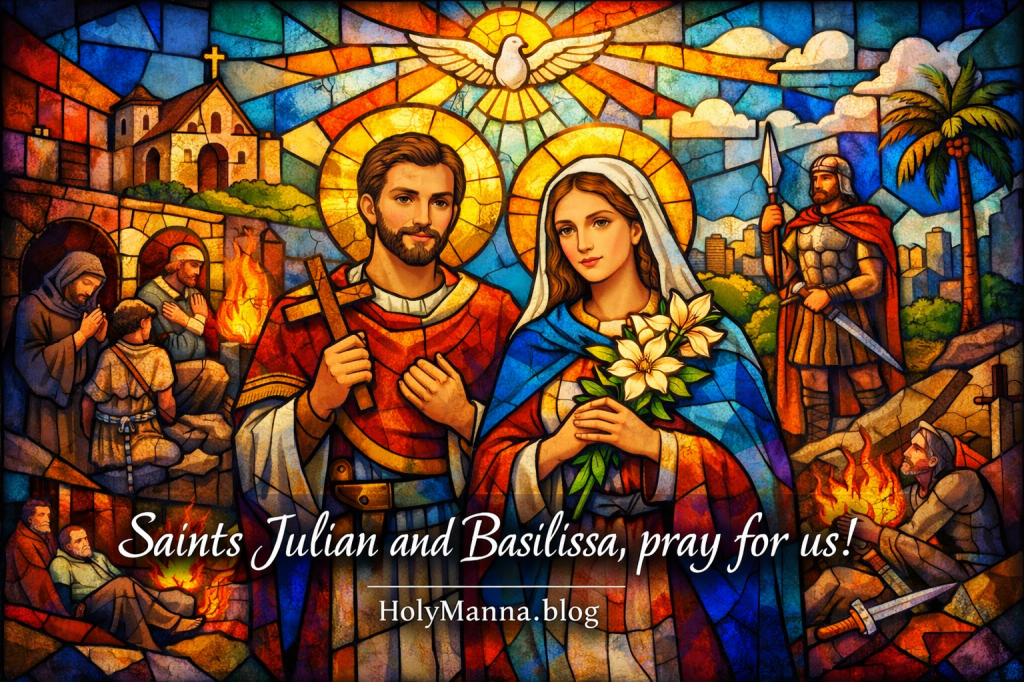
A Marriage Turned into a Sanctuary
Saints Julian and Basilissa hold a unique place in the memory of the Church because their holiness was lived out in the ordinary structure of married life while pointing unmistakably toward heaven. They were husband and wife during the age of persecution, yet their union became a radical witness to the Gospel. Honored in both Eastern and Western Christian tradition, they are remembered as chaste spouses who freely offered their marriage to Christ and transformed their home into a place of prayer, refuge, and sacrificial love.
Their story has been preserved through ancient liturgical remembrance rather than modern biography. The Church has never claimed that every dramatic detail attributed to them is historically provable in the modern sense. What the Church does affirm is their ancient veneration and the spiritual truth their lives proclaim. Their witness aligns closely with the Church’s teaching that all the baptized are called to holiness, whether in marriage, consecrated life, or martyrdom, as taught in The Catechism of the Catholic Church.
A Marriage Transformed by the Gospel
Julian is traditionally described as having been born into a prominent pagan family during the early fourth century. According to custom, he was urged into marriage, and Basilissa became his wife. Basilissa is remembered as a Christian woman whose faith shaped her entire life. Shortly after their marriage, the two agreed by mutual consent to live in continence, dedicating themselves fully to God while remaining truly married.
This decision reflects a spiritual path long honored by the Church. Christ Himself spoke of those who renounce marital relations for the sake of the Kingdom of heaven in The Gospel of Matthew. Saint Paul also taught that spouses may, by agreement, dedicate themselves to prayer for a time. Julian and Basilissa embraced this path permanently, not out of contempt for marriage, but out of love for Christ. Their marriage became an offering, demonstrating that authentic Christian love always seeks the good of the other and ultimately seeks God.
Basilissa is remembered for her devotion to prayer and her leadership among women consecrated to God. Julian devoted himself to works of charity and hospitality. Their household ceased to be merely a private residence and became a place ordered toward the service of the Church. Their lives remind believers that holiness often begins with a single shared decision to place God at the center.
A Home That Became a Refuge
The most enduring aspect of Julian and Basilissa’s witness is the way their home became a sanctuary for persecuted Christians. During times when clergy and faithful were hunted, Julian opened his doors to those in danger. Hospitality in Scripture is never optional, and the early Church understood welcoming the persecuted as welcoming Christ Himself, echoing the words of the Lord in The Gospel of Matthew about serving Him in the least of His brethren.
Ancient tradition attributes conversions and miracles to Julian’s prayer, including the conversion of pagans who initially opposed the faith. Some accounts even speak of a resurrection associated with his ministry. While the Church approaches such accounts with discernment, they have long been preserved because they point to the power of Christ working through a faithful servant. Basilissa’s life, though quieter in the sources, shines through her perseverance in prayer and charity. Her peaceful death after a life of devotion is remembered as the completion of a faithful offering to God.
Their lives illustrate that the Church is built not only through public preaching, but through faithful homes where prayer, sacrifice, and charity are lived daily. Their example challenges modern Christians to ask whether their own homes are places where Christ is welcomed or quietly sidelined.
Faith Tested by Fire and Steel
Julian’s open practice of the faith eventually brought persecution upon him. Authorities discovered that his home had sheltered Christians, including clergy. According to ancient accounts preserved in the Church’s liturgical memory, many of those associated with his household were arrested and put to death. Julian himself was seized, tortured, and commanded to deny Christ. He refused.
His martyrdom stands as a powerful witness to the teaching of the Church that martyrdom is the supreme testimony to the truth of the faith. The Catechism teaches that martyrdom is an act of charity by which the disciple becomes conformed to Christ’s own sacrifice. Julian’s fidelity unto death reveals that faith is not merely an interior conviction, but a public allegiance to Christ that may demand everything.
Basilissa did not die a martyr, yet her sanctity is no less honored. The Church has always recognized that holiness is not measured only by violent death, but by faithful perseverance. Together, Julian and Basilissa show that different paths of suffering and sacrifice can lead to the same crown of glory.
The Memory of the Church as a Living Testimony
While specific posthumous miracles attributed to Saints Julian and Basilissa are not extensively documented, their enduring veneration is itself a sign of spiritual fruitfulness. Their names appear in ancient martyrologies and liturgical calendars, and their feast has been celebrated for centuries. Churches were dedicated in their honor, and their story was preached and sung in both East and West.
The Church does not preserve devotion without reason. The continued remembrance of Julian and Basilissa shows that their lives spoke powerfully to generations of Christians struggling to live faithfully in hostile environments. Their witness remained relevant because it addressed real questions about marriage, sacrifice, courage, and trust in God.
In some devotional traditions, Basilissa has been invoked for healing and protection, reflecting the way saints become spiritual companions to the faithful. Even when individual miracle stories are sparse, the persistence of prayer and devotion reveals that their intercession has been sought and trusted by the People of God.
A Witness for Homes and Hearts
Saints Julian and Basilissa speak directly to the modern Christian world. Their lives challenge the idea that faith should remain private or convenient. They show that marriage is not merely about mutual comfort, but about mutual sanctification. Their chaste union points to the truth that every vocation is ultimately ordered toward heaven, as the Church teaches in The Catechism.
Their hospitality confronts the temptation to close in on oneself. Their courage exposes the fear that often keeps believers silent. Their fidelity reminds Christians that discipleship always has a cost, even when that cost is not martyrdom. Their lives invite reflection on how daily choices either draw the soul closer to Christ or slowly dull its witness.
How often is faith lived boldly at home, rather than hidden for the sake of comfort?
What would it look like to turn an ordinary household into a place ordered toward prayer, charity, and truth?
Engage with Us!
Readers are invited to share thoughts and reflections in the comments below.
- How does the witness of Saints Julian and Basilissa challenge modern views of marriage and holiness?
- In what ways can faith be lived more boldly in daily life, even when it brings discomfort or risk?
- What does their commitment to chastity and hospitality reveal about trusting God completely?
May the example of Saints Julian and Basilissa encourage every believer to live with greater courage and intentionality. Let homes become places of prayer, let charity be lived generously, and let every action be shaped by the love and mercy Jesus taught and embodied for the world.
Saints Julian and Basilissa, pray for us!
Follow us on YouTube, Instagram and Facebook for more insights and reflections on living a faith-filled life.

 Holy Manna!
Leave a comment