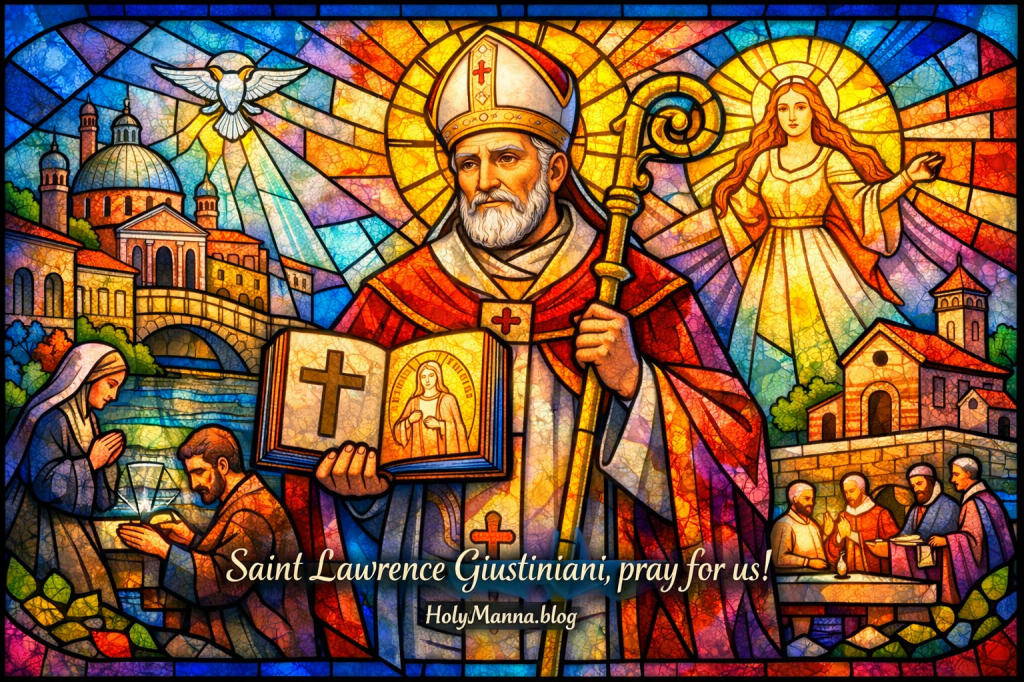
Heaven’s Reformer
Saint Lawrence Giustiniani is the kind of saint who proves that authentic Catholic reform is never driven by noise, power, or outrage. It is driven by holiness. He became the first Patriarch of Venice, yet he lived with the heart of a monk and the hands of a shepherd. In a city marked by wealth, politics, and influence, he chose prayer, simplicity, and fearless charity. The Church venerates him because he renewed priestly life, strengthened religious communities, protected the poor, and restored reverence to worship at a time when the Church deeply needed interior renewal.
His life shows that reform is not about tearing down, but about rebuilding on Christ. When leaders allow the Gospel to reshape their hearts, the Church becomes stronger without becoming harsh. Saint Lawrence stands as a model of how authority and humility can live together without contradiction.
When Wisdom Calls, the Heart Must Answer
Lawrence was born on July 1, 1381, in Venice, into the noble Giustiniani family. His father died while Lawrence was still very young, leaving his mother to raise the family with strength and resolve. From childhood, Lawrence was surrounded by education, privilege, and opportunity. A comfortable and influential future stood open before him, and no one would have questioned his pursuit of it.
Yet his heart was restless. As he matured, he became increasingly aware that a life built on status and comfort could not satisfy the deeper hunger of the soul. This interior struggle reached a turning point through a profound spiritual experience that he later described in his own writings. Drawing from the biblical tradition of Divine Wisdom found in The Book of Wisdom, Lawrence recounts an encounter in which Wisdom appears as radiant and inviting, calling him away from vanity and toward God. His words reflect the intensity of that moment: “Finally there appeared to me a most beautiful maiden… she said… she was the Wisdom of God.”
That call demanded a response, and Lawrence did not delay. He entered the community of Augustinian Canons Regular at San Giorgio in Alga, a reform-oriented house where priests lived in common life under the Rule of Saint Augustine. There, prayer, fasting, poverty, and obedience shaped daily life. Lawrence embraced this discipline with seriousness and joy. He did not treat religious life as an escape from the world, but as a way to be purified for deeper service to the Church.
His humility and holiness became evident to those around him. Without seeking prominence, he was eventually entrusted with leadership as prior and later as head of the reform movement within the community. Under his guidance, San Giorgio in Alga became a model for priestly renewal, influencing reform far beyond the island itself.
Reform Rooted in Wisdom
Saint Lawrence Giustiniani is best known as a reforming bishop who governed through holiness rather than force. In 1433, he was appointed Bishop of Castello, and in 1451 he became the first Patriarch of Venice. This placed him at the center of Church life in one of the most politically complex cities of Europe. Venice valued its independence, and tensions between civic authority and Church leadership were never far away.
Lawrence responded not with fear or compromise, but with integrity. He worked tirelessly to renew the clergy, calling priests back to prayer, discipline, and a life that matched the sacred mysteries they celebrated. He strengthened reverence in the liturgy, restored churches, reorganized parish life, and encouraged faithful observance of Christian morals. He also supported the founding and renewal of monasteries and convents, knowing that the hidden life of prayer sustains the visible life of the Church.
He cared deeply about priestly formation and ensured that poor candidates who were truly called were not excluded due to lack of resources. This reflects the Church’s teaching that vocation is a gift of God and must be nurtured responsibly, as taught in The Catechism. Bishops are called to teach, sanctify, and govern not as administrators detached from souls, but as fathers who know their people.
Lawrence’s writings reveal his hatred for empty religious language disconnected from real charity. One of his most enduring statements exposes this temptation with clarity: “To speak of the effects of charity without having experienced it is reckless.” For him, reform meant conversion of heart before correction of structures.
The Quiet Miracles of Conversion and Renewal
While Saint Lawrence is not remembered for dramatic public miracles during his lifetime, the Church recognizes another kind of miracle that marked his ministry. Through his holiness, hearts were converted, priests were renewed, religious communities were strengthened, and the poor were protected. These are the quiet miracles that endure long after spectacle fades.
He lived with personal austerity and practiced generous charity. He gave freely to those in need and refused to insulate himself with comfort or privilege. His compassion was practical and consistent. He visited the suffering, supported the vulnerable, corrected with patience, and encouraged with wisdom. This integrity gave credibility to his reforms and allowed them to take root.
His life reflects the Church’s constant teaching that love of neighbor is inseparable from love of God. The Catechism teaches that charity toward the poor is a witness to the Gospel itself. Saint Lawrence lived this truth without turning it into ideology. His charity flowed from prayer, not from self-promotion.
The Cross of Leadership in a World That Loves Comfort
Saint Lawrence did not die as a martyr by blood, but he lived a form of daily martyrdom through the weight of leadership and responsibility. Reform always brings resistance, especially when it challenges comfort and complacency. As Patriarch of Venice, he faced suspicion from civic leaders who feared conflict between Church authority and political power.
He overcame this not by asserting dominance, but by demonstrating holiness. His authority was rooted in prayer and integrity, not ambition. People recognized that he sought neither control nor prestige, but the good of souls. His leadership reflected Christ the Good Shepherd, who lays down His life for the sheep.
During his final illness, his spirituality became even more evident. He rejected unnecessary comforts, desiring to remain united to the crucified Christ until the end. His words from that period reveal his heart: “Christ died on the cross, and I should die on a bed of feathers?” This was not contempt for the body, but love for the Lord expressed through sacrifice.
He died on January 8, 1456, having spent himself completely in service to Christ and His Church.
A Shepherd Still at Work
After his death, devotion to Saint Lawrence Giustiniani spread quickly among the faithful. His body was venerated for an extended time, and many reported favors received through his intercession. Healings and spiritual graces were attributed to him, especially by those who sought his help with humility and trust.
His relics are honored in Venice, particularly at San Pietro in Castello, closely connected to his ministry as bishop. The veneration of relics reflects the Church’s incarnational faith. God works through matter because the Word became flesh. The bodies of the saints are reminders that holiness is lived in real places, real bodies, and real history.
He was beatified in the sixteenth century and canonized in 1690, confirming the Church’s long-standing recognition of his heroic virtue. As a patron of Venice, he continues to stand as a witness that cities are renewed not by power alone, but by sanctity.
Reforming the Church by Reforming the Heart
Saint Lawrence Giustiniani teaches that holiness begins with personal conversion. His life challenges the tendency to demand reform everywhere except within the heart. He shows that prayer, discipline, and charity are not optional extras, but the foundation of Christian life.
His example confronts modern comfort culture. Christianity cannot be reduced to inspiration without sacrifice. Saint Lawrence embraced discipline because he understood that love requires structure. A serious prayer life, reverent participation in the sacraments, regular confession, and intentional generosity are concrete ways to live his witness today.
He also reminds believers that charity must be visible and consistent. Love of the poor is not a slogan. It is a daily responsibility rooted in the Gospel and affirmed by The Catechism. When faith shapes ordinary decisions, the Church becomes credible again.
Where might God be calling for deeper simplicity or discipline right now?
How can prayer become more central rather than squeezed into leftover time?
What would charity look like if it were treated as essential instead of optional?
Engage with Us!
Readers are invited to share their thoughts and reflections in the comments below and to reflect more deeply on the witness of this great saint.
- What part of Saint Lawrence Giustiniani’s life challenges the heart the most right now?
- Where might God be calling for deeper discipline or simplicity in daily life?
- How can charity become more intentional and concrete in ordinary routines?
May the life of Saint Lawrence inspire deeper prayer, greater humility, and fearless charity. May everything be done with the love and mercy Jesus taught us, so that faith becomes visible, faithful, and strong in daily life.
Saint Lawrence Giustiniani, pray for us!
Follow us on YouTube, Instagram and Facebook for more insights and reflections on living a faith-filled life.

 Holy Manna!
Leave a comment