A Saint for the End of an Empire
Saint Severinus of Noricum shines brightest in one of history’s darkest chapters. He lived in the fifth century, when the Western Roman Empire was collapsing and whole communities along the Danube frontier were being swallowed by fear, famine, and violence. Towns that once depended on Roman soldiers and stable trade suddenly found themselves isolated, underdefended, and exposed to raids, extortion, and forced migration. In that chaos, God raised up a monk who could not be bought, intimidated, or distracted.
Severinus is revered because he did what the Church has always done in hard times. He gathered the faithful, called sinners to repentance, strengthened the weak, and organized real mercy when there was almost nothing left to organize. The tradition remembers him as the Apostle of Noricum because he became a spiritual father to a whole region, guiding people not only toward survival, but toward sanctity. His life is a reminder that Christianity is not reserved for peaceful decades. It is built for storms, confusion, and collapse.
Behind his story is a truth the Church never stops preaching. Jesus Christ remains Lord even when the world feels like it is coming apart. The saints prove that the Gospel still works when everything else breaks down.
Humility That Guarded His Soul
One of the most striking details about Saint Severinus is that his early life is largely hidden, and this was intentional. The ancient account of his life, written by Eugippius who lived among his disciples, admits that people tried to learn Severinus’ birthplace, social standing, and family background. Severinus refused to answer. He wanted attention fixed on Christ rather than on himself.
Eugippius preserves a saying attributed directly to Severinus that explains this decision with spiritual clarity. He warned that curiosity about the servant of God can easily turn into vanity, which distracts from conversion and obedience. His words remain challenging even today: “What profiteth it the servant of God to name his country or race? For vainglory is like the left hand.” This refusal to center his own story was not secrecy for its own sake. It was discipline rooted in humility.
What can be known is that Severinus lived an ascetic life shaped by prayer, fasting, and detachment from comfort. He was deeply formed by monastic spirituality, likely influenced by Eastern Christian practices. This interior discipline prepared him to remain calm, focused, and charitable when he was sent into a region unraveling socially and politically. His silence about his origins became a witness in itself, showing that holiness does not depend on pedigree, education, or status.
A Monk Who Rebuilt Christian Life Along the Danube
When Severinus arrived in Noricum, he did not come as a bishop, governor, or military leader. He came as a monk formed by prayer and obedience. The region he served lay along the Danube River in what is now modern Austria, and it included several struggling Roman towns facing constant threats. These were communities marked by hunger, fear, and moral fatigue.
Severinus founded monastic communities that became spiritual and practical anchors for the people. These monasteries were places of worship, but they were also centers of relief. Food was stored and distributed during famine. Captives were ransomed when possible. Refugees were sheltered. The faithful were called back to discipline, repentance, and trust in God. His leadership was not theoretical. It was concrete and sacrificial.
He preached consistently on fasting, prayer, and almsgiving, not as optional devotions for the especially pious, but as necessities for survival of both soul and society. This reflects the teaching of The Catechism, which reminds the faithful that interior conversion is expressed through visible acts of penance and charity (CCC 1434). Severinus understood that when faith becomes vague, communities crumble. When faith becomes embodied in daily practice, even fragile societies can endure.
Love That Reflected the Gospel
The ancient account of Saint Severinus records many miracles during his lifetime, and they follow a consistent pattern. His miracles strengthened faith, protected communities, and called people back to God. Healings occurred through prayer and fasting. Warnings were given that allowed towns to escape destruction. Lives were spared because a holy man listened closely to God.
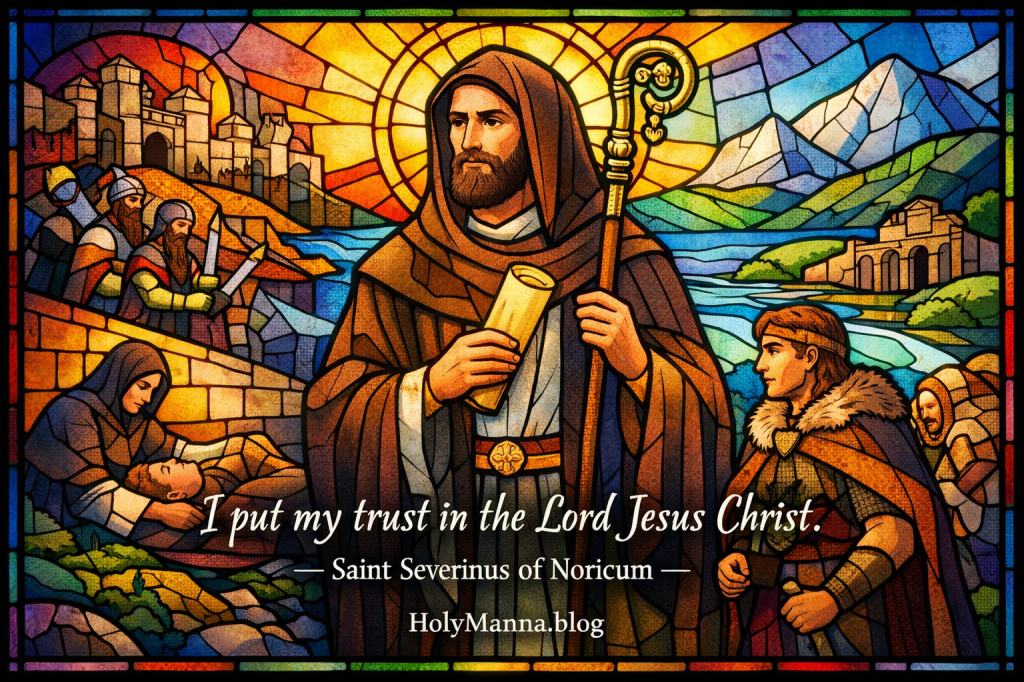
One of the most well known moments from his life involves the young warrior Odoacer, who would later become ruler in Italy. Severinus spoke to him with prophetic confidence, offering a message that later proved true. Eugippius preserves this saying as spoken directly by the saint: “Go to Italy. Now clothed in poor skins, you will soon give rich gifts to many.” In the same encounter, Severinus made clear that his confidence rested not in political insight but in divine providence, saying: “I put my trust in the Lord Jesus Christ.”
Severinus was also a tireless advocate for mercy. He confronted violent leaders, pleaded for prisoners, and negotiated peace whenever possible. His courage did not come from aggression, but from conviction that every human person bears the image of God. This reflects the heart of Catholic teaching on human dignity and the corporal works of mercy, which the Church teaches are essential expressions of Christian life (CCC 2447).
Faithful Courage
Saint Severinus did not die a martyr’s death, but his entire life was marked by hardship. He lived through famine, disease, insecurity, and constant political instability. He also served in a region marked by religious tension, particularly pressure from Arian rulers hostile to Catholic teaching about the divinity of Christ. In such an environment, Catholics could easily be marginalized or coerced.
Severinus endured these trials with spiritual steadiness. He did not stir panic or resentment. He called people to repentance and perseverance. He encouraged prayer instead of fear and mercy instead of retaliation. His strength came from a disciplined interior life shaped by trust in God’s providence.
As his death approached around the year 482, Severinus foretold that the Roman population of Noricum would eventually be forced to leave the region. He instructed his followers to remain united and to carry his body with them when the migration came, so that their faith would not fracture in exile. Tradition records his final words as an act of pure praise drawn from Psalm 150: “Let everything that breathes praise the Lord.” These words summarize a life that refused to let suffering silence worship.
A Saint Who Traveled with His People
After Saint Severinus’ death, his monks eventually carried his relics with them into Italy during the evacuation he had predicted. The early account records signs of grace connected to this journey, including healings and consolations for the faithful. His relics were honored and preserved, and devotion to him continued to grow.
The Church teaches that the saints remain united to the faithful even after death through the communion of saints (CCC 946). The veneration of relics reflects confidence in the resurrection of the body and the power of God at work through those who lived holy lives. Saint Severinus remained a shepherd even after death, strengthening believers through his witness and intercession.
His memory endured especially in regions once shaped by his care and later in Italy, where his relics were honored. His life became a bridge between a collapsing Roman world and a new Christian society emerging from its ruins.
A Rule of Faith for Times of Uncertainty
Saint Severinus speaks powerfully to Christians living in uncertain times. His life shows that the Gospel does not require stability to flourish. It requires prayer, repentance, discipline, and mercy. He demonstrates that holiness is not passive retreat, but active charity rooted in trust in Christ.
His example teaches that fasting strengthens freedom, prayer steadies the soul, and almsgiving heals communities. When these practices fade, fear grows stronger. When they are embraced, faith becomes resilient and fruitful. Severinus also reminds believers that leadership in the Church is service, not control, and that rebuilding often begins quietly through fidelity rather than force.
Where is God inviting deeper trust when the world feels unstable?
How can prayer and fasting be practiced with greater seriousness and consistency?
What concrete act of mercy is being delayed out of fear or convenience?
Saint Severinus of Noricum teaches that saints are formed precisely when circumstances are hardest, and that Christ remains faithful to His Church in every age.
Engage with Us!
Readers are invited to share their thoughts and reflections in the comments below.
- What part of Saint Severinus’ life feels most relevant to the challenges of today?
- How can fasting and prayer become steadier practices rather than occasional efforts?
- Where is God calling for greater mercy toward the vulnerable, even when it is uncomfortable?
May the witness of Saint Severinus encourage every heart to live with courage, to serve with compassion, and to do all things with the love and mercy Jesus taught us and lived perfectly.
Saint Severinus of Noricum, pray for us!
Follow us on YouTube, Instagram and Facebook for more insights and reflections on living a faith-filled life.

 Holy Manna!
Leave a comment