A Saint of Truth and Mercy
Saint Raymond of Peñafort is one of those saints who makes it impossible to pretend that holiness is only about emotions or good intentions. He was a Dominican priest, a master of canon law, a trusted confessor, and a reformer whose influence still shapes the daily life of the Church. He is best known for organizing Church law in a way that protected souls and strengthened unity, and for forming confessors to judge wisely without losing compassion. His life matters because the Church has always taught, as expressed in The Catechism, that discipline and mercy are not opposites but partners in the work of salvation. Saint Raymond lived this truth with clarity and courage, showing that God’s law exists not to trap people in guilt, but to lead them toward freedom and healing.
A Brilliant Mind That Chose Humility Over Status
Raymond was born around the year 1175 in Catalonia, near Barcelona, into a noble family with influence and opportunity. From an early age, his intellectual gifts were obvious. He studied philosophy and rhetoric before traveling to Bologna, the leading center for legal studies in Europe, where he earned a doctorate in both canon and civil law. By the time he returned home, he was already a respected teacher and churchman, admired for his sharp mind and disciplined reasoning.
What makes his story compelling is that success did not satisfy him. In his early forties, when most people are settling into comfort and recognition, Raymond entered the Dominican Order. This decision was not an escape from responsibility, but a deeper embrace of it. He chose poverty, obedience, and preaching because he recognized that knowledge without holiness can easily become pride. His later work would prove that learning, when surrendered to God, becomes a powerful instrument of mercy.
Raymond’s most influential pastoral work, the Summa de Casibus Poenitentiae, was written to help confessors navigate complex moral situations faithfully. It was not cold or abstract. It combined doctrine, Church law, and pastoral wisdom so that priests could guide penitents toward repentance without crushing them with despair. This work shaped confession for generations and reinforced the Church’s conviction that truth must always be spoken in love.
The Confessional, the Classroom, and a Cloak on the Sea
Saint Raymond’s holiness unfolded through tireless service rather than dramatic public displays. Pope Gregory IX summoned him to Rome and entrusted him with the monumental task of organizing papal decretals into a coherent and authoritative collection. The result became the foundation of canon law for centuries. This work was not about control or bureaucracy. It existed to protect the faithful, ensure justice, and prevent abuse, so that the Church could more clearly reflect the order and mercy of God.
He also served as Master General of the Dominican Order, guiding the friars during a time of growth and challenge. He reformed religious life with humility, even introducing a provision that allowed superiors to resign. When he later found the burden too heavy because of age and health, he used that provision himself. This quiet decision revealed a man free from ambition and deeply rooted in obedience.
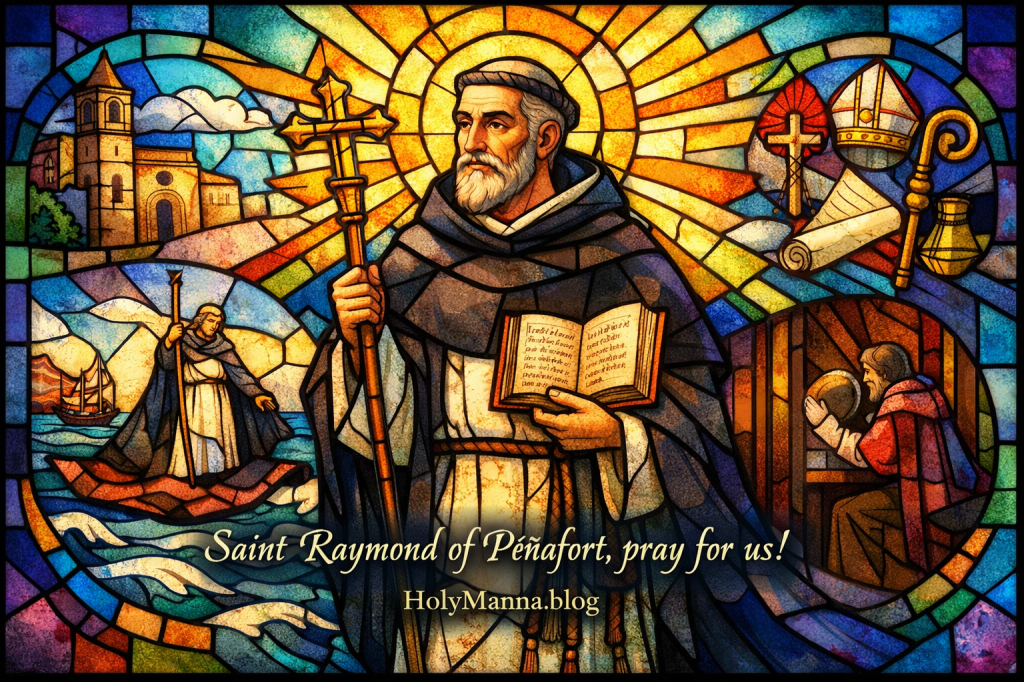
The miracle most associated with Saint Raymond reveals the heart behind his obedience. While serving as confessor to King James I of Aragon, Raymond confronted the king over public immorality. When the king refused to amend his life and attempted to prevent Raymond from leaving the island of Majorca, the saint placed his trust entirely in God. According to long held tradition, he laid his cloak upon the sea, used his staff as a mast, and sailed across the water toward Barcelona. The miracle mattered not because it was impressive, but because it showed that obedience to God takes precedence over fear, authority, or convenience.
A saying traditionally attributed to Saint Raymond during this episode reflects that confidence in divine providence: “Soon you will see how the King of Heaven will confound the deeds of this earthly king and provide me with a ship.” Another quotation associated with him expresses his deep Eucharistic devotion and gratitude: “As you drink the cup of the Lord Jesus, how glorious it is, give thanks to the Lord, the giver of all blessings.”
Obedience That Costs Something
Saint Raymond was not a martyr by execution, but his obedience carried real cost. He lived under constant pressure as a counselor to popes, kings, and religious communities. Correcting the powerful is rarely safe, and fidelity often brought discomfort rather than praise. His faith demanded courage, especially when silence would have been easier.
Even honors became burdens. He was appointed Archbishop of Tarragona later in life, but illness and humility led him to resign after a short time. This was not failure. It was discernment. Raymond understood that obedience includes knowing when to step back for the good of the Church. In his later years, he continued to teach, preach, and combat heresy, serving faithfully even as age weighed heavily upon him.
His hardships were not chains or swords, but responsibility, moral clarity, and the daily demand to choose God over human approval. In a world that rewards compromise, his life stands as a quiet rebuke and a steady encouragement.
A Legacy That Kept Healing
Saint Raymond died in Barcelona on January 6, 1275, at nearly one hundred years of age. Devotion to him spread steadily, especially among those seeking guidance in difficult moral decisions. He was canonized in 1601, and he is honored as a patron of canon lawyers, confessors, and those who work for justice within the Church.
His legacy is not limited to miracles or relics. It lives on every time a priest patiently untangles a complicated confession without diluting the truth. It lives on whenever the Church insists that repentance is not humiliation, but restoration. His influence continues wherever the law of the Church is applied with wisdom, restraint, and love.
Learning to Love the Way the Church Loves
Saint Raymond of Peñafort teaches a lesson that remains deeply relevant. Mercy does not mean ignoring sin, and truth does not mean abandoning compassion. The Church teaches, in The Catechism, that moral law is ordered toward freedom and happiness, not fear. Raymond’s life shows what this teaching looks like when it is lived with integrity.
His example invites Catholics to take conscience seriously and to approach confession as a place of healing rather than avoidance. It challenges believers to speak the truth calmly and courageously, especially in family life, friendships, and public witness. It also teaches patience with others, remembering that conversion is often gradual and always requires grace.
Is there a place where truth has been avoided out of fear of conflict?
Is there a place where truth has been spoken without gentleness, as if winning mattered more than saving?
What might change if confession were approached as Christ’s clinic for the soul instead of a courtroom of shame?
Engage with Us!
Start by inviting readers to share their thoughts and reflections in the comments below. Then, provide specific reflection questions to encourage thoughtful engagement and discussion.
- Which part of Saint Raymond of Peñafort’s life most challenges the way faith is lived today?
- How can confession become a place of courage and healing instead of fear and avoidance?
- Where might God be asking for obedience that costs something, even if it brings no applause?
- How can truth be spoken this week in a way that is firm, patient, and genuinely loving?
May Saint Raymond intercede for every reader to love the truth, trust God more than human approval, and live with a clear conscience. Move forward in faith, and do everything with the love and mercy Jesus taught us.
Saint Raymond of Peñafort, pray for us!
Follow us on YouTube, Instagram and Facebook for more insights and reflections on living a faith-filled life.

 Holy Manna!
Leave a comment