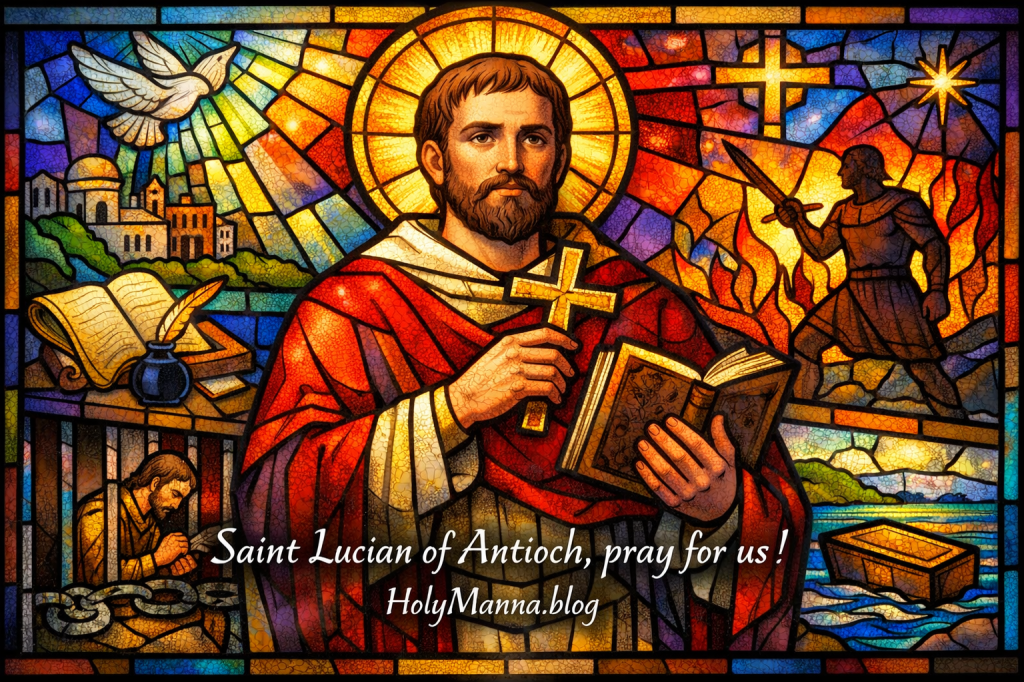
Faith Forged in Truth and Fire
Saint Lucian of Antioch stands among the great witnesses of the early Church as a priest, scholar, and martyr whose life joined intellectual rigor with heroic fidelity. Living during a time when Christianity was still illegal and often violently opposed, he dedicated himself to the careful study of Sacred Scripture and to the formation of Christians who desired to know Christ not vaguely, but truly. He is especially revered for his role in the Antiochene tradition of biblical interpretation, which emphasized clarity, historical grounding, and faithfulness to the revealed Word of God.
Lucian’s significance does not rest on personality or popularity, but on perseverance. His life shows that holiness often unfolds quietly through study, discipline, and obedience, and then is tested publicly through suffering. The Church venerates him because he loved truth enough to serve it patiently and loved Christ enough to die rather than deny Him.
A Mind Trained for Truth and a Heart Drawn to God
Saint Lucian was traditionally believed to have been born in Samosata in Syria around the middle of the third century. While the historical record preserves only limited details about his childhood and family life, it is clear that he received an excellent education. He was trained in rhetoric, philosophy, and literary studies, disciplines that sharpened his intellect and prepared him for a life of teaching and scholarship.
Lucian eventually made his way to Antioch, one of the most influential Christian cities of the ancient world. There he embraced the Christian faith deeply and was ordained a priest. Antioch was a place where theology, Scripture, and pastoral life were closely connected, and Lucian flourished in that environment. His conversion was not a dramatic emotional moment preserved in legend, but a steady deepening of commitment expressed through study, prayer, and service to the Church.
He became especially known for his work with biblical manuscripts. At a time when texts were copied by hand and errors could easily multiply, Lucian devoted himself to comparing and correcting Greek copies of the Old and New Testaments. His goal was not innovation, but fidelity. He wanted Christians to hear the Word of God as clearly and accurately as possible, trusting that truth itself is a form of charity.
When the Greatest Miracle Is Fidelity
Saint Lucian’s life does not include widely attested accounts of dramatic public miracles, yet his holiness shines through a quieter but no less powerful form of witness. His dedication to Sacred Scripture helped preserve the integrity of the biblical text and shaped generations of Christian teachers. This influence mattered deeply because the Church believes that God speaks through Scripture for the salvation of souls.
According to The Catechism, Sacred Scripture is “the speech of God as it is put down in writing under the breath of the Holy Spirit” (CCC 81). Lucian lived as someone who truly believed this. He approached the Bible not as an academic puzzle, but as divine revelation entrusted to the Church. His work strengthened the Church’s ability to teach Christ faithfully in an age filled with confusion and persecution.
Lucian’s life also reflects an important spiritual lesson. Intelligence alone does not make a saint. Knowledge must be purified by humility and obedience. Despite periods of misunderstanding and controversy surrounding theological debates of his time, Lucian ultimately remained within the communion of the Church and sealed his faith with martyrdom. The miracle of his life is that truth shaped not only his mind, but his choices.
Nine Months in Chains and One Final Confession
The final years of Saint Lucian’s life unfolded during the brutal persecution under Emperor Maximinus Daia. As a well known Christian priest and teacher, Lucian was arrested and taken to Nicomedia. There he endured long imprisonment marked by physical deprivation and harsh treatment. Ancient accounts emphasize that he remained steadfast, refusing to offer sacrifice to pagan gods or deny Christ.
Tradition preserves that Lucian suffered greatly in prison, including prolonged hunger. Yet even in chains, his witness strengthened other Christians. Some accounts describe him encouraging fellow prisoners and continuing to confess the faith boldly under interrogation. His suffering reflects the Church’s teaching that martyrdom is “the supreme witness given to the truth of the faith” (CCC 2473).
Shortly before his death in the year 312, Lucian is said to have made a simple and powerful confession. “I am a Christian.” According to tradition, he repeated these words three times. This was not a slogan, but a summary of his entire life. His martyrdom proclaims that Christian identity is not merely cultural or private, but something worth dying for when faith is put to the test.
A Witness That Endures
After his martyrdom, Saint Lucian was honored by the faithful as a saint whose life bore lasting fruit. Traditions recount that his body was treated with reverence, and some accounts include the dramatic detail of his remains being cast into the sea and later recovered. Whether emphasized symbolically or historically, these traditions express the Church’s conviction that the bodies of the saints are precious, destined for resurrection.
While specific posthumous healing miracles are not widely recorded, Lucian’s enduring legacy itself testifies to God’s work through him. His influence on biblical scholarship continued for centuries, shaping how Scripture was taught and preached in the Christian East. The Church recognizes that not all miracles are instantaneous or visible. Some unfold slowly across generations as faith is preserved and passed on.
The veneration of Saint Lucian reminds believers that God often glorifies His saints through the lasting impact of their fidelity. The Word of God that Lucian labored to protect continues to nourish the Church, fulfilling the promise of Psalm 119, where it is written, “Your word is a lamp for my feet, and a light for my path.”
Clarity in Confusion and Courage in Fidelity
Saint Lucian of Antioch speaks powerfully to Christians living in a world marked by noise, division, and uncertainty. His life teaches that charity without truth becomes shallow, and truth without charity becomes harsh. Authentic Christian living requires both. Lucian shows that love for Scripture must be paired with obedience to the Church, because the Word of God was entrusted not to individuals, but to the Body of Christ.
His witness invites an honest examination of daily life. Christian identity is not something reserved for safe spaces or convenient moments. It shapes decisions, priorities, and sacrifices. Lucian did not wait for persecution to define him. He lived as a Christian long before he died as one.
Is the Word of God being treated as daily bread or as background noise?
Is Christian identity shaping everyday choices or being set aside to avoid discomfort?
Is there a willingness to stand with Christ when faith becomes costly, even in small ways?
Engage with Us!
Readers are invited to share their thoughts and reflections in the comments below and to join in thoughtful conversation with the wider Holy Manna community.
- What does “I am a Christian” need to look like in everyday life today?
- How can devotion to Sacred Scripture grow in consistency and reverence?
- Where is courage most needed right now to remain faithful to Christ and His Church?
May Saint Lucian intercede for all who seek clarity, courage, and fidelity. May his love for Scripture deepen faith, and may his martyr’s confession inspire lives lived fully for Christ, doing everything with the love and mercy Jesus taught and revealed.
Saint Lucian of Antioch, pray for us!
Follow us on YouTube, Instagram and Facebook for more insights and reflections on living a faith-filled life.

 Holy Manna!
Leave a comment