Wednesday after Epiphany – Lectionary: 214
When Love Steps Into the Storm
There are days when faith feels like a warm candle in a quiet chapel, and there are days when it feels like trying to row a boat through black water with the wind in your face. Today’s readings speak straight into that second kind of day. They circle around one central theme that holds everything together: God’s love becomes visible and powerful when it drives out fear, strengthens trust in Jesus, and spills over into mercy for the poor and forgotten.
This makes a lot of sense for the Wednesday after Epiphany. The Church is still living in the light of Epiphany, which is not just a sweet story about wise men and gifts. Epiphany is a season of revelation. It is the Church’s way of saying that Jesus is not hidden, not private, and not just for one people. He is the Savior of the world, and His glory is meant to be recognized. That is why the readings keep moving between what is unseen and what becomes unmistakably real. Saint John says plainly that no one has ever seen God, but then he turns around and says that God is made present when His people love each other, because “if we love one another, God remains in us, and his love is brought to perfection in us”. That is not sentimental. That is supernatural. That is what the Holy Spirit does in ordinary Christians who keep choosing charity when it would be easier to retreat into self protection.
The Psalm places that same love into the public square. In the biblical imagination, the king is not just a political figure. The king is supposed to be an image of God’s justice, defending those who have no defender. That is why the Psalm describes a ruler who rescues, hears the cry of the poor, and refuses to ignore the oppressed. In other words, when God’s reign shows up, it looks like protection for the weak and dignity for the needy.
Then the Gospel brings everything to a point of decision. The disciples are not dealing with abstract theology. They are exhausted, stuck, and terrified. Jesus comes to them in the darkest hours and speaks the words every fearful heart needs to hear: “Take courage, it is I, do not be afraid!” The season after Epiphany is meant to teach this lesson again and again. Jesus reveals who He is, not only through miracles, but through His presence. He does not abandon His friends in the storm, even when they are slow to understand and quicker to panic.
So this is the invitation for today: God’s love is not a vague feeling, and it is not a spiritual decoration. God’s love is meant to mature into something solid, something fearless, something that looks like trust in Christ when the waters are rough and looks like mercy when the poor cry out. Where has fear been calling the shots lately, and what would change if Christ’s love was allowed to drive it out?
First Reading – 1 John 4:11-18
When God Cannot Be Seen, Love Makes Him Known
Saint John is writing to early Christians who are living in a complicated moment. The Church is growing, but it is also getting tested from the inside. Some believers are being tempted by false ideas about Jesus, especially the denial that the Son of God truly came in the flesh. That matters because Christianity is not a philosophy club. Christianity is the shocking claim that the Father sent His Son into the real world to save real people, and that the Holy Spirit now makes that salvation personal and visible in the life of the Church. That is why John keeps returning to a simple, demanding proof of authentic faith: love that looks like Christ.
This reading fits today’s theme perfectly because it answers a question that every honest believer has asked at some point. If God is real, why does He feel unseen? John does not dodge that. He says plainly that no one has ever seen God. Then he shows how God makes Himself known anyway. God becomes visible in the world through Christians who remain in His love. That love is not a mood. It is the very life of God poured into the soul, strengthened by the Spirit, and matured through obedience, sacrifice, and mercy. When that love is being perfected, fear starts losing its grip, because the heart learns it is held by a Father, saved by a Son, and filled with the Spirit.
1 John 4:11-18 – New American Bible (Revised Edition)
11 Beloved, if God so loved us, we also must love one another. 12 No one has ever seen God. Yet, if we love one another, God remains in us, and his love is brought to perfection in us.
13 This is how we know that we remain in him and he in us, that he has given us of his Spirit. 14 Moreover, we have seen and testify that the Father sent his Son as savior of the world. 15 Whoever acknowledges that Jesus is the Son of God, God remains in him and he in God. 16 We have come to know and to believe in the love God has for us.
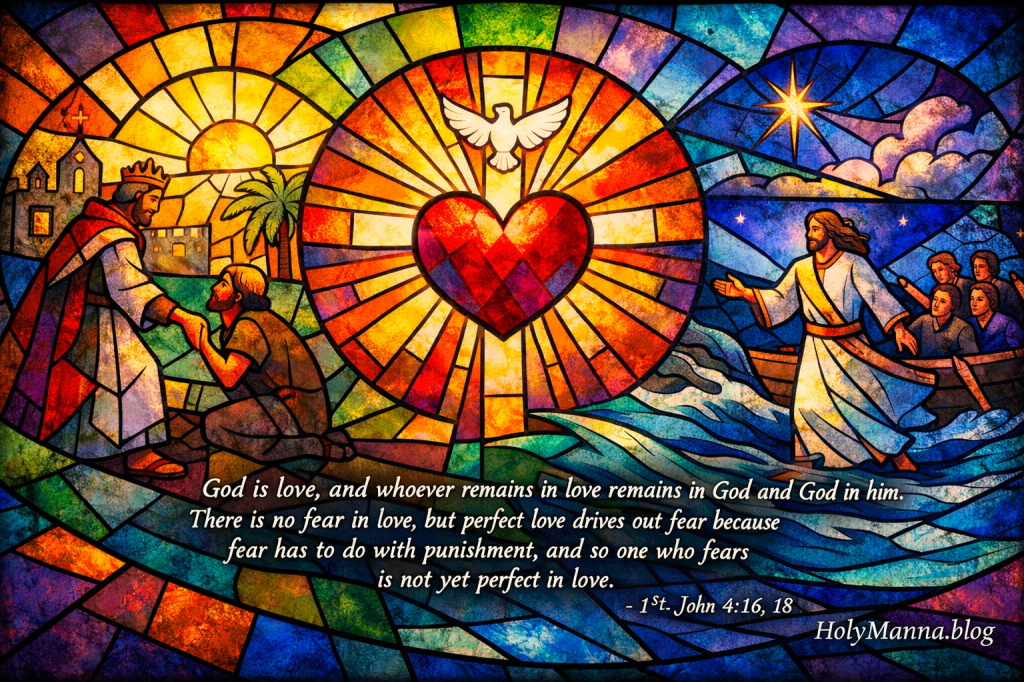
God is love, and whoever remains in love remains in God and God in him. 17 In this is love brought to perfection among us, that we have confidence on the day of judgment because as he is, so are we in this world. 18 There is no fear in love, but perfect love drives out fear because fear has to do with punishment, and so one who fears is not yet perfect in love.
Detailed Exegesis
Verse 11 – “Beloved, if God so loved us, we also must love one another.”
John begins with the Gospel logic of obligation that does not feel like legal pressure. God loved first. God loved freely. God loved at the cost of His Son. So Christian love is not optional, and it is not something saved for people who deserve it. The word “must” is important. Charity is a commandment because it is a participation in God’s own life. The Church teaches that charity is the greatest theological virtue, and it animates everything else. CCC 1822 says, “Charity is the theological virtue by which we love God above all things for his own sake, and our neighbor as ourselves for the love of God.”
Verse 12 – “No one has ever seen God. Yet, if we love one another, God remains in us, and his love is brought to perfection in us.”
This verse is both humbling and empowering. God is invisible, so nobody gets to brag about having Him under control. Yet love becomes the evidence of His indwelling. John uses the language of “remain,” which is about communion, stability, and staying rooted. God “remains” in the soul that lives in charity. And love is “brought to perfection” not because a person becomes flawless, but because God’s love reaches its intended goal in a human life: communion with God that overflows into communion with neighbor.
Verse 13 – “This is how we know that we remain in him and he in us, that he has given us of his Spirit.”
John is not interested in vague spirituality. He wants Christians to have confidence. The assurance does not come from personality type or emotional highs. It comes from the gift of the Holy Spirit. The Spirit is not just a symbol of God’s presence. The Spirit is God’s presence. The Spirit enables faith to confess Jesus, strengthens charity to endure sacrifice, and forms the Church into one body.
Verse 14 – “Moreover, we have seen and testify that the Father sent his Son as savior of the world.”
John grounds everything in the mission of Jesus. Love is not a human project that tries to climb up to heaven. Love begins in heaven and comes down in the Son. The phrase “savior of the world” matters in this season after Epiphany because it highlights the universality of Christ. Jesus is not only for insiders, and He is not limited by ethnicity, status, or past sins. He is the Savior of the world.
Verse 15 – “Whoever acknowledges that Jesus is the Son of God, God remains in him and he in God.”
John connects confession and communion. To acknowledge Jesus as the Son of God is not just to recite a line. It is to surrender to who He is. Real faith leads to abiding. Abiding leads to love. Love reveals God. That is how the whole Christian life holds together.
Verse 16 – “We have come to know and to believe in the love God has for us.”
This is one of the most important lines in the whole reading because it describes mature Christianity. It is possible to believe that God exists and still doubt that He is good. John is speaking about knowing and believing in God’s love personally. That kind of faith is what begins to heal fear, resentment, and suspicion toward God.
Verse 16 – “God is love, and whoever remains in love remains in God and God in him.”
John is not saying God merely has love, like a tool in His pocket. He is saying love belongs to God’s very identity. God is love. Remaining in love means remaining in God, because charity is a real participation in the divine life. This is why the saints are so joyful and so fearless even when their circumstances are painful. They are rooted in Love Himself.
Verse 17 – “In this is love brought to perfection among us, that we have confidence on the day of judgment because as he is, so are we in this world.”
Perfection here means completion. Love reaches maturity when it produces confidence before God, not because a person becomes self-righteous, but because Christ’s life is taking shape in them. The phrase “as he is, so are we in this world” points to real transformation. Christians are meant to resemble Jesus in the world. That resemblance is not an act. It is the fruit of grace.
Verse 18 – “There is no fear in love, but perfect love drives out fear because fear has to do with punishment, and so one who fears is not yet perfect in love.”
This is not saying that a believer never feels nervous or shaken. It is saying that servile fear, the fear of God as a harsh punisher, is healed as love matures. Fear that “has to do with punishment” is the fear of someone who does not yet trust the Father’s heart. As charity grows, the soul stops relating to God like a threat and starts relating to Him like a Father. This is the kind of freedom Jesus speaks into the storm when He says, “Take courage, it is I, do not be afraid!”
Teachings
This reading is basically a masterclass in what the Church calls charity as a theological virtue. It is not just being polite or generous. Charity is supernatural. It is the love of God poured into the heart by the Holy Spirit. That is why John ties love to abiding, confession of Jesus, the gift of the Spirit, and confidence before judgment.
The Catechism is blunt about what real love looks like and what it costs. It teaches that love is not sentimental and it is not fragile. CCC 1825 says, “Christ died out of love for us, while we were still ‘enemies.’ The Lord asks us to love as he does, even our enemies, to make ourselves the neighbor of those farthest away, and to love children and the poor as Christ himself.”
That line connects beautifully with today’s Psalm, where the just king rescues the poor and shows pity to the needy. A Christian who remains in God’s love cannot ignore the vulnerable, because the vulnerable are where Christ loves to be found.
The Church also teaches that fear is not meant to rule the Christian life. There is a healthy fear of the Lord that means reverence and awe, but servile fear that imagines God as primarily a punisher is not the goal. The Gospel is meant to purify that. CCC 1828 says, “The practice of all the virtues is animated and inspired by charity, which ‘binds everything together in perfect harmony’; it is the form of the virtues; it articulates and orders them among themselves; it is the source and the goal of their Christian practice. Charity upholds and purifies our human ability to love, and raises it to the supernatural perfection of divine love.”
Saint Augustine pushes this even further with a line that is famous because it is true and dangerous in the best way when it is properly understood. He says, “Love, and do what you will.” When love is real charity, love does not lead to chaos. It leads to freedom from fear and freedom for holiness. A heart anchored in God’s love stops obsessing over punishment and starts longing to please the Father, because the relationship has become personal.
Reflection
This reading lands in the real world because fear is everywhere. Fear shows up as anxiety about the future, fear of being rejected, fear of not being in control, and even fear of God when the conscience is heavy. John does not shame anyone for experiencing fear. He points to the remedy. The remedy is not pretending everything is fine. The remedy is letting God’s love mature inside the soul through prayer, repentance, and concrete acts of charity.
A practical step is to stop treating love like a feeling that has to appear before action is possible. In the Christian life, love often grows by being chosen. Charity matures when the tongue is restrained, when forgiveness is offered, when patience is practiced, and when mercy is given to someone who cannot pay it back. This is how love becomes “brought to perfection” in ordinary life.
Another practical step is to examine what image of God is operating in the background. Many people believe in God while secretly relating to Him like a strict supervisor who cannot wait to catch mistakes. John is offering a different path. He is saying that believers can come to “know and believe” in God’s love, and that this is what drives out fear. That does not make sin less serious. It makes repentance more possible, because the heart runs toward the Father instead of hiding in the dark.
Where has fear been shaping decisions more than love lately?
Is God being treated like a punisher to be avoided, or like a Father to be trusted?
What would change this week if love was chosen in one concrete place where it has been difficult to love?
Responsorial Psalm – Psalm 72:1-2, 10-13
The King Who Proves His Greatness by Defending the Poor
Psalm 72 is one of the Church’s most striking royal psalms because it does not measure greatness the way the world usually does. In the ancient world, a king’s glory was often displayed through conquest, wealth, and the fear he could inspire. Israel’s faith cuts against that instinct. The psalmist prays for a king whose power looks like justice, and whose honor is revealed in mercy, especially toward the oppressed and the poor. Traditionally, this psalm is linked to Solomon, but it reaches beyond any single earthly ruler. It becomes a prophetic longing for the Messianic King, the one ruler whose reign will be truly righteous and universal.
That connection matters deeply in the days after Epiphany. Epiphany celebrates the manifestation of Christ to the nations. The Magi bringing gifts to the Child Jesus echoes the psalm’s vision of kings bringing tribute and nations serving the Lord’s anointed. But the psalm is careful to show what kind of King is being revealed. This is not a distant monarch who collects gifts and forgets the weak. This is the King who hears the cry of the poor. That fits today’s theme perfectly. God’s love drives out fear not by denying hardship, but by sending a Savior King who draws near, rescues, and brings justice with compassion.
Psalm 72:1-2, 10-13 – New American Bible (Revised Edition)
A Prayer for the King
1 Of Solomon.
2 O God, give your judgment to the king;
your justice to the king’s son;
That he may govern your people with justice,
your oppressed with right judgment,10 May the kings of Tarshish and the islands bring tribute,
the kings of Sheba and Seba offer gifts.
11 May all kings bow before him,
all nations serve him.
12 For he rescues the poor when they cry out,
the oppressed who have no one to help.
13 He shows pity to the needy and the poor
and saves the lives of the poor.
Detailed Exegesis
Verse 1 – “O God, give your judgment to the king; your justice to the king’s son;”
The psalm begins as a prayer, which is already a statement of humility. A king cannot rule well by instinct alone. He needs God’s judgment and God’s justice. In Scripture, “judgment” is not just punishment. It is God’s wise ordering of reality, where truth is upheld and wrongdoing is corrected. The psalmist is asking that the ruler’s decisions reflect God’s own heart. This sets the stage for understanding Christ as the true King, because only the Son can perfectly reveal the Father’s justice.
Verse 2 – “That he may govern your people with justice, your oppressed with right judgment,”
The goal of leadership in God’s plan is not self-enrichment. It is justice for the people, especially protection for the oppressed. The psalm makes the vulnerable impossible to ignore. This is the kind of justice that lines up with love. It defends the weak, restrains the strong, and restores what is broken.
Verse 10 – “May the kings of Tarshish and the islands bring tribute, the kings of Sheba and Seba offer gifts.”
This verse opens up the horizon. Tarshish and “the islands” suggest far off places, the edges of the known world. Sheba and Seba evoke wealthy kingdoms associated with trade and riches. The point is not name dropping. The point is universal recognition. The psalm imagines the nations drawn toward the king, bringing gifts in acknowledgment of his righteous reign. In the light of Epiphany, this sounds like a psalm shaped for the Magi, because the nations come bearing gifts to honor the true King.
Verse 11 – “May all kings bow before him, all nations serve him.”
Here the psalm becomes openly messianic in its scope. No ordinary Israelite king ever received the worshipful obedience of all nations in a lasting way. The Church hears this as pointing to Christ, whose kingdom is not bounded by geography. This is not a threat of domination. It is the promise that truth and justice will finally be recognized.
Verse 12 – “For he rescues the poor when they cry out, the oppressed who have no one to help.”
This “for” is the heart of the psalm. It explains why the nations serve him. The king’s glory is not first in armies or tribute, but in rescue. The poor cry out, and the king responds. The oppressed are alone, and the king becomes their helper. This is a portrait of Jesus, who never treats suffering people as interruptions. He draws near, listens, and acts.
Verse 13 – “He shows pity to the needy and the poor and saves the lives of the poor.”
The psalm doubles down on compassion. “Pity” here is not condescending. It is tender mercy that moves to action. The king “saves the lives” of the poor. That is not only spiritual language. It includes real protection and real deliverance. It is the kind of mercy that looks like God’s love made visible, which connects directly to 1 John 4, where love becomes the proof that God remains in His people.
Teachings
This psalm shows something essential about how Scripture understands authority. Authority exists to serve, protect, and promote the good of others, especially those who are easily crushed by injustice. The Church teaches that legitimate authority must be exercised as service. CCC 2235 says, “Those subject to authority should regard those in authority as representatives of God, who has made them stewards of his gifts.”
That is a strong line because it means leadership is never merely personal. It is stewardship before God. A ruler is accountable to God for the vulnerable.
This psalm also lines up with the Church’s insistence that love for the poor is not a side hobby. It is part of fidelity to Christ. CCC 2443 says, “God blesses those who come to the aid of the poor and rebukes those who turn away from them: ‘Give to him who begs from you, do not refuse him who would borrow from you’; ‘You received without pay, give without pay.’ It is by what they have done for the poor that Jesus Christ will recognize his chosen ones.”
That teaching echoes the Psalm’s picture of the true king. Jesus is recognized as King because He rescues the poor and shows mercy to the needy. In the season after Epiphany, this is a reminder that Christ’s glory is not only revealed in light and wonder, but also revealed in compassion, justice, and rescue.
Historically, the Church has often read Psalm 72 as a prophecy of Christ’s universal reign. The early Christian imagination naturally connected the psalm’s tribute and gifts to the worship of the nations, especially through the story of the Magi. The point is not merely that kings bring gold. The point is that the world finally meets a King who deserves honor because His heart is righteous and His reign protects the weak.
Reflection
A lot of people say they want Jesus as Savior, but they get nervous about Jesus as King. That nervousness usually comes from experience. Earthly rulers often disappoint, and authority often feels like control instead of care. Psalm 72 helps reframe that. The King God reveals is not a tyrant. He is the rescuer. He is the defender. He is the one who hears the cry of the poor and refuses to look away.
That changes the way daily life is lived. If Christ is King, then real greatness in the Christian life is not measured by image, comfort, or dominance. It is measured by justice shaped by mercy. It is measured by how the vulnerable are treated, especially when there is nothing to gain.
A simple and real step is to notice how quickly the heart can become numb to need. Modern life trains people to scroll past suffering. This psalm invites a different reflex. It calls for a life where the cry of the poor is heard, and where mercy is not postponed until life feels more convenient. That can look like generosity, but it can also look like attention, advocacy, patience, and refusing to treat needy people as invisible.
Who is being overlooked right now because their need feels inconvenient or messy?
Where is God inviting mercy that costs something, not just mercy that feels easy?
If Jesus is the King who rescues the poor, how can His reign become visible in the way money, time, and attention are handled this week?
Holy Gospel – Mark 6:45-52
When the Waves Are Loud, Jesus Speaks Louder
This scene takes place right after the miracle of the loaves. The crowd has eaten, the apostles have worked, and momentum is building. In The Gospel of Mark, moments like that can turn dangerous fast, because crowds do not just want miracles. They want control. They want a king who serves their agenda. So Jesus does something that can look strange at first. He sends the disciples away in the boat, dismisses the crowd, and goes up the mountain to pray. That is not a retreat from mission. That is the heart of mission. The Son returns to the Father in prayer, and the disciples are sent into the night.
The cultural background matters too. For ancient Jews, the sea often symbolized chaos, danger, and forces beyond human control. It is not that water is evil. It is that the sea represents what cannot be tamed by human strength. So when Jesus walks on the sea, it is not just a cool miracle. It is a revelation. He steps onto the place of chaos like it is solid ground, because creation obeys its Creator.
This Gospel fits today’s theme because it is a lived experience of what 1 John 4 proclaims. Love drives out fear. The disciples are terrified, and Jesus answers fear with presence and a command that is both tender and firm. “Take courage, it is I, do not be afraid!” That is the voice of the King from Psalm 72 who rescues the poor, except here the poor are the exhausted disciples who have nothing left to give. Christ does not save only with power. He saves with nearness.
Mark 6:45-52 – New American Bible (Revised Edition)
45 Then he made his disciples get into the boat and precede him to the other side toward Bethsaida, while he dismissed the crowd. 46 And when he had taken leave of them, he went off to the mountain to pray. 47 When it was evening, the boat was far out on the sea and he was alone on shore. 48 Then he saw that they were tossed about while rowing, for the wind was against them. About the fourth watch of the night, he came toward them walking on the sea. He meant to pass by them. 49 But when they saw him walking on the sea, they thought it was a ghost and cried out. 50 They had all seen him and were terrified. But at once he spoke with them, “Take courage, it is I, do not be afraid!” 51 He got into the boat with them and the wind died down. They were [completely] astounded. 52 They had not understood the incident of the loaves. On the contrary, their hearts were hardened.
Detailed Exegesis
Verse 45 – “Then he made his disciples get into the boat and precede him to the other side toward Bethsaida, while he dismissed the crowd.”
Jesus “made” them get into the boat. This was not optional. He is shepherding them away from the crowd’s intensity and away from the temptation to misunderstand His mission. The disciples are being trained to follow Christ’s timing, not their own plans.
Verse 46 – “And when he had taken leave of them, he went off to the mountain to pray.”
Jesus prays. That is not a detail to skip. The mountain in Scripture is often a place of encounter with God, like Sinai and Carmel. Here, the Son models dependence, communion, and interior strength. The outward mission flows from the inner life of prayer.
Verse 47 – “When it was evening, the boat was far out on the sea and he was alone on shore.”
Mark paints the loneliness clearly. The disciples are far from land, and Jesus is alone on shore. This sets up the tension of the story. It also mirrors the Christian experience where God can feel distant during hardship, even when He is fully aware and fully present.
Verse 48 – “Then he saw that they were tossed about while rowing, for the wind was against them. About the fourth watch of the night, he came toward them walking on the sea. He meant to pass by them.”
Jesus sees them struggling. That matters. Their hardship is not invisible to Him. The “fourth watch” is the late night hours, a time when exhaustion and fear hit hardest. Jesus comes at the hour that feels too late, which is often how grace feels in real life. The line “He meant to pass by them” is a biblical phrase that suggests more than walking past. In Scripture, when God “passes by,” it echoes moments of divine self-revelation, like the Lord passing by Moses. Jesus is not just approaching. He is revealing.
Verse 49 – “But when they saw him walking on the sea, they thought it was a ghost and cried out.”
Fear distorts perception. The disciples misinterpret Jesus, even though He is coming to help. This is a warning and a comfort. It warns that fear can twist reality. It comforts because even when understanding is weak, Jesus still comes.
Verse 50 – “They had all seen him and were terrified. But at once he spoke with them, ‘Take courage, it is I, do not be afraid!’”
This is the heart of the passage. Jesus speaks into fear. “It is I” carries deep weight. In the biblical world, this phrase resonates with God’s self-identification. Jesus is not only saying, “It is me.” He is revealing that God Himself is present. This is why His love can drive out fear. Fear loses its power when the heart recognizes who is near.
Verse 51 – “He got into the boat with them and the wind died down. They were completely astounded.”
Jesus does not shout instructions from a distance. He gets into the boat. His presence calms the storm. The astonishment of the disciples shows that they are still learning who He is. The calm is not just meteorological. It is spiritual. Peace follows presence.
Verse 52 – “They had not understood the incident of the loaves. On the contrary, their hearts were hardened.”
This is a challenging ending, but it is honest. The disciples saw the loaves multiply, but they did not understand what it revealed about Jesus. Their hearts are described as hardened, which means resistant, slow to trust, and slow to see. Mark includes this not to shame them, but to show that discipleship is a process. Jesus keeps revealing Himself, even to slow hearts.
Teachings
This Gospel reveals Jesus as Lord over creation and Lord over fear. The Church teaches that the miracles of Christ are signs that the Kingdom is present and that Jesus is who He claims to be. When Jesus walks on the sea, He is showing divine authority. When He speaks, He is showing divine mercy.
The Church also teaches that faith is not blind optimism. Faith is trust in a Person. That matters because the disciples are not told to be brave in themselves. They are told to take courage because Jesus is there. CCC 164 says, “Now, however, ‘we walk by faith, not by sight’; we perceive God as ‘in a mirror, dimly’ and only ‘in part.’ Even though enlightened by him in whom it believes, faith is often lived in darkness and can be put to the test.”
That line describes the boat in the night. It also describes a lot of ordinary Christian life. Faith is often lived in darkness, but it is not lived alone.
The Lord’s words also connect directly to the Christian understanding of fear and love. The Catechism teaches that charity is the form of all the virtues and matures the soul. CCC 1828 says, “The practice of all the virtues is animated and inspired by charity, which ‘binds everything together in perfect harmony’; it is the form of the virtues; it articulates and orders them among themselves; it is the source and the goal of their Christian practice.”
This is why 1 John 4 can say that perfect love drives out fear. Love anchors the soul in God, and fear stops being the master.
Saint John Chrysostom also offers a wise lens on Christ’s timing in trials. He points out that God sometimes allows the struggle to intensify so that faith becomes stronger and so that deliverance is recognized as grace, not as luck. This does not mean God enjoys suffering. It means God uses the storm to reveal the Savior.
Reflection
This Gospel is for anyone who has been doing the right things and still feels like the wind is against them. The disciples are obeying Jesus. They are rowing. They are not partying on the shore. And still the storm hits. That is an important correction for a shallow faith that expects obedience to automatically produce comfort. Sometimes obedience puts a person in the boat where the lesson will be learned.
A practical step today is to notice what fear does to the mind. The disciples see Jesus and think He is a ghost. That is what fear can do. It can turn help into threat and grace into suspicion. The remedy is not to shame the fear. The remedy is to let Christ’s words cut through it. “Take courage, it is I, do not be afraid!” Those words can be prayed slowly, especially in the moments when anxiety spikes or when the future feels uncertain.
Another practical step is to remember how Jesus saves here. He gets into the boat. He does not always remove the storm instantly, but He always offers His presence. That presence is given most intimately through prayer and the sacraments. The Christian life is not rowing alone. It is learning to recognize who is near.
Where has fear been interpreting everything lately, like it did for the disciples in the dark?
What would change if Christ’s presence was treated as more real than the storm?
Is there one specific worry that can be handed to Jesus today, using His own words as a prayer, and trusting that His love is stronger than punishment and stronger than dread?
Let Love Take the Oars
Today’s readings are like three angles on the same reality. God’s love is not an abstract idea floating above real life. God’s love is personal, it is revealed in Jesus Christ, and it is meant to mature inside the soul until fear stops being the loudest voice.
The First Reading insists that the invisible God becomes known through visible charity. When believers love one another, God remains in them, and His love is brought to perfection. That is not a soft message, because Saint John goes straight for the hard part. “There is no fear in love, but perfect love drives out fear”. Fear keeps the heart curled inward, always calculating punishment, always assuming rejection, always bracing for impact. Love opens the heart outward toward God and neighbor, because love trusts the Father’s goodness and the Son’s saving work.
The Psalm then shows what that love looks like when it becomes public and concrete. The true king is not praised because he is intimidating. He is honored because he is just, and because he rescues the poor when they cry out. This is the kind of kingship revealed in Jesus. His glory is not only seen in miracles, but also in mercy. His reign is recognized where the vulnerable are protected, where the needy are not forgotten, and where compassion is strong enough to act.
The Gospel takes all of this out onto the water at night. The disciples are tossed about, exhausted, and terrified, and Jesus comes near with the words that still cut through anxiety like a blade of light: “Take courage, it is I, do not be afraid!” He does not merely offer advice. He offers Himself. He steps into the boat. He calms the storm. And He exposes the deeper problem, which is not just wind and waves, but hearts that are slow to understand and quick to harden when fear takes over.
So the key message today is simple enough to remember and deep enough to spend a lifetime living out. Remain in Christ’s love, let that love mature into fearless trust, and allow that same love to become mercy toward others, especially toward those who are poor, weary, or ignored. The call to action is not complicated, but it is demanding in the best way. Choose one concrete act of charity today that costs something real, even if it is small. Pray with the words of Jesus when fear rises, and do not let anxiety dictate decisions. Let the King who rescues the poor also rescue the heart from suspicion and dread.
What would change if fear stopped holding the steering wheel, and love took the oars instead?
Engage with Us!
Readers are invited to share reflections in the comments below, because the Word of God is meant to be lived, prayed, and wrestled with together in the heart of the Church. Use these questions to spark honest conversation and to help today’s readings move from the page into daily life.
- First Reading, 1 John 4:11-18: How is God inviting deeper trust in His love so that fear stops shaping decisions and reactions? What is one concrete way to love another person this week so that God’s love can be “brought to perfection” in daily life?
- Responsorial Psalm, Psalm 72:1-2, 10-13: Where is there a call to reflect Christ the King by defending, noticing, or serving someone who feels overlooked or powerless? What does justice with mercy look like in the relationships, responsibilities, and decisions that fill ordinary days?
- Holy Gospel, Mark 6:45-52: What is the current “storm” that has been stirring fear, and how can Jesus’ words, “Take courage, it is I, do not be afraid!” become a real prayer in that moment? Where might fear be distorting perception, causing grace to be mistaken for a threat or help to be overlooked?
Keep pressing forward with faith, even when the wind feels against the boat. Live close to Jesus in prayer, let His love drive out fear, and do everything with the love and mercy He taught, so that others can recognize the presence of God through a life rooted in Christ.
Sacred Heart of Jesus, we trust in You!
Immaculate Heart of Mary, pray for us!
Saint Michael the Archangel, defend us in battle!
Follow us on YouTube, Instagram and Facebook for more insights and reflections on living a faith-filled life.


 Holy Manna!
Leave a comment