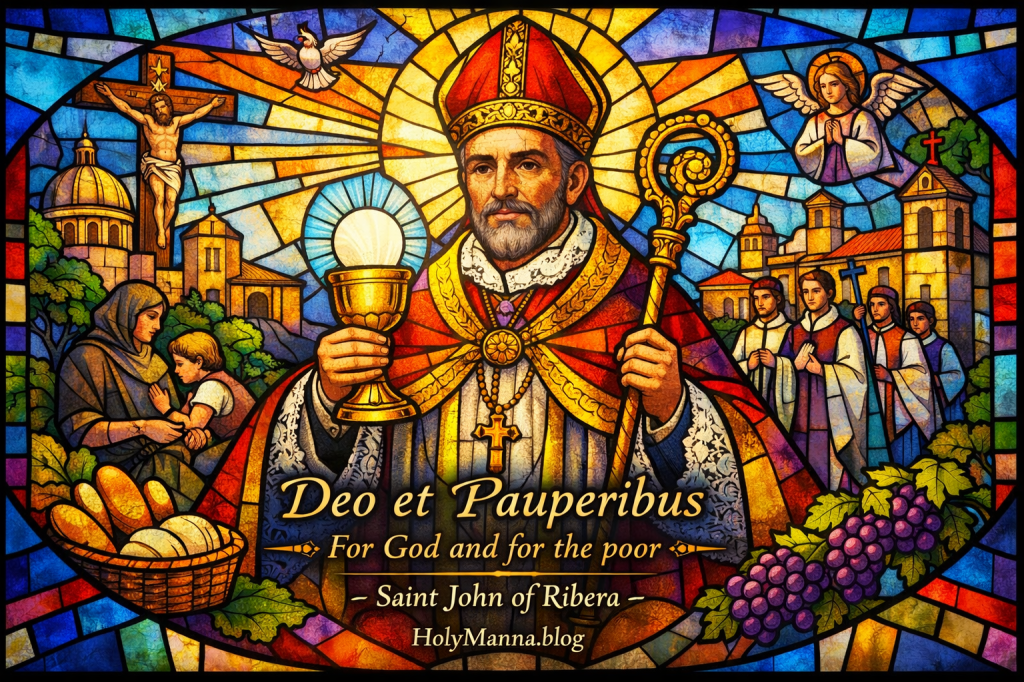
The Patriarch of Valencia and the Fire of Eucharistic Reform
Saint John of Ribera was a towering shepherd during one of the most turbulent moments in Church history. Living in the heart of post Reformation Europe, he embodied what the Catholic Counter Reformation looked like when it was lived seriously and not just talked about. As Archbishop of Valencia for more than forty years, he devoted his life to restoring clarity, discipline, and holiness to a local Church wounded by confusion, weak formation, and cultural tension.
He is revered not for dramatic flair but for steady faithfulness. Saint John of Ribera believed deeply that the Church is renewed when bishops shepherd, priests live holy lives, and the faithful are nourished by sound teaching and reverent worship. His entire ministry flowed from confidence in Christ truly present in the Holy Eucharist, which The Catechism teaches is “the source and summit of the Christian life” (CCC 1324). He lived and governed as if that were not a slogan but a fact.
From Seville’s Nobility to a Life on the Altar
John of Ribera was born in Seville, Spain, in 1532 into a prominent and influential family. His upbringing emphasized education, discipline, and responsibility, forming a young man capable of carrying authority without seeking admiration. From an early age, he showed intellectual brilliance and a serious moral character, qualities that led him to advanced theological studies and eventually to a doctorate.
His conversion was not from unbelief to belief, but from comfort to mission. Immersed in theology during a time of intense doctrinal conflict, he became convinced that truth demanded more than correct ideas. It required a life shaped by prayer, obedience, and sacrifice. Ordained a priest in 1557, he quickly gained a reputation for orthodoxy and pastoral seriousness. When he was appointed Archbishop of Valencia in 1568, he accepted a task that would define his life: reforming a diocese that desperately needed shepherding rooted in truth rather than accommodation.
Deo et Pauperibus
Saint John of Ribera is most remembered as a reforming bishop who implemented the decrees of the Council of Trent with patience and resolve. He understood that renewal had to begin with the clergy, which led him to found the Royal College Seminary of Corpus Christi in Valencia. This seminary was not a prestige project. It was a place meant to form priests who prayed well, taught clearly, celebrated the sacraments reverently, and lived disciplined moral lives.
His episcopal motto summed up his vision with striking simplicity: “Deo et Pauperibus”, meaning “For God and for the poor.” Those words reveal a deeply Catholic balance. Love for God could never be separated from love for neighbor, especially the vulnerable. The Catechism teaches that concern for the poor is a constant part of the Church’s tradition and a non negotiable demand of charity (CCC 2443 to 2449), and Saint John of Ribera lived this teaching quietly but consistently.
He preached often, governed firmly, and visited parishes personally. While he is not widely known for spectacular public miracles during his lifetime, many conversions, reconciliations, and spiritual healings were attributed to his prayers and pastoral care. His greatest miracle was the slow transformation of diocesan life through Eucharistic devotion, sound doctrine, and consistent discipline. In an age hungry for shortcuts, he trusted the long work of grace.
Bearing the Weight of Controversy Without Dropping the Cross
Saint John of Ribera governed during a time of deep political and religious tension, especially surrounding the Moriscos in Valencia. His involvement in decisions related to their expulsion remains one of the most difficult and debated aspects of his legacy. These events must be approached with sobriety, historical awareness, and humility. They reflect a painful chapter in history and the heavy burden carried by Church leaders navigating faith, civil order, and conscience in a fractured society.
Beyond this controversy, his commitment to reform brought resistance from clergy and laypeople alike. Reform always unsettles those who are comfortable with mediocrity. He endured criticism, fatigue, and misunderstanding, yet remained obedient to the Church and faithful to his pastoral mission. Though not a martyr by execution, he lived a quiet martyrdom of perseverance, responsibility, and moral courage, offering daily sacrifices for the good of souls.
A Holy Death and a Reputation That Would Not Fade
Saint John of Ribera died on January 6, 1611, having spent his entire adult life in service to the Church. After his death, devotion to him grew steadily. Many reported healings and favors obtained through his intercession, strengthening his reputation for holiness. His life of discipline, charity, and Eucharistic devotion continued to inspire generations long after his passing.
The Church formally recognized his sanctity through beatification in 1796 and canonization in 1960. His memory remains closely tied to the Royal College of Corpus Christi in Valencia, which stands as a living witness to his vision for priestly formation and Eucharistic reverence. Saints endure because their lives continue to nourish the Church, and Saint John of Ribera remains a steady guide for those seeking renewal rooted in truth.
What Saint John of Ribera Still Teaches the Modern Catholic
Saint John of Ribera speaks powerfully to Catholics living in an age of distraction and compromise. His life shows that renewal does not begin with trends, slogans, or outrage. It begins with prayer, repentance, sound teaching, and reverence for the sacraments. His witness challenges believers to examine whether faith is shaping daily decisions or merely occupying a small corner of life.
His motto, “Deo et Pauperibus”, remains a sharp examination of conscience. Is life truly ordered toward God, or is God treated as an accessory? Is love for the poor expressed through real sacrifice, or only through opinions and intentions? The unity of love for God and neighbor is at the heart of Christian life, as The Catechism teaches when it explains that charity is the form of all virtues (CCC 1822 to 1829).
Above all, Saint John of Ribera reminds Catholics that the Eucharist is not optional or symbolic. If Jesus Christ is truly present, then everything changes. Work, relationships, moral choices, and the way Sundays are lived all take on new meaning. His life calls for a serious, joyful, and disciplined faith that trusts Christ enough to let Him reorder everything.
Engage with Us!
Readers are invited to share their thoughts and reflections in the comments below.
- When reflecting on “Deo et Pauperibus”, what is one concrete way to live more intentionally for God this week, and one concrete way to serve the poor with love?
- How can greater reverence for the Holy Eucharist be practiced more intentionally at Mass and beyond it?
- Where might Jesus be inviting deeper conversion right now: prayer life, moral discipline, sacramental life, or charity toward someone difficult?
May the example of Saint John of Ribera encourage perseverance, courage, and clarity of faith. Let daily life be shaped by truth, nourished by the sacraments, and marked by the love and mercy Jesus taught us.
Saint John of Ribera, pray for us!
Follow us on YouTube, Instagram and Facebook for more insights and reflections on living a faith-filled life.

 Holy Manna!
Leave a comment