Tuesday after Epiphany – Lectionary: 213
When Love Takes the Throne and Breaks the Bread
There is something quietly powerful about the days right after Epiphany. The Church is still soaking in the light of Christ revealed to the nations, but the readings start pressing a very practical question: what does that light actually look like once it lands in real life, with real people, real needs, and real limits? Today’s central theme is simple and demanding: God reveals His love through the true King who shepherds His people with justice and feeds them with merciful abundance.
That is why 1 John 4:7-10 does not begin with a Hallmark version of love. It gets right to the heart of the Gospel. God is not merely loving. God is love. And this love is not defined by human initiative or emotional intensity, but by God’s concrete action in history. “In this is love: not that we have loved God, but that he loved us and sent his Son as expiation for our sins.” This is the kind of love that steps into the mess, takes sin seriously, and pays the price to restore communion. It also sets the standard for Christian living, because anyone who claims to know God but refuses love is living in contradiction.
Then the Church places on our lips Psalm 72:1-4, 7-8, a royal psalm that sounds like a prayer for Solomon but reaches beyond him. Israel knew what it meant to hope for a king who would not exploit the weak. In the ancient world, rulers often built their greatness on the backs of the poor. But this psalm dares to ask for something different: a king whose authority looks like righteousness, protection, and peace. “That he may defend the oppressed among the people, save the children of the poor and crush the oppressor.” The psalm is basically a checklist for what true leadership looks like when it is shaped by God’s heart. It also hints at a kingdom that cannot be contained by borders, because “May he rule from sea to sea.”
That prayer becomes flesh in Mark 6:34-44. Jesus sees the crowd and reacts like the true Shepherd of Israel. “His heart was moved with pity for them, for they were like sheep without a shepherd.” That line carries a lot of biblical weight. Israel’s prophets warned about shepherds who abandoned the flock, and the people suffered because leadership without holiness always turns cruel or careless. Here, Christ does what God promised: He teaches the lost, organizes the scattered, and feeds the hungry. When the disciples stare at the problem and calculate impossibility, Jesus does not deny reality, but He refuses to let scarcity write the ending. He blesses what they have, breaks it, and multiplies it until everyone is satisfied and there are leftovers, not just enough to survive but enough to testify that God is still providing.
Taken together, today’s readings are a portrait of the Lord revealed at Epiphany: the beloved Son sent in love, the King whose reign is justice for the oppressed, and the Shepherd who feeds the flock when no one else can. This is not abstract theology. This is the kind of truth that changes how a person looks at sin, how a person treats the poor, and how a person responds when needs feel bigger than resources. How might God be inviting deeper trust in His love today, especially in places where the heart is tempted to say, “There is not enough”?
First Reading – 1 John 4:7-10
Love Has a Name, and His Name Is Jesus
The Church does not let Epiphany fade into a sweet memory. Right after celebrating Christ revealed to the nations, today’s first reading from 1 John 4:7-10 gets intensely personal. It answers the question people actually live with: What does God’s revelation look like on a random Tuesday, when hearts are tired, relationships are messy, and the world feels cold? Saint John writes to Christians who are trying to stay faithful in a culture that does not think truth matters and does not always think love costs anything. He refuses to let “love” become a vague slogan. For John, love has an origin, a definition, and a decisive moment in history.
This reading sits perfectly inside today’s theme: God reveals His love through the true King who shepherds and feeds His people. Before anyone can live Christian charity, they have to know where love comes from. It does not start in human effort. It starts in God. Then John goes further and points to the concrete proof that love is real: the Father sends the Son, not as a life coach or motivational speaker, but as the saving sacrifice who gives life and deals with sin. This is love that rules like a just King and feeds like a merciful Shepherd, because it restores what sin broke and it refuses to abandon the flock.
1 John 4:7-10 – New American Bible (Revised Edition)
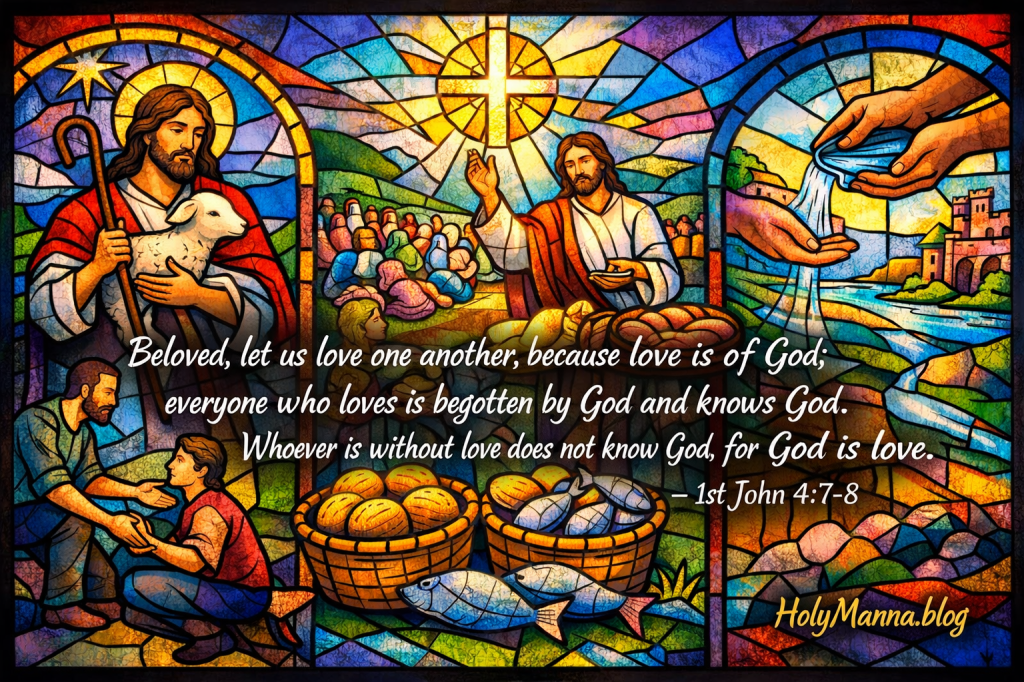
God’s Love and Christian Life. 7 Beloved, let us love one another, because love is of God; everyone who loves is begotten by God and knows God. 8 Whoever is without love does not know God, for God is love. 9 In this way the love of God was revealed to us: God sent his only Son into the world so that we might have life through him. 10 In this is love: not that we have loved God, but that he loved us and sent his Son as expiation for our sins.
Detailed Exegesis
Verse 7 “Beloved, let us love one another, because love is of God; everyone who loves is begotten by God and knows God.”
John begins with a family word, “Beloved,” because Christianity is not a solo self-improvement program. It is communion. The command is straightforward: love one another. Then John gives the reason: love is of God, meaning love does not originate in human mood, personality, or convenience. Love flows from God’s own life. When John says the one who loves is “begotten by God,” he is describing what grace does in baptism and ongoing conversion. Real charity is not simply a human virtue. It is evidence that God’s life is active in the soul. To “know God” here is not mere information. It is relational, covenant knowledge that shapes behavior.
Verse 8 “Whoever is without love does not know God, for God is love.”
This is one of the most direct lines in Scripture, and it is also one of the most misunderstood. John is not saying “love equals whatever feels nice,” and then calling that God. He is saying God’s very nature is love, so a life that refuses love is a life out of sync with reality. If someone claims to know God while nurturing bitterness, cruelty, or indifference, John says the claim is false. This verse is also a warning for religious people. Orthodoxy without charity becomes a contradiction, because God is not an idea to master but a Father to resemble.
Verse 9 “In this way the love of God was revealed to us: God sent his only Son into the world so that we might have life through him.”
John anchors love in revelation and mission. God’s love is not hidden behind clouds of mystery, because it has been revealed. The proof is the sending of the only Son. The phrase “into the world” matters, because the world in John’s writings often represents humanity wounded by sin and confused about God. Into that brokenness, the Father sends the Son. The goal is life, not just survival, not just comfort, but supernatural life through union with Christ. This lines up with the Epiphany season, because Christ is not only shown to the nations, but given to the nations as life.
Verse 10 “In this is love: not that we have loved God, but that he loved us and sent his Son as expiation for our sins.”
John makes sure nobody gets the order wrong. Love does not begin with a human search for God. Love begins with God’s initiative. That is humbling and liberating at the same time. Then John names the cost: the Son is sent as “expiation for our sins.” That means sin is not waved away. It is taken seriously, confronted, and atoned for. Love is not sentimental. Love bleeds. Love repairs. Love rescues. This verse also protects Christians from pride, because nobody can boast that God loves them because they earned it. God loves because God is love, and He saves because He is merciful.
Teachings
This passage is one of the clearest biblical summaries of charity and redemption, and the Church’s teaching echoes it with the same realism. The Catechism makes the foundation plain in CCC 221: “God’s very being is love.” That means love is not optional for Christians, and it is not a side project for spiritual people who have time. Love is the shape of divine life, and discipleship is learning to live that life.
The Catechism also explains that God’s love is not reactive, as if He starts loving after humans behave well. In CCC 604, the Church states: “By giving up his own Son for our sins, God manifests that his plan for us is one of benevolent love.” That line matches 1 John 4:10 almost word for word in meaning. Salvation is not an afterthought. It is the expression of God’s eternal goodness.
When John speaks about “expiation,” the Church clarifies that Christ’s sacrifice is truly for sinners and truly effective. In CCC 615, the Catechism teaches: “For as by one man’s disobedience many were made sinners, so by one man’s obedience many will be made righteous.” Christianity is not just about moral advice. It is about a real healing accomplished by Christ’s obedient love.
And because John’s command is “let us love one another,” the Church insists that charity is not just feelings but a supernatural virtue. In CCC 1822, the Catechism defines charity like this: “Charity is the theological virtue by which we love God above all things for his own sake, and our neighbor as ourselves for the love of God.” That is the kind of love that can forgive, serve, and persevere even when it costs.
Saints have always read this passage as both comfort and challenge. Saint Augustine famously keeps love grounded in God, not in chaos or impulse: “Love, and do what you will.” When charity is real, it does not lead to selfishness. It leads to holiness, because true love does not contradict God’s commands. Saint Thomas Aquinas makes the same point in a more technical way: “Charity is the form of the virtues.” In other words, charity is what makes every other virtue truly Christian. Without love, even good works can become self-serving.
Historically, this teaching mattered deeply in the early Church because Christian communities were surrounded by a pagan culture where “love” could mean appetite, status, or power. The Church’s witness was different. Christians cared for the poor, the sick, and even abandoned infants, not because it was trendy, but because God had loved them first. When John says love reveals who truly knows God, he is describing a visible, public faith, not a private hobby.
Reflection
This reading is a reality check for everyday life. A lot of people want to love, but they want it to be easy, quick, and rewarding. Saint John does not let anyone pretend. He teaches that love begins with God’s initiative and is proven by sacrifice. That means a Christian cannot wait for the perfect mood or the perfect conditions to start loving. Love is learned by receiving it from Christ and then giving it away, especially when it is inconvenient.
A practical starting point is to notice where love gets replaced with control, resentment, or withdrawal. When the heart starts saying, “They do not deserve it,” today’s reading responds with the truth: God loved first. When the mind says, “There is no way to fix this,” today’s reading answers: God sent His Son as expiation, which means God specializes in repairing what humans cannot repair.
Concrete steps help. Begin the day by naming one person who will receive intentional charity, not vague kindness, but a real act of love that costs something, like patience, an apology, a meal, a call, or a hidden sacrifice. Then take one honest inventory of the heart: is love being treated like a feeling, or like a decision rooted in God’s action? This is where Epiphany gets real, because Christ revealed to the nations is also Christ revealed in a kitchen, an office, a commute, and a tense conversation.
Where has God’s love been treated like something to earn, instead of something to receive? Who is being hardest to love right now, and what would it look like to love them “because love is of God”? If God proved love by sending His Son, what small proof of love can be offered today that actually costs something and blesses someone else?
Responsorial Psalm – Psalm 72:1-4, 7-8
The King Who Proves His Power by Protecting the Weak
Right after Epiphany, the Church keeps pulling the heart toward a bigger question than holiday vibes: What kind of King is Jesus, really? Psalm 72:1-4, 7-8 answers that with a vision of kingship that would have sounded almost shocking in the ancient world. Most rulers measured success by territory, tribute, and military victories. Israel was taught to measure a king differently. A righteous king was supposed to reflect God’s own justice, especially in how he treated the poor, the oppressed, and the vulnerable.
This psalm is traditionally linked with Solomon, but it clearly reaches beyond any merely human king. It is a prayer for a ruler whose reign produces justice, peace, and abundance that does not run dry. That is why it fits perfectly with today’s theme. The first reading says God’s love is revealed in sending the Son. This psalm shows what that love looks like when it takes the form of a kingdom. It protects the weak, crushes oppression, and spreads peace like a blessing that keeps growing. In the Gospel, Jesus feeds the crowd like a Shepherd King. In the psalm, that Shepherd King is described before He even appears on the shore.
Psalm 72:1-4, 7-8 – New American Bible (Revised Edition)
A Prayer for the King
1 Of Solomon.
2 O God, give your judgment to the king;
your justice to the king’s son;
That he may govern your people with justice,
your oppressed with right judgment,
3 That the mountains may yield their bounty for the people,
and the hills great abundance,
4 That he may defend the oppressed among the people,
save the children of the poor and crush the oppressor.7 That abundance may flourish in his days,
great bounty, till the moon be no more.8 May he rule from sea to sea,
from the river to the ends of the earth.
Detailed Exegesis
Verse 1 “Of Solomon.”
This heading matters because it connects the psalm to Israel’s monarchy and its hopes for wise leadership. Solomon was remembered for wisdom and for building the Temple, but the psalm’s ideals go beyond Solomon’s actual reign. The Church has long read this as pointing toward the Messiah, because only the Christ can fulfill the full scope of what is being prayed for here.
Verse 2 “O God, give your judgment to the king; your justice to the king’s son; That he may govern your people with justice, your oppressed with right judgment,”
This is not a prayer for a king to follow his own instincts. It is a prayer for the king to receive God’s judgment and God’s justice. That is a huge distinction. The king is not meant to be the source of truth. The king is meant to be accountable to God and shaped by God. The goal is that governance becomes justice for the people and right judgment for the oppressed. The psalm assumes that power is a responsibility, not a privilege. It also implies that the poor are a spiritual test for leadership.
Verse 3 “That the mountains may yield their bounty for the people, and the hills great abundance,”
Mountains and hills were symbols of stability and strength, and here they become images of creation responding to righteous rule. In biblical thought, when God’s order is honored, blessings flow. When injustice reigns, disorder spreads. This verse points to a kingdom where the common good is real, where people are not crushed by corruption, and where society becomes fertile again. It is also a quiet reminder that God wants abundance to serve the people, not just enrich elites.
Verse 4 “That he may defend the oppressed among the people, save the children of the poor and crush the oppressor.”
This is the psalm’s backbone. The righteous king defends the oppressed and saves the children of the poor. That phrase is not sentimental. It is specific. It points to the most vulnerable, those with the least protection, the least political leverage, and the least ability to fight back. The psalm also says the king must crush the oppressor. That does not mean personal vengeance. It means ending systems and actions that devour the weak. This is what justice looks like when it is not theoretical.
Verse 7 “That abundance may flourish in his days, great bounty, till the moon be no more.”
The psalm links justice to peace and abundance. When the king rules with God’s justice, blessing is not a quick flash. It endures. The phrase “till the moon be no more” is poetic language for a reign with lasting impact. Read in a Messianic key, it points toward the eternal kingdom of Christ, whose peace does not expire with the next election, the next crisis, or the next generation.
Verse 8 “May he rule from sea to sea, from the river to the ends of the earth.”
This is universal language. It expands the horizon beyond Israel’s borders and points toward a reign meant for all nations. That is why this psalm feels at home in the Epiphany season. Epiphany is about Christ revealed to the Gentiles, and here the psalm is already praying for a kingdom that reaches to “the ends of the earth.” The kingship of the Messiah is not tribal. It is catholic, meaning universal.
Teachings
This psalm is not just ancient political theory. It is a prophetic portrait of the Messiah and a moral standard for anyone who holds authority. The Catechism teaches that the coming of God’s kingdom is inseparable from justice for the poor and liberation from oppression. In CCC 544, the Church says: “The Kingdom belongs to the poor and lowly, which means those who have accepted it with humble hearts. Jesus is sent to preach the good news to the poor.” That is exactly what Psalm 72 describes. The true king is measured by how he treats the lowly.
The Catechism also makes clear that Christ reigns by serving. In CCC 786, speaking of the People of God sharing in Christ’s kingship, it says: “The People of God fulfills its royal dignity by a life in keeping with its vocation to serve with Christ.” That line protects Catholics from confusing Jesus with worldly rulers. Christ’s throne is the Cross, and His royal authority is expressed through self-giving love that restores the weak.
The Church also insists that care for the poor is not optional. It is a direct demand of the Gospel. In CCC 2448, the Catechism teaches: “In its various forms material deprivation, unjust oppression, physical and psychological illness and death are the signs of the hereditary condition of weakness caused by sin and in need of salvation. This is why Christ the Savior showed special concern for the poor and alleviating their suffering.” This psalm gives the template for that concern, because it ties righteousness to defending the oppressed.
Saint John Chrysostom preached with fire about this connection between worship and justice. He did not let Christians pretend they loved Christ while ignoring the needy. He said: “If you cannot find Christ in the beggar at the church door, you will not find Him in the chalice.” That is exactly the spirit of Psalm 72. A true king, and true disciples of the King, cannot be indifferent to suffering.
Historically, Christians often used this psalm in royal contexts, including coronations, because it offered a standard higher than propaganda. It reminded rulers that legitimacy comes from conforming to God’s justice. In the light of Christ, it becomes even clearer: the only King who perfectly fulfills this psalm is Jesus, who defends the oppressed not by speeches, but by saving from sin, feeding the hungry, and gathering the scattered.
Reflection
This psalm challenges modern instincts, because it says power is proven by protection, not by dominance. It also hits close to home, because everyone has some kind of authority. Parents have it. Managers have it. Older siblings have it. Coaches have it. Priests have it. Teachers have it. Even friendships have it, because influence is real. The question becomes whether that influence is used like the Messiah’s kingship or like the world’s.
A practical way to live this psalm is to start small and get specific. Look for the “children of the poor” in daily life, meaning the people who are easiest to overlook, the ones who cannot repay kindness, the ones whose needs are inconvenient. That could be the coworker who is quietly struggling, the elderly neighbor who is isolated, the single parent who is exhausted, or the family member who is always treated like the problem. Justice begins when the heart refuses to crush and chooses to defend.
This psalm also teaches that peace and abundance are not produced by comfort alone. They flourish where righteousness is real. That means a Catholic cannot separate prayer from the treatment of others. A person can pray beautifully and still be unjust at home, unfair at work, or cold toward the needy. The psalm invites integrity: to ask God for justice, and then to act like someone who really wants it.
Where does daily life offer a chance to defend someone instead of dismissing them? Who feels oppressed or unseen in the circles closest to home, and what would it look like to bring them right judgment instead of quick judgment? If Christ’s kingdom is meant to reach “to the ends of the earth,” what part of the heart still resists letting His justice reign in habits, spending, speech, or priorities?
Holy Gospel – Mark 6:34-44
The Shepherd King Who Refuses to Send the Hungry Away
Right after Epiphany, the Church keeps revealing what kind of Messiah Jesus actually is. He is not a distant ruler who stays clean while the people struggle. He is the Shepherd King whose heart moves first, whose teaching comes with authority, and whose mercy becomes bread in the hands of ordinary disciples. In Mark 6:34-44, Jesus steps off the boat and immediately sees a massive crowd. They are not organized, not impressive, and not self-sufficient. They are hungry in more ways than one, and Saint Mark describes them with a line that carries the whole Old Testament behind it: “They were like sheep without a shepherd.”
That image matters because Israel had a long memory of failed shepherds, leaders who exploited rather than served. The prophets promised that God Himself would come shepherd His people, gather the scattered, and feed them. This Gospel shows that promise taking flesh. It also fits perfectly with today’s theme. In the first reading, love is revealed because the Father sends the Son. In the psalm, the true king defends the poor and brings abundance. Here in the Gospel, Jesus does both. He teaches like the true Shepherd, and He feeds like the King whose kingdom is not scarcity but mercy.
Mark 6:34-44 – New American Bible (Revised Edition)
The Feeding of the Five Thousand. 34 When he disembarked and saw the vast crowd, his heart was moved with pity for them, for they were like sheep without a shepherd; and he began to teach them many things. 35 By now it was already late and his disciples approached him and said, “This is a deserted place and it is already very late. 36 Dismiss them so that they can go to the surrounding farms and villages and buy themselves something to eat.” 37 He said to them in reply, “Give them some food yourselves.” But they said to him, “Are we to buy two hundred days’ wages worth of food and give it to them to eat?” 38 He asked them, “How many loaves do you have? Go and see.” And when they had found out they said, “Five loaves and two fish.” 39 So he gave orders to have them sit down in groups on the green grass. 40 The people took their places in rows by hundreds and by fifties. 41 Then, taking the five loaves and the two fish and looking up to heaven, he said the blessing, broke the loaves, and gave them to [his] disciples to set before the people; he also divided the two fish among them all. 42 They all ate and were satisfied. 43 And they picked up twelve wicker baskets full of fragments and what was left of the fish. 44 Those who ate [of the loaves] were five thousand men.
Detailed Exegesis
Verse 34 “When he disembarked and saw the vast crowd, his heart was moved with pity for them, for they were like sheep without a shepherd; and he began to teach them many things.”
Jesus does not begin with annoyance or distance. He begins with compassion, and the word “pity” here is deep, gut-level mercy. This is not sentiment. This is a Shepherd’s love. The crowd is “without a shepherd,” which implies spiritual vulnerability and leadership failure. Jesus responds by teaching first, because hunger for truth is real hunger. The Church always holds together truth and charity, because mercy without truth becomes confusion, and truth without mercy becomes harshness.
Verse 35 “By now it was already late and his disciples approached him and said, ‘This is a deserted place and it is already very late.’”
The disciples are not wrong. The setting is remote, time is running out, and the crowd is huge. This verse sets up the human problem that makes the miracle meaningful. God does not perform miracles to show off. He reveals His kingship where human limits become obvious.
Verse 36 “Dismiss them so that they can go to the surrounding farms and villages and buy themselves something to eat.”
This is practical logic. It also reveals a temptation that shows up in every generation: send people away when their needs become inconvenient. The disciples’ suggestion is not cruel, but it is limited. It assumes the best solution is to disperse the needy rather than to care for them. In a spiritual sense, it is also the temptation to treat people as someone else’s problem.
Verse 37 “He said to them in reply, ‘Give them some food yourselves.’ But they said to him, ‘Are we to buy two hundred days’ wages worth of food and give it to them to eat?’”
Jesus makes the disciples participants, not spectators. “Give them some food yourselves.” He is forming them for mission. Their response is honest panic. Two hundred days’ wages is a huge sum. They are doing the math, and the math says impossible. This is the moment where discipleship gets purified. Either trust grows, or anxiety takes over.
Verse 38 “He asked them, ‘How many loaves do you have? Go and see.’ And when they had found out they said, ‘Five loaves and two fish.’”
Jesus begins with what is available, not with what is ideal. This is not because five loaves and two fish are sufficient, but because obedience places what little is present into the hands of God. The disciples have to go and see, which means they cannot stay in abstractions. They have to face reality and bring it to Jesus.
Verse 39 “So he gave orders to have them sit down in groups on the green grass.”
This is not chaos. Jesus orders the crowd, which shows leadership and care. The green grass gives a quiet echo of Psalm imagery about the Lord as Shepherd who makes His people rest in green pastures. It also makes the scene feel like a banquet, not a desperate scramble.
Verse 40 “The people took their places in rows by hundreds and by fifties.”
The grouping reinforces that this is a shepherding moment. It is organized, communal, and deliberate. Jesus is forming a people, not just feeding individuals. This also prepares the crowd to receive, and it prepares the disciples to serve.
Verse 41 “Then, taking the five loaves and the two fish and looking up to heaven, he said the blessing, broke the loaves, and gave them to [his] disciples to set before the people; he also divided the two fish among them all.”
This verse is loaded. Jesus takes, blesses, breaks, and gives. That sequence echoes the Eucharistic pattern that will appear clearly at the Last Supper. He looks up to heaven, showing that the Father is the source of the gift. The disciples distribute, meaning Jesus feeds the crowd through their hands. This is a lesson about the Church’s mission. Christ remains the source, but He chooses to work through His disciples.
Verse 42 “They all ate and were satisfied.”
This is not a symbolic nibble. It is real satisfaction. God’s mercy is not stingy. When Christ provides, He provides abundantly. Spiritually, this also hints at the deeper truth that human hearts are not satisfied by bread alone, but Christ begins with bread because He cares for the whole person.
Verse 43 “And they picked up twelve wicker baskets full of fragments and what was left of the fish.”
Twelve baskets is not an accident. Twelve evokes the twelve tribes of Israel, suggesting the Messiah is gathering and providing for the whole people of God. The leftovers show superabundance. God’s generosity overflows. The fragments also matter because nothing is wasted. What God gives is to be reverenced, gathered, and protected.
Verse 44 “Those who ate [of the loaves] were five thousand men.”
The number highlights the scale. This is not a small crowd at a private retreat. This is a public sign on a massive level. Jesus reveals His kingship in front of thousands, not through domination, but through mercy and provision. It is a glimpse of the kingdom described in Psalm 72, where abundance flourishes under the just reign of the true King.
Teachings
This Gospel is one of the clearest windows into Christ’s compassion and into how the Church understands the Eucharist. The Catechism teaches that Christ’s miracles are signs of the kingdom and acts of mercy. In CCC 547, the Church says: “Jesus accompanies his words with numerous ‘mighty works and wonders and signs’, which manifest that the kingdom is present in him and attest that he was the promised Messiah.” The feeding of the five thousand is exactly that, a sign that the Messiah has come and the kingdom is breaking into history.
The Catechism also connects Christ’s compassion to the mission of the Church. In CCC 2449, it states: “Jesus says: ‘As you did it to one of the least of these my brethren, you did it to me’, and he also says: ‘You always have the poor with you, but you will not always have me.’” Jesus refuses to dismiss the crowd, and He forms His disciples to serve them. That is not only a miracle story. It is a pattern for Christian life.
This passage also foreshadows the Eucharist in a way the Church takes seriously. In CCC 1335, the Catechism teaches: “The miracles of the multiplication of the loaves, when the Lord says the blessing, breaks and distributes the loaves through his disciples to feed the multitude, prefigure the superabundance of this unique bread of his Eucharist.” That is why the Church reads this Gospel with Eucharistic ears. Jesus does not just give bread. He reveals the kind of Savior He is, one who will ultimately give Himself as the true Bread from heaven.
Saint John Paul II often returned to this logic of Christ’s compassion and Eucharistic self-gift. He wrote in Ecclesia de Eucharistia that the Eucharist is not only worship but mission, and it forms believers into what they receive. Even without quoting that document here, the point matches today’s Gospel: the disciples have to put their hands to the work, and the people have to be fed, because Christ’s love is never meant to stay theoretical.
Historically, the early Church understood this miracle as both a sign of Jesus’ messianic identity and a picture of the Church’s life. Christians gathered for the breaking of bread, cared for the poor, and became known for refusing to abandon the needy. This Gospel helps explain why. A Church that receives Christ but dismisses the hungry is not acting like the Church Christ formed.
Reflection
This Gospel hits daily life right in the pressure points. It is easy to have compassion when a need is small and manageable. It is harder when the need is big, complicated, and expensive. The disciples look at the crowd and see a problem. Jesus looks at the crowd and sees persons, sheep without a shepherd, and His heart moves first.
There is a very practical lesson here: Jesus does not usually begin by dropping a miracle out of the sky. He begins by asking for what is already in hand. Five loaves and two fish is not impressive, but obedience turns small offerings into instruments of grace. That means daily life is not primarily about having more resources. It is about bringing what is available to Christ, even when it feels insufficient.
This also challenges the instinct to “dismiss” people. In modern life, dismissal can look polite. It can sound like, “Someone else will handle it,” or “It is not the right time,” or “That is not my responsibility.” Jesus’ words cut through that: “Give them some food yourselves.” This is not a call to burnout or savior complexes. It is a call to charity with trust, where each person gives what they can and relies on God to multiply it.
A simple way to live this today is to identify one concrete hunger nearby. That might be literal hunger, like someone who needs a meal. It might be emotional hunger, like someone who needs attention and patience. It might be spiritual hunger, like someone who needs truth spoken with kindness. Then the heart can ask whether it wants to send them away or serve them through Christ.
Where has the heart been tempted to dismiss someone because their need feels too big or too inconvenient? What are the “five loaves and two fish” available today, meaning the small resources of time, money, patience, or prayer that could be placed into Christ’s hands? If Jesus feeds through the hands of disciples, what would change if daily responsibilities were treated as a place where Christ wants to multiply love instead of a place where scarcity gets the final word?
Let the King Teach the Heart and Feed the Day
Today’s readings land like one united message with three strong notes: God’s love is real, God’s kingdom is just, and God’s mercy is abundant. None of this is theory, and none of it is reserved for people who have perfect lives. This is the kind of truth meant for ordinary days when there is not enough energy, not enough patience, and not enough clarity.
In 1 John 4:7-10, the foundation is laid with a truth that changes everything: “God is love.” Love is not invented by human effort, and it is not proved by big feelings. Love is revealed in what God has done, because “he loved us and sent his Son as expiation for our sins.” That means faith starts by receiving. It starts by letting God’s initiative rewrite the story, especially in places where sin, shame, or resentment try to speak louder than grace.
In Psalm 72:1-4, 7-8, the Church prays for the kind of king the world rarely offers: a ruler shaped by God’s justice, defending the oppressed and bringing peace that actually holds. The psalm makes it clear that righteousness is not optional and the poor are never invisible to God. This is what Christ’s reign looks like when it touches the ground. It lifts the lowly, confronts oppression, and makes abundance flourish for the good of the people.
Then Mark 6:34-44 shows that King stepping into the real world. Jesus sees the crowd, and “his heart was moved with pity for them.” He teaches them because truth feeds the soul, and He feeds them because love refuses to abandon the body. When the disciples want to dismiss the problem, Jesus turns their fear into mission with one command that still stings in the best way: “Give them some food yourselves.” He takes the small offering, blesses it, breaks it, and multiplies it until everyone is satisfied, and the leftovers prove that God is not a minimalist.
So the call to action today is straightforward, and it is completely doable. Receive God’s love first, especially in the places that feel most unlovable. Then let that love become concrete by defending someone who is overlooked, serving someone who is inconvenient, and offering what is available even if it feels small. Christ does not ask for what is not there. He asks for what can be placed into His hands.
What would change if God’s love was treated as the starting point instead of the reward? Who needs the mercy of a Shepherd today through a real act of charity, a real conversation, or a real sacrifice? What “five loaves and two fish” can be offered with trust, letting Christ do the multiplying?
Engage with Us!
Share reflections in the comments below, because God loves to build up the Church through the wisdom and honesty of ordinary disciples walking through ordinary days. These readings are rich, practical, and challenging in the best way, so let the heart slow down and respond with real prayer and real intention.
- First Reading, 1 John 4:7-10: Where has love been treated like something to earn instead of something to receive, and how does “God is love” challenge that mindset today? What relationship needs a concrete act of charity that is rooted in God’s initiative, not personal mood or convenience?
- Responsorial Psalm, Psalm 72:1-4, 7-8: Where is God inviting a more just and compassionate kind of leadership in daily life, whether at home, at work, or in friendships? Who is being overlooked, oppressed, or quietly struggling nearby, and what would it look like to defend them with patience, truth, and real support?
- Holy Gospel, Mark 6:34-44: When life feels like a “deserted place,” what does it look like to bring the little that is available to Jesus instead of giving in to discouragement? Who is hungry for attention, help, or hope right now, and how can the heart respond to Christ’s words, “Give them some food yourselves” with trust and generosity?
Keep walking forward in faith, even when resources feel small and problems feel big, because Christ is still the Shepherd King who teaches, feeds, and multiplies mercy. Let everything today be done with the love and compassion Jesus shows, so that others encounter His heart through simple, faithful choices.
Sacred Heart of Jesus, we trust in You!
Immaculate Heart of Mary, pray for us!
Saint Michael the Archangel, defend us in battle!
Follow us on YouTube, Instagram and Facebook for more insights and reflections on living a faith-filled life.

 Holy Manna!
Leave a comment