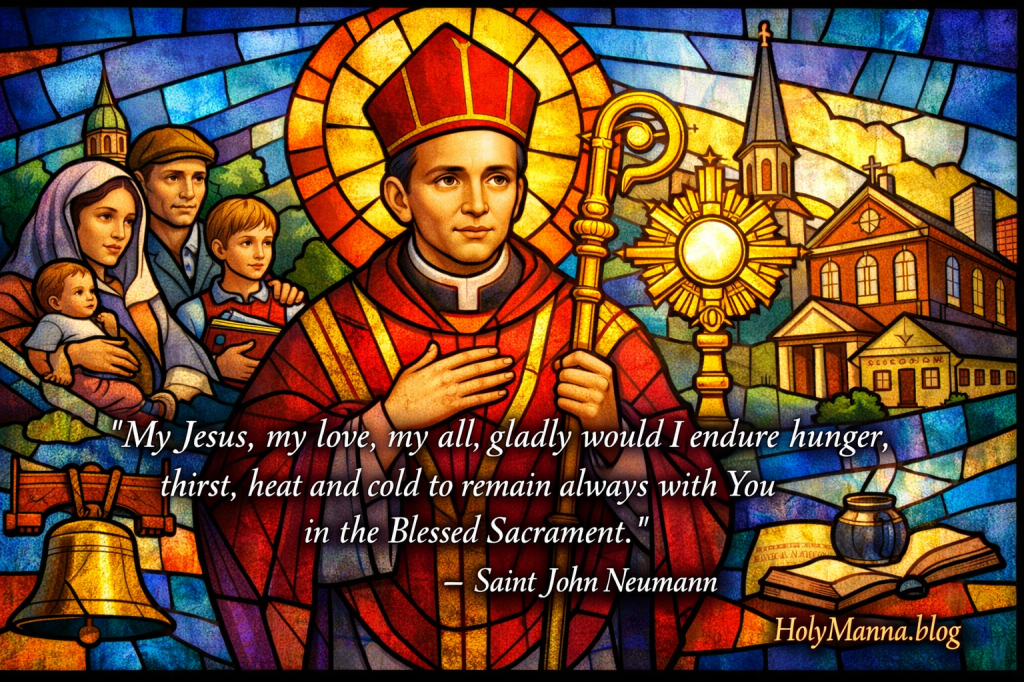
A Saint for Every Busy Catholic
Saint John Nepomucene Neumann holds a unique and deeply American place in the history of the Church. He was the first male American citizen to be canonized and served as the fourth Bishop of Philadelphia during a period of massive immigration, social unrest, and strong anti Catholic sentiment. His sanctity was not rooted in dramatic gestures but in quiet perseverance, obedience, and an unshakable love for the Eucharist. He is especially remembered for strengthening parish life, defending Catholic identity, and laying the groundwork for one of the most influential Catholic school systems in the world.
His life shows that holiness often looks ordinary on the outside while being heroic on the inside. He did not seek recognition, comfort, or influence. He sought fidelity. In doing so, he reshaped the American Church for generations. His example continues to resonate with Catholics trying to remain faithful while juggling responsibility, exhaustion, and cultural pressure.
From Bohemia to the New World
John Neumann was born in 1811 in Prachatice, Bohemia, into a devout Catholic family that took prayer, study, and moral discipline seriously. From an early age, he showed exceptional intellectual ability and a deep attraction to the priesthood. His love for learning was so intense that he later recalled, “My mother used to chide me, and call me book mad, a bibliomaniac.” His early formation grounded him in the theological clarity and sacramental devotion of Central European Catholicism.
Despite completing his theological studies, he faced an unexpected trial. There were more seminarians than available ordinations in his homeland, and he was denied ordination. Rather than abandon his calling, he discerned a missionary vocation and emigrated to the United States in 1836 with almost no possessions. This decision reflected radical trust in divine providence and a willingness to go wherever the Church most needed laborers.
After his ordination in America, he served scattered immigrant communities, often traveling long distances on foot to bring the sacraments to isolated families. Later, he joined the Redemptorists, drawn by their missionary zeal and commitment to preaching the Gospel to the poor. He became the first Redemptorist to profess vows in the United States, embracing a life marked by simplicity, discipline, and obedience.
The Daily Grind of Love
Saint John Neumann’s ministry was shaped by one unchanging center: Jesus Christ present in the Holy Eucharist. Everything else flowed from that truth. He once wrote with striking intimacy, “How much I love You, O my Jesus! I wish to love You with my whole heart; yet I do not love You enough. My lack of devotion and my negligence still haunt me. I have one desire, that of being near You in the Blessed Sacrament. You are the sweet bridegroom of my soul. My Jesus, my love, my all, gladly would I endure hunger, thirst, heat and cold to remain always with You in the Blessed Sacrament.”
As Bishop of Philadelphia, he oversaw explosive growth in the Catholic population, largely driven by immigrants struggling to preserve their faith in a hostile environment. He understood that faith would not survive on sentiment alone. It needed structure, education, and sacramental life. Under his leadership, parish schools expanded rapidly, forming what would become a model diocesan school system. His work embodied the truth that the Eucharist is “the source and summit of the Christian life” as taught in CCC 1324.
Neumann also taught the faith with clarity and charity. In his catechetical writing, he stated plainly, “Can we be saved in every religion? No; we can be saved only in the religion that Jesus Christ has taught.” This conviction reflected the Church’s teaching that Christ is the one Savior and that the fullness of the means of salvation subsists in the Catholic Church, as articulated in CCC 846 to 848. His firmness was not rooted in pride but in pastoral concern for souls.
When the Cross Shows Up
Saint John Neumann did not suffer martyrdom by execution, but his life was marked by a steady, demanding cross. He ministered during a time when anti Catholic prejudice was widespread and sometimes violent. Churches were attacked, religious communities were mistrusted, and Catholic leaders were often criticized for simply defending the faith. Neumann endured misunderstanding from both outside and within the Church, especially when enforcing discipline or expanding Catholic institutions.
Physically, he paid a heavy price. He was frail, chronically overworked, and often ignored warnings to rest. His pastoral zeal kept him moving constantly, visiting parishes, schools, and families despite exhaustion. He embraced penance quietly and consistently, and after his death, evidence of hidden mortification was discovered, revealing a private life of sacrifice known only to God.
His sudden death in 1860, when he collapsed on a Philadelphia street at the age of forty eight, shocked the city. It revealed how deeply he was loved by those he served. His own prayer captures his interior surrender, “Deprive me of everything, my God, but not of the desire to unite my will to your will in perfect resignation!” His life embodied the teaching that Christians are called to share in Christ’s sacrifice, as explained in CCC 618.
Heaven Confirmed His Holiness
After his death, devotion to John Neumann grew steadily. Many of the faithful sought his intercession, especially for healing and perseverance in faith. Several medically inexplicable cures were later recognized by the Church during the canonization process. These included the healing of a young girl suffering from severe peritonitis, a young man critically injured in a car accident, and a child diagnosed with an aggressive form of cancer whose recovery defied medical explanation.
His tomb became a place of pilgrimage, particularly for immigrants, educators, parents, and those seeking strength to remain faithful amid hardship. His incorrupt legacy reinforced the Church’s confidence that God continues to act through the communion of saints, as taught in CCC 956.
A Blueprint for Catholic Life
Saint John Neumann offers a powerful model for Catholics living busy, demanding lives. His first lesson is Eucharistic realism. He lived as though Jesus was truly present, because He is. The Church affirms this reality clearly in CCC 1374, and Neumann’s life shows what happens when that truth shapes daily decisions.
His second lesson is the importance of formation. Faith must be taught, protected, and lived intentionally. Schools, catechesis, and family prayer are not optional extras but essential tools for passing on the faith.
His third lesson is humility through obedience. Neumann avoided honors and accepted responsibilities reluctantly, yet he obeyed faithfully. His life reflects the obedience of faith described in CCC 144 to 149, showing that surrender to God’s will leads to true freedom.
One of his prayers captures his pastoral heart and still speaks today: “O my Jesus, I, a poor, ignorant young man, have become a shepherd in Thy sheepfold. Grant that not one of those confided to me be lost.” This prayer belongs not only to bishops but to parents, teachers, godparents, and anyone entrusted with the care of souls.
Engage with Us!
Readers are invited to share their thoughts and reflections in the comments below and to join the conversation about this remarkable saint.
- Where is perseverance being demanded right now, and what would it look like to bring that burden to Jesus in the Eucharist?
- What part of Catholic formation needs strengthening at home, whether that is prayer, Scripture, catechesis, or sacramental life?
- Who in your life feels spiritually scattered or isolated, and how can patient charity help bring them closer to the Church?
May the quiet courage and Eucharistic love of Saint John Neumann inspire a deeper fidelity to Christ, so that daily duties become acts of love and lives are shaped by the mercy and truth Jesus taught and lived for the salvation of the world.
Saint John Neumann, pray for us!
Follow us on YouTube, Instagram and Facebook for more insights and reflections on living a faith-filled life.

 Holy Manna!
Leave a comment