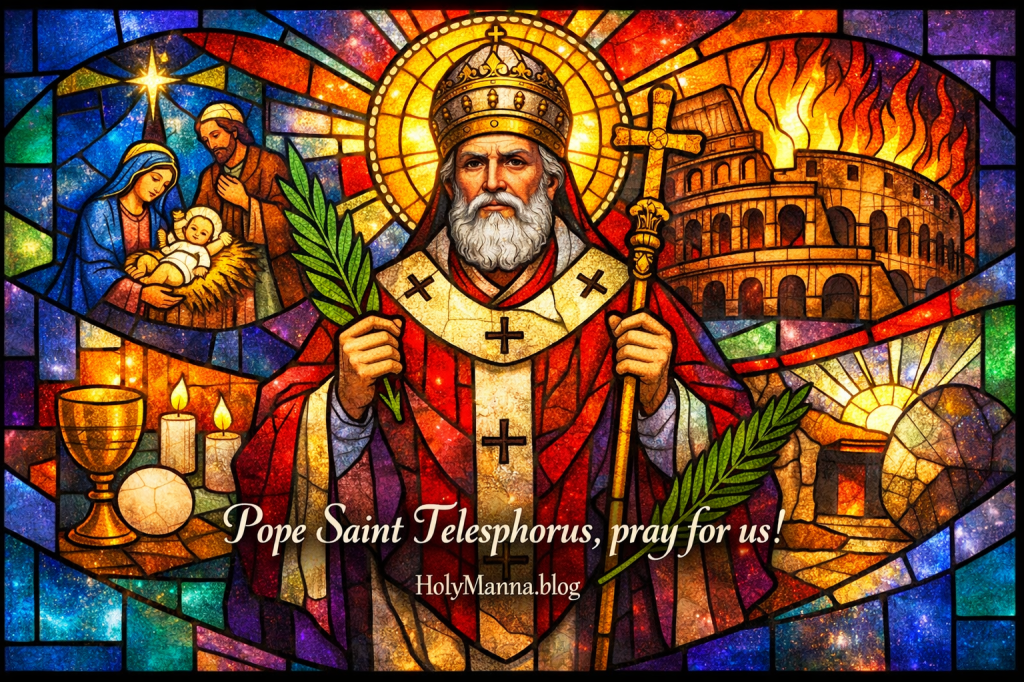
A Quiet Giant of the Early Church
Pope Saint Telesphorus lived in the earliest and most fragile years of the Church, when following Christ was not socially acceptable or culturally protected. It was dangerous. He served as Bishop of Rome in the second century, at a time when Christian worship was still forming and Christian leaders were constant targets. One of the most important early witnesses to his life is Saint Irenaeus, who listed the bishops of Rome and wrote of him “Telesphorus, who was gloriously martyred.”
That brief statement carries enormous weight. It comes from a near contemporary source and tells the Church exactly how to remember him. Not as an administrator or a celebrity, but as a shepherd who remained faithful to Christ unto death. Many later traditions associate Saint Telesphorus with specific liturgical developments, especially related to Christmas and fasting before Easter. While historians debate the historical certainty of some of these attributions, the Church does not doubt his holiness, his fidelity to apostolic tradition, or his martyrdom. His life stands as a reminder that sanctity often looks quiet, steady, and costly.
Greek Origins and a Life Formed in Faith
Very little is known with certainty about the early life of Saint Telesphorus, which is typical for saints of the second century. Later sources describe him as Greek by birth, possibly from southern Italy, and some traditions portray him as a man shaped by prayer and penitence. While details such as an anchoritic background cannot be historically verified, they do reflect how the early Church understood his character. He was remembered as a man formed interiorly before he was ever entrusted with leadership.
There is no dramatic conversion story recorded for Telesphorus, but that absence speaks volumes. His faith appears to have been consistent, rooted, and lived from within the Christian community itself. In a time when becoming Christian could mean losing one’s livelihood or life, perseverance itself was a form of conversion. Saint Irenaeus emphasizes apostolic succession precisely to show that the faith was being handed on intact, not reinvented. Telesphorus stands firmly within that chain, guarding what he received and transmitting it faithfully to those who followed.
Guarding Worship and Unity
Later Church tradition associates Pope Saint Telesphorus with strengthening the Church’s liturgical life, particularly the celebration of Christ’s Nativity and the discipline of fasting before Easter. While these attributions appear in sources written centuries later and cannot be proven with historical certainty, they do point to something undeniably true about his role. He lived at a time when worship mattered deeply, because it was often celebrated in secret and at great personal risk.
One enduring tradition connects him with maintaining unity in the Church during early disagreements over the date of Easter. The Roman practice of celebrating Easter on Sunday was upheld, while communion with other Christian communities was preserved. This approach reflects a pastoral wisdom that balanced truth and charity, a balance still urgently needed today.
No specific, verifiable miracle stories from his lifetime survive. That does not diminish his sanctity. In the early Church, the daily miracle was endurance. To shepherd a persecuted community, preserve doctrinal unity, encourage prayer and penance, and refuse compromise required grace far beyond human strength. Faithfulness itself was the sign of God’s action.
A Witness Sealed in Blood
Pope Saint Telesphorus is consistently honored as a martyr by the Church. Among the early popes, he is the first after Saint Peter whose martyrdom is supported by early and credible testimony. The details of his death are not preserved, but the Church has never forgotten its meaning. Saint Irenaeus’s description of his death as “glorious” is deeply theological, not sentimental.
The Catechism teaches that “martyrdom is the supreme witness given to the truth of the faith” (CCC 2473). Saint Telesphorus embodied that teaching long before it was written down. His death strengthened the faith of the early Christian community and reminded them that the truth of Christ was worth more than safety or comfort. His martyrdom was not an interruption of his ministry. It was its completion.
Veneration That Outlasts Empires
Because Saint Telesphorus lived so early in Church history, there are no detailed, well documented miracle accounts attributed to him after death. What the Church does possess is something just as meaningful: continuous veneration. His name appears consistently in early lists of popes and martyrs, and his feast day has been remembered in both Western and Eastern Christian traditions.
The absence of elaborate miracle stories highlights an important truth about early sainthood. The Church canonized saints because of their fidelity to Christ, not because of dramatic narratives. The enduring memory of Saint Telesphorus is itself a kind of miracle. His witness survived persecution, centuries of historical uncertainty, and the rise and fall of empires. His life continues to call Catholics to seriousness, reverence, and courage.
Learning to Live a Solid Faith
Saint Telesphorus offers a powerful example for Catholics who want a faith that is grounded and real. His life shows that holiness is often built through ordinary fidelity, not public recognition. He teaches the value of worship that is reverent, disciplined, and centered on Christ, even when culture is indifferent or hostile.
His example invites Catholics to take the liturgical year seriously, to recover fasting and self denial as spiritual tools rather than outdated customs, and to remain faithful without becoming harsh. The Catechism reminds believers that interior conversion is expressed through practices like fasting, prayer, and sacrifice (CCC 1434). These practices are not about punishment. They are about love.
Where has faith become too casual or too comfortable?
How might deeper reverence in worship reshape daily life?
What small sacrifice could help the heart grow freer for God right now?
Engage with Us!
Readers are invited to share their thoughts and reflections in the comments below and join the conversation as the Church continues to learn from her saints.
1. What does Saint Telesphorus teach about holding the faith steady when culture pushes back?
2. Where could worship become more reverent and more central in daily life right now?
3. What kind of fasting or self-denial would genuinely help the heart grow closer to God this week?
May the witness of Pope Saint Telesphorus strengthen every Catholic to live a steady and courageous faith, and may everything be done with the love and mercy Jesus taught us, even when it costs something.
Pope Saint Telesphorus, pray for us!
Follow us on YouTube, Instagram and Facebook for more insights and reflections on living a faith-filled life.

 Holy Manna!
Leave a comment