Memorial of St. John Neumann, Bishop – Lectionary: 212
When the Light Breaks In
Some mornings feel like walking into the day with fog still clinging to the soul, and that is exactly where today’s readings begin. They speak to anyone who has ever felt surrounded by noise, competing voices, and a world that can look bright on the surface but still leave the heart in the dark. The Word of God does not pretend that confusion is not real. Instead, it gives a clear path forward: cling to Jesus Christ, stay rooted in His commandments, and learn to recognize the difference between the Spirit of truth and the spirit of deceit.
The central theme tying today’s readings together is this: Christ brings His light into a dark world, and that light is received and protected through obedient love and spiritual discernment. In the First Letter of John, the Church is dealing with real division and real deception, not just personal doubts. Some teachers were denying the Incarnation, refusing to confess that Jesus Christ truly came in the flesh. That matters because if Christ did not truly take on human nature, then He did not truly redeem it. That is why John insists on a very practical test: the Spirit of God confesses Jesus Christ come in the flesh, and the Christian life looks like believing in His name and loving one another. The Christian is not left to drift in feelings or trends, because the Spirit given by God anchors the heart in truth and forms it in love. The promise is steady and strong: “the one who is in you is greater than the one who is in the world.”
That same steady strength shows up in Psalm 72, which is a prayer for the king, but not just any king. It is the kind of king Israel longed for when human rulers failed them, a king whose reign would look like justice for the oppressed, rescue for the poor, and peace that spreads outward like daylight. The Church has always heard this psalm as a window into the Messiah’s reign, because only Christ perfectly fulfills what it describes. When the psalm says “For he rescues the poor when they cry out, the oppressed who have no one to help,” it is not selling a fantasy. It is naming the heart of God’s Kingdom, where the vulnerable are not an afterthought and mercy is not a weakness.
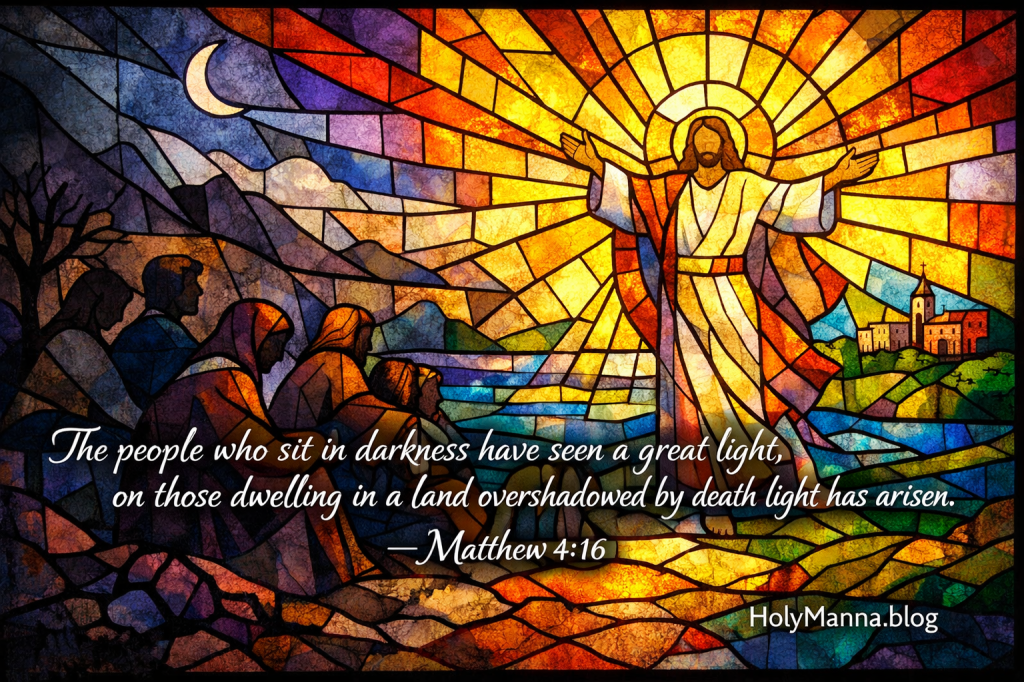
Then the Gospel from The Gospel of Matthew places that Kingdom on the map and in history. After John the Baptist is arrested, Jesus withdraws to Galilee and begins His public preaching in a region marked by mixed populations and heavy Gentile presence, the “Galilee of the Gentiles.” In other words, the light does not start in a place chosen for prestige. It rises in the margins, where people had learned to live with darkness as if it were normal. Matthew reaches back to Isaiah to show that God keeps His promises, and that the arrival of Jesus is not a random event but a divine fulfillment: “the people who sit in darkness have seen a great light.” Immediately, Jesus preaches the message that still confronts every heart today: “Repent, for the kingdom of heaven is at hand.” Repentance is not self-hatred or spiritual panic. It is turning toward the Light because the Light has actually arrived.
Read together, today’s readings form a single invitation: come out of the dark by coming close to Christ, stay in the truth by testing the spirits, and prove that faith is real through love that obeys. The Catechism teaches that faith is not a private opinion but a personal adherence to God who reveals Himself, and that the moral life flows from communion with Him, not from mere rule-keeping. The Spirit does not just inform the mind. He strengthens the will, purifies love, and makes it possible to live as a child of God in a culture that constantly tries to rename darkness as light.
What voices have been shaping the heart lately, and do they lead closer to Jesus Christ who truly came in the flesh? Is love becoming more concrete through obedience, patience, and mercy, or is it staying stuck at the level of good intentions? Those questions set the stage for everything that follows, because today is not about collecting inspiring ideas. Today is about stepping into the light of the King who has come and letting His Spirit teach the heart how to recognize truth, reject deceit, and live the Kingdom for real.
First Reading – 1 John 3:22-4:6
Staying in the Light by Obedient Love and Clear Discernment
1 John comes from the heart of the early Church when Christians were still learning how to live faithfully in a world full of competing spiritual claims. The community behind this letter appears to be facing confusion and division, especially from teachers who sounded spiritual but twisted the truth about Jesus. Some were denying the Incarnation, refusing to confess that the Son of God truly came in the flesh. That might sound like an abstract theological debate, but it strikes at the center of salvation. If Jesus did not truly become man, then He did not truly redeem human life from the inside.
That is why today’s passage feels so direct and so practical. It ties together three realities that always belong together in Catholic life: real faith in Jesus Christ, real love of neighbor, and real discernment of spirits. This fits perfectly with today’s theme, because Christ’s light is not received by vibes and slogans. Christ’s light is received by those who remain in Him through obedience, charity, and truth, and who refuse to let the world’s counterfeit spirituality replace the Gospel.
1 John 3:22-4:6 – New American Bible (Revised Edition)
22 and receive from him whatever we ask, because we keep his commandments and do what pleases him. 23 And his commandment is this: we should believe in the name of his Son, Jesus Christ, and love one another just as he commanded us. 24 Those who keep his commandments remain in him, and he in them, and the way we know that he remains in us is from the Spirit that he gave us.
Testing the Spirits. 1 Beloved, do not trust every spirit but test the spirits to see whether they belong to God, because many false prophets have gone out into the world. 2 This is how you can know the Spirit of God: every spirit that acknowledges Jesus Christ come in the flesh belongs to God, 3 and every spirit that does not acknowledge Jesus does not belong to God. This is the spirit of the antichrist that, as you heard, is to come, but in fact is already in the world. 4 You belong to God, children, and you have conquered them, for the one who is in you is greater than the one who is in the world. 5 They belong to the world; accordingly, their teaching belongs to the world, and the world listens to them. 6 We belong to God, and anyone who knows God listens to us, while anyone who does not belong to God refuses to hear us. This is how we know the spirit of truth and the spirit of deceit.
Detailed Exegesis
Verse 22 – “and receive from him whatever we ask, because we keep his commandments and do what pleases him.”
This is not a blank check for comfort or success. It is a promise rooted in communion. When a heart is shaped by God’s commandments, prayer becomes less about trying to bend God’s will and more about being aligned with it. Asking becomes trusting, not demanding. The phrase “do what pleases him” points to a life that is intentionally offered to God, where moral obedience is not mere rule-following but a relationship of love expressed through fidelity.
Verse 23 – “And his commandment is this: we should believe in the name of his Son, Jesus Christ, and love one another just as he commanded us.”
John gives a summary of the whole Christian life in one sentence. Faith and charity are not separate lanes. Believing “in the name” of Jesus means trusting who He is and submitting to His authority, not merely admiring Him. Then John immediately ties that faith to love of neighbor. In Catholic teaching, genuine faith is living and active, and it bears fruit in charity. A Christianity that talks about Jesus but refuses to love is not just immature. It is false.
Verse 24 – “Those who keep his commandments remain in him, and he in them, and the way we know that he remains in us is from the Spirit that he gave us.”
“Remain” is covenant language. It is the language of abiding, dwelling, staying planted. John is describing communion with God, not a passing spiritual moment. Obedience is presented as a sign that this communion is real, because love is proven through action. Then John points to the Holy Spirit as the interior witness. The Spirit is not a vague feeling. The Spirit confirms Christ’s presence by drawing the believer toward truth, repentance, and love that lasts.
Verse 1 – “Beloved, do not trust every spirit but test the spirits to see whether they belong to God, because many false prophets have gone out into the world.”
John is not suspicious of spiritual life. He is realistic about spiritual deception. The early Church encountered preachers who used religious language but led people away from apostolic faith. John calls the faithful to test the spirits, which means discernment is not optional. It is a duty. The Church has always known that not every “spiritual” message is from God, and that false prophecy often rides in on confidence, charisma, and half-truths.
Verse 2 – “This is how you can know the Spirit of God: every spirit that acknowledges Jesus Christ come in the flesh belongs to God,”
John gives a concrete test centered on Christ. True spirits confess the Incarnation. The Spirit of God glorifies Jesus, and never reduces Him to a mere teacher, symbol, or myth. “Come in the flesh” means Jesus is fully God and fully man, truly embodied, truly historical, truly crucified, and truly risen. Catholic faith is not built on an idea but on a Person who entered human history.
Verse 3 – “and every spirit that does not acknowledge Jesus does not belong to God. This is the spirit of the antichrist that, as you heard, is to come, but in fact is already in the world.”
This verse is sharp because the stakes are high. To reject Jesus, or to distort who He is, is not a harmless opinion. It places a person or teaching in opposition to God’s saving work. John’s language about “antichrist” is not meant to fuel panic. It is meant to wake people up. Anything that denies Christ, replaces Christ, or empties Christ of His truth is working against Him, even if it looks religious on the surface.
Verse 4 – “You belong to God, children, and you have conquered them, for the one who is in you is greater than the one who is in the world.”
John speaks like a father who wants his children to be confident, not afraid. The faithful “have conquered” because Christ already has the decisive victory. This is not bragging. This is assurance. Evil is real, but it is not equal to God. The Holy Spirit dwelling in the believer is not weak. The Spirit gives strength to reject lies, endure pressure, and remain faithful even when the world mocks or tempts.
Verse 5 – “They belong to the world; accordingly, their teaching belongs to the world, and the world listens to them.”
John exposes a pattern that is still painfully familiar. Teaching that is “from the world” tends to be flattering, trendy, and comfortable. It confirms people in their preferences rather than calling them to conversion. When the world applauds a message, it is worth asking whether that message is truly the Gospel or simply a baptizing of the culture’s desires.
Verse 6 – “We belong to God, and anyone who knows God listens to us, while anyone who does not belong to God refuses to hear us. This is how we know the spirit of truth and the spirit of deceit.”
John is pointing to apostolic authority and the rule of faith. The “us” here is not ego. It is the apostolic witness safeguarded in the Church. Those who know God receive the Church’s testimony about Christ. Those who refuse the apostolic faith are not merely choosing a different style of spirituality. They are stepping outside the truth. Discernment becomes clearer when the question is simple: does this teaching keep a person in communion with the apostolic Christ, or does it pull them away?
Teachings
This reading harmonizes with a core Catholic principle: love and truth cannot be separated, and authentic spirituality is always Christ-centered and Church-rooted. Discernment is not about being cynical. It is about loving God enough to refuse lies about His Son.
The Catechism teaches that Christ is the definitive revelation and the center of the whole Christian life. It states: “Jesus Christ is true God and true man.” (CCC 464). That short line matters because it is the dividing line John is defending. The Church cannot accept any spirituality that sidelines or reshapes Jesus into something more acceptable to the age.
The Catechism also warns against superstition and false forms of religiosity, because the human heart is capable of seeking spiritual power without surrendering to God. It says: “Superstition is the deviation of religious feeling.” (CCC 2111). That connects directly to John’s command to test the spirits. Not every spiritual feeling is holy, and not every confident teacher is trustworthy.
Saints and Doctors echo this same realism. Saint Ignatius of Loyola, in his rules for discernment, emphasizes that spiritual movements must be tested by their fruits, their direction, and whether they draw a person toward God’s peace through truth and humility, or toward confusion and self-will dressed up as enlightenment. A spirit that leads away from prayer, repentance, sacramental life, and charity is not leading toward God, even if it sounds inspiring.
Historically, the early Church faced serious Christological errors that often claimed to be deeper knowledge. In reality, they hollowed out the Gospel. John’s insistence on confessing Christ “come in the flesh” is a pastoral shield for ordinary believers, protecting them from teachings that would cut them off from the saving reality of the Incarnation, the Cross, and the Resurrection.
Reflection
This reading hits home because the modern world is overflowing with voices that sound spiritual but quietly deny Jesus. Some deny Him outright. Others keep His name but empty it of meaning, turning Him into a motivational figure who never challenges sin and never calls anyone to repent. John’s message is simple and strong: stay close to Christ by keeping His commandments, and do not be afraid to test what is being preached, posted, and promoted.
A good daily practice is to slow down before adopting a message that feels spiritual and ask honest questions. Does this teaching lead toward repentance, humility, and sacrificial love, or does it excuse selfishness while calling it self-care? Does it confess the real Jesus, the Son of God who came in the flesh, or does it reshape Him into a symbol that never demands conversion? Does it deepen love for the Church, the sacraments, and the commandments, or does it train the heart to treat obedience like a burden?
John also gives a quiet comfort that should steady any anxious heart. The Christian is not left alone with deception and temptation. God gives His Spirit, and the Spirit makes it possible to remain in Christ and recognize what is true.
Where has obedient love been getting harder lately, and what step would make it concrete today? What voices have been forming the conscience recently, and do they lead closer to Jesus Christ and His Church, or further away from both? When prayer feels unanswered, is the heart still willing to obey, trusting that communion matters more than outcomes?
This is how the light spreads in everyday life. Faith stays rooted in the real Jesus. Love becomes visible through obedience. Discernment becomes steady because the Spirit of truth is stronger than the spirit of the world.
Responsorial Psalm – Psalm 72:1-2, 7-8, 10-13
The King Who Makes the Light Visible Through Justice and Mercy
Psalm 72 is traditionally associated with Solomon, and it reads like a royal prayer offered at a king’s coronation or at the beginning of a reign. In ancient Israel, kingship was never supposed to be mere political power or personal glory. The king was meant to reflect God’s own rule by defending the poor, upholding justice, and keeping peace within the covenant people. That is why this psalm does not start with military strength or economic strategy. It starts with a plea for God’s judgment and God’s justice, because a king who rules without God’s righteousness becomes a threat to the very people he is supposed to protect.
In the Church’s prayer, this psalm becomes even more radiant because it points beyond any earthly king to Jesus Christ, the true Son of David and the universal King whose Kingdom is marked by light, justice, mercy, and salvation. This fits today’s theme perfectly. The Gospel announces that those who sat in darkness have seen a great light, and this psalm shows what that light looks like when it takes flesh in a righteous reign. It looks like the oppressed defended, the needy protected, and the poor treated with dignity. It is the opposite of the world’s counterfeit power. It is the power of God expressed as mercy and truth.
Psalm 72:1-2, 7-8, 10-13 – New American Bible (Revised Edition)
A Prayer for the King
1 Of Solomon.
2 O God, give your judgment to the king;
your justice to the king’s son;
That he may govern your people with justice,
your oppressed with right judgment,7 That abundance may flourish in his days,
great bounty, till the moon be no more.8 May he rule from sea to sea,
from the river to the ends of the earth.10 May the kings of Tarshish and the islands bring tribute,
the kings of Sheba and Seba offer gifts.
11 May all kings bow before him,
all nations serve him.
12 For he rescues the poor when they cry out,
the oppressed who have no one to help.
13 He shows pity to the needy and the poor
and saves the lives of the poor.
Detailed Exegesis
Verse 1 – “O God, give your judgment to the king; your justice to the king’s son;”
This opening line sets the whole tone. The king does not invent justice. The king receives it from God. In biblical language, “judgment” is not primarily about condemnation. It is about right order, wise decisions, and covenant fidelity. The plea for “your justice” means the king must reflect God’s own righteousness, especially in how he treats those who cannot protect themselves. In Catholic life, this points to Christ the King, whose authority is not selfish but saving, and whose judgments are true because they flow from divine wisdom.
Verse 2 – “That he may govern your people with justice, your oppressed with right judgment,”
The psalm immediately highlights the oppressed. That is not sentimental. That is covenant realism. When leadership is corrupt, it is the vulnerable who suffer first. This verse teaches that righteous rule is measured by the care given to those on the margins. It also echoes the consistent biblical theme that God hears the cry of the poor. The Kingdom of God is not indifferent to suffering. It confronts it with justice and mercy.
Verse 7 – “That abundance may flourish in his days, great bounty, till the moon be no more.”
Here the psalm describes the fruit of righteousness: abundance and flourishing. This is not a prosperity slogan. It is the biblical claim that when justice and peace reign, life becomes more human and more stable. Flourishing is connected to moral order. When people are treated rightly, families and communities can breathe again. The phrase “till the moon be no more” stretches the hope toward permanence, pointing beyond temporary human success to a reign that endures. In the light of Christ, this hints at the everlasting Kingdom that will not pass away.
Verse 8 – “May he rule from sea to sea, from the river to the ends of the earth.”
This is the universal horizon of the psalm. Israel’s kings never truly ruled “to the ends of the earth,” so the Church hears this as messianic. Christ’s reign is not limited by geography or ethnicity. The Gospel reading confirms this by placing Jesus in Galilee of the Gentiles, signaling that His light is for all nations. The Kingdom spreads not by conquest but by conversion, truth, and grace.
Verse 10 – “May the kings of Tarshish and the islands bring tribute, the kings of Sheba and Seba offer gifts.”
These are distant places, symbolizing the nations beyond Israel. The tribute is not just political. It is the recognition of rightful kingship. This verse also harmonizes beautifully with the season’s lingering Epiphany themes, where the nations bring gifts to the Messiah. It points toward worship, toward the world acknowledging that the true King is not a tyrant but a Savior.
Verse 11 – “May all kings bow before him, all nations serve him.”
This is not the language of domination. It is the language of rightful order under God. The nations are not erased. They are gathered. Service here implies alignment with truth and justice. In Christ, this becomes a call for every human authority to submit to God’s moral law and to govern in a way that honors human dignity. It also reminds the heart that no earthly power deserves ultimate loyalty. Only Christ does.
Verse 12 – “For he rescues the poor when they cry out, the oppressed who have no one to help.”
Now the psalm gives the reason for universal allegiance. The King is worthy because He rescues. This is the heart of divine kingship. The poor are not forgotten. Their cries are heard. This line is deeply consonant with the Gospel where Jesus’ light enters darkness and begins to heal and restore. The Kingdom is not mere speech. It is rescue.
Verse 13 – “He shows pity to the needy and the poor and saves the lives of the poor.”
The psalm ends this selection with compassion that becomes action. “Pity” here means mercy, tenderness, and solidarity, not condescension. The King does not just feel for the poor. He saves. This is where the psalm becomes a mirror held up to the Christian conscience, because anyone who belongs to Christ is called to reflect His mercy. Love of neighbor is not optional sentiment. It is part of living in the light.
Teachings
This psalm is a powerful doorway into Catholic teaching about Christ’s kingship and the nature of His Kingdom. Christ reigns, but His reign looks different than worldly power. It is a reign of truth, holiness, grace, justice, love, and peace.
The Catechism speaks directly about this Kingdom, saying: “The kingdom belongs to the poor and lowly, which means those who have accepted it with humble hearts.” (CCC 544). This fits perfectly with Psalm 72, where the King is defined not by luxury but by rescue of the poor and oppressed. The lowly are not a side theme in Scripture. They are at the center of how God reveals His heart.
The Catechism also teaches that Christ is King and Lord of the universe, and that His reign is already present but not yet fully revealed. It states: “Christ is Lord of the cosmos and of history. In him human history and indeed all creation are ‘set forth’ and transcendently fulfilled.” (CCC 668). When this psalm prays for a reign “from sea to sea,” it is ultimately pointing to the cosmic lordship of Christ, the One who gathers nations into the truth and heals what sin has fractured.
Saint Augustine loved to preach that true rulers are servants of justice, and that societies become disordered when they worship power instead of God. His famous insight cuts through political fantasies and forces a spiritual examination. He insisted that without justice, earthly kingdoms become little more than organized theft, because power without righteousness always preys on the weak. That is exactly why Psalm 72 begins by begging God to give His judgment and justice to the king. The psalm is teaching that righteous authority must be received from God and exercised for the good of the vulnerable.
Historically, Israel’s longing for a righteous king intensified during periods of corruption, foreign domination, and internal injustice. In those moments, the promise of a just ruler became a form of hope rooted in God’s covenant. The Church reads this psalm in the light of Christ because He fulfills what every imperfect human reign could only hint at. He does not merely administer justice. He embodies it. He does not merely pity the poor. He becomes poor for love, and He saves.
Reflection
This psalm challenges a comfortable Christianity that stays abstract. It paints a picture of the King’s heart, and it quietly asks whether that heart is being shared. It is easy to say Christ is King and then live like personal convenience is king. It is easy to praise the light of Christ and still ignore the places where people are crushed by loneliness, poverty, or despair. Psalm 72 refuses to let faith float above real life.
A simple way to live this psalm is to let it shape what is noticed. The righteous King notices the poor when they cry out. That means the disciple of Christ trains the eyes to see what is easy to overlook. It might mean paying attention to the coworker who is always anxious, the neighbor who is isolated, the family member who is struggling financially, or the elderly person who feels forgotten. Mercy does not have to be dramatic to be real. It just has to be concrete and faithful.
This psalm also invites a deeper repentance about how power is understood. The world often treats power as the ability to get what is wanted. Christ reveals power as the ability to give oneself in love, to protect the weak, and to tell the truth even when it costs something. When Jesus says the Kingdom is at hand, this psalm shows the shape of that Kingdom. It is a reign where justice is not revenge, and mercy is not weakness.
Is there a hidden place where the heart resists Christ’s kingship because surrender feels too costly? Who is the poor or oppressed person nearby who needs help, not later, but soon? What would change if daily decisions were measured by this question: does this reflect the King who rescues the poor when they cry out?
Holy Gospel – Matthew 4:12-17, 23-25
The Light Moves Into the Shadows and Calls the World to Repent
This Gospel passage lands right at the start of Jesus’ public ministry in The Gospel of Matthew, and it begins with tension. John the Baptist has been arrested, which signals that the powers of this world are already pushing back against God’s saving plan. In response, Jesus withdraws into Galilee, not to hide in fear, but to begin the mission in the very place Isaiah prophesied would see the first dawn of messianic light. Galilee sat on the edge of Israel, culturally mixed, economically active, and often looked down on by the religious elite in Judea. It was called “Galilee of the Gentiles” because of its proximity to non Jewish populations and its long history of foreign influence. That matters because it shows how God works. The Lord does not wait for the perfect audience. He begins where the darkness is thick and where ordinary people are hungry for hope.
This fits today’s theme with surprising precision. The First Reading calls believers to remain in Christ through obedient love and to test the spirits in a world full of deception. The Psalm describes the true King whose reign is defined by justice and mercy for the poor. Now the Gospel reveals the King Himself stepping into the shadows, bringing light, calling for repentance, proclaiming the Kingdom, and healing what sin and suffering have damaged. This is not a vague spirituality. This is God acting in history through His Son, and the only sane response is conversion.
Matthew 4:12-17, 23-25 – New American Bible (Revised Edition)
12 When he heard that John had been arrested, he withdrew to Galilee. 13 He left Nazareth and went to live in Capernaum by the sea, in the region of Zebulun and Naphtali, 14 that what had been said through Isaiah the prophet might be fulfilled:
15 “Land of Zebulun and land of Naphtali,
the way to the sea, beyond the Jordan,
Galilee of the Gentiles,
16 the people who sit in darkness
have seen a great light,
on those dwelling in a land overshadowed by death
light has arisen.”17 From that time on, Jesus began to preach and say, “Repent, for the kingdom of heaven is at hand.”
23 He went around all of Galilee, teaching in their synagogues, proclaiming the gospel of the kingdom, and curing every disease and illness among the people. 24 His fame spread to all of Syria, and they brought to him all who were sick with various diseases and racked with pain, those who were possessed, lunatics, and paralytics, and he cured them. 25 And great crowds from Galilee, the Decapolis, Jerusalem, and Judea, and from beyond the Jordan followed him.
Detailed Exegesis
Verse 12 – “When he heard that John had been arrested, he withdrew to Galilee.”
This verse connects Jesus’ mission to the prophetic ministry of John. John’s arrest is the first clear sign that the Kingdom will be opposed. Jesus’ withdrawal is not cowardice. It is purposeful. The timing is chosen and the place is chosen. God’s plan moves forward even when the world tightens its grip. This verse also sets a pattern for Christian discernment. Sometimes prudence means stepping away from unnecessary confrontation in order to fulfill a mission more effectively.
Verse 13 – “He left Nazareth and went to live in Capernaum by the sea, in the region of Zebulun and Naphtali,”
Jesus relocates from Nazareth to Capernaum, a fishing and trade hub on the Sea of Galilee. Spiritually, this is a move toward the margins, toward a place where Jews and Gentiles interacted, and where life felt more complicated and less protected by religious structure. Mentioning Zebulun and Naphtali is not trivia. It is a direct link to Isaiah’s prophecy, and it signals that God’s promises are being fulfilled in a concrete geography.
Verse 14 – “that what had been said through Isaiah the prophet might be fulfilled:”
Matthew constantly shows Jesus as the fulfillment of the Old Testament, not as a break from it. This verse reminds readers that Jesus does not improvise salvation. He fulfills it. God’s plan is coherent, patient, and faithful across centuries. For anyone tempted to think God has forgotten His promises, Matthew quietly insists that the Lord’s timing is real and His word stands.
Verse 15 – “Land of Zebulun and land of Naphtali, the way to the sea, beyond the Jordan, Galilee of the Gentiles,”
This line emphasizes that the light begins in a place associated with mixture and marginal status. Galilee’s identity included contact with Gentiles, and that foreshadows the universal mission of the Church. The Messiah is not for one tribe’s comfort. He is for the salvation of the world. This also challenges a common human temptation: to believe God is most active only in the places that feel clean, respectable, and culturally secure.
Verse 16 – “the people who sit in darkness have seen a great light, on those dwelling in a land overshadowed by death light has arisen.”
This is one of the most hopeful lines in all of Scripture. Darkness here is not just sadness. It includes ignorance, sin, oppression, fear, and spiritual blindness. The “land overshadowed by death” evokes the human condition after the fall, where suffering and mortality loom over everything. The promise is not that people climb their way out. The promise is that light arises and reaches them. Christ is that light. He does not merely teach about light. He is the Light.
Verse 17 – “From that time on, Jesus began to preach and say, ‘Repent, for the kingdom of heaven is at hand.’”
This is Jesus’ first summary proclamation in Matthew. Repentance is the doorway into the Kingdom. It means turning around, changing direction, and surrendering false gods. The Kingdom being “at hand” means it is near, present, pressing in. The call is urgent because grace is present. This also connects back to the First Reading. In a world of competing spirits, repentance is not only moral cleanup. It is a return to the true King and the true Gospel.
Verse 23 – “He went around all of Galilee, teaching in their synagogues, proclaiming the gospel of the kingdom, and curing every disease and illness among the people.”
This verse gives a threefold picture of Jesus’ ministry: teaching, proclaiming, healing. Teaching forms the mind in truth. Proclaiming announces the Kingdom and calls for response. Healing demonstrates the Kingdom’s power over the brokenness of body and soul. The word “synagogues” shows Jesus working within Israel’s worship life, honoring the covenant while bringing it to fulfillment. The healing also reveals that God cares about the whole person. The Kingdom is not disembodied spirituality.
Verse 24 – “His fame spread to all of Syria, and they brought to him all who were sick with various diseases and racked with pain, those who were possessed, lunatics, and paralytics, and he cured them.”
The reach expands beyond Israel, which signals again the universal horizon of salvation. The list of afflictions is intense, showing the depth of human suffering and the many forms of bondage people carry. The mention of possession reminds readers that the spiritual realm is real and that evil seeks to enslave. Jesus’ healing is not entertainment. It is liberation. It is the Light confronting darkness, publicly and decisively.
Verse 25 – “And great crowds from Galilee, the Decapolis, Jerusalem, and Judea, and from beyond the Jordan followed him.”
The crowds come from everywhere, including Jewish heartlands like Jerusalem and Judea and mixed regions like the Decapolis. The magnet is Christ. When the Light rises, people move. Some will follow out of faith. Some will follow out of curiosity. Some will follow out of desperation. Matthew shows that Jesus draws the whole region, because the Kingdom is not a private club. It is God’s rescue mission.
Teachings
This Gospel reveals the Kingdom as both proclamation and power. Jesus announces repentance, and then He demonstrates what repentance is for: communion with God and healing for a wounded humanity. The Light is not simply information. The Light is a Person who enters human darkness to save.
The Catechism teaches that Jesus’ message is inseparable from the call to conversion. It says: “Jesus’ invitation to enter his kingdom comes in the form of parables, a characteristic feature of his teaching.” (CCC 546). While parables are not in this particular excerpt, the point still lands: Jesus calls people to enter the Kingdom, and that entry requires a response of faith and conversion.
It also states: “The proclamation of the kingdom of God is the announcement of the salvation of God now coming to men in the person of Christ.” (CCC 549). That sentence captures today’s Gospel perfectly. The Kingdom is “at hand” because Christ is present, and salvation is not theoretical. It is arriving in real time, in real places, among real people who are suffering.
The healings also matter deeply in Catholic theology. They are signs of the Kingdom’s inbreaking and hints of the deeper healing Jesus offers through forgiveness and grace. The miracles are not tricks. They are mercy, and they reveal the Messiah’s identity.
Saint John Chrysostom often emphasized that Christ’s miracles were acts of compassion and also confirmations of the truth of His preaching. The Lord does not demand repentance and then remain distant. He draws near, heals, and makes a new way of life possible. That is the pattern of grace. God commands what is good, and then supplies what is needed to live it.
Historically, this passage also echoes a harsh reality of first century life: poverty, illness, and lack of medical resources made disease and disability common and terrifying. When Jesus heals “every disease and illness,” it is not simply kind. It is revolutionary. It reveals a Kingdom where human dignity is restored and the suffering are not discarded.
Reflection
This Gospel invites a very honest look at daily life, because it is easy to admire the idea of Christ as Light while still choosing to sit in darkness out of habit. Many people do not choose darkness because they love it. They choose it because it feels familiar, because repentance feels hard, or because letting go of a sin feels like losing a coping mechanism. Jesus does not flatter the darkness. He enters it. He brings light. Then He speaks the one word that opens the door: repent.
A practical way to live this reading is to treat repentance as a daily turning, not a once a year spiritual project. Repentance becomes real when it is specific. It might mean naming the one pattern that keeps pulling the heart away from prayer. It might mean cutting off a source of temptation that keeps feeding distraction or impurity. It might mean admitting a resentment that has been justified for years. Repentance is not about being miserable. It is about stepping into the freedom of the Kingdom that is already near.
This Gospel also teaches that Christ does not only want moral improvement. He wants healing. Many people carry sickness of soul that looks like anxiety, despair, bitterness, or a constant sense of being spiritually numb. Jesus heals bodies in this passage, but He is also showing what He does for the whole person. The Light rises over places “overshadowed by death,” which means no part of life is too dark for Him to enter.
Where has the heart been “sitting in darkness” while pretending everything is fine? What one concrete act of repentance would make space for Christ’s light today? Is the Kingdom being treated like a distant concept, or like a present reality that demands a real response?
The good news is that the Gospel does not end with a command. It shows a Savior who draws near. The same Jesus who says “Repent, for the kingdom of heaven is at hand” is the Jesus who heals, who teaches, who restores, and who proves that the Light is not fragile. The Light has already arisen, and anyone willing to follow will not be left in the shadows.
Walk in the Light Today and Let the King Reign
Today’s readings come together like three beams of the same light, and they land with the kind of clarity the soul actually needs. The First Reading from 1 John teaches that real faith is not vague and real love is not optional. The Christian remains in God by believing in Jesus Christ, loving one another, and refusing to be fooled by counterfeit spirituality. The world is full of voices that sound confident and even religious, but the Church is not left defenseless. The Spirit of truth makes Jesus recognizable, strengthens obedience, and exposes deception. That is why the heart can stand firm even when the culture feels loud, because “the one who is in you is greater than the one who is in the world.”
Then Psalm 72 shows what the light of Christ looks like when it is lived out. It looks like justice that protects the oppressed and mercy that rescues the poor. It looks like a King whose authority is not about dominance but about saving lives. This is a necessary reminder because it is easy to talk about Christ’s Kingdom while ignoring the people He cares about most. The psalm refuses to let faith stay theoretical. It insists that the reign of the true King shows up in how the vulnerable are treated, how the needy are noticed, and how compassion becomes action.
Finally, the Gospel from The Gospel of Matthew reveals the King Himself stepping into Galilee, into a place known for darkness and mixed influence, and fulfilling Isaiah’s promise that light would arise where death once cast its shadow. Jesus does not begin with an abstract lecture. He begins with a summons that is both urgent and hopeful: “Repent, for the kingdom of heaven is at hand.” The Kingdom is near because the King is near. The Light has arrived, and the right response is to turn toward Him with trust, humility, and a willingness to change.
This is the invitation to carry into the rest of the day. Let faith be concrete by confessing Jesus Christ clearly and choosing the commandments without negotiating them. Let love be visible through patience, forgiveness, and care for the people who cannot repay. Let discernment be steady by testing what is being listened to, absorbed, and repeated, and by rejecting anything that subtly denies Christ or excuses sin. Most of all, let repentance be practical, because the Kingdom is not far away. It is at hand.
What would actually change today if Christ’s light were treated as more real than the mood of the world? What temptation or distraction needs a clean break so that the heart can hear the voice of the true Shepherd again? Who nearby needs a small act of mercy that reflects the King who rescues the poor when they cry out?
This is a good day to choose the light on purpose. The King has come. The Spirit has been given. The path is clear. Walk in the truth, love like a disciple, repent without delay, and let the Kingdom begin where life is actually happening.
Engage with Us!
Share reflections in the comments below, because the Word of God is meant to be received personally but never lived in isolation. When Catholics talk honestly about how Scripture hits the heart, it strengthens everyone to keep walking in the light, especially when the world feels noisy or confusing.
- First Reading, 1 John 3:22-4:6: What is one concrete way obedience to God’s commandments can become more real this week, and what “voice” in daily life needs to be tested more carefully so that the spirit of truth is followed instead of the spirit of deceit?
- Responsorial Psalm, Psalm 72:1-2, 7-8, 10-13: Where is Christ inviting a deeper commitment to justice and mercy, especially toward the poor, the overlooked, or the people who cannot repay kindness, and what practical act of compassion can be done soon?
- Holy Gospel, Matthew 4:12-17, 23-25: Where has the heart been “sitting in darkness,” and what specific act of repentance would make space for Christ’s light and healing to rise in that place today?
Keep living a life of faith with confidence and peace, because Christ’s Kingdom is near and His grace is not fragile. Choose truth, practice mercy, and do everything with the love Jesus taught, so that His light can shine through ordinary life in a way the world cannot ignore.
Sacred Heart of Jesus, we trust in You!
Immaculate Heart of Mary, pray for us!
Saint Michael the Archangel, defend us in battle!
Follow us on YouTube, Instagram and Facebook for more insights and reflections on living a faith-filled life.

 Holy Manna!
Leave a comment