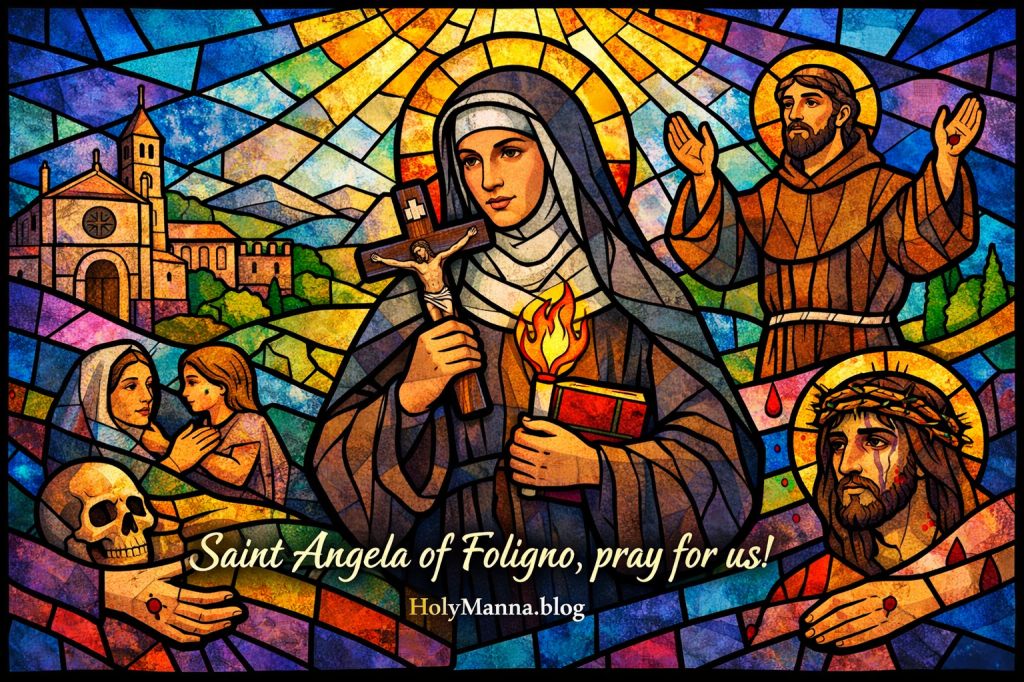
A Saint Who Let Christ Rebuild Her Life
Saint Angela of Foligno is one of those saints who makes it impossible to believe the lie that it is too late or that someone has gone too far for God’s mercy. She was a wife and mother from a comfortable background who openly admitted that she lived distracted, indulgent, and spiritually careless for many years. Then grace broke through in a decisive way, and she became a Franciscan tertiary, a fearless lover of the poor, and one of the most profound mystics the Church has ever known. She is often called the “Teacher of Theologians,” not because she received formal academic training, but because her knowledge of God came from lived experience, repentance, and deep union with Christ Crucified.
Her life reflects the truth taught in The Catechism, that conversion is not a vague feeling or a passing moment of regret, but a real and lasting turning of the whole life back to God. That turning usually costs something, but it also restores freedom. Saint Angela’s story shows that holiness is not about curating a spiritual image. Holiness is about surrendering control and allowing Christ to take possession of the heart completely.
When the World Stopped Feeling Safe
Angela was born around the year 1248 in Foligno, a town in the Umbrian region of Italy, not far from Assisi. She married young and became a mother, living a life that outwardly appeared stable and respectable. By her own later testimony, her early adulthood was marked by vanity, attachment to wealth, and neglect of the spiritual life. She was baptized and nominally Catholic, but her faith had not yet taken root in a serious or demanding way.
Several events began to unsettle her complacency. Her era was marked by violence, social unrest, and even natural disasters, including a major earthquake in 1279 that deeply frightened many in central Italy. These experiences awakened in Angela a fear of divine judgment and hell. At first, this fear did not immediately lead to holiness. She hesitated, delayed confession, and struggled with shame. Eventually, grace overcame her resistance, and she made a full and sincere confession that she later described as the true beginning of her conversion.
Not long after this turning point, Angela’s life was stripped of nearly everything she had relied upon. Her mother died, followed by the death of her husband and children within a relatively short span of time. Rather than becoming hardened or bitter, Angela interpreted these losses as a call to detach herself completely from the world and belong entirely to God. She sold her possessions, embraced a penitential life, and devoted herself to prayer and works of mercy. In 1291, she entered the Third Order of Saint Francis, placing herself under obedience and spiritual direction, and beginning a new life rooted in poverty, humility, and trust.
Jesus Crucified Became Her Whole Map
After her conversion, Saint Angela’s life revolved around Christ, particularly Christ suffering and crucified. This was not an abstract devotion. She lived among the poor, cared for the sick, and gave generously of herself, recognizing Christ in those who suffered. Her prayer life deepened dramatically, marked by long hours of contemplation, fasting, and meditation on the Passion.
At the request of her confessor, Angela dictated her spiritual experiences and teachings, which were later compiled into The Book of the Blessed Angela, sometimes referred to as The Book of Visions and Instructions. These writings describe stages of purification, illumination, and union, always grounded in humility, obedience, and fidelity to the Church. Her mystical experiences included visions, profound interior insights, and moments of deep union with God, but she consistently emphasized that such gifts were unearned and could not be grasped or explained by human effort alone.
One of her most striking cries, recorded in her spiritual writings, reveals both intimacy and longing: “Oh, unknown Love, why do you leave me?” This was not despair, but the cry of a soul that had tasted God’s closeness and now longed for complete union. In another passage, describing the limits of human language before divine mystery, she confessed with honesty: “I truly heard these words, but it is in no way possible for me to know or tell of what I saw and understood.” Her humility before God’s greatness remains one of the strongest signs of the authenticity of her mystical life.
Saint Angela’s Cross
Saint Angela did not suffer martyrdom by execution, but her life was marked by real and sustained suffering. Her conversion caused tension within her family and suspicion among others who did not understand her radical renunciation. Like many mystics, she lived under close scrutiny, as the Church carefully discerned her experiences to ensure their authenticity and orthodoxy.
She also endured profound interior trials. Her writings speak of spiritual darkness, intense longing, and periods of deep suffering when God seemed distant. These moments purified her love, teaching her to seek God not for consolation, but for who He is. Her perseverance reflects what The Catechism teaches about prayer as a battle, requiring endurance, humility, and trust, especially when feelings offer no reassurance.
Through these trials, Angela learned that suffering united to Christ becomes a place of transformation. She did not glorify pain for its own sake, but she accepted it as a means of deeper communion with the Crucified Lord.
A Tomb That Drew the Faithful
Saint Angela of Foligno died in January of 1309, surrounded by spiritual daughters and disciples who had learned from her example. Almost immediately, devotion to her spread, and many reported favors and miracles attributed to her intercession. Her tomb became a place of prayer and pilgrimage, particularly for those seeking conversion, healing, and perseverance in suffering.
Her reputation for holiness endured for centuries, supported by the continued reading of her writings and the steady devotion of the faithful. In 2013, Pope Francis formally recognized her sanctity through equipollent canonization, confirming her as a saint for the universal Church. This act affirmed that her life, teachings, and witness were fully consistent with Catholic faith and morals.
Bringing Saint Angela’s Fire into Daily Life
Saint Angela of Foligno speaks powerfully to anyone tempted to settle into a comfortable but shallow faith. Her life shows that repentance is not about self improvement, but about restoring communion with God. Sin is not merely a mistake. Sin is a rupture of love. Confession, then, is not therapy, but mercy, a place where God rebuilds what has been broken.
Her witness encourages an honest examination of conscience, not driven by fear, but by love and truth. It invites a deeper meditation on the Passion of Christ, not as a distant historical event, but as the lens through which suffering can be understood and redeemed. It also calls for concrete charity, especially toward those who are inconvenient, forgotten, or difficult to love.
Where has comfort dulled urgency in the spiritual life?
What would change if the Cross were treated as the place where love is proven, not just pain endured?
Engage with Us!
Share thoughts and reflections in the comments below. Join the conversation and help build a community rooted in faith and truth.
- What part of Saint Angela of Foligno’s conversion story speaks most directly to the heart today?
- How can suffering be more intentionally united to the Cross in daily life?
- What practical steps can be taken this week to deepen repentance and trust in God’s mercy?
May Saint Angela inspire a renewed love for Christ crucified, a deeper trust in divine mercy, and the courage to live the Gospel fully. May every action, whether joyful or painful, be offered with love, striving to do all things with the mercy and faith Jesus Himself taught.
Saint Angela of Foligno, pray for us!
Follow us on YouTube, Instagram and Facebook for more insights and reflections on living a faith-filled life.

 Holy Manna!
Leave a comment