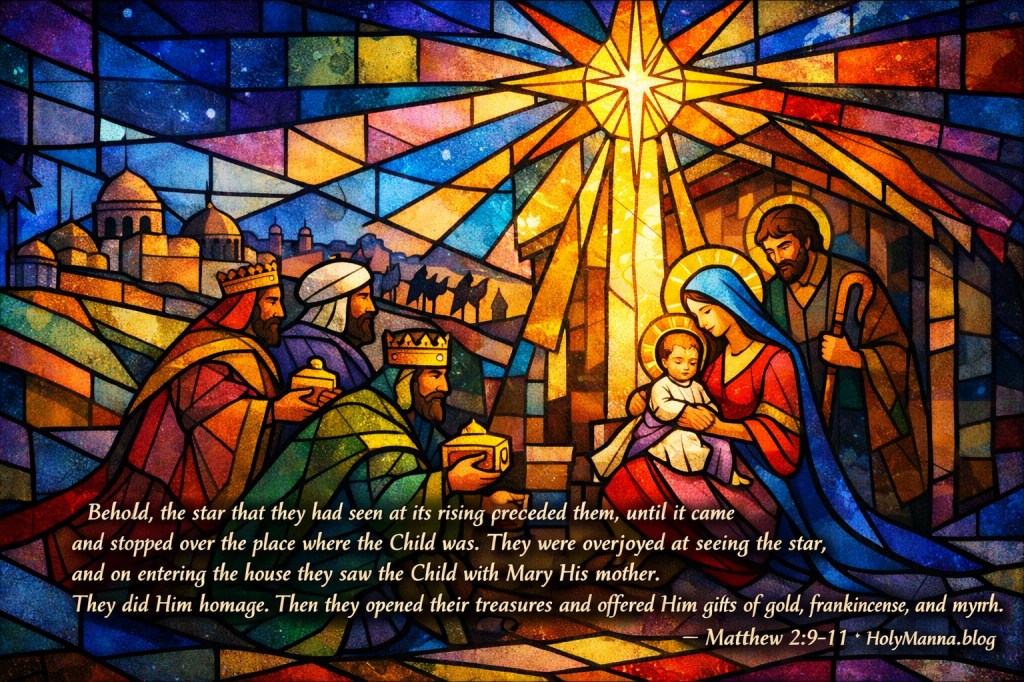
The Epiphany of the Lord – Lectionary: 20
When the Light Breaks Open the World
There are moments in the Church year when the veil is gently pulled back and God allows the world to see what has been true all along. The Solemnity of the Epiphany celebrates one of those moments, when divine light breaks into human history and reveals that God’s saving plan has always been meant for everyone, not just a chosen few. Today’s readings are united by a single, powerful theme: God reveals His glory in Christ so that all nations may be drawn into His light, His kingdom, and His mercy.
In the ancient world, light was more than a comforting image. It was a sign of life, protection, truth, and divine presence. When Isaiah 60 proclaims “Arise! Shine, for your light has come, the glory of the Lord has dawned upon you,” it is speaking to a people who had known exile, humiliation, and darkness. Jerusalem is promised not merely restoration, but transformation. God’s glory will be so radiant that the nations themselves will be drawn toward it, bringing their wealth, their worship, and their hope. This is not nationalism dressed in religious language. It is a prophetic vision of God using Israel as a beacon so that the whole world might find its way home.
That same vision echoes in Psalm 72, a royal prayer originally written for the kings of Israel but ultimately fulfilled in Christ. The psalm describes a ruler whose authority stretches to the ends of the earth, yet whose greatness is revealed most clearly in compassion. “For he rescues the poor when they cry out, and the oppressed who have no one to help,” the psalm declares. This is not the power of domination, but the power of justice and mercy. Even here, kings from distant lands are imagined bringing gifts, foreshadowing the moment when earthly authority recognizes the reign of God’s anointed King.
Saint Paul, writing in Ephesians 3, finally names what had long been hinted at but not fully understood. The mystery hidden for generations is now revealed. The Gentiles are not guests or second-class citizens in God’s plan. They are, as Paul insists, “coheirs, members of the same body, and copartners in the promise in Christ Jesus.” Epiphany is not simply about outsiders being welcomed. It is about the creation of one new people in Christ, bound together by grace rather than bloodline, culture, or geography.
All of this comes into sharp focus in The Gospel of Matthew with the arrival of the Magi. These wise men are foreigners, scholars of the stars, and representatives of the nations. They are guided not by Scripture at first, but by creation itself, until Scripture completes the journey. Their gifts of gold, frankincense, and myrrh echo the prophecy of Isaiah and the longing of Psalm 72. When they kneel before the Child, the world quietly changes. Kingship, worship, and sacrifice are all gathered into the small, hidden life of Jesus of Nazareth.
Epiphany proclaims that Christ is not a private Savior for a religious elite. He is the Light who enters the darkness of the world so that every nation, every culture, and every heart might be invited to worship, to belong, and to be transformed. How is God’s light inviting a deeper response of faith, generosity, and trust today?
First Reading – Isaiah 60:1-6
The Light That Pulls the Whole World Home
Isaiah 60 speaks into a real, gritty moment in Israel’s story. God’s people had been humbled by exile, scattered, and tempted to believe that darkness was the final word. Into that discouragement, the prophet announces something almost unbelievable: God is not finished with Zion, and the Lord’s glory is about to rise like sunrise after a long night. This is not simply a promise of civic renewal for Jerusalem. It is a prophecy that God’s saving light will be so unmistakable that the nations will come toward it. That is why this reading fits perfectly with today’s Epiphany theme. The Lord does not hide His glory to keep it private. The Lord reveals His glory to gather the world, to draw hearts out of confusion, and to receive worship that belongs to Him alone.
Isaiah 60:1-6 – New American Bible (Revised Edition)
The Dawning of Divine Glory for Zion
1 Arise! Shine, for your light has come,
the glory of the Lord has dawned upon you.
2 Though darkness covers the earth,
and thick clouds, the peoples,
Upon you the Lord will dawn,
and over you his glory will be seen.
3 Nations shall walk by your light,
kings by the radiance of your dawning.The Nations Come to Zion
4 Raise your eyes and look about;
they all gather and come to you—
Your sons from afar,
your daughters in the arms of their nurses.
5 Then you shall see and be radiant,
your heart shall throb and overflow.
For the riches of the sea shall be poured out before you,
the wealth of nations shall come to you.
6 Caravans of camels shall cover you,
dromedaries of Midian and Ephah;
All from Sheba shall come
bearing gold and frankincense,
and heralding the praises of the Lord.
Detailed Exegesis
Verse 1 – “Arise! Shine, for your light has come, the glory of the Lord has dawned upon you.”
This opening sounds like a trumpet blast meant to wake up a weary soul. Zion is told to stand up and receive what God is giving. The light is not self-generated, and it is not a motivational slogan. The light “has come” because God has acted. The “glory of the Lord” recalls the biblical theme of God’s manifest presence, the same glory that filled the tabernacle and later the temple. Here it is pictured as dawn, which is a gentle but unstoppable victory over night. For Epiphany, this verse points straight to Christ, the true Light whose coming changes what “darkness” even means.
Verse 2 – “Though darkness covers the earth, and thick clouds, the peoples, upon you the Lord will dawn, and over you his glory will be seen.”
This verse is honest about the world. Darkness is real, and it spreads over “the earth” and “the peoples,” meaning this is bigger than one nation’s troubles. Yet God’s response is not panic and it is not retreat. The Lord chooses to “dawn” upon His people so that His glory can be seen publicly. Epiphany celebrates that public revealing, because God does not merely rescue individuals in private. God reveals His Son in history so the nations can see, recognize, and respond.
Verse 3 – “Nations shall walk by your light, kings by the radiance of your dawning.”
This is the missionary heartbeat of the passage. The light is given to Zion, but it is not meant to stop at Zion. Nations “walk” by it, which suggests guidance, direction, and a new way forward. Even kings, the powerful and the proud, are pictured as coming under the attraction of God’s radiance. Epiphany shows this prophecy moving from poetry into flesh and blood, because the Magi are exactly what this verse anticipates. They are Gentiles drawn by light to the true King.
Verse 4 – “Raise your eyes and look about; they all gather and come to you, your sons from afar, your daughters in the arms of their nurses.”
The prophet tells Zion to look up and look outward. God is gathering what was scattered. The image of children returning is tender and concrete, because exile and displacement had torn families apart. This verse speaks to restoration, but it also hints at something larger. In God’s plan, the homecoming is not only geographic. It is spiritual. People far away are brought near. Epiphany celebrates that God is building a family that crosses borders, languages, and bloodlines, because belonging is now centered on Christ.
Verse 5 – “Then you shall see and be radiant, your heart shall throb and overflow. For the riches of the sea shall be poured out before you, the wealth of nations shall come to you.”
Radiance here is contagious. Zion becomes radiant because Zion receives God’s gift and then reflects it. The language of a heart that “throbs and overflows” describes joy that cannot be contained. The nations bring “wealth,” but the deeper point is not material prosperity as an end in itself. It is the recognition that everything good ultimately belongs to God and is meant to be offered back to Him. On Epiphany, the gifts of the Magi become a sign of what every human life is meant to do: bring what is valuable, surrender it in worship, and let God purify and redirect it.
Verse 6 – “Caravans of camels shall cover you, dromedaries of Midian and Ephah; all from Sheba shall come bearing gold and frankincense, and heralding the praises of the Lord.”
This verse is almost cinematic. It pictures long trade routes and foreign lands, the kind of international movement that would have felt huge to an ancient listener. Midian, Ephah, and Sheba evoke distant places and Gentile peoples. They arrive with gold and frankincense, which is exactly the language that makes Christians hear the footsteps of the Magi. Yet notice the climax of the verse. The greatest “gift” is not the gold. The climax is worship, because they come “heralding the praises of the Lord.” That is the heart of Epiphany: adoration.
Teachings
This reading teaches that God’s salvation is universal, and it also teaches that God’s way of saving is to reveal Himself, not to remain hidden. The Lord gives light that draws the nations, and that light is ultimately fulfilled in Jesus Christ, who is not a tribal deity but the Savior of the world. This is why Epiphany is so important for the Church’s identity. The Church does not exist to protect a private religious club. The Church exists to proclaim Christ so that the world can see His glory and come to worship.
The Catechism describes God’s plan as a free gift meant to be shared, not hoarded. CCC 1 says “God, infinitely perfect and blessed in himself, in a plan of sheer goodness freely created man to make him share in his own blessed life.” That line fits Isaiah 60 beautifully, because the nations are not being invited into a political alliance. They are being drawn toward the blessed life of God, the only light bright enough to cut through the world’s thick clouds.
The human heart is also made for this seeking and this homecoming. CCC 27 says “The desire for God is written in the human heart, because man is created by God and for God; and God never ceases to draw man to himself.” That is basically the interior version of Isaiah 60. God’s glory rises, and human hearts, even from far away, find themselves drawn toward it.
The saints often describe this same reality in a way that feels personal and direct. Saint Augustine famously prays “You have made us for yourself, and our heart is restless until it rests in you.” That restlessness is not meant to be medicated away with distractions. It is meant to be converted into pilgrimage. Epiphany says the restlessness is a clue, because it is the soul hearing the distant call of divine light.
Historically, Christians have always read Isaiah 60 as one of the great Epiphany prophecies because of the nations coming with gold and frankincense, but also because of the deeper pattern. God’s glory rises first upon a particular people, and then that glory becomes a beacon for the whole earth. That pattern becomes the Church’s mission. The Lord’s light is received through faith, and then it must be reflected in worship, charity, and truth.
Reflection
This reading asks for more than admiration, because it is a call to get up and live like light has actually arrived. Many people still live as if darkness is the most realistic thing in the room, and it is easy to fall into that mindset when the news is chaotic and personal burdens are heavy. Isaiah 60 does not deny darkness, but it refuses to let darkness set the agenda. The Lord rises first, and then the people are told to arise.
A practical step is to treat worship as the first response to God’s light. The nations in this prophecy do not come merely to study Zion. They come to praise the Lord. When prayer becomes optional, life tends to drift back into the fog. When prayer becomes steady, even simple, the heart begins to recognize where the light is coming from and where it is leading.
Another concrete step is to offer God real gifts, not symbolic leftovers. The nations bring their treasures, and the Magi will do the same in the Gospel. This can look like offering time that is normally guarded, offering reconciliation that is normally avoided, offering generosity that is normally postponed, or offering purity of mind that is normally negotiated away. The Lord does not need these gifts to become rich. The Lord invites these gifts to make the heart free.
Where has darkness been allowed to shrink hope and make faith feel small? What would change this week if life were lived like God’s glory has truly dawned in Christ? Which “treasure” needs to be placed before the Lord so it can become praise instead of possession?
Responsorial Psalm – Psalm 72:1-2, 7-8, 10-13
The King the World Has Been Waiting For
Psalm 72 is a royal prayer, traditionally associated with Solomon, and it carries the hopes Israel had for a king who would rule with God’s own justice. In the ancient world, kings often used power to enrich themselves and crush the weak. Israel knew that temptation firsthand, and it also knew something deeper: a king was only truly “good” if he reflected the Lord’s righteousness. That is why this psalm is so perfect for Epiphany. It describes a universal King whose reign reaches the ends of the earth, whose authority draws distant nations, and whose greatness is proven by mercy toward the poor. The Magi offering gifts to Jesus in The Gospel of Matthew is not a random detail. It is the living fulfillment of what this psalm has been praying for all along.
Psalm 72:1-2, 7-8, 10-13 – New American Bible (Revised Edition)
A Prayer for the King
1 Of Solomon.
2 O God, give your judgment to the king;
your justice to the king’s son;
That he may govern your people with justice,
your oppressed with right judgment,7 That abundance may flourish in his days,
great bounty, till the moon be no more.8 May he rule from sea to sea,
from the river to the ends of the earth.10 May the kings of Tarshish and the islands bring tribute,
the kings of Sheba and Seba offer gifts.
11 May all kings bow before him,
all nations serve him.
12 For he rescues the poor when they cry out,
the oppressed who have no one to help.
13 He shows pity to the needy and the poor
and saves the lives of the poor.
Detailed Exegesis
Verse 1 – “O God, give your judgment to the king; your justice to the king’s son.”
This verse begins with humility. The psalmist does not assume that a king automatically knows how to rule well. The king needs God’s “judgment” and “justice,” which means the ability to see rightly and to act rightly. In Scripture, justice is not simply a legal category. It is the right ordering of life according to God’s truth. This verse already hints that the true King must be more than a clever politician. The true King must be formed by God Himself. Christians hear this and immediately recognize Christ, whose kingship is not learned by trial and error but flows from His divine identity.
Verse 2 – “That he may govern your people with justice, your oppressed with right judgment.”
Here the psalm defines what good leadership looks like. God’s people are meant to be governed with justice, and the oppressed are meant to be protected with “right judgment.” The oppressed are singled out because they are usually the first to be ignored. God does not treat their suffering as background noise. This verse fits the Epiphany theme because the Light that draws the nations is not sentimental. It is a light that exposes injustice and restores the vulnerable. A kingdom that welcomes the nations must also be a kingdom where the weak are not disposable.
Verse 7 – “That abundance may flourish in his days, great bounty, till the moon be no more.”
Abundance here is not the shallow promise of constant comfort. In biblical terms, a just king creates conditions where life can actually thrive, where families can live without constant fear, and where the land can produce without being stolen by the powerful. The phrase “till the moon be no more” points to a reign that endures. For Christians, this reaches beyond any earthly king. Christ’s reign is not limited by dynasty, death, or political collapse. Epiphany celebrates that the newborn King has an everlasting kingdom, even if it begins quietly in a home in Bethlehem.
Verse 8 – “May he rule from sea to sea, from the river to the ends of the earth.”
This verse is the psalm’s universal horizon. The kingdom is not meant to be cramped inside one region. The imagery suggests an expansive dominion, a reign that reaches everywhere. Yet the context keeps that dominion from turning into imperialism, because this king rules with justice and mercy. The Church reads this as a portrait of Christ’s kingship, because only Christ can truly reign over every people without crushing their dignity. His rule is not conquest. His rule is conversion.
Verse 10 – “May the kings of Tarshish and the islands bring tribute, the kings of Sheba and Seba offer gifts.”
Tarshish and the “islands” suggest distant lands at the edges of the known world. Sheba and Seba evoke Arabia and Africa, places associated with wealth and trade. The point is clear. Foreign rulers recognize this king and bring gifts. Epiphany puts flesh on this verse when the Magi arrive from the east with treasure. The psalm’s prayer becomes a scene in history. The Gentiles come, not to negotiate, but to honor.
Verse 11 – “May all kings bow before him, all nations serve him.”
This is a sweeping statement of worshipful submission. It does not mean the erasing of cultures or the humiliation of peoples. It means that every authority is accountable to God and must ultimately bend the knee to the true King. Christians cannot read this without thinking of Christ, because in Him God’s authority meets human history in a way that demands a choice. Herod reacts with fear and manipulation, but the Magi respond with joy and homage. This verse quietly asks what kind of response will be offered.
Verse 12 – “For he rescues the poor when they cry out, the oppressed who have no one to help.”
Now the psalm explains why this king deserves homage. His greatness is revealed in rescue. The poor cry out, and he listens. The oppressed have no helper, and he becomes their helper. This is a direct rebuke to any vision of kingship that celebrates power for its own sake. It also teaches that worship and justice belong together. The nations come to adore the King who defends the weak.
Verse 13 – “He shows pity to the needy and the poor and saves the lives of the poor.”
The psalm ends this selection by underlining the king’s heart. He shows pity, which is not condescension but compassionate action. He saves lives, which means his reign produces real, tangible protection for those who would otherwise be crushed. On Epiphany, this matters because the revelation of Christ is never only about information. It is about salvation. The Light that appears is a Light that heals.
Teachings
Psalm 72 forms Catholics to desire the right kind of king. It teaches that authority is meant to be received from God and exercised for the good of others, especially for those who cannot repay favors or fund campaigns. The Church has always understood that this psalm ultimately points beyond Solomon to Jesus Christ, the King who fulfills Israel’s hopes and gathers the nations into one kingdom.
The Catechism teaches that Christ’s kingship is real, but it does not look like worldly domination. CCC 786 says “Finally, the People of God shares in the royal office of Christ. Jesus Christ, King and Lord of the universe, made himself the servant of all, for ‘the Son of man came not to be served but to serve, and to give his life as a ransom for many.’ For the Christian, ‘to reign is to serve him,’ particularly when serving ‘the poor and the suffering,’ in whom the Church recognizes ‘the image of her poor and suffering founder.’” This quote matches the heartbeat of Psalm 72, because the king’s greatness is measured by rescue and pity, not by spectacle.
The Catechism also insists that Christ’s kingdom cannot be reduced to politics, even though it transforms how Christians live in society. CCC 2816 says “In the New Testament, the word basileia can be translated by ‘kingship’ (abstract noun), ‘kingdom’ (concrete noun) or ‘reign’ (action noun). The Kingdom of God lies ahead of us. It is brought near in the Word incarnate, it is proclaimed throughout the whole Gospel, and it has come in Christ’s death and Resurrection. The Kingdom of God has been coming since the Last Supper and, in the Eucharist, it is in our midst. The Kingdom will come in glory when Christ hands it over to his Father.” Epiphany is a celebration that the Kingdom has come near, because the King has come near.
Historically, Christians have prayed Psalm 72 with Epiphany for centuries because of its direct imagery of distant kings bringing gifts. Yet the deeper reason is even stronger. This psalm protects the faithful from confusing Christ with a strongman. It shows that the nations are drawn not to a tyrant but to a Savior whose rule is justice for the oppressed and mercy for the poor.
Reflection
This psalm challenges the instinct to measure greatness by influence, wealth, or the ability to win arguments. It teaches that real authority is meant to protect the weak and lift up the oppressed. That can feel inconvenient because it demands a change in priorities. It is easy to treat the poor as a political topic or a distant problem, but Scripture treats them as neighbors whose cries reach the ear of God.
A practical step is to pray for leaders, not with blind loyalty, but with the clear request that they receive God’s wisdom and justice. A second step is to practice a small, consistent form of mercy that is actually sustainable, because mercy is not meant to be a one time emotional reaction. Mercy is meant to become a habit. It can look like giving time to someone who is lonely, giving patience to someone who is difficult, giving money to someone in genuine need, or giving attention to a person who is normally overlooked.
Epiphany also invites a personal response. Kings bring gifts, and hearts must bring gifts too. Gold can look like trust, frankincense can look like worship, and myrrh can look like accepting the cost of discipleship. This King is worth bowing before, but that bowing must show up in daily life.
Where is there a temptation to treat Jesus as helpful advice instead of the true King who deserves obedience? How can mercy toward the needy become more concrete and less theoretical this week? What gift can be offered to Christ that actually costs something, so that love becomes more real and less comfortable?
Second Reading – Ephesians 3:2-3, 5-6
The Secret God Could Not Wait to Share
The Epiphany is not only about a star and wise men. It is about God revealing what had been hidden and then inviting the whole world to step into it. That is exactly what Saint Paul is talking about in Ephesians 3. Paul is writing to a Church that includes Gentiles, people who did not grow up with the covenants, the temple worship, or the expectations of Israel. In the first century, that was shocking. Many Jews assumed the Messiah would restore Israel and then the nations might come in later as outsiders. Paul announces something far bigger and far more personal. Through Christ, the Gentiles are not spectators. They are full members of the family, included by grace, and united into one Body. This reading fits today’s theme perfectly because the light of Christ does not simply attract the nations. The light of Christ makes the nations coheirs.
Ephesians 3:2-3, 5-6 – New American Bible (Revised Edition)
2 if, as I suppose, you have heard of the stewardship of God’s grace that was given to me for your benefit, 3 [namely, that] the mystery was made known to me by revelation, as I have written briefly earlier.
5 which was not made known to human beings in other generations as it has now been revealed to his holy apostles and prophets by the Spirit, 6 that the Gentiles are coheirs, members of the same body, and copartners in the promise in Christ Jesus through the gospel.
Detailed Exegesis
Verse 2 – “If, as I suppose, you have heard of the stewardship of God’s grace that was given to me for your benefit,”
Paul begins with a reminder that his mission is not self-appointed. He calls it a “stewardship,” which means a responsibility entrusted by God. Grace is not merely something Paul enjoys privately. It is something he has been charged to deliver for the benefit of others, especially the Gentiles. The Church hears in this verse the basic pattern of Christian life. Grace is given to be received, and then grace is given to be shared. Epiphany is the feast that celebrates this outward movement of salvation.
Verse 3 – “Namely, that the mystery was made known to me by revelation, as I have written briefly earlier.”
Paul uses the word “mystery,” but not in the modern sense of a puzzle that clever people solve. In Scripture, a mystery is a divine plan that human beings could not discover on their own. It has to be revealed. Paul insists that he learned it by revelation, meaning God acted first. This keeps the Church grounded. The Gospel is not a human invention, and Christianity is not a self-improvement philosophy. It is a revealed gift, an initiative from God that must be welcomed with faith.
Verse 5 – “Which was not made known to human beings in other generations as it has now been revealed to his holy apostles and prophets by the Spirit,”
This verse explains timing. God prepared the world slowly. Earlier generations received real promises and real glimpses, but the full picture was not yet unveiled. Now it is revealed through the apostles and prophets “by the Spirit,” which highlights the Holy Spirit as the agent of revelation and unity. Epiphany celebrates this same unveiling. What was promised in Isaiah 60 and sung in Psalm 72 is no longer just prophetic poetry. The Spirit reveals its fulfillment in Christ and teaches the Church how to understand it.
Verse 6 – “That the Gentiles are coheirs, members of the same body, and copartners in the promise in Christ Jesus through the gospel.”
This is the core of the passage, and it is one of the most important sentences in the New Testament for understanding the Church. The Gentiles are “coheirs,” meaning they inherit the promises with Israel, not after Israel and not beneath Israel. They are “members of the same body,” meaning there is one Church, not parallel communities separated by background or ethnicity. They are “copartners in the promise,” meaning they share in what God promised through the covenant, now fulfilled in Christ. All of it is “through the gospel,” which means it happens through faith in Christ, baptism into Christ, and incorporation into His Body. Epiphany shows the first fruits of this reality when the Magi kneel before Jesus. Paul explains the theological depth of that moment.
Teachings
This reading teaches that the Church is not an ethnic club, and it is not a voluntary association built around shared preferences. The Church is the Body of Christ formed by grace, and the inclusion of the Gentiles is not a side note. It is part of God’s plan from the beginning, now made clear in Christ.
The Catechism teaches that the Church is universal by her very nature, because she is sent to all. CCC 849 says “The missionary mandate. ‘Having been divinely sent to the nations that she might be “the universal sacrament of salvation,” the Church, in obedience to the command of her founder and because it is demanded by her own essential universality, strives to preach the Gospel to all men.’” Paul’s “stewardship” is a concrete example of this mandate, because he is sent precisely so that the Gentiles can receive what God has revealed.
The Catechism also insists that unity is not optional, because it is rooted in Christ Himself. CCC 813 says “The Church is one because of her source: ‘the highest exemplar and source of this mystery is the unity, in the Trinity of Persons, of one God, the Father and the Son in the Holy Spirit.’ The Church is one because of her founder: for ‘the Word made flesh, the prince of peace, reconciled all men to God by the cross, restoring the unity of all in one people and one body.’ The Church is one because of her ‘soul’: ‘It is the Holy Spirit, dwelling in those who believe and pervading and ruling over the entire Church, who brings about that wonderful communion of the faithful and joins them together so intimately in Christ that he is the principle of the Church’s unity.’” Paul’s language of “same body” fits this perfectly. The unity is not manufactured by human agreement. It is created by Christ and sustained by the Spirit.
Saint John Chrysostom, preaching on Paul’s letters, often emphasizes the shock of this inclusion. He points out that the Gentiles were not simply given access to blessings. They were made equal sharers in the inheritance, which reveals God’s generosity and humbles human pride. That is a needed reminder in every age, because people still try to rank each other in God’s house. Paul crushes that instinct with one sentence: coheirs, same body, copartners.
Historically, this teaching shaped the early Church’s identity in a world that was deeply divided by ethnicity, social status, and religion. Jews and Gentiles worshiping together was not the easy path. It required conversion, patience, and humility. Yet that painful unity became one of the most powerful witnesses to the truth of the Gospel. Epiphany is an annual reminder that the Church must never retreat into tribalism, because the King has revealed Himself to the nations.
Reflection
This passage is comforting, but it is also challenging. It comforts because it says belonging is not earned by pedigree. Belonging is given by grace in Christ. It challenges because it means no one gets to treat the Church like a private space reserved for the “right kind” of people. If God calls Gentiles coheirs, then Christians cannot build walls where Christ has built a table.
A practical step is to examine how easily preferences turn into exclusions. It is easy to love “the Church” in the abstract while quietly resenting real people in the pews. Paul’s language of “same body” makes that impossible to ignore. A body cannot say one member is unnecessary without harming itself. Another practical step is to take evangelization seriously, not as awkward marketing, but as love. If grace is real, it is meant to be shared. If Christ is the Light, it is meant to shine outward.
This reading also invites gratitude. The word “coheirs” should soften the heart because it is a gift that no Gentile could demand. It is a mercy that had to be revealed. That gratitude should become worship, and worship should become charity.
Is there any quiet attitude that treats certain people as outsiders in God’s family, even if it is never said out loud? How can unity in the parish be protected through patience, kindness, and a refusal to gossip or label people? Who needs to hear the Gospel this year, not as a debate, but as an invitation into the promise of life in Christ Jesus?
Holy Gospel – Matthew 2:1-12
When Outsiders Find Themselves At The Center Of God’s Story
The account of the Magi in The Gospel of Matthew is more than a charming scene with a star and exotic visitors. In the first century, this story carried a strong shock value. The expected religious insiders in Jerusalem are disturbed and hesitant, while foreign seekers from the east recognize the newborn King and travel a long distance to adore Him. This passage unfolds under the shadow of King Herod, a ruler known for his paranoia and brutality, which makes his fear of a “newborn king” feel very real. At the same time, the religious leaders know the Scriptures and can quote the prophecy about Bethlehem from Micah 5:1, yet they do not move an inch toward the Child. The ones who actually set out in faith are the outsiders.
The Epiphany celebrates the manifestation of Christ to the nations, and here the nations arrive in the form of the Magi. Creation itself participates, as the star guides them, and then Scripture completes the journey. The gifts of gold, frankincense, and myrrh echo Isaiah 60 and Psalm 72, where kings and nations bring tribute to the Lord’s anointed. The scene becomes a living icon of what Saint Paul describes in Ephesians 3: Gentiles becoming coheirs, members of the same body, and copartners in the promise in Christ Jesus. The Light has risen, and the first fruits of the nations are already at His feet.
Matthew 2:1-12 – New American Bible (Revised Edition)
The Visit of the Magi. 1 When Jesus was born in Bethlehem of Judea, in the days of King Herod, behold, magi from the east arrived in Jerusalem, 2 saying, “Where is the newborn king of the Jews? We saw his star at its rising and have come to do him homage.” 3 When King Herod heard this, he was greatly troubled, and all Jerusalem with him. 4 Assembling all the chief priests and the scribes of the people, he inquired of them where the Messiah was to be born. 5 They said to him, “In Bethlehem of Judea, for thus it has been written through the prophet:
6 ‘And you, Bethlehem, land of Judah,
are by no means least among the rulers of Judah;
since from you shall come a ruler,
who is to shepherd my people Israel.’”7 Then Herod called the magi secretly and ascertained from them the time of the star’s appearance. 8 He sent them to Bethlehem and said, “Go and search diligently for the child. When you have found him, bring me word, that I too may go and do him homage.” 9 After their audience with the king they set out. And behold, the star that they had seen at its rising preceded them, until it came and stopped over the place where the child was. 10 They were overjoyed at seeing the star, 11 and on entering the house they saw the child with Mary his mother. They prostrated themselves and did him homage. Then they opened their treasures and offered him gifts of gold, frankincense, and myrrh. 12 And having been warned in a dream not to return to Herod, they departed for their country by another way.
Detailed Exegesis
Verse 1 – “When Jesus was born in Bethlehem of Judea, in the days of King Herod, behold, magi from the east arrived in Jerusalem,”
This opening verse anchors the story in real places and a real political context. Bethlehem of Judea recalls the city of David, which already signals messianic expectations. “In the days of King Herod” hints at tension, because Herod was famous for violent jealousy and fear of rivals. The “magi from the east” were likely learned men, possibly astrologers or scholars, who studied the heavens and interpreted signs. They represent the searching wisdom of the Gentile world. Even before they speak, the scene is charged with contrast: the true King is born in lowliness, while a fearful king sits on a throne, and foreign seekers arrive with open questions.
Verse 2 – “Saying, ‘Where is the newborn king of the Jews? We saw his star at its rising and have come to do him homage.’”
The Magi’s question is both simple and explosive. They speak of a “newborn king of the Jews,” which strikes at the heart of Herod’s insecurity. They have seen “his star,” suggesting that creation bears witness to the birth of Christ. Their intention is clear. They have come “to do him homage,” which means to prostrate in reverence, an act normally reserved for royalty and, in a deeper sense, for God. The Church sees here a first hint of the nations recognizing Jesus as both King and more than a king.
Verse 3 – “When King Herod heard this, he was greatly troubled, and all Jerusalem with him.”
Herod’s reaction reveals the spiritual danger of clinging to power. The news of a child should be a cause for joy, yet Herod is “greatly troubled” because he views the world through fear and control. “All Jerusalem with him” likely reflects the political tension that follows whenever Herod is upset, since his anxiety often leads to violence. Spiritually, this verse exposes the human struggle between welcoming God’s reign and defending personal kingdoms.
Verse 4 – “Assembling all the chief priests and the scribes of the people, he inquired of them where the Messiah was to be born.”
Herod turns to the experts in Scripture, the chief priests and scribes. They know the prophecies and can give a precise answer. This shows that correct doctrine can be present even when the heart is not converted. It also shows that God’s plan is not secret in a hidden corner. The place of the Messiah’s birth has been revealed in Scripture, and even a corrupt ruler can access that information.
Verse 5 – “They said to him, ‘In Bethlehem of Judea, for thus it has been written through the prophet:”
The leaders respond with confidence, because they know the text. They recognize that Bethlehem is not random but chosen by God. Their answer bridges the Old Testament and the New, showing that what is happening in Bethlehem fulfills a long awaited promise. Yet strikingly, their knowledge does not lead them to go with the Magi. They speak truth without letting it move their feet.
Verse 6 – ‘“And you, Bethlehem, land of Judah, are by no means least among the rulers of Judah; since from you shall come a ruler, who is to shepherd my people Israel.”’
This quotation from Micah 5:1 highlights the paradox of Bethlehem. It is small and seemingly insignificant, yet in God’s plan it is the place where the true ruler and shepherd emerges. The word “shepherd” evokes tenderness, guidance, and sacrificial care, not mere domination. The Church sees here a clear prophecy of Christ, who will shepherd Israel and, through Israel, the nations. The ruler who comes is not a tyrant but a shepherd King.
Verse 7 – “Then Herod called the magi secretly and ascertained from them the time of the star’s appearance.”
Herod moves from public consultation to secret plotting. The “time of the star’s appearance” matters to him because he is already calculating how to deal with this perceived threat. The secrecy reveals his duplicity. Instead of responding in humility, he chooses manipulation. Spiritually, this warns against approaching God’s revelation with hidden agendas rather than honest surrender.
Verse 8 – “He sent them to Bethlehem and said, ‘Go and search diligently for the child. When you have found him, bring me word, that I too may go and do him homage.’”
Herod’s words sound pious, but readers know they are a lie. He speaks of “searching diligently” and “doing homage,” but his heart is bent toward destruction, as later events will show. This verse underlines how religious language can be misused when the heart is hardened. It also highlights the difference between the Magi’s sincere desire to adore and Herod’s counterfeit interest.
Verse 9 – “After their audience with the king they set out. And behold, the star that they had seen at its rising preceded them, until it came and stopped over the place where the child was.”
Once the Magi leave Herod and continue their journey, the star appears again and leads them directly to the Child. This suggests that God is personally guiding their search. Creation, under God’s command, serves the salvation plan. The star “stops” over the place where Jesus is, which emphasizes that God’s guidance is not vague. The Lord knows how to lead sincere seekers to His Son.
Verse 10 – “They were overjoyed at seeing the star,”
This brief verse captures a surge of emotion. The Magi’s joy is not abstract. Their journey has not been wasted. The sign that had once set them in motion now reassures them that they are close to the goal. Joy here is the fruit of fidelity. They followed limited light, and now they receive confirmation.
Verse 11 – “And on entering the house they saw the child with Mary his mother. They prostrated themselves and did him homage. Then they opened their treasures and offered him gifts of gold, frankincense, and myrrh.”
This moment is the heart of the Epiphany. The Magi finally reach their destination and discover that God’s glory is not revealed in power or spectacle, but in humility. They find a child with His mother, not a throne or an army, and yet they respond with prostration and worship. Their posture shows recognition that this Child is a true King, worthy of homage, and more than a king, worthy of adoration.
The opening of their treasures is an outward sign of an interior surrender. Gold acknowledges Christ’s kingship, frankincense points to His divinity and priestly role, and myrrh quietly foreshadows His suffering and death. In this simple act of worship, the nations offer not only wealth, but themselves. Epiphany reveals that encountering Christ always leads to humility, generosity, and true adoration.
Verse 12 – “And having been warned in a dream not to return to Herod, they departed for their country by another way.”
This final verse completes the spiritual journey of the Magi. God intervenes directly to protect the Child and to guide the Magi away from danger. The dream shows that revelation does not end at the moment of worship. Obedience must follow. “Another way” is not only a geographical detail. It points to interior conversion. Having encountered Christ, the Magi cannot return to their old paths unchanged. Epiphany reveals Christ, but it also redirects lives.
Teachings
This Gospel teaches that God reveals Himself to all who sincerely seek the truth, even those outside the expected religious boundaries. The Magi represent the nations, guided by creation, Scripture, and finally grace. Their journey confirms that faith involves movement, risk, and humility.
The Catechism teaches that the Epiphany is the manifestation of Jesus as Savior of the whole world. CCC 528 says “The Epiphany is the manifestation of Jesus as Messiah of Israel, Son of God and Savior of the world. The great feast of Epiphany celebrates the adoration of Jesus by the wise men from the East, who represent the Gentiles seeking and finding Jesus.” This explains why the Magi are central. They are not background characters. They are signs of God’s universal plan.
The gifts offered also carry deep meaning. Gold acknowledges Christ’s kingship, frankincense His divinity, and myrrh His future suffering and death. The Church has consistently taught that true worship includes recognizing Christ for who He truly is, not who it is convenient for Him to be.
Historically, this passage shaped Christian understanding of mission and conversion. The Magi show that encountering Christ leads to a changed direction. Faith is not only about arriving at Bethlehem. It is about leaving Bethlehem differently.
Reflection
This Gospel invites an honest look at how Christ is approached. The Magi search, travel, rejoice, worship, give, listen, and obey. Herod hears and plots. The scribes know and stay still. Each response is possible in every age.
A practical step is to ask whether faith has become static or whether it still involves movement and trust. Another step is to examine what is being offered to Christ. Gifts reveal priorities. Time, attention, obedience, and repentance are often harder to give than gold.
Epiphany also challenges comfort. The Magi return “by another way,” which suggests that encountering Christ requires letting go of familiar routes. Growth in faith usually includes change, even when that change feels inconvenient.
What does sincere searching for Christ look like right now? Which gift is being withheld out of fear or control? What “other way” might God be inviting after encountering Jesus more deeply?
Follow the Light and Bring the Treasure
The Epiphany brings every reading into one clear message: Jesus Christ is God’s Light given for the whole world, and that Light is meant to be seen, followed, and adored. In Isaiah 60, the glory of the Lord rises over Zion like dawn, and the nations are drawn in, not by force, but by radiance. In Psalm 72, the King who receives the tribute of distant rulers is also the King who defends the poor and rescues the oppressed, proving that His authority is mercy in action. In Ephesians 3, Saint Paul names the mystery that makes Epiphany so joyful: the Gentiles are not outsiders looking in, but coheirs, members of the same body, and copartners in the promise in Christ Jesus. Then The Gospel of Matthew shows the mystery in motion, as the Magi travel, rejoice, kneel, and offer their treasures to the Child who is both King and Savior.
This feast is a reminder that God still guides seekers, even through darkness, and God still leads them to Christ. The question is not whether the Light has come. The Light has come. The real question is whether the heart will move, whether worship will be real, and whether the gifts offered will be honest. Christ does not ask for empty words. Christ asks for surrender, for trust, and for a life that reflects His light in a world that still knows thick clouds.
A strong way to live Epiphany is to imitate the Magi in simple, concrete steps. Keep searching when the path feels long, keep listening when God redirects, and keep offering Christ what matters most, not what is convenient. Gold can look like trust placed in God rather than in control. Frankincense can look like prayer that is faithful and reverent. Myrrh can look like embracing sacrifice without bitterness, because love is often proven by what it is willing to carry.
Is there a place where Christ’s light is being resisted because it would require change? What “treasure” can be placed before Jesus today so that worship becomes real and not routine? Let Epiphany be more than a memory of wise men and a star. Let it be the day that faith grows legs, worship grows depth, and life takes “another way” because the true King has been found.
Engage with Us!
Share reflections in the comments below, because it is encouraging to hear how God is speaking through today’s readings and how the Lord is drawing hearts closer to Christ’s light.
- First Reading, Isaiah 60:1-6: Where has God been asking for faith to “arise” instead of staying discouraged, and what would it look like to live as if the Lord’s glory has truly dawned?
- Responsorial Psalm, Psalm 72:1-2, 7-8, 10-13: How can daily life reflect the justice and mercy of Christ the King, especially toward the poor, the forgotten, and the people who have no one to help?
- Second Reading, Ephesians 3:2-3, 5-6: What does it mean to live as a true member of Christ’s Body, and how can unity be protected in the home, the parish, and friendships through humility and charity?
- Holy Gospel, Matthew 2:1-12: What “star” has God used to draw the heart toward Jesus, and what treasure can be offered to Christ today with real sincerity and trust?
Keep walking in faith even when the path feels long and keep turning toward Christ’s light when the world feels cloudy. Let every decision be shaped by the love and mercy Jesus taught, so that worship becomes daily obedience, and the joy of Epiphany becomes a steady way of life.
Sacred Heart of Jesus, we trust in You!
Immaculate Heart of Mary, pray for us!
Saint Michael the Archangel, defend us in battle!
Follow us on YouTube, Instagram and Facebook for more insights and reflections on living a faith-filled life.

 Holy Manna!
Leave a comment