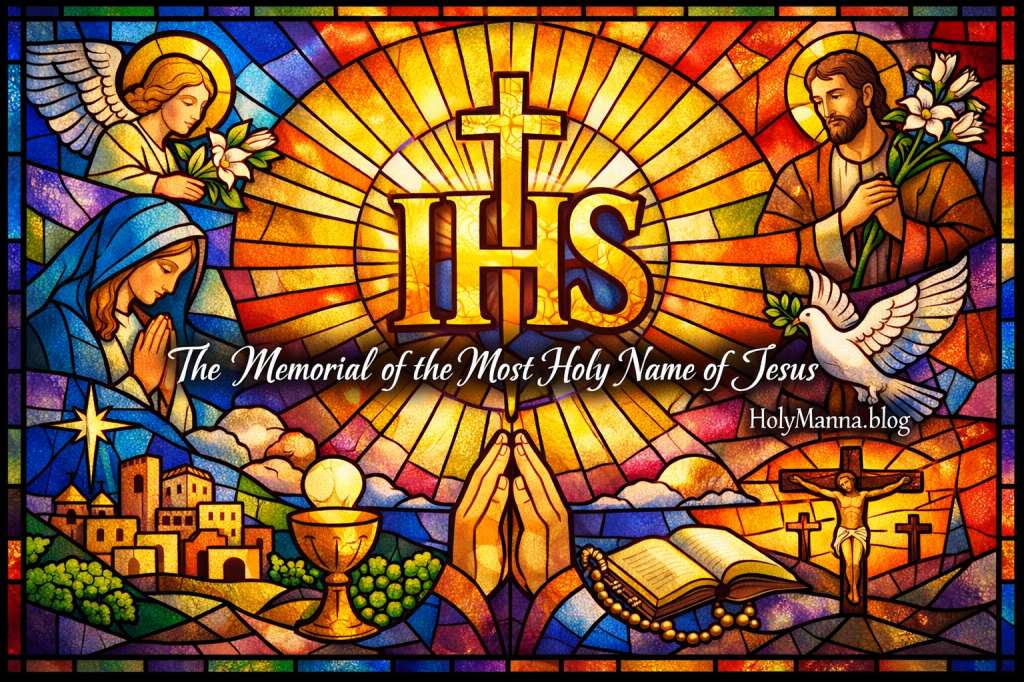
The Name Above Every Name
The Memorial of the Most Holy Name of Jesus is one of those quiet treasures of the Church’s calendar that can easily be overlooked, especially because it does not come with dramatic imagery like Bethlehem or Calvary. Yet this memorial goes straight to the heart of the Christian faith because the name of Jesus is not a random sound or a religious nickname. It is a name chosen by God Himself, delivered through an angel, and filled with divine power and saving purpose. Every time Catholics speak the name of Jesus, they are not merely recalling a historical figure. They are invoking the living Savior who reigns, intercedes, and draws souls to Himself.
This memorial also speaks directly to the modern world. Language today is casual, rushed, and often careless with what is sacred. The Church responds by lifting up the Holy Name and teaching the faithful to slow down, to remember who Jesus truly is, and to let reverence shape both prayer and speech. This is not sentimentality or superstition. It is a reminder that Christians belong to Christ, and that His name is holy because He is holy.
Named by Heaven
The devotion to the Holy Name begins in the Gospel itself. In The Gospel of Luke, the angel Gabriel announces to Mary, “Behold, you will conceive in your womb and bear a son, and you shall name him Jesus”. In The Gospel of Matthew, the angel explains the meaning of that name to Joseph with unmistakable clarity, “You shall call his name Jesus, for he will save his people from their sins”. This name is not chosen for its beauty or popularity. It is chosen because it reveals Christ’s mission.
Scripture also shows that this name is formally given according to the Law. In The Gospel of Luke, Jesus is circumcised on the eighth day and officially receives the name that had been spoken by the angel before His conception. This moment matters deeply because it shows the Son of God entering fully into the covenant life of Israel. The Savior does not stand outside human history. He steps directly into it, carrying a name that announces salvation from the very beginning.
As the Church moved through history, reverence for the Holy Name remained constant, but it became especially visible during the late Middle Ages. Europe at the time was fractured by political rivalries, public violence, and moral decay. Saint Bernardine of Siena, a Franciscan preacher of the fifteenth century, preached repentance and peace by lifting up the Holy Name of Jesus. He carried a tablet bearing the monogram IHS, drawn from the first letters of Jesus’ name in Greek, often shown with a cross and rays of light. He urged people to place this symbol in homes, churches, and public squares as a visible confession that Christ alone brings unity and healing.
This devotion was examined carefully by Church authorities and ultimately approved and encouraged. Over time, the Feast of the Holy Name of Jesus was formally established and extended to the universal Church. While its place in the calendar has shifted, its meaning has never changed. The Church continues to set aside time to remind the faithful that the Savior has a name, and that name deserves love, reverence, and trust.
Why the Name of Jesus Saves
The theological depth of this memorial is clearly expressed in The Catechism of the Catholic Church. It teaches that “Jesus means ‘God saves’” (CCC 430). That short statement contains the entire Gospel. Salvation is not an abstract idea or a self-improvement project. Salvation is God acting in history, rescuing sinners through His Son.
The Catechism goes further by explaining that “The name ‘Jesus’ signifies that the very name of God is present in the person of his Son” (CCC 432). This is why Christians have always treated the Holy Name with awe. To speak the name of Jesus is to address the living God who took flesh for the sake of humanity.
The New Testament repeatedly confirms this truth. In The Acts of the Apostles, Saint Peter proclaims that salvation is found in no one else, because no other name has been given by which humanity is saved. The Church has never understood this as arrogance or exclusion. It is simply fidelity to reality. If Jesus is truly God and truly Savior, then His name is unique, irreplaceable, and universal.
Saint Paul captures the cosmic scope of this truth in The Letter to the Philippians, teaching that God bestowed on Christ the name above every name, so that at the name of Jesus every knee should bend. This memorial invites believers to let that truth move from theory into daily life. Honoring the Holy Name is not only about words. It is about recognizing Jesus as Lord in thought, action, and allegiance.
A Name That Forms Us
Devotion to the Holy Name of Jesus has always been meant to shape daily Christian life. One of the most enduring expressions of this devotion is the Jesus Prayer, especially cherished in the Christian East. By repeatedly invoking the name of Jesus with humility and trust, the believer learns to turn instinctively toward Christ in moments of fear, temptation, or confusion. This practice does not empty the mind. It fills the heart with the presence of the Savior.
In the Western Church, the Holy Name Society played an important role in encouraging reverence for the name of Jesus and discouraging careless or profane speech. This devotion emphasized that words matter because the Word became flesh. Reverence for the Holy Name trains Catholics to speak more carefully, to resist using sacred language casually, and to let speech reflect faith rather than impulse.
This devotion also appears in the Church’s liturgy. Many Catholics were taught to bow the head at the mention of the name of Jesus, especially during the Mass. This simple gesture teaches humility without fanfare. It forms the body to remind the soul that Jesus Christ is Lord, worthy of honor in both posture and prayer.
The Holy Name Is Lifted High
Although this memorial is not tied to a single apparition or geographic event, its presence can be seen throughout the Church. The IHS monogram appears in churches, stained glass, vestments, altars, and sacred art across centuries. It is often found in places associated with preaching, evangelization, and education because it proclaims Christ clearly and boldly.
This symbol is closely associated with the Society of Jesus, which adopted it as a central emblem. That connection highlights how devotion to the Holy Name has fueled missionary work, theological clarity, and faithful service to the Church. The purpose has never been decoration. The purpose has always been proclamation.
Pilgrimage connected to the Holy Name often takes a quieter form. Visiting churches dedicated to the Holy Name or praying in places shaped by Franciscan or Jesuit spirituality draws the heart back to the same truth. Every authentic pilgrimage leads deeper into surrender to Christ. The memorial reminds believers that the most important journey is the one that brings the soul closer to Jesus.
How the World Honors the Name of Jesus
Across cultures, the Memorial of the Most Holy Name of Jesus is celebrated with reverence and joy. The prayers of the Mass emphasize the power and beauty of Christ’s name, and sacred music often highlights the tenderness and majesty of Jesus as Savior and Lord.
In Catholic families, this devotion has long shaped everyday habits. Children learn that the name of Jesus is not a throwaway word or an expression of frustration. It is a holy name, spoken with love and trust. Many families cultivate the habit of calling on Jesus at the start of work, before travel, or during moments of anxiety. These simple practices anchor daily life in faith.
In some communities, the memorial has also been marked by acts of reparation for blasphemy and irreverence. Properly understood, this is not about guilt or fear. It is about love responding to disrespect. When the world treats the name of Jesus lightly, the faithful respond by honoring Him more deeply.
Let the Name of Jesus Become a Lifeline
This memorial speaks directly to everyday Christian living because it addresses speech, attention, and habit. Modern life encourages constant noise and instant reaction. The Memorial of the Most Holy Name of Jesus invites a different rhythm. It teaches believers to pause, to remember who Jesus is, and to call on Him with confidence.
Invoking the Holy Name during temptation can redirect the heart. Speaking it during anger can cool the moment. Whispering it during suffering can bring peace. This is not a technique or a mantra. It is faith expressed as dependence on a living Lord.
Reverence for the Holy Name also reshapes the entire spiritual life. When Jesus is treated seriously, faith becomes steadier and deeper. Reverence is not stiffness or fear. Reverence is love that knows who is being addressed.
Engage with Us!
Readers are invited to share their thoughts and reflections in the comments below and to join the conversation with openness and charity.
- How does hearing or speaking the Name of Jesus shape prayer during moments of stress or temptation?
- In what ways can greater reverence for the Holy Name influence daily speech and relationships?
- How might devotion to the Holy Name help keep faith centered on Christ rather than habits or routines?
May this memorial encourage deeper faith, renewed reverence, and a life shaped by the love and mercy Jesus taught, so that everything spoken and done reflects the power of His Holy Name.
Jesus Christ, our Lord and Savior, we trust in You!
Follow us on YouTube, Instagram and Facebook for more insights and reflections on living a faith-filled life.

 Holy Manna!
Leave a comment