A Light Raised Up for a City
Saint Geneviève of Paris is one of those saints who makes faith feel grounded, realistic, and demanding in the best possible way. She lived in fifth century Gaul during the slow collapse of Roman order, when invasions, famine, and political uncertainty were part of everyday life. In the middle of that instability, God raised up a consecrated virgin whose influence came not from force or position, but from prayer, penance, and courageous charity. She is honored as the patroness of Paris because she became a spiritual guardian of the city, especially when fear threatened to overwhelm reason and faith.
Saint Geneviève is remembered for urging people to stay, pray, and trust in God when invasion loomed. She also organized relief for the hungry and defended the vulnerable with a firmness that never slipped into bitterness. Her life reflects what The Catechism teaches about Christian hope, which is not optimism or denial, but trust rooted in God’s promises. The Catechism explains that “hope is the theological virtue by which we desire the kingdom of heaven and eternal life, placing our trust in Christ’s promises” (CCC 1817). Saint Geneviève lived that hope publicly, steadily, and without theatrics.
No verified quotations from Saint Geneviève survive in the earliest sources. Many sayings attributed to her online cannot be historically confirmed. Her witness comes through her actions and the testimony of the Church that preserved her memory.
A Child Marked for God
Saint Geneviève was born around the years 419 to 422 in the village of Nanterre, just outside what would later become Paris. She was raised in a Christian household during a time when the faith was still shaping society amid lingering pagan customs. According to early tradition, her life changed decisively when Saint Germanus of Auxerre visited Nanterre around 429. He recognized her unusual seriousness and devotion even as a child and encouraged her desire to belong entirely to Christ. With the blessing of her parents, she consecrated herself to God as a virgin and embraced a life ordered around prayer and self denial.
This consecration did not take place in a convent as modern readers might imagine. Geneviève initially lived at home, practicing fasting, prayer, and works of mercy in the midst of ordinary life. After her parents died, she moved to Paris to live with her godmother. There, her spiritual discipline deepened, and her reputation for holiness began to spread. She fasted rigorously for many years, prayed long hours, and gave generously to the poor.
Her seriousness stirred suspicion and resentment. Some accused her of hypocrisy or spiritual deception, and ancient accounts even speak of attempts to silence or harm her. Yet she endured these trials without abandoning her vocation. Her perseverance reflects the pattern of Christian discipleship taught throughout Scripture, including The Gospel of Matthew, where Jesus warns that faithfulness will not always be met with approval. Saint Geneviève learned early that holiness often draws opposition before it draws admiration.
When Prayer Became the Shield of a City
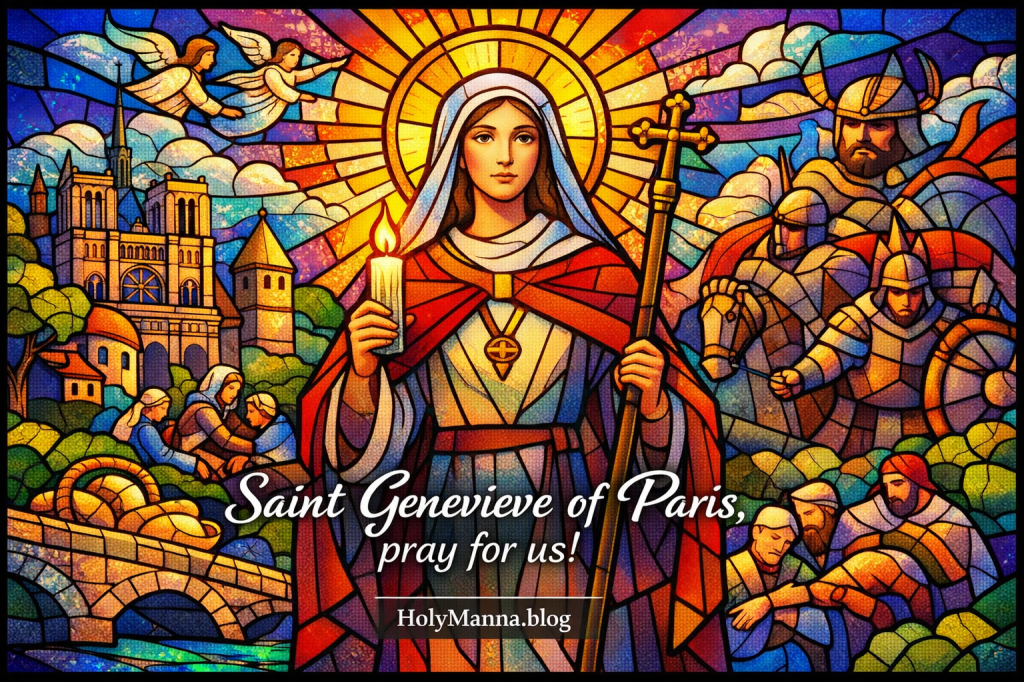
Saint Geneviève’s most well known moment came in the year 451, when news spread that Attila the Hun and his armies were advancing through Gaul. Fear swept through Paris, and many citizens prepared to flee. Geneviève urged them instead to remain, to fast, and to pray with confidence in God’s protection. She was mocked by some for her boldness, but she refused to retreat from her conviction that fear was not the Christian response to danger.
According to tradition, Attila’s forces ultimately turned away from Paris, and the city was spared. The people credited this deliverance to Geneviève’s intercession, and she became known as a protector of the city. Her leadership did not end with that crisis. She organized food shipments during famine, cared for the sick, and arranged aid for prisoners. She also exercised moral influence among Frankish leaders, encouraging mercy and restraint.
Her life shows that prayer is not passive or detached from real needs. The Catechism teaches that “prayer is the raising of one’s mind and heart to God” (CCC 2559). Saint Geneviève raised her heart to God so consistently that when crisis came, her faith steadied others. She united contemplation and action in a way that still challenges modern Christians to stop separating spiritual life from public responsibility.
Faith That Withstood All Trials
Saint Geneviève did not suffer martyrdom, but she lived through sustained opposition and misunderstanding. Her influence as a woman of prayer unsettled both civic and religious figures who did not know how to categorize her authority. She faced ridicule, accusations, and attempts to discredit her visions and spiritual experiences. Rather than retreating into isolation or responding with anger, she remained obedient to the Church and faithful to her calling.
Her endurance illustrates what The Catechism teaches about suffering united to Christ. It explains that by patience and perseverance in trials, believers are drawn into the redemptive work of Jesus. Saint Geneviève’s hardships were not dramatic in the way martyrdom is, but they required daily courage and humility. She shows that sanctity is often forged through consistency rather than spectacle.
In a culture that equates truth with popularity and faith with comfort, her life reminds believers that fidelity matters more than approval. She remained steady not because she was stubborn, but because she trusted that God’s will was worth more than her reputation.
A Presence That Continued to Protect Paris
Saint Geneviève died peacefully in Paris sometime around the year 500 to 512. She was buried in a church associated with her memory, which became an important center of devotion. Tradition also connects her to the encouragement and construction of churches in Paris, including those honoring Saints Peter, Paul, and Denis. Her influence helped shape the spiritual identity of the city long after her death.
Miracles were reported at her tomb, including healings and deliverances during times of plague and disaster. One well known tradition recounts that during a severe epidemic in 1129, a public procession invoking her intercession was followed by a sudden end to the disease. These events strengthened devotion to her throughout the Middle Ages.
The French Revolution brought deep destruction to many sacred places, and her relics were largely destroyed during that period. Even so, devotion to Saint Geneviève endured. The faithful continued to honor her as a protector and intercessor, not because of relics alone, but because the Church believes that the saints live in Christ. The Catechism teaches that “being more closely united to Christ, those who dwell in heaven fix the whole Church more firmly in holiness” (CCC 956). Saint Geneviève’s care for her city did not end with her earthly life.
Learning to Stand Firm in Faith
Saint Geneviève offers a powerful example for Christians navigating anxious times. Her life shows that prayer is not an escape from reality, but the foundation for facing reality without fear. Her fasting and discipline were not attempts to earn God’s favor, but ways of staying free and attentive to His will. She also demonstrates that charity must be concrete. She prayed deeply and then acted decisively to care for the poor and defend the vulnerable.
Her response to criticism is equally instructive. She was mocked, opposed, and misunderstood, yet she did not abandon her mission. She trusted that obedience to God would bear fruit even when results were not immediate. Her example encourages believers to cultivate steady prayer, sacrificial charity, and courage rooted in faith rather than emotion.
A practical way to imitate Saint Geneviève is to build a life that does not depend on fear driven reactions. Consistent prayer, meaningful acts of self-denial, and regular works of mercy form a soul that can stand firm when pressure comes. That kind of faith may not attract attention, but it can quietly transform families, parishes, and communities.
Engage with Us!
Readers are invited to share their thoughts and reflections in the comments below and join the conversation as the Church continues to learn from the saints.
- Where does fear most often challenge trust in God’s providence today?
- How can prayer become a more active force in responding to uncertainty or crisis?
- What does Saint Geneviève’s courage teach about faithful leadership in everyday life?
May the example of Saint Geneviève strengthen hearts to pray with confidence, serve with real charity, and remain faithful under pressure, doing all things with the love and mercy Jesus taught and lived.
Saint Geneviève of Paris, pray for us!
Follow us on YouTube, Instagram and Facebook for more insights and reflections on living a faith-filled life.

 Holy Manna!
Leave a comment