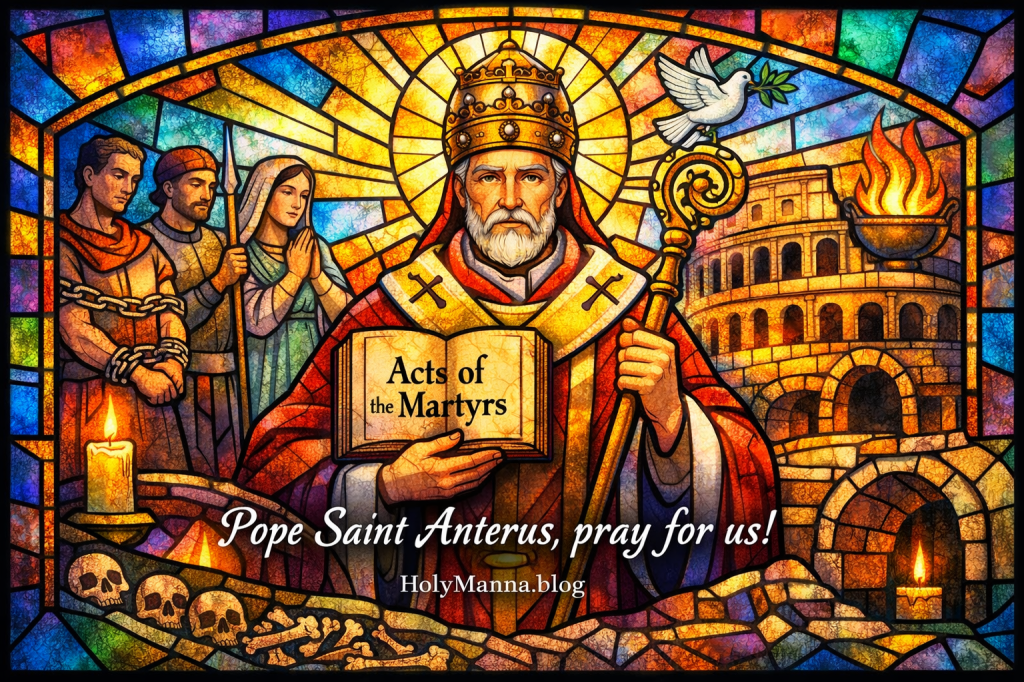
The Archivist of the Catacombs
Pope Saint Anterus is one of those early popes who proves that holiness does not require a long résumé to be authentic. His pontificate lasted only a few weeks, yet the Church has remembered him for nearly two thousand years because he remained faithful when being Bishop of Rome could cost a man his life. He is honored as a martyr and remembered especially for his concern that the witness of the martyrs never be forgotten.
This was the Church in its raw and vulnerable beginnings. There was no political influence and no legal protection, only baptized believers trying to remain loyal to Jesus Christ while the Roman Empire watched closely. Pope Saint Anterus mattered because he helped keep the Church anchored to the truth proven by the martyrs with their blood: Christ is Lord, and the Gospel is worth everything. No verified quotations from Pope Saint Anterus have been reliably preserved, and the Church does not invent words where history has remained silent.
From Greek Roots to the Chair of Peter
Early Christian records describe Anterus as being of Greek origin, reflecting the truly universal nature of the early Church. Tradition also preserves the name of his father, Romulus, and associates Anterus with southern Italy, likely Calabria. While these details are modest, they reveal a man formed within the ordinary life of the early Christian community, long before he was called to lead it.
He succeeded Pope Saint Pontian in the year 235, during the reign of Emperor Maximinus Thrax, a ruler openly hostile toward Christians and especially toward Church leaders. To accept election as Bishop of Rome in this climate was not an honor sought lightly. It was a responsibility accepted with full awareness of danger. Anterus stepped into his role knowing that faithfulness might demand suffering, and he accepted that burden without hesitation.
A Short Pontificate with a Long Echo
Though Pope Saint Anterus reigned for only a brief time, ancient tradition associates his pontificate with a vital act of pastoral care: safeguarding the records of the martyrs. He is remembered for encouraging the preservation of the Acts of the martyrs, which documented the interrogations, trials, and deaths of Christians who chose Christ over safety. These were not merely historical records but testimonies meant to strengthen the faith of the living.
The importance of this work cannot be overstated. The martyrs were not admired for their endurance alone but honored because their deaths proclaimed the truth of the Gospel. As The Catechism teaches, “Martyrdom is the supreme witness given to the truth of the faith.” (The Catechism 2473). By ensuring these testimonies were preserved, Pope Saint Anterus helped protect the Church’s memory and identity. No verified miracles are attributed to him during his lifetime, but his quiet fidelity itself remains a lasting witness.
When Leading the Church Could Cost Everything
The persecution under Maximinus Thrax placed intense pressure on Christian leaders. Bishops were seen as threats to imperial unity, and the Bishop of Rome was especially vulnerable. Pope Saint Anterus was arrested during this persecution and died shortly thereafter, earning recognition as a martyr of the Church.
While historical sources do not provide dramatic details of his death, the Church has always understood his martyrdom as real and meaningful. He died because of hostility toward the Christian faith and his role as its shepherd. He was buried in the papal crypt of the Catacombs of Saint Callixtus, alongside other popes and martyrs. His burial there stands as a silent proclamation that he belonged among those who gave their lives in hope of the Resurrection.
The Witness That Continued After Death
No specific posthumous miracles are firmly attributed to Pope Saint Anterus, yet his veneration endured from the earliest centuries. The faithful honored his memory not because of wonders but because of his martyrdom and fidelity. The catacombs where he was buried became places of prayer and remembrance, reminding Christians that death does not sever communion in Christ.
The Church has always understood remembrance as an act of faith. The saints are not relics of the past but living members of the Body of Christ. As The Catechism affirms, “The martyrs bear witness to the truth of the faith.” (The Catechism 2473). Pope Saint Anterus served that truth by preserving their witness, ensuring that future generations would know the cost and the beauty of discipleship.
A Lesson in Quiet Courage for Today
Pope Saint Anterus speaks powerfully to a Church often tempted to measure success by visibility or influence. His life teaches that faithfulness, even when hidden, strengthens the Church. He reminds believers that truth must be guarded, memory must be preserved, and courage must be lived, even when it goes unnoticed.
His example invites reflection on daily life. Fidelity today may mean refusing to compromise Catholic teaching, honoring the sacrifices of earlier Christians, or quietly passing on the faith within families and communities. The world still pressures believers to keep faith private and convictions mild. Pope Saint Anterus reminds the faithful that the Church was built by those who refused those terms.
The Catechism states this clearly: “The Church has grown through the blood of the martyrs.” (The Catechism 2474). Christians are not called to seek persecution, but they are called to remain faithful when truth becomes inconvenient. That steady courage remains just as necessary now as it was in the third century.
Engage with Us!
Readers are invited to share their thoughts and reflections in the comments below and join the conversation as fellow pilgrims in faith.
- What does it mean to honor the martyrs in a culture that forgets quickly and avoids sacrifice?
- Where is there pressure to soften or hide Catholic conviction, and what would faithful courage look like in that situation?
- How can the witness of early popes and martyrs shape prayer, choices, and priorities this week?
May Pope Saint Anterus strengthen hearts to love truth, guard what is sacred, and live with steady courage. May every day be lived with the love and mercy Jesus taught, trusting that even quiet fidelity echoes through eternity.
Pope Saint Anterus, pray for us!
Follow us on YouTube, Instagram and Facebook for more insights and reflections on living a faith-filled life.

 Holy Manna!
Leave a comment