Christmas Weekday – Lectionary: 206
The Family Name of God, Written in Righteousness
Some days feel like a spiritual mirror, because the Word does not just inform the mind, it exposes the heart. Today is one of those days. In the heart of the Christmas season, the Church does not let anyone stay sentimental for long. The Child in the manger is already being revealed as the Redeemer, and the question becomes simple but serious: Will life match the identity God has given?
The central theme tying today’s readings together is this: Christ is revealed as the Lamb who takes away sin, and those who belong to Him must remain in Him as true children of God, living in righteousness and purity with joyful, public praise.
That is why 1 John 2:29 to 3:6 hits so close to home. It is not a vague “be nice” message. It is a bold declaration of Christian identity and Christian consequence. Scripture says, “See what love the Father has bestowed on us that we may be called the children of God. Yet so we are.” This is family language. In the ancient world, family identity shaped everything: name, reputation, inheritance, and future. Saint John is saying that baptism does not merely change a person’s religious habits. It changes who a person is. And if God is Father, then righteousness is not optional, because children begin to resemble their Father. The reading pushes even further, reminding the Church that sin is not a minor mistake or a private weakness, because “sin is lawlessness” and Christ came precisely to tear it out by the roots.
That same victory note rings through Psalm 98, which is basically the soundtrack of a world that has witnessed God step into history and win. The psalm invites the whole earth to sing because God’s mercy and faithfulness are not hidden in a corner. “All the ends of the earth have seen the victory of our God.” In the Christmas octave and the days that follow, that is exactly what the Church celebrates: the Lord has acted, the Lord has come, and the Lord has triumphed. Praise is not background music. Praise is the proper response to revelation.
Then the Gospel from John 1:29 to 34 ties it all together with John the Baptist pointing straight at Jesus and making one of the most important proclamations in all of Scripture: “Behold, the Lamb of God, who takes away the sin of the world.” For any Jew listening, “lamb” was not a cute image. It was sacrifice. It was Passover. It was blood that meant deliverance. John is announcing that Israel’s long story of worship and waiting is reaching its fulfillment in a person. The Spirit descends and remains on Jesus, confirming that He is not just a prophet or a reformer. He is the Son of God, and He will baptize not only with water, but with the Holy Spirit.
So today’s readings are not separate ideas stacked together. They are one message from heaven: Christ has been revealed, sin is being taken away, and God’s children are called to live like God’s children, not in fear, but in hope and purity. The world may not understand that identity, because as Saint John says, it did not know Him. Still, the Church is invited to sing, to witness, and to stay close to Jesus, because remaining in Him is where freedom becomes real.
First Reading – 1 John 2:29 – 3:6
Beloved Children, Real Purity
This letter comes from the spiritual family around Saint John, written to Christians who were living in a culture that did not share their beliefs and, in some places, had started to distort them. Some teachers were trying to separate “knowing God” from actually obeying God, as if faith could stay in the head while life stayed the same. Saint John will not allow that split. In the Christmas season, when the Church celebrates the Word made flesh, this reading insists that the Incarnation is not just a beautiful idea. It is a new identity, because God has made believers His children. And it is a new way of living, because the Son of God has come to take away sin. That fits today’s theme perfectly: Christ is revealed as the Lamb who takes away sin, and God’s children are called to remain in Him and live like they belong to the Father.
1 John 2:29-3:6 – New American Bible (Revised Edition)
2:29 If you consider that he is righteous, you also know that everyone who acts in righteousness is begotten by him.
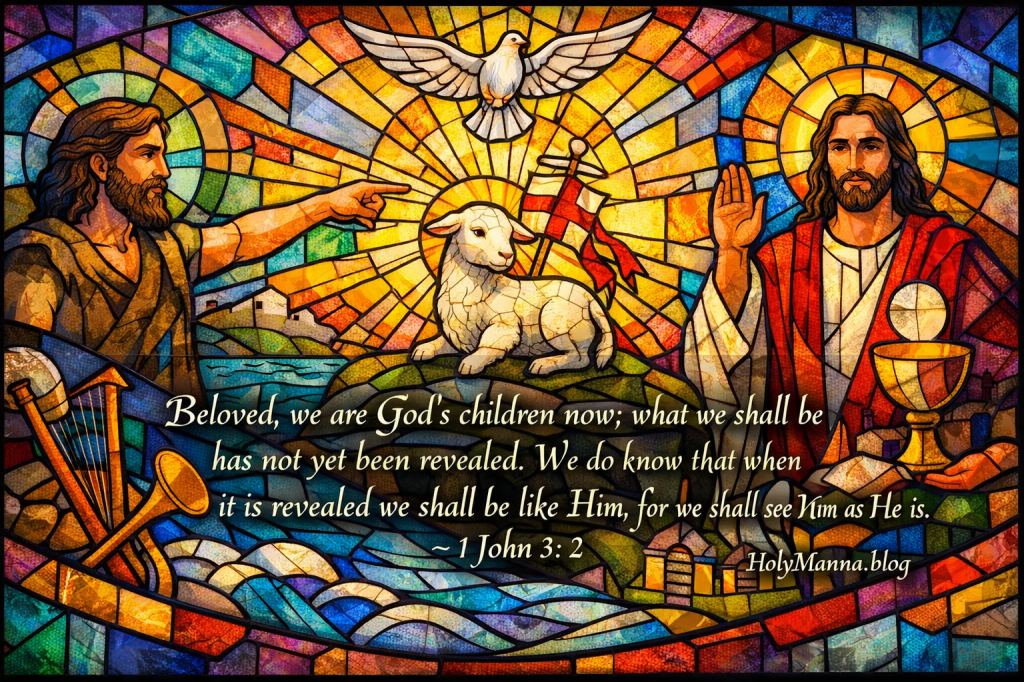
3:1 See what love the Father has bestowed on us that we may be called the children of God. Yet so we are. The reason the world does not know us is that it did not know him. 2 Beloved, we are God’s children now; what we shall be has not yet been revealed. We do know that when it is revealed we shall be like him, for we shall see him as he is. 3 Everyone who has this hope based on him makes himself pure, as he is pure.
Avoiding Sin. 4 Everyone who commits sin commits lawlessness, for sin is lawlessness. 5 You know that he was revealed to take away sins, and in him there is no sin. 6 No one who remains in him sins; no one who sins has seen him or known him.
Detailed Exegesis
Verse 2:29 “If you consider that he is righteous, you also know that everyone who acts in righteousness is begotten by him.”
Saint John starts with a spiritual reality that is easy to forget: righteousness is not just a behavior, it is a family resemblance. God is righteous, so those who are “begotten” by Him will begin to live righteously. This is not moralism, and it is not perfectionism. It is the logic of rebirth. When grace is real, it produces fruit that can be seen over time. That is why righteousness is not presented as optional extra credit, but as evidence that a person truly belongs to God.
Verse 3:1 “See what love the Father has bestowed on us that we may be called the children of God. Yet so we are. The reason the world does not know us is that it did not know him.”
This verse is the heart of the reading. The Christian life begins in astonishment at God’s love. Being called God’s children is not a compliment. It is a gift of adoption that changes status, belonging, and destiny. The world not recognizing Christians makes sense, because it did not recognize Christ. Christmas itself proves that point. The world saw a baby and missed the eternal Son. In the same way, the world often sees ordinary Catholics and misses the supernatural identity that God has given them.
Verse 2 “Beloved, we are God’s children now; what we shall be has not yet been revealed. We do know that when it is revealed we shall be like him, for we shall see him as he is.”
Notice the balance. Christians are God’s children now, not someday. At the same time, the final glory is still hidden. Saint John points to the promise of seeing Christ “as he is,” which is a direct line into the Church’s teaching on heaven, where the blessed see God face to face. This is not an abstract promise. It is the future that reshapes the present. If the destination is becoming like Christ, then daily life becomes a training ground in holiness.
Verse 3 “Everyone who has this hope based on him makes himself pure, as he is pure.”
Hope is not wishful thinking. Hope is a decision to live toward what God has promised. Saint John connects hope to purification, because what someone truly hopes for will shape what someone truly chooses. Purity here is bigger than one narrow topic. It is the whole heart being cleansed and aligned with Christ. It includes thoughts, desires, habits, relationships, and the way the body is treated, because the Christian life is not “spiritual” in the detached sense. It is incarnational. God cares about the whole person.
Verse 4 “Everyone who commits sin commits lawlessness, for sin is lawlessness.”
This verse cuts through excuses. Sin is not merely personal preference or a minor slip. It is “lawlessness,” meaning a rejection of God’s order and love. In the biblical mindset, God’s law is not an arbitrary set of rules. It is the truth about reality, the path that leads to life. When someone sins, the person is not just breaking a commandment, but stepping outside the harmony God designed.
Verse 5 “You know that he was revealed to take away sins, and in him there is no sin.”
This is Christmas language with a Good Friday purpose. Christ was “revealed” not only to teach but to save, and the saving is specific: to take away sins. Saint John also anchors everything in who Jesus is. Because there is no sin in Him, He can carry sin away. He is not just a better moral example. He is the sinless Savior who can actually free people from what enslaves them.
Verse 6 “No one who remains in him sins; no one who sins has seen him or known him.”
This is the line that forces honesty. Saint John is not claiming that Christians never fall, because he also speaks elsewhere about confession and forgiveness. Here he is talking about a pattern, a settled way of life. Remaining in Christ means living in communion with Him, not treating Him like a distant idea. A life that calmly chooses sin as a lifestyle is a life that is not really staying close to Jesus. The point is not despair. The point is clarity: intimacy with Christ and comfort with sin cannot live together for long.
Teachings
The Church teaches that becoming a child of God is not a metaphor. It is a real participation in divine life through grace. That is why Saint John’s words sound so strong, because the gift is so real. The Catechism teaches that adoption and new life are part of what baptism actually does. It says, “Baptism makes us members of the Body of Christ” and it speaks of baptism as a true rebirth into divine life, not a mere external sign. CCC 1267. This is exactly what Saint John is describing when he says believers are “begotten” by God and are “children of God” right now.
Saint John’s insistence on purification also lines up with the Church’s teaching that grace does not erase the moral life. Grace empowers it. The Catechism speaks about the call to holiness and the seriousness of sin, explaining that sin wounds communion with God and that conversion is real, concrete, and ongoing. One short line captures the moral realism behind this reading: “Sin is an offense against God.” CCC 1850. Saint John says the same thing with different words when he defines sin as lawlessness.
The most important link to today’s theme is Christ’s mission to remove sin. In the Gospel, John the Baptist points to Jesus as the Lamb of God who takes away the sin of the world, and in this First Reading Saint John says, “he was revealed to take away sins.” Both texts are pointing to the same reality: Jesus does not negotiate with sin. He destroys it. The early Church loved to preach this as liberation, not gloom. Saint Athanasius famously summarized the purpose of the Incarnation with a line that has shaped Catholic theology for centuries: “For the Son of God became man so that we might become God.” This does not mean becoming divine by nature, but sharing in God’s life by grace. That is the “children of God” reality Saint John celebrates.
Historically, this reading also pushes back against a recurring temptation in every age: to claim spiritual enlightenment while downplaying concrete obedience. In the first century, there were already strains of thought that treated the body and moral choices as less important than “knowledge.” Saint John insists that real knowledge of God produces real righteousness, because the God revealed in Jesus Christ is righteous, pure, and sinless.
Reflection
This reading is a gut check in the best way. It does not start with guilt. It starts with identity. God’s love has made believers His children. That means the daily question is not, “How far can life go without getting in trouble?” The daily question becomes, What does a son of the Father do in this situation? What does a daughter of God choose when nobody is watching?
Remaining in Christ is not a vague feeling. It is a relationship built by habits that keep the heart close to Him. Prayer that is consistent, even when it feels dry, is one of the most practical ways to “remain.” Frequent confession is another, because it refuses to let sin become normal. Reading Scripture steadily is another, because it keeps God’s truth louder than the world’s noise. Choosing one concrete act of self-denial can also matter, because it trains the will to prefer Christ over impulse.
It also helps to notice Saint John’s hope. The Christian is not purifying the heart to earn love. The Christian purifies the heart because love has already been given, and because the future is real: seeing Christ as He is, and becoming like Him. That hope is not meant to float above ordinary life. It is meant to shape it.
Where has the world tried to rename believers as something other than children of God? What habit, relationship, or private pattern needs to change if life is going to look like someone who “remains in Him”? Is hope in Christ leading to purification, or is hope being replaced by excuses that keep sin comfortable?
Responsorial Psalm – Psalm 98:1, 3-6
A Victory Song for the Whole World
Psalm 98 is a liturgical shout of joy, the kind of hymn Israel would sing when God had clearly acted in history. In the Old Testament world, victories were not just national pride moments. They were signs that the Lord was faithful to His covenant, that He remembered His people, and that His saving power was not imaginary. This psalm carries that covenant language loudly, because it celebrates God’s “marvelous deeds,” His mercy, and His faithfulness. That is why the Church places it right here in the Christmas season. The birth of Christ is not just a sweet scene. It is the decisive intervention of God into the world, the beginning of the victory that will be completed through the Cross and Resurrection. In today’s theme, this psalm becomes the joyful response to what the First Reading and the Gospel proclaim: Christ is revealed, sin is being taken away, and God’s children are meant to live like it and praise like it.
Psalm 98:1, 3-6 – New American Bible (Revised Edition)
The Coming of God
1 A psalm.
Sing a new song to the Lord,
for he has done marvelous deeds.
His right hand and holy arm
have won the victory.3 He has remembered his mercy and faithfulness
toward the house of Israel.
All the ends of the earth have seen
the victory of our God.4 Shout with joy to the Lord, all the earth;
break into song; sing praise.
5 Sing praise to the Lord with the lyre,
with the lyre and melodious song.
6 With trumpets and the sound of the horn
shout with joy to the King, the Lord.
Detailed Exegesis
Verse 1 “Sing a new song to the Lord, for he has done marvelous deeds. His right hand and holy arm have won the victory.”
A “new song” in Scripture is not just a fresh melody. It is a response to a new act of God. When the Lord saves, His people sing. The “right hand” and “holy arm” are biblical images for God’s power, emphasizing that salvation is not human achievement. In the Christmas season, that line lands with extra force. God wins by coming close, by becoming man, by entering weakness and transforming it from the inside. The victory begins in Bethlehem, even if the world does not recognize it yet.
Verse 3 “He has remembered his mercy and faithfulness toward the house of Israel. All the ends of the earth have seen the victory of our God.”
This verse ties praise to covenant memory. God “remembering” is not God recalling information. It is God acting faithfully, keeping promises, and showing steadfast love. Israel’s story is the story of God refusing to abandon His people, even when they fall. Then the psalm turns outward: the victory is not meant to stay within Israel’s borders. “All the ends of the earth” will see it. That matches the Gospel today, where John the Baptist points to Jesus as the Lamb who takes away the sin of the world, not just the sin of one nation.
Verse 4 “Shout with joy to the Lord, all the earth; break into song; sing praise.”
This is missionary praise. The psalm calls “all the earth” to worship the Lord, which is an early hint of the universal plan of salvation that becomes explicit in Christ. Praise is not private therapy. It is truth expressed publicly. When God is King, creation is invited to respond. This verse also shows that joy is not a personality trait. Joy is a spiritual response to who God is and what He has done.
Verse 5 “Sing praise to the Lord with the lyre, with the lyre and melodious song.”
The psalm gets specific: worship is embodied, expressed, and communal. Instruments matter because human beings are not pure spirits. The body, the voice, and the senses all belong in worship. In Catholic life, this fits naturally with liturgy, where the Church prays with words, chant, posture, incense, art, and music. God does not just want mental agreement. God wants the whole person.
Verse 6 “With trumpets and the sound of the horn shout with joy to the King, the Lord.”
Trumpets and horns were used for royal announcements, festivals, and major public moments. The psalm is basically saying: treat the Lord like the true King, because He is. This is more than emotional excitement. It is allegiance. When the Church sings this in the Christmas season, it is proclaiming that Jesus is not simply a moral teacher. He is King and Lord, and His victory is real.
Teachings
This psalm is a strong reminder that worship is a response to revelation. God acts, then God’s people respond with praise. That rhythm is at the center of Catholic life, especially the sacred liturgy. The Catechism teaches that worship and praise are not side activities, but part of the very purpose of the human person: “The glory of God is man fully alive; moreover man’s life is the vision of God.” CCC 294. When believers praise God, they are not flattering Him. They are stepping into the truth of who they are and who He is.
The psalm also highlights something that is easy to forget: salvation is meant for the whole world. Israel is chosen, but not chosen to hoard God. Israel is chosen to become the channel through which the nations are blessed. In Christ, that becomes explicit, because the Church is sent to all peoples. This psalm says it in poetic form when it declares that the ends of the earth have seen God’s victory.
Saint Augustine often preached that the “new song” is the song of a renewed life, not merely a different tune. He tied singing to loving, and loving to living differently. That fits today perfectly. If Christ is taking away sin, then the “new song” should also show up as new habits, new purity, new mercy, and new courage. The praise that Psalm 98 calls for is meant to overflow from the liturgy into daily life.
Historically, this psalm has had a natural home in the Church’s seasons that celebrate God’s saving works, because it is basically a victory anthem. In the context of Christmas, it becomes a proclamation that the birth of Christ is not sentimental nostalgia. It is God’s decisive move to save, and the whole world is invited to rejoice.
Reflection
This psalm challenges the quiet kind of Christianity that stays polite, private, and hidden. It invites a joyful boldness that does not need to be annoying or performative, but does need to be real. God has done marvelous deeds. Christ has entered the world. Sin is being defeated. That is not small news, so the response should not be small either.
A practical way to live this is to take worship seriously. Singing at Mass, even when the week has been heavy, is a small act of faith that says God is still King. Praying a psalm during the day can also reset the heart, especially when the mind starts spiraling into stress or impatience. Another concrete step is gratitude, because gratitude is a form of praise that can be practiced anywhere. Naming God’s mercy out loud, even in a kitchen or car, retrains the soul to see the victory of God rather than the chaos of the world.
This psalm also pushes believers to think bigger than personal spirituality. If “all the ends of the earth” are meant to see God’s victory, then the Christian life cannot stay locked inside comfort zones. Praise naturally leads to witness, and witness can be as simple as speaking about God’s goodness without embarrassment, choosing integrity when it costs something, or offering hope when everyone else is cynical.
Does praise show up only when life feels easy, or does it show up because God is King even in hard seasons? Where has the Lord shown mercy and faithfulness recently that deserves a “new song” in everyday life? Is worship shaping the way speech, choices, and relationships look during the week, or is it staying trapped inside Sunday?
Holy Gospel – John 1:29-34
Behold the Lamb
This passage drops readers right into the early days of Jesus’ public revelation, when expectations in Israel were intense. Many were longing for deliverance, but not everyone agreed on what that deliverance should look like. Some hoped for political freedom from Rome. Others longed for spiritual renewal, a cleansing of the nation, and a true return to God. John the Baptist appears in that setting like an Old Testament prophet reborn, preaching repentance and baptizing in the Jordan, the river tied to Israel’s entry into the Promised Land. His mission is not to draw attention to himself. His mission is to identify the Messiah and prepare hearts to receive Him.
That is why this Gospel fits today’s theme so perfectly. Saint John’s First Letter says Christ was revealed to take away sins, and today the Baptist points directly at Jesus and announces it publicly. Psalm 98 calls the whole earth to rejoice in God’s victory, and this passage shows the victory beginning to be named out loud. The Lamb who takes away the sin of the world has arrived, and the Spirit confirms who He is.
John 1:29-34 – New American Bible (Revised Edition)
John the Baptist’s Testimony to Jesus. 29 The next day he saw Jesus coming toward him and said, “Behold, the Lamb of God, who takes away the sin of the world. 30 He is the one of whom I said, ‘A man is coming after me who ranks ahead of me because he existed before me.’ 31 I did not know him, but the reason why I came baptizing with water was that he might be made known to Israel.” 32 John testified further, saying, “I saw the Spirit come down like a dove from the sky and remain upon him. 33 I did not know him, but the one who sent me to baptize with water told me, ‘On whomever you see the Spirit come down and remain, he is the one who will baptize with the holy Spirit.’ 34 Now I have seen and testified that he is the Son of God.”
Detailed Exegesis
Verse 29 “The next day he saw Jesus coming toward him and said, ‘Behold, the Lamb of God, who takes away the sin of the world.’”
This is one of the most important lines in the entire Gospel. “Behold” is not casual. It is a command to look, to pay attention, to stop drifting. Calling Jesus the “Lamb of God” pulls in rich biblical meaning: sacrifice, Passover, deliverance, substitution, innocence offered for the guilty. John does not say Jesus takes away only personal sins, or only Israel’s sins, but the sin of the world. This is universal salvation language. Jesus is being revealed as the one who will deal with humanity’s deepest problem, not just its external troubles.
Verse 30 “He is the one of whom I said, ‘A man is coming after me who ranks ahead of me because he existed before me.’”
John the Baptist has chronological priority in public ministry, but he insists Jesus ranks ahead because Jesus existed before him. This is a clear hint of Christ’s preexistence. Jesus is not just another prophet stepping onto the scene. He is the eternal Son entering history. That is why the Christmas season matters so much. The Child born of Mary is the eternal Word made flesh.
Verse 31 “I did not know him, but the reason why I came baptizing with water was that he might be made known to Israel.”
John’s humility is striking. He admits he did not fully recognize Jesus in a human way. His mission was driven by obedience to God’s plan, not personal certainty or popularity. John’s baptism is a preparation, a call to repentance, so that when Jesus is revealed, hearts are ready. This shows that grace often works through preparation. God does not usually force conversion in a single dramatic moment without any lead up. He softens the soil first.
Verse 32 “John testified further, saying, ‘I saw the Spirit come down like a dove from the sky and remain upon him.’”
The Spirit “remaining” is key. In the Old Testament, the Spirit can come upon individuals for a mission, then depart. Here the Spirit remains on Jesus because Jesus is the anointed one in a unique and permanent way. The dove imagery also echoes creation, where the Spirit hovered over the waters, and it echoes the flood narrative, where the dove signals a new world. In Jesus, God is beginning the new creation.
Verse 33 “I did not know him, but the one who sent me to baptize with water told me, ‘On whomever you see the Spirit come down and remain, he is the one who will baptize with the holy Spirit.’”
John’s authority comes from being sent. He is not self-appointed. God gives him a sign to identify the Messiah. The prophecy is clear: Jesus will baptize with the Holy Spirit. This is not only about forgiveness, but about transformation. Water cleanses externally. The Spirit renews internally. The Church will later experience this at Pentecost, but the promise is already being stated here.
Verse 34 “Now I have seen and testified that he is the Son of God.”
John’s testimony reaches its peak. Jesus is not only Lamb, not only Messiah, not only Spirit baptizer. He is the Son of God. This is the foundation of Christian faith, because Christianity is not merely a moral system. It is the revelation of a person who is truly divine and truly the Savior.
Teachings
This Gospel is woven into the Church’s worship constantly. At Mass, right before Holy Communion, the Church echoes John the Baptist with the words, “Behold the Lamb of God, behold him who takes away the sins of the world.” The liturgy is not quoting Scripture for decoration. It is placing believers in the same posture as John the Baptist: eyes on Jesus, humility in the heart, and trust that He truly takes away sin.
The Church teaches that Christ’s mission as Lamb is tied to His sacrificial offering. The Catechism summarizes the meaning of Christ’s sacrifice clearly: “Jesus freely offered himself for our salvation.” CCC 609. This freedom matters, because it shows love, not coercion. Jesus is not a victim of history. He is the Redeemer choosing the Cross.
The identity of Jesus as the Son of God is also central to Catholic doctrine. The Church teaches that Jesus is not a creature adopted into divine status, but eternally begotten of the Father. That is why the Incarnation is so astonishing. The eternal Son truly entered time, took flesh, and revealed the Father. The Catechism speaks about the reason for the Word becoming flesh: “The Word became flesh to save us by reconciling us with God.” CCC 457. That fits perfectly with John’s proclamation that Jesus takes away the sin of the world.
The promise that Jesus will baptize with the Holy Spirit also points straight to sacramental life. Baptism is not merely symbolic. It is a real communication of grace that brings a person into Christ’s life, and confirmation strengthens that gift. The Spirit does not only comfort, but sanctifies and empowers. This is the inner engine behind the First Reading’s call to purity. Remaining in Christ is not accomplished by willpower alone. It is lived by cooperating with the Holy Spirit.
Saint John Chrysostom often emphasized that John the Baptist’s greatness is found in his humility and clarity. He does not cling to attention. He points away from himself and insists everyone look at Jesus. That is a lesson the Church never outgrows, because discipleship always involves learning how to decrease so that Christ increases.
Reflection
This Gospel calls for a very practical kind of faith: the habit of looking at Jesus and letting Him define reality. John the Baptist does not say, “Behold your potential.” He says, “Behold, the Lamb of God.” That is the difference between a self improvement religion and the Catholic faith. The Catholic faith begins with Jesus, stays with Jesus, and ends with Jesus.
A strong way to apply this reading is to treat sin like a real enemy and treat Jesus like a real Savior. Too many people do the opposite. They treat sin like a minor issue and treat Jesus like a distant concept. This Gospel flips that. Jesus takes away sin, which means sin is serious, but it also means despair is not necessary. The Lamb has come. Forgiveness is real. Freedom is possible. Purity is not only a command, but a gift that grows when a person remains close to Christ in prayer, confession, and the Eucharist.
John the Baptist also models something needed in daily life: clarity without drama. He speaks the truth plainly and points to Christ confidently. That is a great pattern for conversations with family, friends, and coworkers. Faith does not need to be loud or cheesy to be real. It needs to be clear, steady, and centered on Jesus.
What competes for attention so strongly that it becomes hard to “behold” Christ with a focused heart? Is there a sin that has been treated like a pet instead of an enemy, even though Jesus came to take it away? How can the coming week include one concrete choice that points more clearly to Jesus, just like John the Baptist did?
When the Lamb Is Revealed, Life Has to Change
Today’s readings land like one clear message spoken three different ways: Jesus Christ has been revealed, He truly takes away sin, and that reality demands a real response. This is not a day for vague spirituality or comfortable habits that never get challenged. This is a day for looking straight at Jesus, remembering who God says His people are, and choosing the kind of life that matches that identity.
The First Reading from 1 John 2:29 to 3:6 makes the foundation unmistakable. Christians are not merely moral people trying harder. Christians are “the children of God” right now, and that family name comes with a family likeness. Remaining in Christ cannot coexist with making peace with sin. The reading does not say this to crush anyone. It says this to wake up hope, because Christ was revealed to take away sins, and His grace is powerful enough to purify a life that has been messy for years.
Then Psalm 98 teaches the right response when God acts: worship that is joyful and public. God’s mercy and faithfulness are not abstract ideas. They are historical deeds, culminating in the coming of Christ. That is why the psalm calls the whole earth to sing a new song. A heart that truly believes Jesus is Savior does not stay stuck in cynicism. It learns to praise again, because the King has come and His victory is real.
Finally, the Holy Gospel from John 1:29 to 34 brings the moment of revelation into full view. John the Baptist points, testifies, and refuses to make it about himself. He names Jesus plainly: “the Lamb of God, who takes away the sin of the world.” That line ties the whole day together. The Lamb is not a symbol. The Lamb is a person. Jesus does not offer inspirational advice while sin stays in charge. Jesus takes sin away, and He baptizes with the Holy Spirit, which means God does not just demand holiness. God provides the grace to live it.
So the call to action is simple and strong. Keep eyes on Jesus this week, not as a concept, but as the Lamb and the Son of God who is truly present and truly saving. Let praise return, even if the mood is not perfect, because worship trains the heart to remember God’s victory. Choose one concrete step toward purity, because hope in Christ is meant to produce a cleaner heart and a steadier life. And when temptation shows up, do not negotiate with it like it is harmless. Bring it into the light, run to confession when needed, pray with real honesty, and cling to Christ with the kind of trust a child has for a good Father. That is how God’s children live when the Lamb has been revealed.
Engage with Us!
Share reflections in the comments below. It is always encouraging to hear how the Lord is speaking through today’s Word, especially when these readings challenge the heart and strengthen hope at the same time.
- First Reading, 1 John 2:29 to 3:6: What does it mean in everyday life to live as a real child of God, not just in words but in habits, choices, and relationships? What is one area where “remaining in Him” needs to become more concrete this week?
- Responsorial Psalm, Psalm 98:1, 3 to 6: Where has God shown mercy and faithfulness recently that deserves a “new song” of gratitude, even if life has been stressful or imperfect? How can praise become a steady practice instead of only an occasional mood?
- Holy Gospel, John 1:29 to 34: When John says “Behold, the Lamb of God, who takes away the sin of the world”, what sin or burden needs to be handed to Jesus with more trust and less delay? What would change if Jesus were treated as a real Savior today, not a distant idea?
Keep showing up with faith, even when it feels ordinary, because God does extraordinary work through steady discipleship. Stay close to Jesus, choose the good with courage, repent quickly when falling happens, and keep moving forward with hope. Do everything with the love and mercy Jesus taught and let that mercy shape the way people are treated at home, at work, and everywhere in between.
Sacred Heart of Jesus, we trust in You!
Immaculate Heart of Mary, pray for us!
Saint Michael the Archangel, defend us in battle!
Follow us on YouTube, Instagram and Facebook for more insights and reflections on living a faith-filled life.

 Holy Manna!
Leave a comment