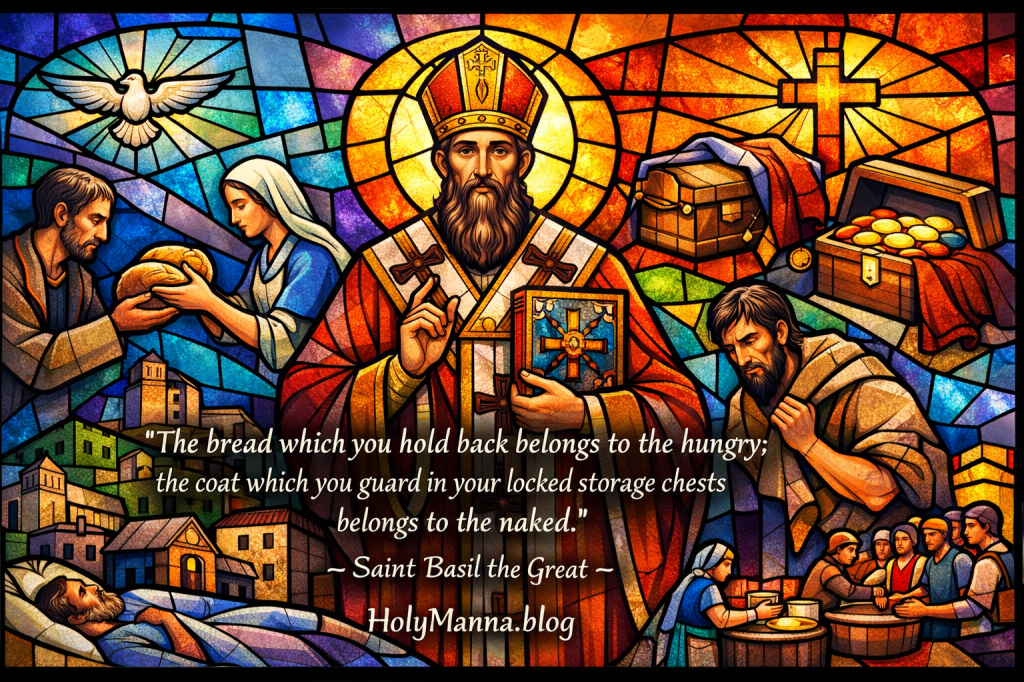
The Bishop Who Defended the Trinity and Built a City for the Poor
Saint Basil the Great is one of those saints who makes it impossible to separate sound theology from real Christian living. He was a fourth century bishop of Caesarea in Cappadocia, a Doctor of the Church, and one of the great Cappadocian Fathers. He is especially revered for defending the Nicene faith during the Arian crisis, helping the Church articulate her teaching on the Holy Trinity, and transforming Christian charity into an organized, visible force in society. Saint Basil shows that fidelity to doctrine and love for the poor are never in competition but always belong together.
The Church honors him as “the Great” not because he sought influence or power, but because he united prayer, intellect, courage, and mercy in a single life. He helped shape Eastern monasticism, clarified the Church’s teaching on the Holy Spirit, and modeled what it means to shepherd souls in times of confusion and pressure. His witness remains deeply relevant for Catholics who want to live the faith with both conviction and compassion.
A Wake-Up Call from God
Saint Basil was born around the year 330 in Caesarea of Cappadocia into an extraordinary Christian family. His parents, Basil the Elder and Emmelia, raised their children in deep faith, prayer, and moral discipline. Several members of his family are honored as saints, including his sister Saint Macrina the Younger and his brother Saint Gregory of Nyssa. This family environment functioned as a true domestic Church, forming Basil’s conscience and love for God long before he held any position of leadership.
Basil received an elite education, studying rhetoric and philosophy in Caesarea, Constantinople, and Athens. In Athens he formed a lifelong friendship with Saint Gregory of Nazianzus. Though raised Christian, Basil became absorbed in academic success and worldly ambition. Later in life he looked back on this period with striking honesty, admitting that knowledge without humility had dulled his soul. He famously confessed, “I wasted much time in the vanities of this world and spent nearly all my youth in vain labors.”
This realization marked a turning point. Influenced deeply by his sister Macrina and inspired by the witness of ascetics, Basil experienced a profound interior conversion. He traveled throughout the East to learn from monastic communities in Egypt, Syria, and Palestine. These encounters convinced him that the Gospel must be lived with discipline, simplicity, and radical dependence on God. When he returned home, he committed himself entirely to a life ordered by prayer, Scripture, and service.
Truth with Teeth
Saint Basil’s mature life reveals what happens when faith is taken seriously. Ordained a priest and later consecrated bishop of Caesarea, he assumed leadership during one of the most dangerous theological crises in Church history. The Arian heresy denied the full divinity of Jesus Christ, and political pressure tempted many bishops to compromise. Basil refused. He defended the teaching affirmed at Nicaea and worked tirelessly to clarify the Church’s faith in the Holy Spirit, helping lay the groundwork for later doctrinal definitions.
Yet Basil was never content to defend truth only with words. He believed doctrine must shape daily life. During times of famine and economic injustice, he preached forcefully against greed and indifference to the poor. His sermons confronted comfortable Christians with uncomfortable truth. One of his most famous teachings declares, “The bread which you hold back belongs to the hungry; the coat which you guard in your locked storage chests belongs to the naked.” These words reflect the Gospel logic found in The Gospel of Matthew, where Christ identifies Himself with the least.
Basil’s preaching was matched by action. He founded what came to be known as the Basiliad, a vast complex that included a hospital, hospice, shelters for travelers, and care for the poor and for lepers who were often rejected by society. This was not charity as sentiment, but charity as Christian responsibility. Basil made mercy visible, organized, and unmistakably Christian.
The Quiet Miracles of a Holy Shepherd
Saint Basil’s miracles were often quiet and pastoral rather than dramatic. Accounts speak of healings, deliverance from evil spirits, and answered prayers through his intercession even during his lifetime. Yet his most powerful miracles were the transformation of hearts and communities. Through preaching and example, Basil led many to repentance, generosity, and deeper faith.
In his homily often associated with the parable of the rich fool, Basil exposed the illusion of security rooted in possessions. Drawing on the wisdom of The Gospel of Luke, he warned that hoarded wealth becomes a spiritual danger. He taught that generosity multiplies grace, writing, “Just as grain that has fallen on the earth becomes a gain to the sower, so the loaf thrown to the hungry man renders abundant fruit thereafter.” His confidence in God’s providence shaped a community that trusted mercy more than accumulation.
Basil’s life demonstrates that miracles are not always spectacles. Sometimes they look like a city that feeds the hungry, a bishop who refuses bribes, or a Church that stands firm when truth is unpopular.
Standing Strong Against an Empire
Saint Basil endured constant pressure from imperial authorities who favored Arian theology. He faced threats of exile, confiscation of Church property, and political intimidation. When officials attempted to frighten him into submission, Basil responded calmly, noting that he owned little and feared nothing except betraying Christ. His courage was rooted not in pride but in clarity of conscience.
He also carried immense physical suffering. Basil’s health was fragile, weakened by ascetic discipline and relentless labor. He governed his diocese, preached, wrote theological works, organized charitable institutions, and defended orthodoxy while battling illness. Though he did not die by execution, Basil lived a form of daily martyrdom through endurance and sacrifice.
The Catechism teaches that martyrdom is the supreme witness to the truth of the faith, and Basil’s life exemplifies this witness through fidelity under pressure. He shows that suffering accepted in obedience can be just as powerful as a martyr’s death.
A Legacy That Keeps Healing
Saint Basil died on January 1, 379, mourned by Christians and non Christians alike. His influence only grew after his death. Miracles of healing and answered prayers were attributed to his intercession, and devotion to him spread widely throughout the Christian world. His writings continued to guide the Church in theology, monastic life, and pastoral care.
The model he established through the Basiliad shaped the Church’s understanding of institutional charity. Hospitals, hospices, and organized care for the poor would become hallmarks of Christian civilization. Basil’s legacy proves that the Church’s concern for the vulnerable is not an invention of modern times but flows directly from the Gospel.
His life remains a powerful reminder that holiness leaves structures behind. When faith is authentic, it reshapes not only individuals but entire communities.
Reflection
Saint Basil the Great challenges modern Christians to examine whether faith is treated as a private comfort or a transforming force. His life shows that belief in the Trinity demands action. The Father sends the Son, the Son reveals love unto the Cross, and the Holy Spirit empowers believers to live that love boldly in the world.
Basil also teaches the value of structure in spiritual life. Prayer, fasting, Scripture, and community were not optional extras but necessary foundations. In a distracted age, his example calls believers back to disciplined love. His teaching on wealth confronts a culture obsessed with comfort and accumulation. Basil does not preach guilt but freedom, reminding the faithful that generosity loosens the grip of fear.
Where has comfort softened commitment to the Gospel? What would change if generosity were practiced as obedience to Christ rather than optional kindness?
Engage with Us!
Readers are invited to share their thoughts and reflections in the comments below and join the conversation about this remarkable saint.
- What part of Saint Basil the Great’s life challenges comfort driven faith the most today?
- How can truth and charity be better united in daily Christian living?
- What practical step can be taken this week to serve the poor more intentionally?
Saint Basil the Great reminds the Church that authentic faith is sturdy, joyful, and outward facing. May his intercession inspire a life rooted in truth, courage, and mercy, and may everything be done with the love and mercy Jesus taught us.
Saint Basil the Great, pray for us!
Follow us on YouTube, Instagram and Facebook for more insights and reflections on living a faith-filled life.

 Holy Manna!
Leave a comment