The Yes That Changed Everything
The Blessed Virgin Mary is honored as the Holy Mother of God because the Child she bore is truly God. This title is not an exaggeration or poetic sentiment. It is a precise confession of faith about Jesus Christ. By calling Mary Mother of God, the Church protects the truth that Jesus is one divine Person who is fully God and fully man. The early Church defended this title to safeguard the Gospel itself, not to elevate Mary above Christ.
Mary’s greatness does not come from power, status, or public recognition. Her greatness flows from her total belonging to the Lord. She receives God’s Word, trusts it, and lives it without reservation. The Catechism teaches that “Mary’s role in the Church is inseparable from her union with Christ and flows directly from it” (CCC 964). She is honored because her life reveals what perfect discipleship looks like. She does not compete with Christ for attention. She magnifies him by her obedience.
This is why Mary matters so much for everyday Catholics. She shows that holiness is not about being impressive, loud, or constantly affirmed. Holiness is about fidelity, humility, and perseverance. In a culture addicted to noise and self-promotion, Mary stands as a living reminder that God works most powerfully through quiet surrender.
Nazareth’s Hidden Flower
Mary lived in Nazareth, a small and easily overlooked town. Sacred Tradition identifies her parents as Joachim and Anne, a faithful Jewish couple whose lives were shaped by prayer and trust in God. Mary grows up immersed in the faith of Israel, formed by the Scriptures and the daily rhythm of worship. Her heart is already attentive to God long before the angel Gabriel appears.
At the Annunciation, God invites Mary into a mystery that surpasses human understanding. She is not coerced. She is not rushed. She is asked to trust. Mary responds thoughtfully, asking “How can this be, since I do not know man?” (The Gospel of Luke 1:34). Her question does not come from doubt but from reverence. She seeks understanding while remaining open to obedience.
When the angel reveals God’s plan, Mary freely consents with words that shape the destiny of the world: “Behold, I am the handmaid of the Lord. May it be done to me according to your word.” (The Gospel of Luke 1:38). This is not passive acceptance. It is courageous surrender. Mary places her future, her reputation, and her safety into God’s hands.
Her conversion, in the deepest sense, is this complete gift of self. She believes not only that God exists, but that God is faithful, even when the path ahead is uncertain. That kind of faith is rare, and it is why Mary becomes the model of the Church in every age.
Mary’s Life With Christ and Her Living Witness
Mary’s life is inseparable from the life of Jesus. She carries him in her womb, gives birth to him, raises him, and remains near him throughout his mission. The Gospels consistently portray her as attentive and discerning rather than demanding or controlling. She notices needs before others do and brings them quietly to her Son.
At the Visitation, Mary breaks into praise with words that reveal a soul steeped in Scripture. In the Magnificat, she proclaims “My soul proclaims the greatness of the Lord, and my spirit rejoices in God my Savior” (The Gospel of Luke 1:46–47). This prayer is not soft sentimentality. It is a bold proclamation of God’s justice and mercy, announcing that the proud will be scattered and the lowly lifted up. Mary knows the God of covenant faithfulness.
Mary also lives the hidden heroism of ordinary life. She and Joseph protect Jesus, including the flight into Egypt when Herod seeks to destroy him. She lives years of quiet fidelity in Nazareth, where holiness looks like work, prayer, obedience, and love within the walls of a real family.
At the wedding feast of Cana, Mary reveals her maternal confidence and spiritual clarity. She notices the need and tells Jesus simply, “They have no wine” (The Gospel of John 2:3). Then she turns to the servants and speaks words that remain her lasting instruction to the Church: “Do whatever he tells you” (The Gospel of John 2:5). In one sentence, she offers a complete program for Christian life. Obedience to Christ is the path to freedom and joy.
The Miracle of Faithfulness
Mary’s life contains miracles, but not in the way modern people often expect. Her greatest miracle is her unwavering faith. The Incarnation itself is the central miracle of history, and God freely chooses Mary’s yes as the human doorway through which salvation enters the world.
Mary’s faith remains steady even when she does not fully understand God’s plan. She treasures mysteries in her heart. She does not demand constant explanations. She trusts that God’s promises are reliable.
At Cana, her intercession is connected to Christ’s first public sign. Jesus is always the source of the miracle, but Mary’s role reveals the pattern of her motherhood. She brings needs to her Son and invites others into obedience. Her compassion is practical, attentive, and rooted in trust.
Mary’s presence at key moments in salvation history is itself a sign of grace. She stays when others leave. She remains faithful when following Jesus becomes costly. This kind of perseverance is a miracle of grace, and it is one that ordinary believers desperately need to rediscover.
The Sword and the Cross
Mary’s life includes profound suffering. Simeon’s prophecy that a sword would pierce her soul unfolds across her years, reaching its sharpest point at the Cross. She experiences danger during the flight into Egypt, misunderstanding during Jesus’ public ministry, and deep anguish as opposition to her Son intensifies.
At Calvary, Mary stands near the Cross. She does not flee. She does not despair. She remains united to her Son in love and faith. The Catechism teaches that “she faithfully persevered in her union with her Son unto the Cross” (CCC 964). Her suffering is not passive resignation. It is an active offering joined to Christ’s redemptive sacrifice.
Although Mary is not martyred by execution, the Church honors her as Queen of Martyrs because her suffering is fully united to the Passion of Christ. She teaches that suffering does not have the final word. When suffering is united to Jesus, it becomes a place where grace is at work.
A Mother Still at Work
When Mary’s earthly life was completed, the Church teaches that she was assumed body and soul into heavenly glory. Her Assumption is not an escape from humanity but a sign of hope for the Church. It reveals what God desires for all who belong to Christ. Mary already shares fully in the resurrection promised to believers.
The Catechism teaches that Mary now continues her maternal role in heaven, caring for the brothers and sisters of her Son through her intercession (CCC 969). Christians have sought her prayers since the earliest centuries, confident that the Mother of Jesus remains close to Jesus.
Throughout history, countless healings, conversions, and graces have been attributed to her intercession. Marian shrines and approved apparitions have consistently pointed souls toward repentance, prayer, and deeper faith in Christ. Mary never draws attention to herself for its own sake. She always leads souls to her Son.
Scripture preserves several verified quotations from Mary, including her words at the Annunciation, the Magnificat, and her instruction at Cana. Outside of Scripture, the Church does not rely on historically certain quotations attributed directly to Mary, which is why her inspired words remain the safest and richest source for understanding her heart.
Learning Mary’s Rhythm
Mary’s life is not meant to be admired from a distance. She is meant to be imitated in her virtues and trusted as a mother who prays. She teaches reverence in a casual age, silence in a noisy culture, courage in moments of fear, and obedience when excuses feel easier.
Marian discipleship looks like choosing prayer over panic and humility over ego. It looks like making room for Christ in daily life and refusing to abandon faith when it becomes inconvenient. It looks like trusting that God is still at work even when answers are not immediate.
Mary’s message remains simple and demanding. “Do whatever he tells you” (The Gospel of John 2:5). Those words continue to free hearts that are willing to listen.
Engage with Us!
Readers are invited to share their thoughts and reflections in the comments below and to join the conversation as a community of faith seeking deeper trust in God.
- How does Mary’s yes challenge the way faith is lived today?
- Where might God be asking for greater trust or surrender right now?
- How can Mary’s quiet fidelity shape daily prayer and family life?
May the Blessed Virgin Mary guard every heart and lead every soul closer to Jesus Christ. May her example form lives rooted in faith, strengthened by hope, and generous in love. Keep walking in obedience, keep trusting God’s plan, and keep doing everything with the mercy and charity Jesus taught, even when it is difficult and even when it costs something.
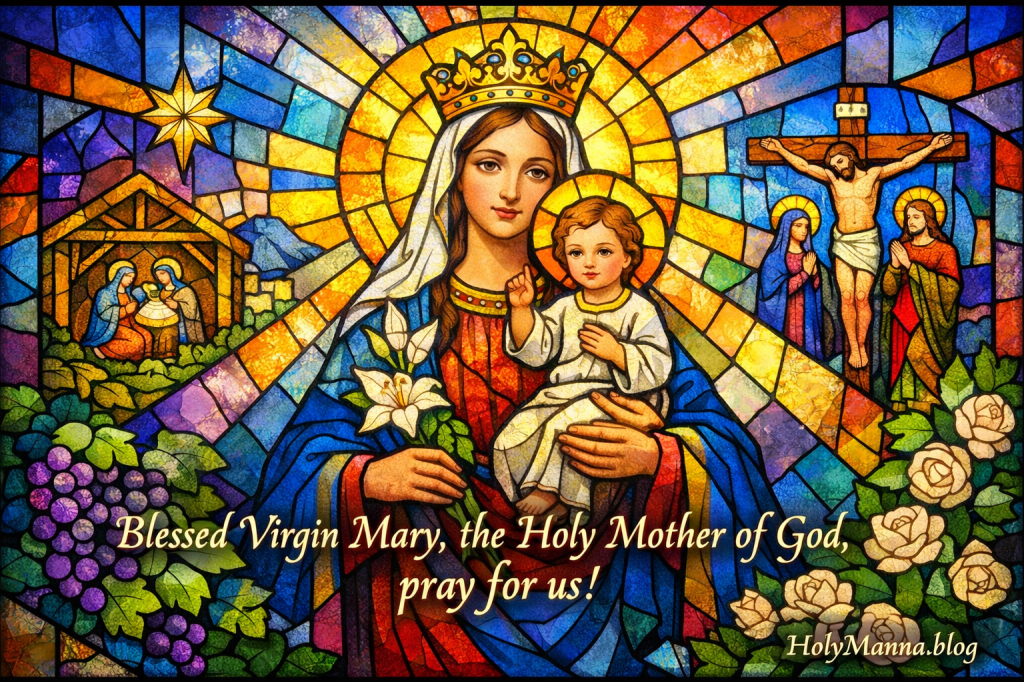
Blessed Virgin Mary, the Holy Mother of God, pray for us!
Follow us on YouTube, Instagram and Facebook for more insights and reflections on living a faith-filled life.

 Holy Manna!
Leave a comment