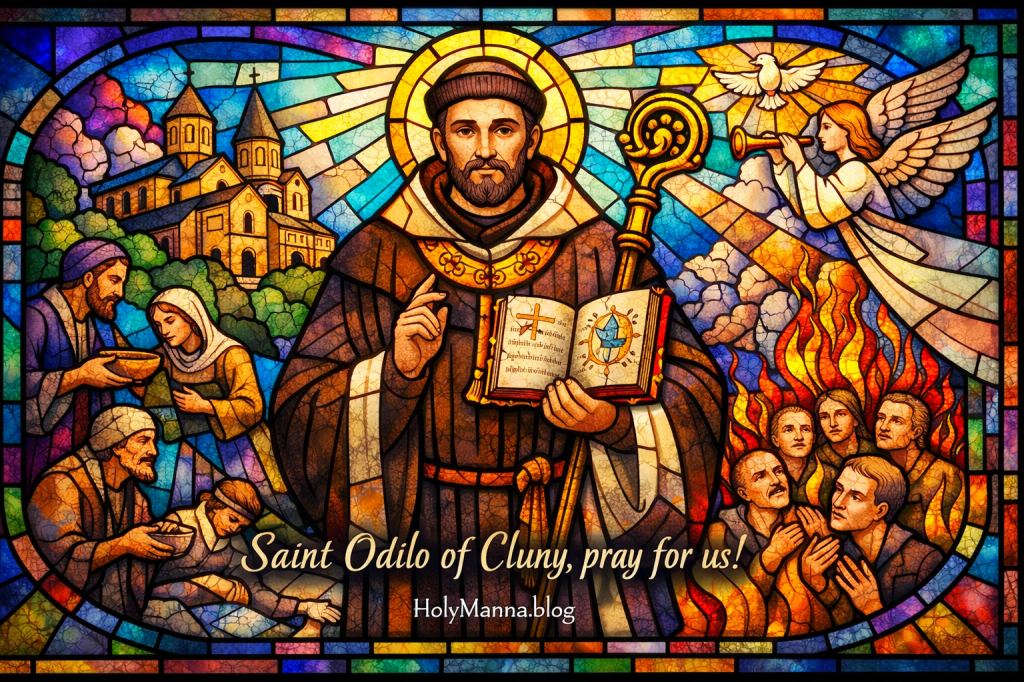
Mercy That Refuses to Forget the Dead
Saint Odilo of Cluny was the kind of holy man who makes modern Christians pause and ask whether believers still love with that depth and seriousness. Living between the late tenth and mid eleventh centuries, he shepherded souls during a time marked by violence, famine, and political instability. As the fifth Abbot of Cluny, he guided one of the most influential monastic movements in Western Christianity for more than fifty years, not through force or ambition, but through prayer, discipline, and mercy.
He is remembered above all for three enduring contributions. He strengthened the Cluniac reform that renewed monastic life across Europe. He promoted peace in a brutal feudal society by supporting the Peace and Truce of God, which sought to limit violence against the innocent. Most enduringly, he gave the Church a lasting spiritual gift by establishing an annual day of prayer for the faithful departed, what Catholics now know as All Souls’ Day on November 2.
This legacy is not merely historical. It touches daily Catholic life. The Church teaches that love does not end at death, because Christ has conquered death itself. The faithful on earth can assist the faithful departed through prayer, especially through the Holy Sacrifice of the Mass. The Catechism teaches, “Our prayer for them is capable not only of helping them, but also of making their intercession for us effective.” (The Catechism of the Catholic Church, 958). Saint Odilo lived that truth with conviction, courage, and consistency.
A Heart Shaped by Humility
Saint Odilo was born around the year 962 into a noble family in the Auvergne region of France. His social standing could have led him toward power or privilege, but his early physical suffering shaped a very different path. Historical tradition records that he suffered from serious weakness in his legs during childhood, leaving him unable to walk properly for a time. This limitation taught him dependence on God rather than self reliance.
According to long held tradition, Odilo experienced healing through prayer and the intercession of the Blessed Virgin Mary. Whether one focuses on the physical recovery or the spiritual lesson behind it, the result was clear. Odilo learned early that strength is received, not earned, and that gratitude must follow grace.
He was educated as a cleric and trained in the intellectual and spiritual life of the Church. Despite noble connections and worldly opportunities, he felt drawn to the monastic life and entered the Abbey of Cluny in 991. His humility, discipline, and wisdom quickly became evident to the community. Within only a few years, he was chosen to succeed Abbot Mayeul, becoming abbot himself in 994.
Under his leadership, Cluny expanded its spiritual influence dramatically, helping reform monasteries throughout Europe. Odilo became known among bishops, nobles, and even emperors as a man of integrity whose authority flowed from holiness rather than ambition. He governed firmly but gently, convinced that discipline without mercy hardens the soul, while mercy without discipline weakens it.
An Abbot of Prayer, Reform, and Costly Charity
Saint Odilo’s daily life was rooted in worship. He was deeply committed to the Divine Office and the beauty of the Church’s liturgy, believing that prayer was the heart from which all charity must flow. Under his guidance, monastic life at Cluny emphasized reverence, learning, and stability, helping to restore spiritual order in a chaotic age.
Yet Odilo’s holiness never remained enclosed within monastery walls. During periods of devastating famine, especially in the early eleventh century, he became known for heroic charity. He ordered the use of monastery resources to feed the starving and is remembered for giving generously until the poor were sustained. His actions saved countless lives and reflected the Church’s perennial teaching that care for the poor is not optional.
The Catechism reminds the faithful, “God blesses those who come to the aid of the poor and rebukes those who turn away from them.” (The Catechism of the Catholic Church, 2443). Saint Odilo did not merely affirm this teaching. He embodied it, even when it required sacrifice and risk.
He also worked tirelessly for peace. In a world accustomed to violence, Odilo supported efforts to restrict warfare and protect clergy, peasants, and pilgrims. He understood that peace was not weakness but a reflection of Christ’s kingship.
One verified quotation attributed to Saint Odilo captures the heart of his spirituality and leadership. He once said, “I would rather be mercifully judged for having shown mercy than be cruelly condemned for having shown cruelty.” This was not sentimentality. It was a sober awareness that every soul must one day stand before Christ, whose mercy triumphs over judgment.
The Hidden Martyrdom of Perseverance
Saint Odilo was not martyred by violence, but his life still bore the marks of sacrifice and endurance. For more than five decades he carried the weight of leadership during constant political pressure, social instability, and human suffering. Secular rulers often sought to control monasteries for personal gain, and Odilo consistently defended the spiritual independence of the Church.
He also endured physical weakness and illness throughout his life, accepting suffering without complaint. Surrounded by famine, disease, and death, he refused to grow numb. Instead, he grew more attentive to eternity and more reliant on God.
Traditional accounts of his final days describe intense spiritual struggle at the hour of death, emphasizing the reality of spiritual warfare and the hope of divine protection. These accounts, common in the lives of saints, remind the faithful that perseverance in prayer and repentance prepares the soul for its final encounter with Christ.
The Catechism teaches that suffering, when united to Christ, becomes a participation in His saving work (The Catechism of the Catholic Church, 1505–1508). Saint Odilo’s endurance was not stoic willpower. It was grace received and cooperated with day after day.
Love That Crosses the Threshold of Death
Saint Odilo’s most enduring contribution to Catholic life is the widespread observance of All Souls’ Day. Moved by a deep awareness of the communion of saints and the reality of purification after death, he established a dedicated annual day of prayer for the faithful departed within the Cluniac monasteries. This practice quickly spread throughout the Western Church.
The precise year of its institution is debated among historians, but the spiritual fruit is undeniable. All Souls’ Day embodies the Church’s teaching on Purgatory and the power of intercessory prayer. The Catechism teaches that those who die in God’s grace but still need purification undergo a final purification, and that the Church has always honored the memory of the dead and offered prayers for them (The Catechism of the Catholic Church, 1030–1032).
This devotion is one of the most radical forms of charity. It is love offered without expectation of earthly reward. It is fidelity to souls who can no longer help themselves. Saint Odilo taught the Church to live the communion of saints as a real family bond rather than a theological abstraction.
Saint Odilo died peacefully on January 1, 1049, while visiting the priory at Souvigny, where he was buried. Devotion to him spread quickly, and he was honored as a saint whose intercession was especially sought for the dying and the faithful departed.
Live Mercy with Eternal Perspective
Saint Odilo’s life confronts modern Catholics with an uncomfortable truth. Holiness is not about being liked. It is about loving as Christ loves. Odilo cared deeply about reverent worship, moral discipline, and doctrinal fidelity, and he cared just as deeply about the poor, the suffering, and the forgotten dead.
Living his example today begins with taking prayer seriously, especially prayer for the faithful departed. It means recovering the habit of offering Mass intentions, praying for deceased loved ones by name, and embracing November not only as a cultural season but as a time of remembrance and hope.
It also means choosing mercy in daily life, especially when it costs pride or comfort. Saint Odilo’s words about preferring mercy echo the heart of the Gospel. Jesus is not confused about sin, but He delights in repentance and forgiveness.
Simple practices can reflect Odilo’s spirit, such as praying a decade of the Rosary for the souls in Purgatory, offering small sacrifices for them, or performing acts of charity without recognition. His life teaches that worship must overflow into love and that love must always remember eternity.
Engage with Us!
Share your thoughts and reflections in the comments below and join the conversation with fellow readers.
- Who is one person you can begin praying for by name who has died, and what would help you make that prayer a daily habit?
- What does Saint Odilo’s devotion to both liturgy and charity reveal about what a balanced Catholic life should look like?
- Where might God be asking for mercy right now, especially toward someone who does not seem to deserve it?
May Saint Odilo of Cluny teach every heart to pray with seriousness, to give with courage, and to love with a mercy that reaches beyond the grave. Keep living a life of faith, and do everything with the love and mercy Jesus taught us.
Saint Odilo of Cluny, pray for us!
Follow us on YouTube, Instagram and Facebook for more insights and reflections on living a faith-filled life.

 Holy Manna!
Leave a comment