Solemnity of Mary, the Holy Mother of God – The Octave Day of the Nativity of the Lord – Lectionary: 18
The Face of God in the New Year
The first day of the year always feels like a fresh page, but the Church refuses to let it be only a calendar moment. Today is the Solemnity of Mary, the Holy Mother of God, and it lands on the Octave Day of Christmas, which means Christmas is still being celebrated with full strength. The liturgy gently pulls the heart away from resolutions and noise and sets it in front of something far better: the blessing of God that has finally taken on a human face in Jesus Christ, born of a woman.
The central theme running through every reading today is simple and life changing: God’s blessing is not just words spoken over God’s people. God’s blessing is a Person given to God’s people. In Numbers 6:22-27, the priests are commanded to bless Israel with the famous lines that ask God to shine His face upon them and give them peace. That blessing was not sentimental poetry. In Israel’s worship, blessing meant protection, belonging, and communion. When God’s Name was invoked over the people, it marked them as His. It was covenant language, the kind of language that told a wandering, fragile people that the Lord was not distant and that His favor was not abstract.
The Church then places Psalm 67 on the lips of the faithful, and it broadens the horizon. The blessing is not meant to stay trapped inside one tribe or one land. The psalm repeats the same desire: that God would be gracious, that His face would shine, and that His way would be known among all nations. God’s blessing is always ordered toward mission. It creates a people who praise Him, and it draws the ends of the earth toward reverence.
Then Galatians 4:4-7 reveals what the Old Testament could only promise in shadows. Saint Paul says “When the fullness of time had come, God sent his Son, born of a woman”. That one line is the bridge between the priestly blessing and the manger. God’s face shines upon His people because God Himself has entered human history. The blessing becomes family adoption. The Spirit teaches Christians to cry “Abba, Father!” not as a religious slogan, but as the voice of true sons and daughters. The peace asked for in Numbers 6:22-27 becomes the peace of belonging, no longer slavery but inheritance.
Finally, Luke 2:16-21 shows the blessing arriving quietly, without spectacle, and yet strong enough to change everything. The shepherds come in haste, they see the Child, and they leave glorifying and praising God. Mary, meanwhile, holds the moment in silence and contemplation, because some gifts are so holy they must be received before they can be explained. Then comes the detail that often gets missed: on the eighth day, the Child is circumcised and given the Name Jesus. This is not a random closing note. In Israel, the eighth day was covenant time. The Child is placed under the Law, and the Holy Name is spoken over Him. The ancient blessing that invoked God’s Name over the people finds its fulfillment when the Name given from heaven is spoken over the Son made man. The Lord’s face shines upon His people in the face of Christ, and Mary is the Mother who brings that blessing into the world.
So today begins the year the right way, not by trying harder, but by receiving deeper. God’s blessing is not earned. God’s blessing is given. God’s blessing has a face, a Name, and a Mother, and it carries a peace that holds steady long after the champagne and fireworks disappear. How might this New Year look different if it begins with asking the Lord to shine His face upon the heart, and then trusting that He already has in Jesus?
First Reading – Numbers 6:22-27
A New Year Starts With a Blessing That Has a Name
This reading comes from a moment when Israel is being formed into a real covenant people, not just a collection of former slaves wandering the desert. The Lord gives Moses very specific words for Aaron and his sons to speak over the people. This is not a casual “good luck out there” kind of blessing. In the ancient world, a spoken blessing was understood as something effective and real, because it invoked the authority and favor of the one who gives it. Here, the Lord Himself writes the blessing and puts it on the lips of the priests.
That matters a lot on today’s feast. On the Solemnity of Mary, the Holy Mother of God, the Church is still celebrating Christmas in the Octave, and the central theme is clear: God’s blessing is not only something spoken. God’s blessing becomes Someone given. In Numbers 6:22-27, Israel longs for the Lord’s face to shine and for peace to rest on the people. In the Gospel, that “shining face” becomes literal in Jesus, born of Mary, and His Holy Name is spoken over Him. The blessing that once invoked God’s Name over Israel reaches its fulfillment when the Name from heaven is revealed in the flesh.
Numbers 6:22-27 – New American Bible (Revised Edition)
The Priestly Blessing. 22 The Lord said to Moses: 23 Speak to Aaron and his sons and tell them: This is how you shall bless the Israelites. Say to them:
24 The Lord bless you and keep you!
25 The Lord let his face shine upon you, and be gracious to you!
26 The Lord look upon you kindly and give you peace!27 So shall they invoke my name upon the Israelites, and I will bless them.
Detailed Exegesis
Verse 22: “The Lord said to Moses:”
God initiates the blessing. Israel does not invent a religious formula to manipulate heaven. The blessing starts with revelation, which is always how real faith begins. The Lord speaks first, and His people receive. That is already a New Year lesson: the spiritual life is not driven by hustle, but by listening.
Verse 23: “Speak to Aaron and his sons and tell them: This is how you shall bless the Israelites. Say to them:”
The blessing is entrusted to the priesthood. Aaron and his sons represent a sacred ministry set apart to serve the people with God’s own gifts. The Lord does not say, “Let them come up with something meaningful.” He says, “This is how you shall bless.” Worship is not self expression. It is obedience that opens the door to communion.
Verse 24: “The Lord bless you and keep you!”
To “bless” is to bestow favor and life, and to “keep” is to guard, preserve, and protect. Israel is vulnerable in the wilderness, surrounded by threats inside and out. This verse asks for the Lord’s active protection, not only from enemies, but also from discouragement, rebellion, and spiritual drift. It is a prayer that the Lord would hold His people close enough that they do not get lost.
Verse 25: “The Lord let his face shine upon you, and be gracious to you!”
In the Bible, God’s “face” is a way of speaking about His personal presence and favor. A shining face means welcome, delight, and nearness. A turned away face signals judgment or distance. This is why the Church pairs this reading with Christmas’s octave. What Israel begged for becomes visible in Christ. The graciousness Israel asked for becomes flesh and blood mercy, because the Son has come near.
Verse 26: “The Lord look upon you kindly and give you peace!”
This is not simply a request for calm feelings. “Peace” in Scripture is shalom: wholeness, right relationship, harmony with God, and a life set in proper order. It is the kind of peace that can exist even in hardship because it rests on God’s faithful presence. The blessing is asking that the Lord’s gaze would not be cold or indifferent, but kind, steady, and saving.
Verse 27: “So shall they invoke my name upon the Israelites, and I will bless them.”
This is the summit. The priests “invoke” the Lord’s Name, which means the people are marked as belonging to Him. God’s Name is not a label. It is a revelation of His personal mystery and His covenant closeness. On today’s Gospel, the Church hears that the Child is named Jesus on the eighth day. That is not a random detail. It is the fulfillment of the logic here: the blessing culminates in the Name, and the New Covenant blessing culminates in the Holy Name of Jesus, given from heaven and carried in Mary’s womb.
Teachings
The Church’s teaching helps make the point that blessings are not sentimental extras. They are part of how God trains His family to live under His favor and then to become a blessing for others.
The Catechism explains the Christian life of blessing in a way that echoes Numbers 6:22-27: “Sacramentals derive from the baptismal priesthood: every baptized person is called to be a ‘blessing,’ and to bless. Hence lay people may preside at certain blessings; the more a blessing concerns ecclesial and sacramental life, the more is its administration reserved to the ordained ministry (bishops, priests, or deacons).” (CCC 1669).
That helps connect the dots. The Aaronic priesthood speaks God’s blessing over Israel, and in the Church, ordained ministry continues to bless in a way ordered to sacramental life. At the same time, the baptized are not spectators. Every Christian is called to live as someone marked by God’s favor and then to speak and act in ways that bless others.
The Catechism also highlights why the “Name” matters so much in verse 27: “Among all the words of Revelation, there is one which is unique: the revealed name of God. God confides his name to those who believe in him; he reveals himself to them in his personal mystery. The gift of a name belongs to the order of trust and intimacy. ‘The Lord’s name is holy.’ For this reason man must not abuse it. He must keep it in mind in silent, loving adoration. He will not introduce it into his own speech except to bless, praise, and glorify it.” (CCC 2143).
That line, “trust and intimacy,” is the whole rhythm of today’s liturgy. God is not only Almighty. He is close. He gives His Name, and that gift is meant to shape speech, prayer, and worship. It also sets up the deeper Christmas reality: God does not only share His Name. He shares His Son.
Finally, when the blessing asks for “peace,” the Church insists peace is bigger than the absence of conflict. “Peace is not merely the absence of war, and it is not limited to maintaining a balance of powers between adversaries. Peace cannot be attained on earth without safeguarding the goods of persons, free communication among men, respect for the dignity of persons and peoples, and the assiduous practice of fraternity.” (CCC 2304).
So when the priestly blessing asks God to “give you peace,” it is asking for a grace that orders life, heals relationships, and forms a people who live differently because they belong to the Lord.
Reflection
A lot of people treat January 1 like a spiritual clean slate that depends on willpower. Today’s first reading teaches something sturdier. The year begins under a blessing that comes from God, spoken by God, and anchored in God’s Name. The heart does not have to earn God’s shining face. The heart has to receive it, and then live like someone who is truly kept by the Lord.
This reading also challenges the way peace is usually chased. Peace is often treated like a mood that shows up when circumstances cooperate. Scripture treats peace like a gift that shows up when God is at the center and the soul is in right relationship with Him. That means a practical path forward is not complicated, but it is real. Start the day with a deliberate request for the Lord’s blessing. Take seriously the way the mouth uses God’s Name, because it is meant for worship and blessing, not casual emptiness. Choose one concrete act of fraternity and reconciliation, because peace grows where charity is practiced.
What would change this year if the first thing the heart asked for each morning was exactly what God taught His priests to ask for, blessing, protection, and peace?
Where does the soul most need the Lord’s face to shine right now, in anxiety, temptation, bitterness, or loneliness?
Who needs to experience God’s peace through a simple act of patience, honesty, or forgiveness today?
Responsorial Psalm – Psalm 67:2-3, 5-6, 8
Blessed to Be Sent, Praised, and Shared With the World
Psalm 67 is one of the most outward looking psalms in the entire Psalter. It takes the language of Israel’s blessing and immediately turns it toward the nations. In ancient Israel, psalms like this were often prayed in communal worship at the Temple, especially during harvest festivals, when God’s blessing on the land was visible and tangible. But this psalm is not content with private gratitude. It insists that blessing has a purpose beyond comfort. God blesses His people so that the world may come to know Him.
Placed on the Solemnity of Mary, the Holy Mother of God, this psalm fits perfectly into today’s theme. The First Reading asks God to let His face shine upon His people. The psalm answers by saying that when God’s face shines, His way becomes known among all nations. In the Gospel, the shepherds receive the good news and immediately spread it. Mary receives the mystery and treasures it in her heart. Blessing always moves in these two directions: inward contemplation and outward proclamation.
Psalm 67:2-3, 5-6, 8 – New American Bible (Revised Edition)
2 May God be gracious to us and bless us;
may his face shine upon us.
Selah
3 So shall your way be known upon the earth,
your victory among all the nations.5 May the nations be glad and rejoice;
for you judge the peoples with fairness,
you guide the nations upon the earth.
Selah
6 May the peoples praise you, God;
may all the peoples praise you!8 May God bless us still;
that the ends of the earth may revere him.
Detailed Exegesis
Verse 2: “May God be gracious to us and bless us; may his face shine upon us.”
This verse intentionally echoes the priestly blessing from Numbers 6:22-27. Grace comes first, not effort. God’s favor is something received before it is ever responded to. The request for God’s shining face is a plea for His presence, approval, and nearness. Israel understands that life only makes sense when lived before the Lord’s face.
Verse 3: “So shall your way be known upon the earth, your victory among all the nations.”
This verse reveals the reason for the blessing. God does not bless His people so they can keep Him to themselves. His “way” refers to His saving plan and His covenant faithfulness. His “victory” is not domination, but salvation. Israel’s life under God’s blessing is meant to become a witness that draws the nations toward the Lord.
Verse 5: “May the nations be glad and rejoice; for you judge the peoples with fairness, you guide the nations upon the earth.”
God’s judgment is described as something joyful, which can sound strange to modern ears. In Scripture, judgment is good news when God is the judge, because His justice restores order and protects the weak. This verse proclaims that God governs the world with fairness and guidance, not tyranny. True joy comes when God is recognized as King.
Verse 6: “May the peoples praise you, God; may all the peoples praise you!”
Praise is the natural response to blessing rightly received. This verse is universal on purpose. It refuses to limit worship to one group, culture, or background. The psalmist envisions a world where praise rises from everywhere because God’s goodness has been experienced everywhere.
Verse 8: “May God bless us still; that the ends of the earth may revere him.”
The psalm closes where it began, with blessing. But now the purpose is unmistakable. Blessing leads to reverence. God’s gifts are not meant to make people complacent, but to awaken awe, worship, and holy fear. When blessing is received properly, it draws the heart toward God, not away from Him.
Teachings
The Church consistently teaches that blessing is inseparable from mission. God’s grace always carries responsibility, not as a burden, but as a calling.
The Catechism explains the missionary meaning behind praise and blessing: “The praise of God is the acknowledgement of his glory. Praise embraces other forms of prayer and carries them toward him who is its source and goal.” (CCC 2639). When God’s people praise Him, they publicly acknowledge that all good comes from Him. That witness naturally invites others to ask where such joy comes from.
The universal scope of Psalm 67 also lines up with the Church’s understanding of salvation history. God chose Israel not to exclude the nations, but to reach them. The Catechism states: “The Church is missionary by her very nature.” (CCC 767). This psalm is an Old Testament glimpse of that truth. Long before Pentecost, the Spirit was already teaching God’s people to look outward.
Saint Augustine preached that this psalm reveals God’s ultimate intention for humanity. He taught that God blesses His people so that they may become a living invitation to conversion, not through force, but through visible joy, justice, and praise. In other words, holiness itself becomes evangelization.
Historically, this psalm has been prayed by the Church in times of renewal and mission, reminding the faithful that authentic worship never ends at the altar. It flows into daily life and shapes how Christians live among the nations.
Reflection
This psalm gently challenges a private version of faith that stays locked inside personal comfort. God’s blessing is real and personal, but it is never meant to stop there. When God’s face shines upon a life, something about that life should quietly point others toward Him.
Living this psalm does not require dramatic gestures or constant preaching. It begins with gratitude that shows up in speech, patience that shows up in relationships, and joy that remains steady even when circumstances are imperfect. Praise offered sincerely changes the atmosphere around it. A heart rooted in blessing becomes a place where others sense peace and fairness instead of resentment and noise.
This psalm also reframes success. It teaches that the goal of blessing is not accumulation, but reverence. When God’s gifts are received humbly, they lead to worship. When they are clutched selfishly, they lose their power to give life.
Where has God’s blessing already been active, even if it has gone unnoticed?
How might daily praise, spoken out loud or lived quietly, become a witness that draws others toward God?
What would change if success were measured less by achievement and more by whether reverence and gratitude are growing in the heart?
Second Reading – Galatians 4:4-7
From Strangers to Sons: Christmas Turns Slaves Into Heirs
Saint Paul is writing to real people dealing with real pressure. The Galatians are being tempted to believe that salvation is basically Jesus plus extra requirements, as if God’s love has to be earned by checking enough religious boxes. Paul pushes back hard because the Gospel is not an upgrade to slavery. The Gospel is adoption.
That is why this reading lands so perfectly on January 1, the Solemnity of Mary, the Holy Mother of God, still inside the Christmas Octave. The theme running through today’s liturgy is God’s blessing made personal. In the First Reading, the Lord’s face shines upon His people and His Name is placed on them. In the psalm, that blessing is meant to reach the ends of the earth. Here in Galatians 4:4-7, Paul reveals how that blessing becomes permanent: God does not just bless from a distance. God sends His Son, born of a woman, so that human beings can truly become God’s children and call Him Father. This is not symbolism. This is family.
Galatians 4:4-7 – New American Bible (Revised Edition)
4 But when the fullness of time had come, God sent his Son, born of a woman, born under the law, 5 to ransom those under the law, so that we might receive adoption. 6 As proof that you are children, God sent the spirit of his Son into our hearts, crying out, “Abba, Father!” 7 So you are no longer a slave but a child, and if a child then also an heir, through God.
Detailed Exegesis
Verse 4: “But when the fullness of time had come, God sent his Son, born of a woman, born under the law,”
The phrase “fullness of time” means God is not improvising. Salvation history is not random. God prepared the world through centuries of covenant, prophecy, and longing, and then He acted decisively. Paul highlights two details that matter on today’s feast. First, the Son is “born of a woman”, which is why the Church calls Mary the Mother of God. This is not a sentimental title. It protects the truth that the one she bore is truly God. Second, the Son is “born under the law”, meaning He enters fully into the covenant life of Israel. He does not hover above human obedience. He steps into it, from the inside, to heal it and fulfill it.
Verse 5: “to ransom those under the law, so that we might receive adoption.”
“Ransom” is liberation language. It calls to mind slavery, captivity, and the price paid to set someone free. Paul is saying that humanity’s problem is deeper than bad habits or poor self-esteem. The problem is bondage. Christ enters under the Law to redeem those under the Law, and not only to forgive, but to elevate. The goal is not merely release from punishment. The goal is adoption. God does not only want forgiven servants. God wants sons and daughters.
Verse 6: “As proof that you are children, God sent the spirit of his Son into our hearts, crying out, ‘Abba, Father!’”
Paul moves from theology into experience. Adoption is not a legal fiction. God gives proof by giving the Spirit. The Spirit “cries out” from within the heart, which means prayer becomes something intimate and personal, not robotic and distant. “Abba” is a family word. It is reverent, but it is close. It is the kind of word a child uses who knows he belongs. This is why Christian prayer is bold. Not because Christians are awesome, but because God has made them His children.
Verse 7: “So you are no longer a slave but a child, and if a child then also an heir, through God.”
Paul lands the plane clearly. Life with God is not a return to fear. It is a new identity. “Heir” means participation in God’s promises, not as an outsider looking in, but as someone inside the household. This verse also reframes the New Year. The future is not driven by anxiety, because the Christian stands in grace. The Father has already claimed His children, and He does not abandon His heirs.
Teachings
The Church speaks about this passage with a clarity that should settle the soul. Christmas is not merely a holy season with warm feelings. Christmas is God’s plan to make human beings His family through the Son and in the Spirit.
The Catechism summarizes why the Son came in a way that directly matches Paul’s language of adoption: “The Word became flesh for us in order to save us by reconciling us with God, who ‘loved us and sent his Son to be the expiation for our sins’: ‘The Father has sent his Son as the Savior of the world’, and he was revealed to take away sins.” (CCC 457)
Then The Catechism goes even further and describes the breathtaking purpose behind adoption, using the voices of the saints: “The Word became flesh to make us ‘partakers of the divine nature’: ‘For this is why the Word became man, and the Son of God became the Son of man: so that man, by entering into communion with the Word and thus receiving divine sonship, might become a son of God.’ ‘For the Son of God became man so that we might become God.’ ‘The only begotten Son of God, wanting to make us sharers in his divinity, assumed our nature, so that he, made man, might make men gods.’” (CCC 460)
That is not exaggerated poetry. It is the Church’s standard teaching on what grace does. God does not absorb people into some vague spiritual force. God adopts them. He shares His own life with them, and He does it through the Son born of Mary.
This is also why the Church is so careful with Mary’s title today. Calling Mary the Mother of God is not mainly about Mary. It is about Jesus. It defends the truth that the one born in time is the eternal Son, truly God and truly man. That is the foundation for adoption. If Jesus were only a man, He could inspire. He could not redeem. If He were only God pretending to be human, He could not truly unite humanity to the Father. But because He is God the Son made man, born of a woman, He can bring human nature into the Father’s house.
Reflection
This reading is perfect for the New Year because it replaces pressure with identity. A lot of people enter January thinking they need to earn a fresh start. Paul says the fresh start has already been given. The Father sent the Son. The Son ransomed. The Spirit has been poured into hearts. The Christian does not begin the year as a slave trying to survive. The Christian begins the year as a child learning to trust.
That changes practical daily life in a very concrete way. When temptation hits, the question is not only, “What should be avoided?” The deeper question becomes, “Does this match the dignity of a son or daughter?” When anxiety hits, the prayer is not a desperate attempt to control outcomes. The prayer becomes the Spirit’s own cry: “Abba, Father!” When shame rises up, the heart has to remember that adoption is stronger than yesterday’s failures, because it is grounded in what God has done, not in what man has achieved.
Where has the heart been living like a slave, trying to earn love, terrified of failure, or stuck in people pleasing?
What would change if prayer this week sounded less like negotiation and more like a child speaking honestly to a Father who already claims His own?
How might this New Year look different if every decision was filtered through one simple truth: through Jesus Christ, this life is being lived as an heir, not as an orphan?
Holy Gospel – Luke 2:16-21
God’s Blessing Among Us
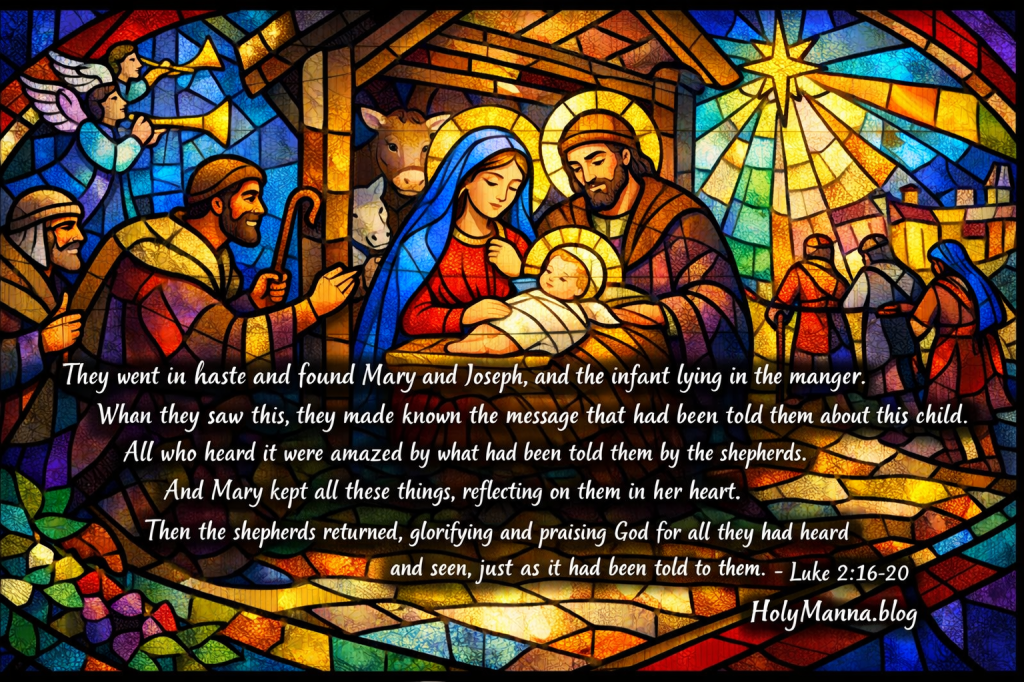
The Church proclaims this Gospel on January 1 with deliberate intention. This day is not simply the start of a new calendar year. It is the Solemnity of Mary, the Holy Mother of God, and the Octave Day of Christmas. The Church remains at the manger, lingering with the mystery rather than rushing past it. Luke’s account is simple on the surface, yet rich with meaning. Shepherds hurry through the night. A newborn lies in a feeding trough. A mother listens more than she speaks. A child is circumcised and given His Name.
This Gospel completes the theme woven through the entire liturgy. God’s blessing is no longer only spoken over the people. God’s blessing has become flesh. In the First Reading, the Lord commands a blessing that asks for His face to shine and His peace to rest upon Israel. Here, God’s face is literally present in the Child. In the psalm, the blessing is meant to reach the nations. Here, ordinary shepherds become the first witnesses. In the Second Reading, Saint Paul proclaims that God sent His Son, born of a woman, so that humanity might receive adoption. Here, that woman is Mary, the Son is Jesus, and the family of God begins to take visible shape.
Luke 2:16-21 – New American Bible (Revised Edition)
16 So they went in haste and found Mary and Joseph, and the infant lying in the manger. 17 When they saw this, they made known the message that had been told them about this child. 18 All who heard it were amazed by what had been told them by the shepherds. 19 And Mary kept all these things, reflecting on them in her heart. 20 Then the shepherds returned, glorifying and praising God for all they had heard and seen, just as it had been told to them.
The Circumcision and Naming of Jesus. 21 When eight days were completed for his circumcision, he was named Jesus, the name given him by the angel before he was conceived in the womb.
Detailed Exegesis
Verse 16: “So they went in haste and found Mary and Joseph, and the infant lying in the manger.”
The shepherds respond without delay. Revelation is not treated as curiosity or entertainment. It is treated as truth that demands action. Their haste is not frantic, but obedient and eager. They find exactly what was promised, confirming that God’s word can be trusted. The manger itself speaks volumes. The Savior enters the world in humility, and the first to recognize Him are the lowly, not the powerful.
Verse 17: “When they saw this, they made known the message that had been told them about this child.”
Encounter naturally leads to proclamation. The shepherds do not keep the experience private. They speak. The message centers on “this child,” not on vague spiritual ideas. Salvation arrives as a person who can be seen and touched. This is the basic rhythm of evangelization: receive the truth, then share what has been given.
Verse 18: “All who heard it were amazed by what had been told them by the shepherds.”
Amazement fills the room. This reaction matters because it signals disruption. God is doing something that does not fit ordinary categories. Wonder becomes the first doorway to faith. Even when belief is not yet complete, awe prepares the heart to receive more.
Verse 19: “And Mary kept all these things, reflecting on them in her heart.”
Mary responds differently. While others speak, she listens. While others react, she reflects. She does not demand immediate clarity. She guards the mystery. The language suggests a deep interior work, holding events together patiently until their meaning unfolds. Mary becomes the model of contemplative discipleship, showing how God’s blessings are meant to be received before they are fully understood.
Verse 20: “Then the shepherds returned, glorifying and praising God for all they had heard and seen, just as it had been told to them.”
They return to ordinary life, but they do not return unchanged. This verse grounds the entire Christmas mystery in daily reality. The shepherds do not escape responsibility. They resume it with transformed hearts. Praise becomes their posture, and worship shapes the way they live.
Verse 21: “When eight days were completed for his circumcision, he was named Jesus, the name given him by the angel before he was conceived in the womb.”
This final verse anchors the mystery firmly in covenant history. Circumcision on the eighth day places Jesus fully under the Law of Moses. He enters the covenant as a true son of Israel, fulfilling it from within. The naming is equally significant. The Name is not chosen by preference or tradition. It is given by God. “Jesus” reveals both identity and mission. The Lord saves. On this feast, the Church proclaims with clarity that Mary truly bore the Savior, and the Savior’s Name is spoken over Him for the life of the world.
Teachings
The Church insists that this Gospel is not seasonal decoration. It is doctrinal revelation that shapes faith, worship, and life.
The Catechism affirms the truth safeguarded by today’s solemnity: “Mary is truly ‘Mother of God’ since she is the mother of the eternal Son of God made man, who is God himself.” (CCC 509). This title protects the heart of Christmas. The Child in the manger is not part God and part man. He is one divine Person with a true human nature.
Mary’s interior pondering also belongs to the Church’s understanding of faith. “By faith Mary welcomes the tidings and promise brought by the angel Gabriel, believing that ‘with God nothing will be impossible’ and so giving her assent: ‘Behold I am the handmaid of the Lord; let it be to me according to your word.’” (CCC 494). Her reflection in Luke 2:19 shows that faith continues long after the first yes. It grows through trust, silence, and perseverance.
The Holy Name itself holds a central place in Christian life. “Jesus means in Hebrew: ‘God saves.’ At the annunciation, the angel Gabriel gave him the name Jesus as his proper name, which expresses both his identity and his mission.” (CCC 430). The Name is not symbolic. It is powerful, revealing who He is and what He has come to do.
Saint Bernard of Clairvaux preached that the Name of Jesus is light for the mind, peace for the heart, and strength for the weak. That insight fits the beginning of a new year perfectly. The Christian does not move forward armed with vague optimism, but with a Name that saves.
Reflection
This Gospel offers three clear models for living the New Year with depth and faith.
The shepherds model obedient urgency. When God speaks, delay weakens grace. Growth often stalls not from ignorance, but from hesitation. The shepherds show that when the Lord invites, the right response is movement.
Mary models interior faithfulness. Modern life rewards speed and surface level engagement. Mary teaches the strength of stillness. God’s work is often slow and quiet, and peace grows when the heart learns to trust the process instead of demanding instant answers.
Jesus being circumcised and named models obedience and identity. Even the Son submits to the Law, and His Name reveals His mission. Holiness is not self invention. It is received and lived. The New Year does not require reinvention. It requires deeper surrender to Jesus, the Lord who saves.
Where is God inviting a prompt and obedient response, rather than continued delay?
What needs to be held with Mary in quiet trust, rather than forced into resolution?
How might the Holy Name of Jesus become a more intentional prayer this week, spoken with faith in moments of temptation, anxiety, or discouragement?
Begin the Year Under the Shining Face of God
Today’s readings land like a single, steady message for the first day of the year: God’s blessing is not a vague wish. God’s blessing is a real gift that has taken on a human face in Jesus Christ, born of Mary. In Numbers 6:22-27, the Lord teaches His priests to speak a blessing that asks for protection, grace, and peace, and it culminates with God placing His Name upon His people. In Psalm 67, that blessing expands outward, because God never blesses a people so they can hoard His goodness. God blesses so that His way will be known, so that the nations will rejoice, and so that praise will rise to the ends of the earth. In Galatians 4:4-7, Saint Paul explains the miracle behind it all: “God sent his Son, born of a woman” so that humanity could be ransomed and adopted, no longer slaves, but children who can cry “Abba, Father!” And in Luke 2:16-21, the blessing becomes visible and concrete. The shepherds hurry to the manger, witness the Child, and return glorifying God. Mary receives the mystery with quiet depth, “reflecting on them in her heart”, and the Child is circumcised and named Jesus, the Holy Name given from heaven.
Put together, the message is clear and practical. The New Year does not begin with human effort climbing up to God. The New Year begins with God coming down to His people. The blessing Israel longed for is fulfilled in the Savior whose face can be seen, whose Name can be spoken, and whose grace makes believers part of the Father’s household. That is why the Church honors Mary today. Her motherhood is not a side detail of Christmas. It is the doorway through which the eternal Son enters time, so that those who were far off can become sons and daughters.
So the call to action is not complicated, but it is serious. Start this year by receiving the Lord’s blessing deliberately, not as background noise, but as truth. Let prayer sound more like a child speaking honestly to a Father than a worker trying to earn approval. Practice praise even on ordinary days, because the shepherds returned to ordinary work still glorifying God. Treasure what God is doing like Mary, especially the parts that are not fully understood yet. Speak the Holy Name of Jesus with reverence and trust, because God gave that Name for salvation, not for decoration.
What would change if this year is measured less by goals achieved and more by whether the heart is growing in peace, reverence, and grateful praise? What would change if the first response to fear, temptation, or discouragement is a simple, faithful prayer: “Abba, Father” and “Jesus, save me”?
Engage with Us!
Drop thoughts and reflections in the comments below, because faith grows when it is spoken, shared, and lived in community. These readings are packed, and each one offers a concrete way to step into the New Year with peace, purpose, and trust in God’s blessing.
- First Reading, Numbers 6:22-27: Where does the heart most need the Lord to “bless and keep” it right now, and what would it look like to actually trust His protection this week?
- Responsorial Psalm, Psalm 67:2-3, 5-6, 8: How can God’s blessing be made visible through daily life so that others are gently drawn toward praise and reverence, even without many words?
- Second Reading, Galatians 4:4-7: Where has the soul been living like a slave instead of a child, and how can prayer become more like the Spirit’s cry of “Abba, Father!” in daily moments?
- Holy Gospel, Luke 2:16-21: Is the heart more like the shepherds who respond quickly, or more like someone who delays, and what is one clear step that can be taken today to act on what God is saying?
Keep showing up with faith, even when life feels ordinary, because that is where the shepherds lived most of their days too. Treasure what God is doing like Mary, praise God like the shepherds, and step forward as a true child of the Father. Let every decision and every conversation be shaped by the love and mercy Jesus taught, so that this year becomes less about self-improvement and more about holiness lived with joy.
Sacred Heart of Jesus, we trust in You!
Immaculate Heart of Mary, pray for us!
Saint Michael the Archangel, defend us in battle!
Follow us on YouTube, Instagram and Facebook for more insights and reflections on living a faith-filled life.

 Holy Manna!
Leave a comment