The Billionaire Who Took Jesus Literally
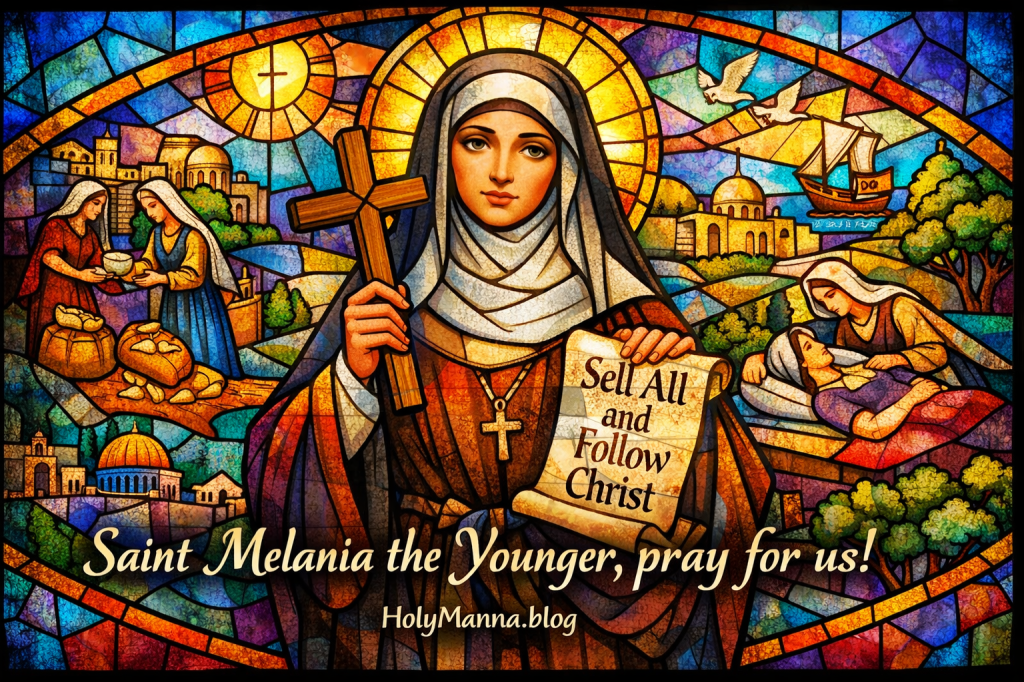
Saint Melania the Younger is one of those saints who gently but firmly unsettles comfortable Christianity. She was born into extraordinary privilege, married into the Roman elite, and surrounded by power, wealth, and security. Yet she chose to live the Gospel without loopholes or excuses. She poured out her fortune for the poor, embraced a demanding life of prayer and penance, and became a major pillar of monastic life in the Holy Land during a fragile period in Church history.
Her story matters because it reveals that holiness is not determined by one’s background, but by surrender. Melania shows what happens when someone believes Jesus means what He says about the Kingdom of God. As The Catechism of the Catholic Church teaches, “The precept of detachment from riches is obligatory for entrance into the Kingdom of heaven” (CCC 2544). Melania did not treat this teaching as theoretical. She lived it so fully that her entire life became a testimony to Christian freedom.
A Roman Heiress Who Chose the Narrow Way
Melania was born in Rome around the year 383 into the powerful Valerii family, one of the most influential senatorial families in the empire. Her parents, Publicola and Albina, were Christians, and her grandmother, Saint Melania the Elder, was already renowned for her ascetic life and pilgrimage to the Holy Land. From an early age, Melania was exposed to a vision of faith that was demanding, disciplined, and serious.
As a young girl, Melania desired a life dedicated entirely to God, but obedience led her into an arranged marriage with her cousin Pinianus, a fellow Roman noble. What could have remained a purely political union instead became a spiritual partnership. Their marriage was marked by deep suffering when both of their children died in infancy. That kind of grief often hardens hearts, but for Melania it became a doorway into deeper trust and radical dependence on God.
After the death of their children, Melania and Pinianus discerned together a call to live in continence, offering their marriage itself as a gift to the Lord. This decision was not impulsive or emotional. It was rooted in prayer, obedience, and a growing conviction that nothing could be placed above fidelity to Christ. When pressure mounted and the cost became clear, Melania spoke words that reveal the clarity of her conscience: “No, not even if it were to cause the loss of everything I have will I change my resolution, for it is better that I should not transgress a single iota of the Scriptures and so act against my conscience in the sight of God, not even were I thereby to gain the whole world.”
Turning Fortune Into Alms and Estates Into Mercy
Saint Melania the Younger is most remembered for her “great renunciation,” a long and complex process that required courage, patience, and unwavering faith. Together with Pinianus, she began selling off enormous estates across the Roman world and distributing the proceeds to the poor, to churches, and to monastic communities. This was not symbolic generosity. This was real wealth being dismantled and redirected toward mercy.
Their decision caused shock and resistance among Roman elites and even civil authorities, since wealth at that time was deeply tied to political stability and social order. Yet Melania refused to compromise. When the sack of Rome in 410 shattered the illusion of imperial security, she left Italy and lived for a time in Sicily in a semi monastic community with former slaves who had become brothers and sisters in Christ.
She later traveled to North Africa, where she supported the Church during theological conflict and hardship, becoming acquainted with figures such as Saint Augustine and Saint Alypius. Eventually, she journeyed to the Holy Land, settling near Jerusalem and the Mount of Olives. There she helped establish monasteries for women and supported monastic communities for men, ensuring that prayer and worship were sustained near the holy places of Christ’s life.
Despite her authority and influence, Melania remained deeply humble. She avoided attention and resisted being seen as extraordinary. Her goal was not legacy, but fidelity.
When God Worked Wonders Through a Woman Who Refused the Spotlight
Saint Melania the Younger was not known primarily as a public miracle worker, yet God clearly worked through her prayers. Her holiness appeared most often in perseverance, charity, and spiritual authority rooted in humility. When miracles occurred, she consistently redirected attention away from herself and toward God and the saints.
One account tells of a young woman tormented by a demon that sealed her mouth shut so completely she could neither eat nor speak, even after physicians failed to help her. When the woman was brought to Melania, the saint immediately downplayed her own role, saying, “In truth, being a sinner, I can do nothing; but let us take her to the holy martyrs, and the God of clemency will cure her through their certain intercession.”
After praying at the shrine of the martyrs and anointing the woman with oil sanctified by their relics, Melania commanded with calm authority, “In the name of our Lord Jesus Christ, open thy mouth.” The account records that the demon fled and the woman was healed, followed shortly by the healing of another woman suffering the same affliction.
Another moving story involves a woman near death during childbirth. Melania went to her, not with spiritual detachment, but with compassion and realism, remarking, “Let us go to her who is in danger, that if for no other reason than by considering the sorrows of those who live in the world, we may learn from how many excruciating afflictions God has rescued us.” After prayer and intercession, the woman delivered the child and survived. Melania again insisted that the glory belonged to God alone.
Trials That Purified Her Love Without the Sword of Martyrdom
Saint Melania the Younger did not die a martyr’s death, but her life was marked by continual sacrifice. She endured misunderstanding, opposition from powerful relatives, and the exhausting labor of divesting an entire empire of wealth without allowing bitterness or pride to take root. She also embraced intense ascetic practices, not out of contempt for the body, but as training in love and self mastery.
Her personal losses were severe. The deaths of her children shaped her vocation, and later she endured the deaths of her mother Albina and her beloved husband Pinianus. Yet grief never turned her inward. Instead, it pressed her further into prayer and service.
In her later years, Melania also played a role in defending orthodox teaching, particularly during controversies surrounding Nestorianism. She traveled to Constantinople and helped guide family members and others toward the truth of the faith. Even in old age, her holiness was active, not passive.
As death approached, those around her wept and begged her to remain. Melania responded with peaceful clarity, saying to her spiritual son Gerontius, “My son, all your prayers and tears are of no avail. It is necessary that I, according to God’s holy dispensation, must break these earthly bonds and depart to the Lord.”
A Holy Death and a Legacy That Endured
Saint Melania the Younger died peacefully in Jerusalem on December 31, 439. Her sanctity was already well known, and devotion to her spread especially in the Christian East. The monasteries she founded near the Mount of Olives continued as places of prayer and worship, carrying her spirit forward long after her death.
While there is no long catalogue of spectacular posthumous miracles, her legacy itself became a living miracle. Her life strengthened monastic worship in the Holy Land, encouraged conversions, and offered a concrete model of Gospel poverty rooted in love, not ideology.
Her memory also reminds the Church of the importance of ordered worship. She believed deeply in the power of the Divine Office and the Church’s prayer offered faithfully near the places sanctified by Christ’s life, death, and resurrection.
The Gospel Challenge for a World Addicted to Comfort
Saint Melania the Younger speaks powerfully to a world obsessed with comfort and control. Her life teaches that wealth is not evil, but it becomes dangerous when it replaces trust in God. She shows that generosity is not simply about money, but about surrendering ownership of one’s life.
Her witness challenges believers to examine whether faith has been reduced to a hobby rather than a way of life. The Gospel calls for conversion, and conversion always costs something. Melania’s life aligns perfectly with the Church’s teaching that love for the poor is inseparable from love for Christ.
Living her virtues today does not require selling everything, but it does require honesty. It looks like disciplined generosity, simpler living, and refusing to treat prayer as optional. It looks like guarding chastity, practicing self control, and rejecting the lie that comfort is the highest good.
What would change if Christ’s promises were trusted more than the culture’s fears? What would be given away if heaven felt more real than security? These questions are not meant to accuse. They are meant to awaken the soul.
Engage with Us!
Readers are invited to share their thoughts and reflections in the comments below.
- What part of Saint Melania the Younger’s life feels most challenging to imitate, and why?
- What is one attachment that Christ may be asking to be surrendered more intentionally right now?
- How can prayer and generosity become steady habits rather than occasional reactions?
May Saint Melania the Younger teach hearts to live free, to love generously, and to trust completely. May every day be lived in faith, and may all things be done with the love and mercy Jesus taught us.
Saint Melania the Younger, pray for us!
Follow us on YouTube, Instagram and Facebook for more insights and reflections on living a faith-filled life.

 Holy Manna!
Leave a comment