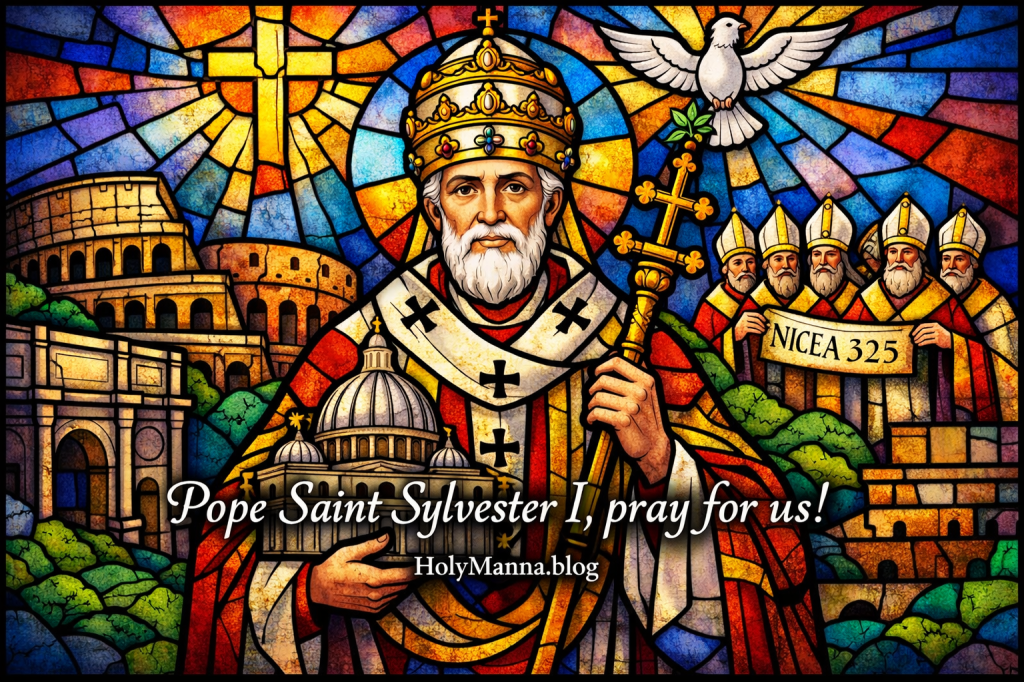
When the Church Walked Out of the Catacombs
Pope Saint Sylvester I reigned at one of the most decisive moments in Christian history, when the Church emerged from centuries of persecution into public life. His pontificate began in 314, shortly after the Edict of Milan legalized Christianity, and continued until his death in 335. This was a time of immense opportunity and equally immense danger. The bloodshed had slowed, but confusion, division, and theological error threatened the heart of the faith.
Saint Sylvester is revered not because he sought the spotlight, but because he guarded the Church’s unity and doctrine during this fragile transition. He presided as pope while Christianity moved from hidden house churches and catacombs into basilicas and public worship. Most importantly, he shepherded the Church during the Arian crisis, when the divinity of Jesus Christ was openly denied by many influential voices. His quiet fidelity helped ensure that the Church remained anchored in the apostolic faith handed down from the beginning.
The Catechism of the Catholic Church reminds believers why this moment mattered so deeply, teaching that “The Church’s confession of the Trinity was developed through the early councils” (The Catechism, CCC 249). Sylvester’s papacy belongs directly to that foundational chapter of Christian belief.
Shaped by the Memory of Persecution
Historical sources provide only limited details about the early life of Pope Saint Sylvester I, and responsible Catholic writing respects those limits. Ancient tradition records that he was born in Rome and that his father was named Rufinus. What can be said with confidence is that Sylvester grew up in a Christian community still marked by the trauma and heroism of persecution.
Even if Sylvester himself did not endure imprisonment or torture, he was formed by the memory of martyrs whose blood had soaked Roman soil. This context shaped a generation of clergy who understood that faith was not an abstraction, but a lived allegiance to Christ that could cost everything. Sylvester was ordained and served faithfully within the Roman clergy, gaining a reputation for seriousness, prudence, and fidelity.
He was elected pope in 314, succeeding Pope Saint Miltiades. His election came at a moment when the Church was free for the first time, but freedom itself brought new responsibilities. Sylvester inherited a Church learning how to live openly without losing her spiritual identity.
Building Churches Without Losing the Cross
Saint Sylvester’s papacy coincided with the reign of Emperor Constantine and the rapid expansion of Christian worship in public life. During this period, monumental churches were constructed in Rome, including the Basilica of Saint John Lateran, the first cathedral of Rome, and the original Basilica of Saint Peter built over the Apostle’s tomb. These buildings were not symbols of triumphalism, but acts of reverence, providing space for the sacraments that Christians had celebrated in secret for generations.
Later legends connected Sylvester closely with Constantine, including stories that claim the pope baptized the emperor and healed him from illness. While these accounts became influential in medieval devotion, historical scholarship treats them cautiously. Constantine was baptized much later in life, and there is no firm evidence that Sylvester personally performed the baptism. These stories, however, reflect how deeply Christians associated Sylvester with healing, peace, and the Church’s new public freedom.
What stands out historically is Sylvester’s restraint. He did not seek political power or personal prominence. He allowed the Church to receive peace without surrendering her mission. His leadership showed that buildings, patronage, and imperial favor are secondary to the Gospel of Jesus Christ.
Guarding the Divinity of Christ
The most enduring legacy of Pope Saint Sylvester I is his connection to the First Council of Nicaea in 325. Although he did not attend in person, he sent papal representatives, and the council’s decrees were received and upheld in the West under his authority. This council condemned Arianism and proclaimed that the Son is fully divine, eternally begotten, and equal to the Father.
Every time Catholics profess the Creed at Mass, they echo the fruit of that council. The Catechism of the Catholic Church affirms this truth clearly, teaching “The Only Begotten Son of God is consubstantial with the Father” (The Catechism, CCC 242). Sylvester’s papacy helped safeguard this confession at a moment when the Church could have fractured irreparably.
No verified personal quotations from Sylvester survive with certainty. Many sayings attributed to him originate in later legendary texts rather than demonstrable historical records. His witness is therefore preserved less in words and more in the structures, councils, and doctrinal clarity that endured long after his death.
Fidelity Under a Different Kind of Pressure
Pope Saint Sylvester I did not die a martyr, but his life was not free from suffering. His hardship came from navigating a Church suddenly entangled with imperial power while facing deep internal division. The temptation of the age was not to deny Christ outright, but to redefine Him in more comfortable terms.
Sylvester endured this pressure by remaining faithful to the apostolic teaching rather than adapting doctrine for the sake of peace. He understood that unity without truth is not unity at all. His leadership required patience, humility, and trust in God’s providence, especially when loud theological voices threatened to distort the Gospel.
His sanctity reminds believers that not all heroic virtue appears in dramatic death. Some holiness is revealed in perseverance, restraint, and obedience over many years.
Memory, Intercession, and Enduring Veneration
Saint Sylvester died peacefully on December 31, 335, and was buried in the Catacomb of Priscilla in Rome. His feast day remains December 31, a fitting moment for reflection on time, mercy, and God’s faithfulness across generations.
After his death, devotion to Sylvester spread throughout Rome and later across Europe. Churches were dedicated in his honor, and the faithful sought his intercession, especially for the protection of the Church and peace between civil authority and Christian life. While specific posthumous miracles are not documented with the precision of later canonization processes, his longstanding veneration testifies to the trust of the faithful in his prayers.
The communion of saints remains a living reality, reminding believers that the Church is not only an institution on earth, but a family that spans heaven and history.
Faithfulness When Life Feels Safe
Pope Saint Sylvester I offers a powerful witness for Catholics living in cultures where Christianity is tolerated but subtly pressured to conform. His life shows that the absence of persecution does not mean the absence of spiritual danger. Comfort can test faith just as severely as suffering.
Sylvester teaches that guarding doctrine is an act of love, not rigidity. To confess Jesus Christ as true God and true man is not an abstract exercise. It shapes prayer, morality, worship, and hope. When Catholics pray the Creed, they are not repeating old words out of habit, but standing with the saints who defended those truths at great cost.
A practical way to imitate Saint Sylvester is to build a life that protects worship and prayer as carefully as he protected the Church’s public life. This means honoring Sunday Mass, taking the sacraments seriously, learning the faith intentionally, and refusing to reduce Catholic teaching to personal opinion.
Engage with Us!
Readers are invited to share their thoughts and reflections in the comments below and to join the conversation as a community of faith.
- Where is the greatest temptation today to choose comfort over clarity in the Catholic faith?
- How does professing the Nicene Creed at Mass shape the way daily life is lived outside the church?
- What is one concrete habit that could be strengthened this week to guard prayer and worship more faithfully?
May Pope Saint Sylvester inspire a life rooted in truth, patience, and courage. May every action be shaped by the love and mercy Jesus taught, so that faith is not only believed, but lived with conviction and joy.
Pope Saint Sylvester I, pray for us!
Follow us on YouTube, Instagram and Facebook for more insights and reflections on living a faith-filled life.

 Holy Manna!
Leave a comment