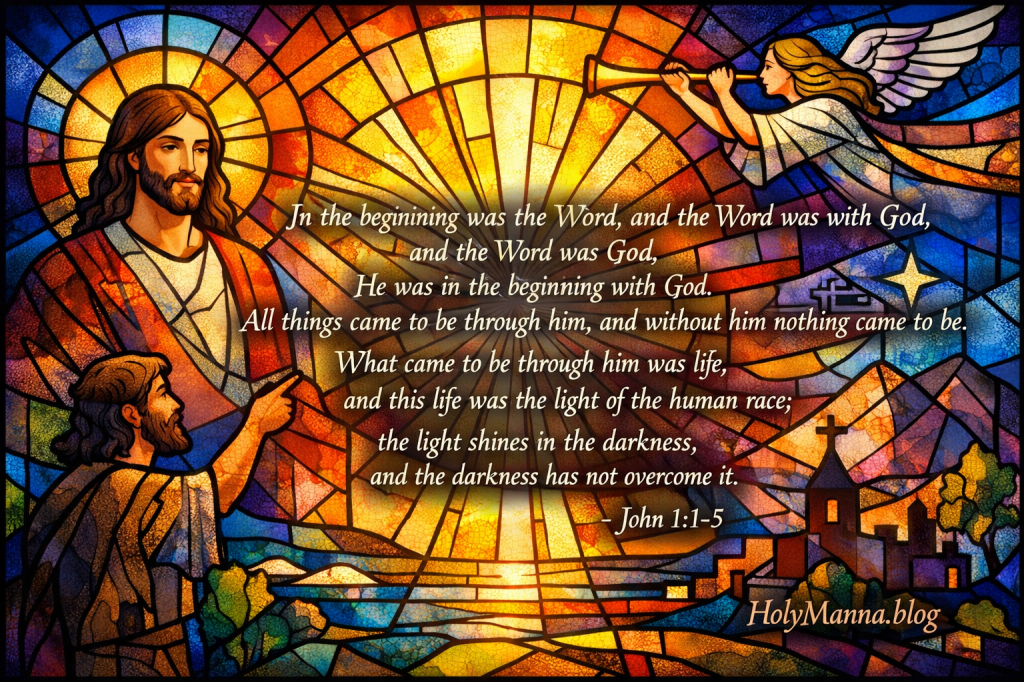
The Seventh Day in the Octave of Christmas – Lectionary: 204
When the Light Meets the Lie
There is something honest about the last day of the year because it naturally makes the heart take stock. December 31 lands inside the Octave of Christmas, when the Church refuses to “move on” too quickly from Bethlehem and keeps holding up the same mystery from different angles: God has truly come near. The readings for today press that mystery into real life with a steady, sober message. The world is full of voices, trends, and spiritual counterfeits, but Christmas is the feast of the One true Light who cannot be replaced, reshaped, or diluted.
In the First Letter of John, the apostle speaks with the urgency of a pastor who loves his people. He tells the faithful that many “antichrists” have appeared, meaning not just one dramatic villain, but a whole pattern of deception that tries to pull believers away from the truth and away from communion with the Church. This was not a theoretical concern in the early Christian communities. They lived in a culture saturated with pagan worship, imperial pressure, and competing claims about God and salvation. Confusion and division were real temptations. Yet John does not write to create fear. He reminds the Church that the faithful have received an “anointing” from the Holy One, and that this grace forms spiritual instincts for the truth. That is why John can say with clarity that “every lie is alien to the truth”. Christmas, then, is not sentimental nostalgia. It is a line in the sand between the truth of Christ and every false substitute.
That is exactly why Psalm 96 feels like the right response. When the Lord comes, creation itself becomes a choir. The psalm is not whispering about private spirituality. It is commanding public praise because God’s salvation is meant to be proclaimed “day after day.” The joy is not naive, either, because the psalm celebrates the Lord who comes to govern with justice and faithfulness. In other words, the world is not left to chaos, spin, and manipulation. God reigns, and His reign is reliable. That is why the heart can sing even when the times feel confusing.
Then the Gospel opens the widest possible horizon. The Gospel of John does not start with a manger. It starts “in the beginning” because Christmas is not a side story to the universe. It is the center. The eternal Word is with God and is God, and that Word became flesh and dwelt among us. This is the Church’s answer to every spiritual counterfeit: Jesus is not merely a teacher with a helpful message. He is the Light Himself. He shines in the darkness, and the darkness does not overcome Him. Some reject Him, even those who should have recognized Him, but those who receive Him are given the power to become children of God. That is the heart of today’s theme: hold fast to Christ, the Word made flesh, because His Light exposes the lie and His truth makes a person part of God’s own family.
Where might subtle lies or spiritual counterfeits be trying to dull trust in Jesus, weaken love for the Church, or distract from the simple obedience of faith today?
First Reading – 1 John 2:18-21
Staying with the Church is how the Light stays in focus.
This little passage from 1 John lands like a pastoral wake up call in the middle of Christmas joy, and it is exactly what the Church needs on the Seventh Day in the Octave of Christmas. The same apostle who gives the soaring prologue in The Gospel of John is also the apostle who looks the faithful in the eye and says, in plain language, that deception is real, division is real, and spiritual counterfeits do real damage.
Historically, the first Christian communities were living in a pressure cooker. They were a tiny minority surrounded by pagan religion, social hostility, and confusion about who Jesus truly is. On top of that, internal fractures were already happening. Some people tried to reshape the Gospel into something more “reasonable,” usually by denying that the Son of God truly became flesh or by treating Jesus like a spiritual idea instead of the living Lord. That is why today’s theme fits so tightly. Christmas proclaims the Word made flesh, full of grace and truth, and 1 John insists that believers stay anchored in that truth, especially when lies show up wearing religious clothing.
1 John 2:18-21 – New American Bible (Revised Edition)
Antichrists. 18 Children, it is the last hour; and just as you heard that the antichrist was coming, so now many antichrists have appeared. Thus we know this is the last hour. 19 They went out from us, but they were not really of our number; if they had been, they would have remained with us. Their desertion shows that none of them was of our number. 20 But you have the anointing that comes from the holy one, and you all have knowledge. 21 I write to you not because you do not know the truth but because you do, and because every lie is alien to the truth.
Detailed Exegesis
Verse 18: “Children, it is the last hour; and just as you heard that the antichrist was coming, so now many antichrists have appeared. Thus we know this is the last hour.”
John calls them “children” because he is speaking like a spiritual father, not like a commentator trying to win an argument. The phrase “last hour” does not mean a date on a calendar. It points to the Christian reality that, since Christ has come, history is living in its decisive season. God has acted, the Light has entered the world, and the conflict between light and darkness is now fully exposed. When John says “many antichrists,” he is not only describing one final figure, but the recurring pattern of people and movements that oppose Christ by distorting Him. The danger is not always obvious hatred. Often it is a more subtle replacement of Jesus with a counterfeit Jesus.
Verse 19: “They went out from us, but they were not really of our number; if they had been, they would have remained with us. Their desertion shows that none of them was of our number.”
This verse is blunt, and it is meant to be. John is describing a real rupture: people leaving the community of faith and trying to pull others with them. In John’s logic, departure is not just a social event. It reveals a spiritual reality. Remaining in communion matters because the Christian faith is not a private project. It is received, guarded, and lived within the apostolic Church. This is not about pretending every person who leaves a parish is evil. It is about recognizing the spiritual seriousness of separating from the faith once delivered, especially when someone leaves in order to deny core truths about Christ and then convinces others to follow.
Verse 20: “But you have the anointing that comes from the holy one, and you all have knowledge.”
Here is the confidence. God does not leave His people defenseless. The “anointing” is a rich word that points to the Holy Spirit given to believers, especially through Baptism and Confirmation, and strengthened through the sacramental life. This is the interior gift that helps Christians recognize the voice of the Shepherd. It is not a license to invent a personal Christianity. It is a grace that tunes the heart to the truth the Church teaches. The “knowledge” John speaks of is not trivia or secret information. It is the lived knowledge of Christ that grows through prayer, obedience, and fidelity.
Verse 21: “I write to you not because you do not know the truth but because you do, and because every lie is alien to the truth.”
John is not scolding the faithful for being ignorant. He is strengthening them because they already know the truth, and they need courage to keep choosing it. The line between truth and lie matters because lies do not simply “add a different opinion.” Lies detach the soul from reality, and reality has a name: Jesus Christ, full of grace and truth. John is teaching discernment with moral clarity. Lies are not neutral. Lies are foreign to the truth, and Christians cannot make peace with them.
Teachings
The Church has always read passages like this with a sober hope. There is a real spiritual conflict at the end of history, and Scripture warns that deception will intensify. The Church names this honestly in The Catechism when it teaches about a final trial and a counterfeit religion. CCC 675 says “The supreme religious deception is that of the Antichrist”. That short line is enough to communicate the core point: the most dangerous deception will not look like obvious atheism. It will look religious while turning hearts away from the true Christ.
This is also why John’s emphasis on remaining “with us” matters so much. The Holy Spirit does not only guide individuals in isolation. The Spirit guards the Church in her teaching and sacramental life. CCC 688 teaches “The Church is… the place where we know the Holy Spirit”. That does not mean every Church member is flawless. It means the Church is the home where the truth is preserved, the sacraments are celebrated, and the Spirit keeps drawing souls into communion with Christ.
Saints and Doctors of the Church regularly warn about this same dynamic: the enemy rarely tempts with something that looks completely ugly at first glance. The enemy tempts by offering something almost true. That is why Christmas is the perfect setting for this reading. The Word truly became flesh, and any teaching that tries to “improve” that truth is actually trying to erase it. The Incarnation is not a metaphor. It is the saving event that makes grace possible, the Light shining in the darkness, and the foundation for becoming children of God.
There is also a very practical Church teaching here about discernment. Discernment is not chasing conspiracies. Discernment is staying close to Christ, staying close to the Church, and letting the Holy Spirit form a love for what is true. John’s “anointing” is not meant to produce spiritual pride. It is meant to produce spiritual stability.
Reflection
This reading has a way of cutting through the fog of modern life because the modern world is full of confident voices. Everyone has a platform, everyone has a take, and a lot of it sounds spiritual. The temptation is to treat faith like a playlist, picking whatever feels inspiring, and quietly discarding whatever feels demanding. John’s message is that this approach makes a person vulnerable to counterfeits.
A simple, steady path shows up in these verses. Remain in communion. Stay rooted in the sacraments. Learn the faith with humility. Pray for the grace to love truth more than comfort. When confusion hits, the best next step is usually not a dramatic change. The best next step is fidelity in small things, especially daily prayer, Sunday Mass, regular Confession, and honest study of the Church’s teaching.
Where has a “near truth” been trying to replace the full truth of Jesus Christ, especially about His Lordship, His Church, or His moral teaching? What habits would help the heart stay close to the “anointing” John talks about, so that discernment becomes steady instead of anxious? Who needs patient, confident witness to the truth right now, not an argument, but a calm refusal to compromise with a lie?
Responsorial Psalm – Psalm 96:1-2, 11-13
Christmas joy is the whole world learning to sing the truth.
Psalm 96 is a hymn of enthronement, a song Israel would pray to celebrate the Lord as King, the One who reigns over all peoples and all creation. In its original setting, this kind of psalm pushes back against the ancient world’s false gods and political idols. The surrounding cultures claimed their deities controlled fertility, storms, war, and prosperity. Israel’s worship, however, was a bold declaration that the Lord alone is God, and His reign is not local or tribal. His kingship is universal, righteous, and faithful.
That is why this psalm fits so perfectly in the Octave of Christmas. The Word has become flesh, the Light has entered the world, and now the right response is not confusion or fear. The right response is worship that spills into proclamation. In today’s theme, lies and counterfeits try to divide and darken, but Psalm 96 calls the whole earth to rejoice because the Lord comes to govern with justice and faithfulness. When truth is recognized, creation itself becomes a choir.
Psalm 96:1-2, 11-13 – New American Bible (Revised Edition)
God of the Universe
1 Sing to the Lord a new song;
sing to the Lord, all the earth.
2 Sing to the Lord, bless his name;
proclaim his salvation day after day.11 Let the heavens be glad and the earth rejoice;
let the sea and what fills it resound;
12 let the plains be joyful and all that is in them.
Then let all the trees of the forest rejoice
13 before the Lord who comes,
who comes to govern the earth,
To govern the world with justice
and the peoples with faithfulness.
Detailed Exegesis
Verse 1: “Sing to the Lord a new song; sing to the Lord, all the earth.”
A “new song” is not just a new melody. It is the response to a new act of God. In the Bible, when God delivers, rescues, or reveals Himself in a fresh way, the faithful are called to sing anew. In the light of Christmas, this line becomes even richer because the “new” thing God has done is the Incarnation. The invitation is also strikingly universal: “all the earth.” Worship is not meant to stay locked inside one people or one culture. The Lord’s salvation is meant for everyone.
Verse 2: “Sing to the Lord, bless his name; proclaim his salvation day after day.”
This verse links praise and mission. To bless His name is to adore Him, to honor Him, to speak His goodness with reverence. Then the psalm immediately moves outward: proclaim His salvation day after day. This is not a seasonal hobby. It is a daily rhythm. In a world full of loud opinions and subtle lies, steady proclamation becomes a way of keeping the heart anchored. The faithful do not just avoid error. They actively announce the saving truth of God.
Verse 11: “Let the heavens be glad and the earth rejoice; let the sea and what fills it resound;”
The psalm turns cosmic. Heaven and earth, sea and all it contains. This is biblical language for totality, like saying, “Let everything that exists join in.” It is also a reminder that creation is not meaningless matter. Creation is made through the Word, and creation responds to its Creator with joy. In a Christmas key, this sounds like creation recognizing the Light shining in the darkness.
Verse 12: “Let the plains be joyful and all that is in them. Then let all the trees of the forest rejoice”
The imagery becomes almost playful. Plains, animals, forests, trees. The psalm gives the sense that joy is meant to ripple outward. When God’s reign is welcomed, it brings order and fruitfulness, not oppression. The world is not meant to be ruled by chaos or deceit. It is meant to be governed by the Lord’s goodness.
Verse 13: “Before the Lord who comes, who comes to govern the earth, To govern the world with justice and the peoples with faithfulness.”
This is the theological core of the psalm. The Lord “comes,” and His coming is not vague inspiration. It is governance. God’s kingship means judgment in the biblical sense: setting things right. He governs with justice, which means He does what is right and makes what is wrong answer to truth. He governs with faithfulness, meaning He keeps His promises and does not change with cultural winds. That word “comes” resonates deeply during Christmas because the Lord has come in the flesh, and He will come again in glory. Between those two comings, the Church sings, proclaims, and waits with hope.
Teachings
The Church teaches that the human person is made for worship, and worship is not optional decoration on a moral life. Worship is the right response to God’s identity as Creator and Savior. The Catechism describes adoration as the first attitude of the human being before God. CCC 2628 says “Adoration is the first attitude of man acknowledging that he is a creature before his Creator.” That posture is exactly what Psalm 96 expresses. All creation acknowledges the Lord as King, and the human heart is invited to take its proper place in that chorus.
The psalm also teaches something important about evangelization. Proclamation flows from praise. When a person truly encounters the Lord’s salvation, the faith naturally wants to be spoken, not hidden. This is why the Church is missionary by her very nature. CCC 849 says “The missionary mandate. Having been divinely sent to the nations that she might be ‘the universal sacrament of salvation,’ the Church, in obedience to the command of her founder and because it is demanded by her own essential universality, strives to preach the Gospel to all men.” The psalm is already praying this reality centuries before Christ’s birth, and Christmas fulfills it by revealing the Savior to the world.
There is also a strong thread of hope here about judgment. Many people hear “judge” and think only of condemnation. Scripture often presents God’s judgment as the moment truth finally wins and the world is set right. That is good news for anyone tired of lies, manipulation, injustice, and spiritual counterfeits. God governs with justice and faithfulness, which means reality will not be forever held hostage by darkness. The Light will have the final word.
Reflection
This psalm is a powerful medicine for anxious hearts, especially when life feels noisy and spiritually confusing. It teaches that the best way to resist lies is not to obsess over them. The best way is to fill the soul with praise, to bless the Lord’s name, and to proclaim His salvation day after day. Praise reorients the heart. It pulls attention away from the chaos of the moment and locks it onto the King who comes.
A very practical way to live this is to build a daily pattern of proclamation and worship. A simple morning offering, a psalm prayed slowly, a habit of speaking gratitude out loud, and a refusal to let complaining become a lifestyle all form the heart in truth. Another practical step is to let Christmas joy show itself publicly in normal life. That could mean speaking about God’s goodness with calm confidence, choosing charitable speech online, and refusing to join the constant cycle of outrage. When the Lord governs with justice and faithfulness, it becomes easier to live with steady hope instead of constant agitation.
What would change in daily life if worship became the first response instead of worry? Where is God inviting a more consistent “day after day” proclamation, not through being pushy, but through steady joy and clear fidelity? How might praise help the heart see the difference between the true Light of Christ and the counterfeit lights that burn bright but leave the soul empty?
Holy Gospel – John 1:1-18
Reality has a Name, and the darkness does not get the last word.
This prologue from The Gospel of John is the Church’s theological heartbeat during Christmas. While the world is still looking at the manger, John pulls back the curtain and shows what is really happening. The Child born in time is the eternal Word who exists before time. In the first century, this was a direct challenge to multiple false stories people told about reality. The pagan world had myths about gods who fought and manipulated humans. Many philosophical schools reduced ultimate truth to an impersonal force. Even within religious debates, some were tempted to treat Jesus as merely a prophet, a moral teacher, or a spiritual symbol. John refuses all of that. He speaks with the clarity of a witness and says the Word is God, the Word creates, the Word gives life, and the Word becomes flesh.
That is why this Gospel ties perfectly into today’s theme. 1 John warns about antichrists and lies that oppose Christ, and John’s Gospel answers with the simplest, strongest confession possible: the true Light has come. The psalm calls all creation to sing because the Lord comes to govern with justice and faithfulness, and John shows the deepest reason creation can rejoice. The Lord has come, not merely to visit, but to dwell among His people in real flesh, full of grace and truth.
John 1:1-18 – New American Bible (Revised Edition)
1 In the beginning was the Word,
and the Word was with God,
and the Word was God.
2 He was in the beginning with God.
3 All things came to be through him,
and without him nothing came to be.
What came to be 4 through him was life,
and this life was the light of the human race;
5 the light shines in the darkness,
and the darkness has not overcome it.6 A man named John was sent from God. 7 He came for testimony, to testify to the light, so that all might believe through him. 8 He was not the light, but came to testify to the light. 9 The true light, which enlightens everyone, was coming into the world.
10 He was in the world,
and the world came to be through him,
but the world did not know him.
11 He came to what was his own,
but his own people did not accept him.12 But to those who did accept him he gave power to become children of God, to those who believe in his name, 13 who were born not by natural generation nor by human choice nor by a man’s decision but of God.
14 And the Word became flesh
and made his dwelling among us,
and we saw his glory,
the glory as of the Father’s only Son,
full of grace and truth.15 John testified to him and cried out, saying, “This was he of whom I said, ‘The one who is coming after me ranks ahead of me because he existed before me.’” 16 From his fullness we have all received, grace in place of grace, 17 because while the law was given through Moses, grace and truth came through Jesus Christ. 18 No one has ever seen God. The only Son, God, who is at the Father’s side, has revealed him.
Detailed Exegesis
Verse 1: “In the beginning was the Word, and the Word was with God, and the Word was God.”
John begins like Genesis to show that Jesus is not an afterthought. The “Word” is the eternal Son. “With God” shows distinction of Persons, and “was God” shows full divinity. This verse is a clear foundation for the Church’s confession of the Trinity and the divinity of Christ.
Verse 2: “He was in the beginning with God.”
John repeats the point to remove ambiguity. The Son is not created. He exists eternally with the Father. This is the groundwork for Christian worship of Jesus, because worship belongs to God alone.
Verse 3: “All things came to be through him, and without him nothing came to be.”
Creation is not independent. The Word is the agent of creation. Everything that exists owes its existence to Him. This matters spiritually because it means Christ is not just a religious option. He is the source of reality itself.
Verse 4: “What came to be through him was life, and this life was the light of the human race;”
The Word not only gives existence. He gives “life” in the full sense, including supernatural life. The light imagery points to truth, holiness, and communion with God. Human beings are meant to be illuminated from within by God’s own life.
Verse 5: “The light shines in the darkness, and the darkness has not overcome it.”
This is one of the most comforting lines in Scripture. Darkness is real, but it is not ultimate. The light is active. It shines. The darkness cannot conquer it. This is not optimism. It is a declaration about Christ’s victory.
Verse 6: “A man named John was sent from God.”
John the Baptist appears as a real historical person with a mission. He is not a mythic figure. God acts in history through real witnesses.
Verse 7: “He came for testimony, to testify to the light, so that all might believe through him.”
John’s vocation is testimony. His role is not to attract attention to himself, but to lead people to faith in Christ. Testimony is how God often draws people: through faithful witness.
Verse 8: “He was not the light, but came to testify to the light.”
This guards against confusion. Even holy messengers are not the Savior. The Church likewise honors saints, but worship is directed to God alone.
Verse 9: “The true light, which enlightens everyone, was coming into the world.”
Christ is the “true” light, not one light among many. He enlightens everyone, meaning His salvation is universal in scope. This connects directly with the psalm’s call for all the earth to sing.
Verse 10: “He was in the world, and the world came to be through him, but the world did not know him.”
The tragedy is not ignorance due to lack of evidence. The Creator enters His own creation, yet creation fails to recognize Him. Sin clouds spiritual sight.
Verse 11: “He came to what was his own, but his own people did not accept him.”
John points to Israel’s history and the painful reality that many did not receive the Messiah. This is not a license for contempt. It is a warning to every generation that familiarity can become blindness.
Verse 12: “But to those who did accept him he gave power to become children of God, to those who believe in his name,”
Here is the Gospel’s promise. Receiving Christ is not merely agreeing with an idea. It is welcoming Him with faith, and that faith brings adoption. Being a child of God is a gift of grace, not a human achievement.
Verse 13: “Who were born not by natural generation nor by human choice nor by a man’s decision but of God.”
This clarifies that divine sonship is supernatural. It is God’s work, given through grace, not something earned by bloodline or effort. It points toward Baptism as the sacramental birth from God.
Verse 14: “And the Word became flesh and made his dwelling among us, and we saw his glory, the glory as of the Father’s only Son, full of grace and truth.”
This is the heart of Christmas. The Word truly becomes flesh. God does not pretend to be human. He becomes human. “Dwelt among us” echoes the tabernacle, God pitching His tent among His people. The glory is real, and the Son is “full of grace and truth.” This line directly answers the lies warned about in 1 John. Every counterfeit collapses in the face of the real Incarnation.
Verse 15: “John testified to him and cried out, saying, ‘This was he of whom I said, ‘The one who is coming after me ranks ahead of me because he existed before me.’”
John the Baptist confesses Christ’s preexistence. Even though Jesus begins His public ministry after John, He outranks John because He is eternal. This is another clear witness to Christ’s divinity.
Verse 16: “From his fullness we have all received, grace in place of grace,”
Grace is not rationed. The Son’s fullness overflows. “Grace in place of grace” suggests a never ending gift, grace upon grace. The Christian life is sustained by receiving, not by self reliance.
Verse 17: “Because while the law was given through Moses, grace and truth came through Jesus Christ.”
John honors the law as a gift, but shows its fulfillment. The law prepares and instructs, but Christ brings the definitive gift: grace and truth. The theme of truth is explicit here, and it ties to both the warning against lies and the psalm’s faithfulness.
Verse 18: “No one has ever seen God. The only Son, God, who is at the Father’s side, has revealed him.”
God is invisible and beyond human grasp, yet the Son reveals Him. To know Jesus is to know the Father. This is why Christianity is not primarily about climbing up to God. It is about God coming down to reveal Himself.
Teachings
The Church’s teaching on the Incarnation stands at the center of everything in this Gospel. The Catechism puts it in a sentence that is worth praying slowly. CCC 461 says “Taking up St. John’s expression, ‘The Word became flesh’, the Church calls ‘Incarnation’ the fact that the Son of God assumed a human nature in order to accomplish our salvation in it.” That is John 1:14 explained in the Church’s own voice.
This Gospel also anchors the doctrine that Christ is true God and true man. The Church teaches that the eternal Son truly became man without ceasing to be God. CCC 464 says “The unique and altogether singular event of the Incarnation of the Son of God does not mean that Jesus Christ is part God and part man, nor does it imply that he is the result of a confused mixture of the divine and the human. He became truly man while remaining truly God.” This guards against ancient and modern counterfeits alike, including the temptation to reduce Jesus to a moral example or a spiritual metaphor.
John’s language about becoming children of God also points to Baptism and the gift of divine adoption. CCC 1265 says “Baptism not only purifies from all sins, but also makes the neophyte ‘a new creature,’ an adopted son of God, who has become a ‘partaker of the divine nature,’ member of Christ and co heir with him, and a temple of the Holy Spirit.” That is exactly what John is describing when he says believers receive the power to become children of God, born of God.
Saint Athanasius is famous for defending the divinity of Christ against Arianism, a major fourth century heresy that tried to make the Son less than God. His summary line captures the logic of John’s prologue and the entire Christmas season. CCC 460 preserves it like a gem. It says “For the Son of God became man so that we might become God.” This does not mean humans become divine by nature. It means grace truly makes the human person share in God’s life. That is why the Incarnation is not a nice story. It is the doorway to salvation.
Historically, this Gospel also shaped the Church’s worship deeply. Christians have long treated John 1 as a kind of Christmas proclamation of the mystery of Christ. It was read frequently in the Church’s liturgy and devotion because it keeps the faithful from shrinking Christmas into mere sentiment. The manger is real, but the One in the manger is the eternal Word through whom all things were made.
Reflection
This Gospel invites a very practical decision: will the heart live as if Jesus is the Light, or will it keep flirting with lesser lights that cannot save. Many modern lies are not openly hostile to God. They are simply distractions that make Christ seem unnecessary, or they present a “custom Jesus” who never challenges sin and never calls for conversion. John’s prologue will not allow that. If the Word is God, and if the Word became flesh, then every part of life must be brought into His light.
A simple way to respond is to make room for the Word to dwell, not as a holiday feeling, but as a daily reality. That means letting Scripture shape the mind, letting the sacraments shape the conscience, and letting prayer shape desires. It also means embracing the humility of receiving, because John emphasizes receiving again and again. Those who accept Him receive adoption. Those who believe receive power. Those who come to Him receive grace upon grace. The spiritual life collapses when it becomes self salvation, and it flourishes when it becomes steady reception of Christ.
The end of the year is a perfect moment to bring this Gospel into daily life with honesty. Darkness usually wins ground through small compromises, quiet rationalizations, and secret habits that thrive away from the light. The Word became flesh to shine into exactly those places, not to humiliate, but to heal and restore. The darkness has not overcome Him, and it does not have to overcome anyone who brings life into His light.
Where has the heart been tempted to treat Jesus like an accessory instead of the center of reality? What would change in daily decisions if the words “the light shines in the darkness” were taken literally and personally? How can Christ be received more concretely this week through prayer, Confession, reverent Mass, and a firmer refusal of the “almost true” lies that pull the soul away from grace and truth?
End the Year in the Light, Not in the Fog
Today’s readings land like a steady hand on the shoulder at the close of the year. They do not ask for dramatic vows fueled by emotion. They ask for something stronger and more lasting: clear faith in Jesus Christ, the true Light, and a firm refusal to make peace with lies. 1 John names the problem with refreshing honesty. There are real counterfeits, real deceivers, and real temptations to drift away from the communion of the Church. Yet the message is not fear. The message is confidence, because the faithful have received an anointing from the Holy One, and truth has a recognizable voice.
Psalm 96 then teaches the right posture of a heart that belongs to the truth. It sings. It blesses the Lord’s name. It proclaims salvation day after day, not as a performance, but as the natural overflow of gratitude. The psalm insists that the Lord comes to govern with justice and faithfulness, which means reality is not controlled by chaos, propaganda, or spiritual confusion. God reigns, and His reign is trustworthy.
Then The Gospel of John seals everything with the most important claim the Church ever makes: “the Word became flesh”. Christmas is not a comforting metaphor. It is God stepping into history, taking on real humanity, and shining a Light that the darkness cannot overcome. This is why lies are so dangerous. Lies try to blur the face of Christ, weaken trust, and pull the soul into a dimmer life. But this Gospel announces that truth is not just a concept. Truth is a Person, and His name is Jesus Christ, full of grace and truth.
So here is the call to action for today. End the year by choosing the Light on purpose. Stay close to the Church instead of drifting into spiritual independence. Stay close to prayer instead of living on spiritual leftovers. Stay close to the sacraments instead of bargaining with sin. Offer the Lord a “new song” by giving Him something concrete, like a cleaner conscience, a more disciplined tongue, a more faithful routine, or a more honest surrender of whatever keeps trying to hide in the dark. The Lord who comes to govern with justice and faithfulness is not coming to crush. He is coming to save, to reveal, to adopt, and to fill the heart with grace upon grace.
What would it look like to begin the new year as someone determined to live as a child of God, not as a person still negotiating with darkness?
Engage with Us!
Share reflections in the comments below. It is always encouraging to hear how the Lord is speaking through the Word, especially on a day like this when the Church is still celebrating Christmas and also calling for real discernment and steady faith.
- First Reading, 1 John 2:18-21: Where is there pressure to compromise the truth about Jesus or the teachings of the Church, and what would it look like to remain faithful with calm confidence instead of anxiety?
- Responsorial Psalm, Psalm 96:1-2, 11-13: What “new song” is God inviting into daily life right now, and how can salvation be proclaimed “day after day” through joy, gratitude, and steady witness?
- Holy Gospel, John 1:1-18: What area of life needs to be brought more honestly into the Light of Christ, and what concrete step can be taken this week to receive “grace in place of grace” through prayer and the sacraments?
Keep walking forward with faith. Choose the Light when the world offers fog, choose truth when the culture sells counterfeits, and do everything with the love and mercy Jesus taught us.
Sacred Heart of Jesus, we trust in You!
Immaculate Heart of Mary, pray for us!
Saint Michael the Archangel, defend us in battle!
Follow us on YouTube, Instagram and Facebook for more insights and reflections on living a faith-filled life.

 Holy Manna!
Leave a comment