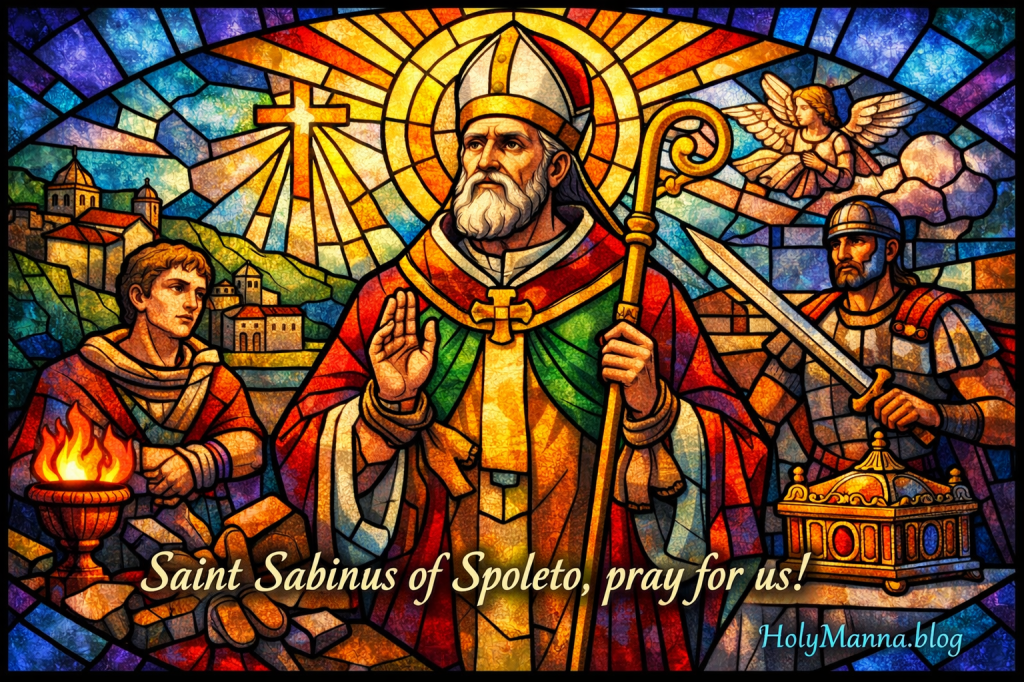
The Bishop Who Would Not Bow
Saint Sabinus of Spoleto is remembered as an early bishop and martyr who held firm to Christ when the surrounding culture demanded compromise. Ancient Christian tradition places his witness during the time of Roman persecution, likely under Emperor Diocletian, when public loyalty to Christ could cost everything. He is venerated alongside his companions, including his deacons Marcellus and Exuperantius, whose shared witness strengthens the Church’s memory of fidelity under pressure.
Saint Sabinus matters because he embodies what the Church expects of her shepherds. Bishops are not simply administrators or public figures. They are successors of the apostles, charged with teaching, sanctifying, and governing in the name of Christ. As The Catechism teaches, bishops are “authentic teachers of the faith” and “guardians of the deposit of faith” (CCC 888). Sabinus lived this calling fully, even when it led directly to suffering.
Hidden Beginnings and a Life Claimed by Christ
Like many saints of the early centuries, very little is known about the childhood or family life of Saint Sabinus. What the Church preserves instead is what mattered most: his faith and his office. He served as Bishop of Spoleto in Umbria, a region shaped by Roman authority and deep pagan religious customs.
His conversion story is not dramatic in the modern sense, but it is profound. It is the conversion of a man whose entire identity became rooted in Christ and His Church. As bishop, Sabinus strengthened his clergy and encouraged the faithful to remain loyal to Christ when imperial authorities demanded sacrifice to false gods. His life shows that conversion is not always a moment, but often a steady and total surrender to truth.
A Shepherd Who Strengthened the Weak
The ancient accounts describe Sabinus as a true spiritual father. When he and his clergy were arrested for refusing to comply with imperial demands, he encouraged his deacons to remain faithful even under torture. Marcellus and Exuperantius were brutally beaten and ultimately killed, offering their lives as witnesses to Christ. Sabinus remained steadfast, strengthening others even while facing his own suffering.
There are also miracle traditions associated with Saint Sabinus during his lifetime. One account tells of a blind man being healed through his prayer, a sign that God’s power was at work even in chains. Another tradition says that a local official named Venustianus suffered from an eye ailment and was healed, leading to his conversion to Christianity. These stories reflect a deeply Catholic truth: miracles are never about spectacle. They are signs meant to lead hearts toward repentance and faith.
No verified written quotations from Saint Sabinus have survived. His witness is preserved not in words on a page, but in the courage of his actions and the fidelity of his suffering.
Torture, Loss, and the Crown of Martyrdom
The persecution of Saint Sabinus was severe and deliberate. According to ancient tradition, his hands were cut off as punishment for his refusal to renounce Christ. He was then beaten and ultimately killed near Spoleto. His death was not accidental or political. It was an act of hatred against the Christian faith, and the Church has always honored him as a martyr.
This is where the Church’s teaching on martyrdom becomes deeply personal. The Catechism teaches that martyrdom is “the supreme witness given to the truth of the faith” (CCC 2473). Saint Sabinus did not seek suffering, but he accepted it rather than betray Christ. His courage was not bravado. It was obedience rooted in love.
When the Tomb Becomes a School of Hope
Devotion to Saint Sabinus continued long after his death. A church dedicated to him outside the city of Spoleto bears witness to enduring local veneration. His burial site became a place of prayer, and traditions speak of later translations of his relics, including to other Italian cities such as Faenza.
This devotion flows directly from the Church’s teaching on the communion of saints. The Catechism reminds the faithful that the saints do not stop caring for the Church after death. Their intercession continues, and their love remains active (CCC 956). Honoring Saint Sabinus is not about nostalgia or legend. It is about trusting that a martyr who suffered for truth continues to intercede for those struggling to remain faithful today.
Living Saint Sabinus Today
Saint Sabinus of Spoleto speaks powerfully to Catholics living in a culture that often rewards silence and compromise. His life shows that fidelity to Christ does not require aggression, but it does require courage. He teaches that truth must be held with humility and that love for the Church is proven when it costs something.
Practical imitation of Saint Sabinus begins with strengthening the foundations of faith. Regular confession, faithful Sunday worship, daily prayer, and a willingness to learn the teachings of the Church all shape courage over time. Supporting bishops and priests through prayer is another concrete way to live his example, because spiritual leadership always invites spiritual opposition.
Where does faith feel pressured today to remain quiet or hidden? Saint Sabinus reminds believers that no suffering endured for Christ is wasted. Every act of fidelity, even unseen, participates in the victory of the Cross.
Engage with Us!
Readers are invited to share their thoughts and reflections in the comments below.
- Where does remaining faithful to Catholic teaching feel most difficult right now?
- How can prayer for bishops and priests become more intentional this week?
- What helps most when fear arises and faith feels costly?
May Saint Sabinus of Spoleto strengthen hearts to live with courage and clarity. May daily life be offered with trust and may every action be shaped by the love and mercy Jesus taught, so that all things become acts of faith and pathways to holiness.
Saint Sabinus of Spoleto, pray for us!
Follow us on YouTube, Instagram and Facebook for more insights and reflections on living a faith-filled life.

 Holy Manna!
Leave a comment