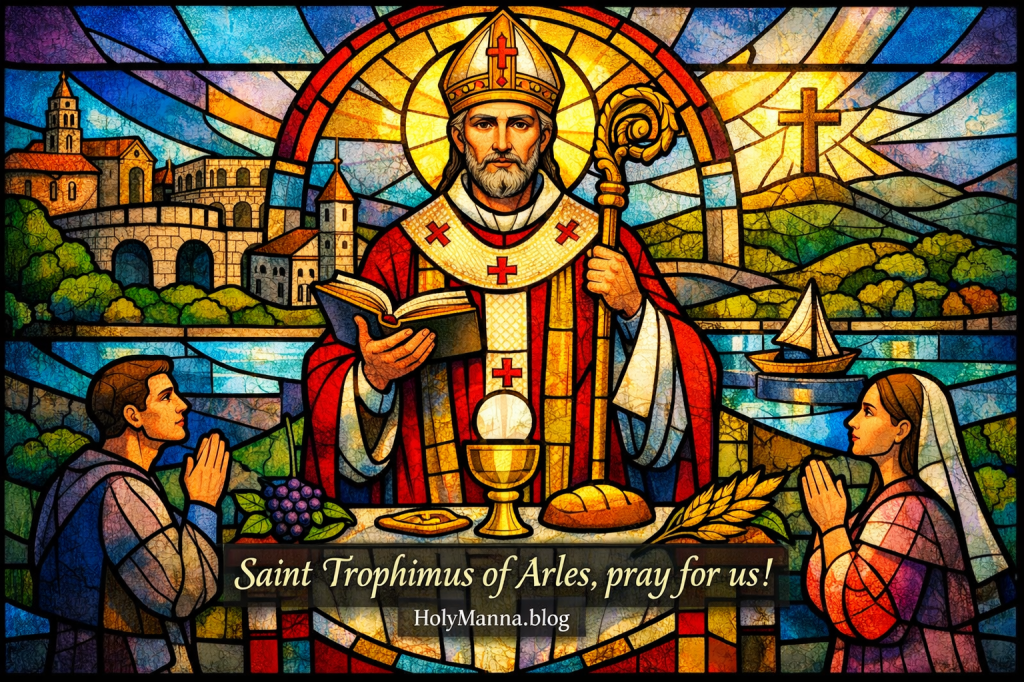
A Quiet Founder with an Apostolic Backbone
Saint Trophimus of Arles is honored as the first bishop of Arles and as one of the foundational missionary figures in the early Christian history of Gaul. Although the historical record preserves only limited personal details about his life, the Church has consistently remembered him for something essential: he helped establish stable Catholic life in a major Roman city at a time when fidelity to Christ demanded courage, patience, and sacrifice. His witness reflects a form of holiness that builds rather than performs, perseveres rather than seeks recognition, and remains rooted in obedience to the Church.
This kind of witness remains deeply relevant. The faith is not sustained only by martyrs in arenas or scholars in libraries. It is also preserved by pastors who preach, baptize, teach, correct, encourage, and remain faithful day after day. This steady pastoral work reflects the structure Christ Himself established for His Church. The Catechism teaches that bishops are “the visible source and foundation of unity in their particular Churches” (CCC 886). Saint Trophimus is remembered precisely as that kind of foundational shepherd.
No historically verified quotations from Saint Trophimus have survived in a reliable form. That absence does not weaken his witness. Instead, it highlights that his legacy is carried primarily through the living Church he helped plant rather than through recorded words.
From the Ancient World Into a Mission Field
The early life of Saint Trophimus is not recorded in detail, and the Church is careful not to fill those gaps with speculation. His birthplace, family background, and early formation remain unknown. What can be stated with confidence is that he emerged from the early Christian world of the Roman Empire, during a period when the Church was still young, contested, and expanding through missionary effort.
Tradition places his mission in the mid third century, during a time of instability and periodic persecution. Christianity was not socially accepted, and bishops carried immense responsibility. They were charged not only with preaching the Gospel but also with preserving doctrinal integrity, celebrating the sacraments, and maintaining communion with the Church of Rome.
Ancient ecclesial tradition associates Saint Trophimus with an organized missionary effort sent from Rome into Gaul. This reflects how the early Church actually spread, through apostolic sending and the establishment of local Churches centered on the bishop, the Eucharist, and apostolic teaching. In this sense, Saint Trophimus stands as a living example of apostolic mission and ecclesial order, grounded in unity rather than innovation.
A Bishop’s Real Work
Saint Trophimus is best known for his role as the first bishop of Arles, a significant Roman city and an important center of commerce and culture. Establishing a Christian community there was not accidental. Cities like Arles shaped the surrounding regions, and planting the Church in such places helped ensure the faith would spread and endure.
His work was deeply pastoral. He preached Christ in a pagan environment, called people to repentance, baptized converts, and formed a community capable of living Christian morality amid Roman social pressures. He also established ecclesial structures that could endure beyond his lifetime, including sacramental life and clerical leadership. This reflects the Church’s understanding of apostolic succession as more than historical continuity. It is a living safeguard of truth and unity.
This quiet but faithful ministry explains why Saint Trophimus remains important today. His life reminds believers that faithfulness is not measured by visibility or acclaim. It is measured by endurance, obedience, and fruitfulness over time. The Church in Arles endured because its foundation was laid carefully and faithfully.
Grace at Work Beyond Recorded Wonders
No specific miracles performed by Saint Trophimus during his lifetime are preserved in reliable historical sources. The Church does not exaggerate or invent miracle accounts, and it is important to speak honestly about what is verified. At the same time, the absence of recorded miracles does not diminish the reality of God’s action through his ministry.
The conversion of hearts, the rejection of idols, and the establishment of Christian family and sacramental life in a pagan city are themselves signs of grace. These are not achievements produced by human effort alone. The enduring presence of Christianity in Arles points to the work of the Holy Spirit acting through faithful preaching and pastoral care.
This aligns with the Church’s teaching that the Holy Spirit builds up and sanctifies the Church through ordinary means, especially through the sacraments and apostolic ministry. Saints like Trophimus remind believers that God often works most powerfully through quiet fidelity rather than dramatic signs.
The Cost of Being the First Bishop
Saint Trophimus ministered during a time when public Christianity involved real risk. Even in periods without active persecution, Christians were viewed with suspicion. They rejected pagan worship, refused to recognize the emperor as divine, and lived moral lives that challenged accepted social norms. These differences often provoked hostility.
There is no solid historical evidence that Saint Trophimus died as a martyr. Nevertheless, his role as a missionary bishop required courage and perseverance. Being the first bishop meant serving without established support, guiding fragile communities, and remaining steadfast amid misunderstanding and opposition.
The Church honors saints not only for martyrdom by blood but also for the daily offering of their lives in faithful witness. The Catechism teaches that martyrdom is the supreme witness to the truth of the faith (CCC 2473), but the spirit of martyrdom is also present in lives marked by perseverance under pressure. Saint Trophimus exemplifies that form of enduring witness.
A Legacy That Shaped the Church in Gaul
After his death, Saint Trophimus continued to be honored as the spiritual father of the Church in Arles. His memory was preserved through local devotion and through the continued flourishing of the Christian community he helped establish. The Church has always treasured her apostolic founders, recognizing them as instruments through whom Christ planted His Church in specific places.
While no specific posthumous miracles are reliably documented, the long standing veneration of Saint Trophimus reflects the Church’s belief in the communion of saints. Catholics believe that the saints live in Christ, intercede for the Church, and continue to strengthen the faithful through their example. The Catechism reminds the faithful that saints are a source of renewal in the most difficult moments of the Church’s history (CCC 828). The endurance of the Church in Arles stands as a testament to that truth.
Lessons for Faithful Catholics Today
Saint Trophimus offers a powerful model for Catholics living in a distracted and often hostile culture. His life demonstrates the importance of patience, consistency, and fidelity over the long term. He shows that not every vocation is dramatic, but every vocation matters when it is lived in obedience to Christ and His Church.
His example encourages Catholics to remain faithful in prayer even when enthusiasm fades, to stay rooted in the sacraments even when convenience tempts compromise, and to support the unity of the Church in daily life. Saint Trophimus did not build a personal platform or pursue influence. He helped build Christ’s Church, trusting that God would bring growth in His time.
A faithful Catholic life is not built on private interpretation or personal preference. It is built on Scripture read within the Church, the sacraments received with reverence, and doctrine embraced with humility. Saint Trophimus of Arles stands as a reminder that the quiet work of faithfulness often shapes history more deeply than anything loud or fleeting.
Engage with Us!
Share your thoughts and reflections in the comments below. Saint Trophimus may not be widely known, but his witness speaks powerfully to the realities of everyday faith.
- Where is God calling for greater perseverance and quiet faithfulness in daily life?
- How can Catholics today better support the unity of the Church in family, parish, and community life?
- What lessons from the early missionary bishops can strengthen commitment to the sacraments and Church teaching today?
May Saint Trophimus of Arles inspire steadfast faith, patient hope, and humble service. Live a life of faith and do everything with the love and mercy Jesus taught, because that is how the Gospel continues to take root in every generation.
Saint Trophimus of Arles, pray for us!
Follow us on YouTube, Instagram and Facebook for more insights and reflections on living a faith-filled life.

 Holy Manna!
Leave a comment