The Archbishop Who Would Not Bend
Saint Thomas Becket is one of those saints who makes it impossible to pretend that faith is only a private hobby. He is remembered because he fought for something many people still misunderstand: the freedom of the Church to obey Christ without being controlled by the State. As Archbishop of Canterbury in the twelfth century, he stood firm when royal power tried to dominate the spiritual authority entrusted by Christ to His Church. His witness culminated in martyrdom, making him a lasting sign of fidelity to conscience and truth.
The Church venerates Thomas Becket because his death fulfilled what the Church teaches about martyrdom. The Catechism explains that martyrdom is the supreme witness to the truth of the faith and means bearing witness even unto death (CCC 2473). Becket did not seek conflict, but when it came, he refused to surrender what belonged to God. His life forces every generation of Christians to ask whether faith is merely convenient or truly authoritative in their lives.
A London Upbringing Shaped by Talent and Ambition
Thomas Becket was born in London around 1118 to a prosperous Norman family. His parents ensured he received an excellent education, and from an early age, Thomas displayed sharp intelligence, confidence, and natural leadership. He studied in London and Paris and later deepened his understanding of law and administration, skills that made him highly valuable in public life.
These abilities brought him into royal service under King Henry II, who quickly recognized Thomas as a capable and loyal ally. As Chancellor of England, Thomas lived comfortably and enjoyed the privileges of court life. He managed royal affairs effectively and defended the interests of the crown with energy. At this stage, few people would have expected him to become a spiritual adversary to the king. Yet in 1162, when Henry appointed him Archbishop of Canterbury, the trajectory of Thomas’s life changed in a profound and unexpected way.
A Conversion of the Heart That Reshaped His Entire Life
Although Thomas was already a baptized Christian, his appointment as archbishop marked a deep interior conversion rather than a sudden emotional moment. He embraced his new responsibility with seriousness and reverence, understanding that he was now accountable not to royal favor but to Christ Himself. He gave up the luxuries of court life, devoted himself to prayer and penance, and took on the pastoral care of souls with renewed intensity.
Historical accounts consistently describe his disciplined spiritual life, including fasting and penitential practices that reflected a sincere desire for holiness. This transformation was not performative. It was rooted in conscience and obedience. Thomas no longer saw himself as a political figure who happened to wear episcopal vestments. He understood himself as a shepherd entrusted with guarding the freedom of the Church and the integrity of her mission.
A Shepherd Who Defended the Church Without Compromise
As Archbishop of Canterbury, Thomas Becket became the most visible defender of the Church’s independence in England. The central conflict with King Henry II concerned whether the crown could exert authority over Church courts and clergy in ways that undermined ecclesiastical governance. Thomas recognized that such control threatened the Church’s ability to teach, sanctify, and govern according to Christ’s will.
This conflict revealed Thomas’s moral clarity. He understood that Christians owe respect to civil authority, but obedience has limits. The Catechism teaches clearly that when civil authority commands actions contrary to the moral order, Christians must refuse obedience (CCC 2242). Thomas’s resistance was not rebellion. It was fidelity. He was willing to lose favor, comfort, and safety rather than betray the Church’s freedom or his own conscience.
Holiness Expressed Through Charity and Discipline
Saint Thomas Becket is not remembered for spectacular public miracles during his lifetime, but his holiness was visible in quieter and more demanding ways. His generosity toward the poor, his dedication to prayer, and his willingness to embrace penance all testified to the work of grace in his life. His transformation from a worldly court official into a disciplined and prayerful bishop stands as one of the most compelling examples of adult conversion in Church history.
This kind of holiness is often overlooked, yet it is deeply challenging. It shows that conversion is not merely intellectual agreement with doctrine but a reordering of priorities, habits, and loyalties. Thomas allowed grace to reshape not only what he believed but how he lived each day.
Exile, Persecution, and Faithfulness Unto Death
Thomas’s defense of the Church eventually forced him into exile in France, where he lived for several years separated from his diocese. Exile brought loneliness, uncertainty, and constant pressure to compromise. Even so, he continued to act as a bishop, making difficult decisions and remaining steadfast in prayer and conviction.
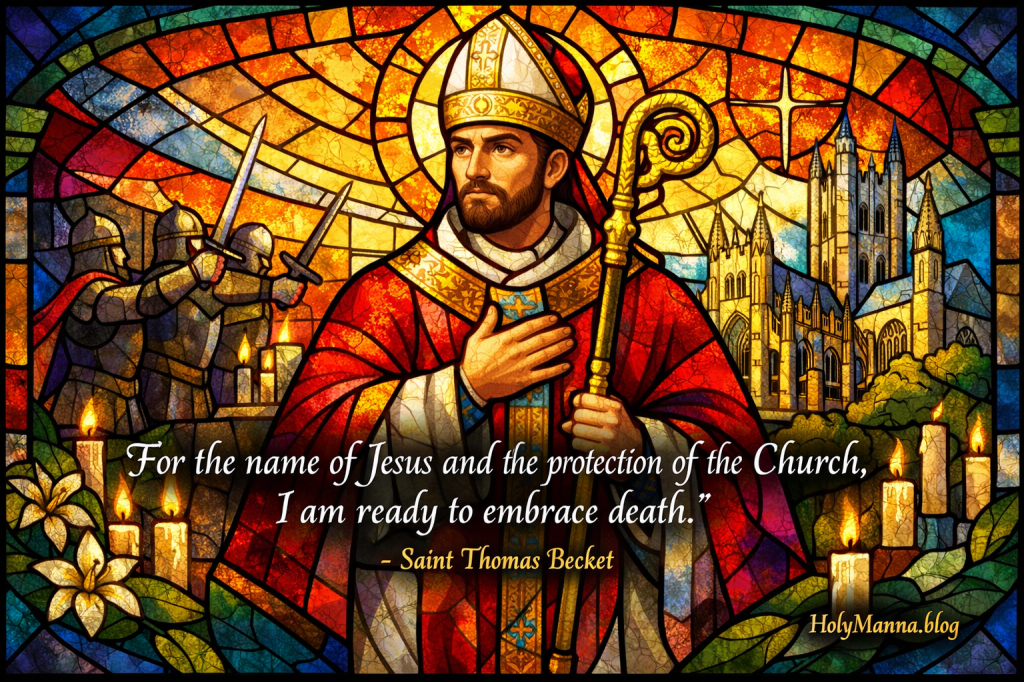
When he returned to England in 1170, tensions quickly reignited. On December 29 of that year, four knights entered Canterbury Cathedral and attacked him. Thomas did not resist or flee. He accepted death calmly, offering himself to God at the altar. One of the most consistently attested statements attributed to him expresses his readiness for martyrdom: “For the name of Jesus and the protection of the Church, I am ready to embrace death.” Another widely preserved line echoes the same resolve: “I am ready to die for my Lord, that in my blood the Church may obtain liberty and peace.”
His martyrdom fulfilled the Church’s understanding of witness. Martyrdom is not the pursuit of danger but the refusal to deny Christ when fidelity becomes costly (CCC 2473).
A Tomb That Drew the Faithful and Shook a Kingdom
Following his death, devotion to Saint Thomas Becket spread rapidly throughout England and Europe. Reports of healings and answered prayers multiplied at his tomb in Canterbury, and it became one of the most important pilgrimage sites of the medieval Christian world. The miracles attributed to his intercession strengthened faith and drew countless souls to repentance and conversion.
Thomas was canonized in 1173, only three years after his martyrdom, reflecting the Church’s recognition of both his witness and the signs associated with his intercession. Even King Henry II eventually performed public penance connected to Thomas’s death, acknowledging the injustice that had occurred. The veneration of Saint Thomas Becket demonstrates how God brings grace, healing, and conversion from suffering offered in fidelity.
Learning Courage and Conscience from Saint Thomas Becket
Saint Thomas Becket speaks powerfully to Christians living in times of moral confusion and cultural pressure. His life teaches that conscience must be formed by truth and defended with courage. Fidelity to Christ often requires choosing integrity over approval and obedience over convenience.
Living out Becket’s example today does not usually mean facing physical martyrdom, but it does mean refusing to water down the faith. It means honoring the Church’s teaching even when it is unpopular, remaining faithful to the sacraments, and loving the Church even when her members fail. His witness reminds believers that real peace is not the absence of conflict but the fruit of living in truth.
Engage with Us!
Share your thoughts and reflections in the comments below. Saint Thomas Becket challenges the heart and conscience, and honest conversation helps faith grow.
- Where is God asking for greater courage or integrity in daily life right now?
- How does the friendship and conflict between Thomas Becket and King Henry II speak to modern pressures to compromise faith?
- What practical steps can help strengthen fidelity to Christ when it feels uncomfortable or costly?
May the witness of Saint Thomas Becket inspire a life rooted in truth, strengthened by prayer, and marked by the love and mercy Jesus taught us to live every single day.
Saint Thomas Becket, pray for us!
Follow us on YouTube, Instagram and Facebook for more insights and reflections on living a faith-filled life.

 Holy Manna!
Leave a comment