The Fifth Day in the Octave of Christmas – Lectionary: 202
When Christmas Light Gets Practical
Christmas is still unfolding, and the Church is not letting anyone treat it like a sentimental afterglow. The central theme tying today’s readings together is this: the true Light of Christmas is proven by obedient love, and that Light reveals what is really in the heart. This is not about having the right “holiday feelings.” It is about living in union with Jesus by keeping His word, loving the brother in front of you, and allowing Christ Himself to shine into the hidden places where excuses and darkness like to linger.
That is why the First Letter of John comes in hot with a reality check. If someone claims to know God but refuses to keep His commandments, John calls it what it is. “Whoever says, ‘I know him,’ but does not keep his commandments is a liar” (1 John 2:4). Then the Apostle brings it home with the “new commandment” that is both ancient and fresh, because it is fulfilled in Christ and now must be lived in Christ. “Whoever loves his brother remains in the light” (1 John 2:10). In other words, the Light is not a theory. The Light becomes visible when love becomes concrete, especially when it costs something.
That same Light is what the psalm is singing about with loud, public confidence. Psalm 96 is a missionary psalm. It is meant for worship, yes, but also for witness. The nations are not supposed to guess what God is like. They are meant to hear it. “Proclaim his salvation day after day. Tell his glory among the nations” (Ps 96:2-3). Christmas is not private. The Child born in Bethlehem is the Lord of heaven and earth, and creation itself is summoned to rejoice because the real King has stepped into human history.
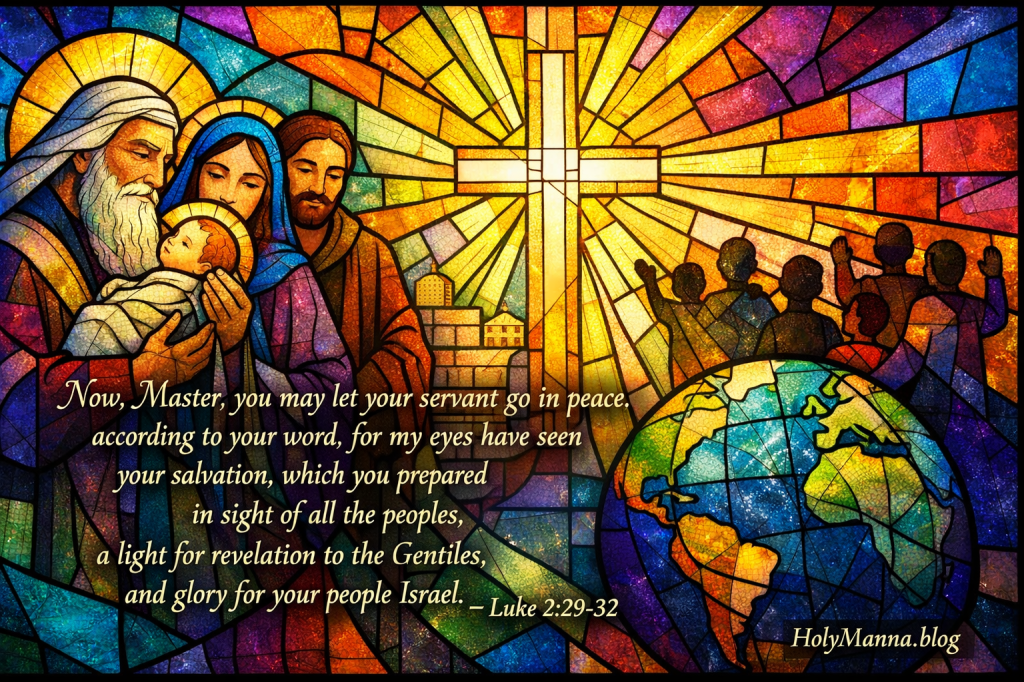
Then the Gospel brings the theme into sharp focus by placing the Light right in the Temple. Mary and Joseph go to Jerusalem in humble obedience to the law of Moses, offering the sacrifice of the poor. This matters because it shows that the Messiah enters the world through fidelity, not flash. Simeon, righteous and devout, recognizes what so many miss: this Child is salvation in the flesh. “My eyes have seen your salvation” (Luke 2:30). Simeon names Jesus as “a light for revelation to the Gentiles” (Luke 2:32), which means Christmas Light is meant to reach beyond Israel to every nation and every living room and every heart that thinks it is too far gone.
But Simeon also tells the truth that keeps Christmas from becoming soft. This Light will be contradicted, and it will reveal hearts. “So that the thoughts of many hearts may be revealed” (Luke 2:35). The Light comforts, but it also exposes. It shows where love is real and where it is performance. It shows whether someone truly abides in Christ or is just borrowing religious language. That is why today’s readings fit together so well. The Church is celebrating the Word made flesh, and at the same time calling everyone to step out of darkness through obedience, brotherly love, and honest worship that proclaims the true God to a world full of idols.
Where is Christ inviting obedience that looks like love today, not just words?
First Reading – 1 John 2:3-11
Proof of Christmas Light
The Church places this passage from 1 John right in the heart of the Christmas Octave because Christmas is not only about celebrating that God came near. It is also about learning how to live now that the true Light has entered the world. John is writing to early Christians who are dealing with a real problem that never went away. Some people were talking like insiders, claiming they “knew God,” while living like nothing had changed. John refuses to let faith become a slogan. In a community where believers were learning how to worship the true God in a pagan world, and where tensions and divisions could easily fracture communion, John makes the test of authentic Christianity very practical. Knowing Jesus means keeping His commandments, and the clearest commandment is love of neighbor. This fits today’s theme perfectly because the Light of Christ does not stay trapped in a manger scene. The Light proves itself in obedience, and it shows itself in love. When love is missing, John says the darkness is still calling the shots.
1 John 2:3-11 – New American Bible (Revised Edition)
3 The way we may be sure that we know him is to keep his commandments. 4 Whoever says, “I know him,” but does not keep his commandments is a liar, and the truth is not in him. 5 But whoever keeps his word, the love of God is truly perfected in him. This is the way we may know that we are in union with him: 6 whoever claims to abide in him ought to live [just] as he lived.
The New Commandment. 7 Beloved, I am writing no new commandment to you but an old commandment that you had from the beginning. The old commandment is the word that you have heard. 8 And yet I do write a new commandment to you, which holds true in him and among you, for the darkness is passing away, and the true light is already shining. 9 Whoever says he is in the light, yet hates his brother, is still in the darkness. 10 Whoever loves his brother remains in the light, and there is nothing in him to cause a fall. 11 Whoever hates his brother is in darkness; he walks in darkness and does not know where he is going because the darkness has blinded his eyes.
Detailed Exegesis
Verse 3: “The way we may be sure that we know him is to keep his commandments.”
John starts with certainty, not guesswork. The Christian life is not built on vague spiritual impressions. The word “know” here is not just intellectual agreement. It is relational, covenant knowledge, like belonging. Keeping the commandments is not about earning God’s love, but about showing that His love has actually taken root.
Verse 4: “Whoever says, ‘I know him,’ but does not keep his commandments is a liar, and the truth is not in him.”
John is blunt because the stakes are high. Faith without obedience is not “a different spirituality.” It is self-deception. When someone claims intimacy with Christ while choosing a life that contradicts Christ, John calls it a lie. The “truth” is not merely a concept. Jesus Himself is the Truth, and a life that rejects His commandments rejects Him.
Verse 5: “But whoever keeps his word, the love of God is truly perfected in him. This is the way we may know that we are in union with him.”
Here is the real goal: union with God. Keeping His word is not cold rule-following. It is love maturing into its full shape. John says the love of God is “perfected” in the one who keeps His word, meaning love reaches its intended completion when it becomes lived fidelity. This is how the Church talks about charity as a real virtue that grows and becomes steady.
Verse 6: “Whoever claims to abide in him ought to live just as he lived.”
“Abide” is a deep word. It means remaining, dwelling, staying connected. If someone says he abides in Christ, then his life should start to resemble Christ’s life. That does not mean becoming a carbon copy with the same job and same geography. It means the same pattern: obedience to the Father, humility, purity of heart, mercy, truth, and sacrificial love.
Verse 7: “Beloved, I am writing no new commandment to you but an old commandment that you had from the beginning. The old commandment is the word that you have heard.”
John speaks like a spiritual father. He calls them “beloved” because this is not a scolding from a stranger. The commandment is “old” because God has always called His people to love, and because they heard it “from the beginning” of their Christian life. It is part of the basic Gospel package, not advanced-level spirituality.
Verse 8: “And yet I do write a new commandment to you, which holds true in him and among you, for the darkness is passing away, and the true light is already shining.”
It is old and new at the same time. It is old in content, but new in fullness because Jesus has lived it perfectly and made it possible for His disciples to live it by grace. This line about darkness passing away is pure Christmas energy. The Light is not coming someday. The Light is already shining. That is why Christian love is not optional. It is what life looks like when the Light is real.
Verse 9: “Whoever says he is in the light, yet hates his brother, is still in the darkness.”
John gives a concrete test. Hatred is not just intense emotion. It is a settled posture of rejection, contempt, or refusal of charity. A person can say all the right religious words and still be living in darkness if he hates his brother. Christmas devotion without charity is a contradiction.
Verse 10: “Whoever loves his brother remains in the light, and there is nothing in him to cause a fall.”
Love keeps a person in the Light because love is how God Himself lives. Love also protects from stumbling because sin thrives in darkness, isolation, and resentment. When charity becomes the habit of the heart, temptation loses one of its favorite entry points.
Verse 11: “Whoever hates his brother is in darkness; he walks in darkness and does not know where he is going because the darkness has blinded his eyes.”
John describes hatred as disorientation. Darkness blinds. That is why bitterness never stays neatly contained. It spreads, it distorts judgment, and it makes a person lose direction. The spiritual tragedy is that the one walking in darkness often thinks he sees clearly. John is warning that hatred turns the heart into a foggy room where truth gets hard to recognize.
Teachings
This reading sits right on top of the Church’s teaching that love is not a feeling but a virtue, and that the moral life is a response to grace. The Catechism explains that charity is the form of all the virtues and the heart of Christian perfection. “Charity is the theological virtue by which we love God above all things for his own sake, and our neighbor as ourselves for the love of God.” (CCC 1822). John is describing exactly this. If the love of God is “perfected” in someone, it means this virtue is maturing and shaping the whole life.
John also connects love with keeping commandments, which matches The Catechism’s insistence that love and law are not enemies. “The moral law is the work of divine Wisdom. Its biblical meaning can be defined as fatherly instruction, God’s pedagogy. It prescribes for man the ways, the rules of conduct that lead to the promised beatitude; it proscribes the ways of evil which turn him away from God and from his love.” (CCC 1950). God’s commandments are not arbitrary restrictions. They are a Father’s directions toward freedom and beatitude.
This passage also shines a spotlight on the scandal of claiming Christ while refusing charity. The Catechism speaks directly about the commandment to love as the new law of the Gospel. “The New Law is the grace of the Holy Spirit given to the faithful through faith in Christ. It works through charity; it uses the Sermon on the Mount to teach us what to do; it makes use of the sacraments to give us the grace to do it.” (CCC 1966). John is basically giving a field test for whether that grace is being welcomed or resisted.
Saint Augustine is famous for a line that gets misunderstood, but when it is read the right way it fits John perfectly. “Love, and do what you will.” Saint Augustine is not saying feelings are a free pass. He is saying that true charity, real supernatural love, reshapes the will so that it chooses what pleases God. When charity rules, obedience becomes the natural fruit, not a forced performance.
Historically, this kind of teaching mattered because early Christian communities were small and vulnerable. Division was not a mild inconvenience. It could destroy witness, fracture worship, and make the Gospel look like hypocrisy to a watching world. John makes it clear that the Light of Christ is meant to be visible in the way Christians treat each other, especially when personality clashes and old wounds show up.
Reflection
This reading is a gift because it makes the spiritual life measurable in a healthy way. It asks a simple question: does life look more like Jesus than it did before? That is not an invitation to anxiety. It is an invitation to honesty and to steady conversion.
A practical step is to take John seriously about the “brother” test. It helps to name one relationship where resentment has become normal, where contempt shows up in jokes, or where silence has become a weapon. Then it helps to choose one concrete act of charity that breaks the pattern. That could mean praying for that person by name every day this week. It could mean refusing to replay the old argument in the mind. It could mean offering a simple greeting, a small kindness, or a genuine apology. It could also mean setting a boundary without hatred, because charity does not mean enabling sin. Charity means willing the good of the other in truth.
It also helps to connect obedience with Christmas. The Light is already shining, and that means daily choices matter. Keeping the commandments is not a way to prove moral superiority. It is a way to stay in the Light where vision is clear, where the heart softens, and where peace becomes possible.
Where does the heart claim to be “in the light” while still holding on to a grudge, a cold attitude, or a private contempt? What would change this week if the love of God was allowed to be “perfected” through one act of obedience that costs something?
Responsorial Psalm – Psalm 96:1-3, 5-6, 11
A Christmas Song That Refuses to Stay Private
Psalm 96 is the kind of worship that spills out of the temple and into the streets. It comes from Israel’s tradition of enthroning the Lord as the true King, especially in a world full of rival “gods” and powerful nations. In the ancient Near East, every people group had its idols and its stories about who made the world and who really ran it. Israel’s prayer cuts straight through all of that. The Lord is not one local deity among many. The Lord is the Creator of heaven and earth, and therefore the Lord deserves the praise of every nation. That is why this psalm is perfect in the Christmas Octave. The Light has come into the world in Jesus Christ, and the right response is not silent admiration. The right response is proclamation. Today’s theme is that the true Light proves itself through obedient love and reveals hearts, and this psalm shows what the heart looks like when it is living in that Light. It sings, it blesses, it proclaims, and it tells the truth about God in a culture that keeps trying to trade the Creator for idols.
Psalm 96:1-3, 5-6, 11 – New American Bible (Revised Edition)
God of the Universe
1 Sing to the Lord a new song;
sing to the Lord, all the earth.
2 Sing to the Lord, bless his name;
proclaim his salvation day after day.
3 Tell his glory among the nations;
among all peoples, his marvelous deeds.5 For the gods of the nations are idols,
but the Lord made the heavens.
6 Splendor and power go before him;
power and grandeur are in his holy place.11 Let the heavens be glad and the earth rejoice;
let the sea and what fills it resound;
Detailed Exegesis
Verse 1: “Sing to the Lord a new song; sing to the Lord, all the earth.”
A “new song” is the Bible’s way of talking about fresh praise in response to a fresh act of God. God does not change, but His mighty deeds in history keep giving new reasons to worship. The call is not limited to Israel. It is cosmic. “All the earth” is invited because the Lord is not a tribal god. In Christmas, the “new song” becomes even more literal. God has done something new by sending His Son in the flesh, so creation is summoned to rejoice.
Verse 2: “Sing to the Lord, bless his name; proclaim his salvation day after day.”
This verse connects worship with mission. Blessing the Lord’s name is liturgical, but proclaiming salvation “day after day” is steady public witness. Faith is not meant to be seasonal or occasional. Christmas is not a one-day aesthetic. It is salvation that changes daily life. This fits today’s theme because the Light is already shining, and a life in the Light speaks consistently.
Verse 3: “Tell his glory among the nations; among all peoples, his marvelous deeds.”
This is a command to evangelize before the word “evangelize” became common Christian vocabulary. The psalm assumes the nations can hear and respond. It also assumes God’s glory is not meant to be hidden. The “marvelous deeds” are God’s saving actions in history, and for Christians they reach their summit in Jesus. If the Light is real, it gets told. It gets shared. It gets lived out loud.
Verse 5: “For the gods of the nations are idols, but the Lord made the heavens.”
This is the turning point. The psalm draws a hard line between idols and the living God. Idols are not just little statues. Idols are whatever people treat as ultimate, whatever gets the trust, love, and obedience that belong to God. The reason the Lord alone deserves worship is simple and strong: He made the heavens. Creation is not an accident, and it is not owned by human power. Christmas deepens this, because the Creator enters His creation. The one through whom all things were made becomes a Child who can be held.
Verse 6: “Splendor and power go before him; power and grandeur are in his holy place.”
God’s presence is described like a royal procession. “Holy place” points to the temple, where Israel gathered for worship, but it also points beyond the building to the reality of God Himself. His splendor is not borrowed, and His power is not fragile. This matters in a season when the Messiah appears in humility. The Child in the manger is not weak in essence. The humility is chosen. The glory is real.
Verse 11: “Let the heavens be glad and the earth rejoice; let the sea and what fills it resound.”
Now the whole cosmos becomes a choir. This is not poetic exaggeration meant to stay on the page. It is the biblical way of saying that when God acts to save, creation itself is drawn toward restoration. Christmas is the beginning of that restoration in a visible way. The Light is not only for private hearts. It is for the whole world.
Teachings
This psalm is basically a roadmap for Catholic worship and mission. The Church teaches that praise is not an optional accessory to faith. Praise is a proper response to who God is and what He has done. The Catechism describes praise as adoration that recognizes God for His own sake. “Praise is the form of prayer which recognizes most immediately that God is God. It lauds God for his own sake and gives him glory, quite beyond what he does, but simply because HE IS.” (CCC 2639). That is exactly what Psalm 96 is doing, especially when it contrasts idols with the Creator.
This psalm also shows that worship naturally leads to proclamation. The Church exists to evangelize because the Gospel is meant for all peoples, not a private club. The Catechism states the Church’s missionary identity plainly. “The Church is missionary by her very nature.” (CCC 849). When the psalm says, “Tell his glory among the nations” (Ps 96:3), it matches the Church’s understanding that the joy of knowing God is meant to be shared.
The anti-idol line also connects to the first commandment, which is always a Christmas issue because Christmas can easily become an idol factory. The Catechism is direct about what idolatry really is. “Idolatry not only refers to false pagan worship. It remains a constant temptation to faith. Idolatry consists in divinizing what is not God.” (CCC 2113). Psalm 96 is cleansing the imagination. It is reminding the heart that created things are good, but they are not God.
Saint Augustine often preached that the human heart becomes like what it worships. When the heart worships idols, it shrinks. When the heart worships the living God, it expands into praise, gratitude, and charity. That insight helps today because praise is not just singing. Praise is a re-ordering of love, and a re-ordering of love leads to obedient living. That is exactly where today’s theme comes back into focus. The Light is proven by real love, and praise trains the heart to choose that love.
Reflection
This psalm is an invitation to let Christmas become courageous and public in the right way. It is easy to sing a Christmas song and still live as if anxiety, money, comfort, and approval are the real kings. Psalm 96 pushes back. It says the Lord is the Creator, and therefore the Lord deserves daily allegiance. A practical step is to make praise part of daily routine in a concrete way. It could mean beginning the day by blessing the Lord’s name out loud, even if it feels awkward at first. It could mean taking one minute to thank God for one specific “marvelous deed” from the past, because gratitude breaks the spell of idolatry.
Another practical step is to practice proclamation with humility. Proclaiming salvation does not always mean preaching at strangers. It often means telling the truth with peace. It means speaking about God naturally with friends or family instead of acting like faith is a private hobby. It also means letting actions match words, because the world can smell hypocrisy a mile away. If today’s first reading says love proves the Light, then this psalm says praise spreads the Light, and both are meant to happen together.
What competes with God for trust and attention right now, especially in the middle of Christmas festivities? How could praise become a daily habit that re-orders the heart, so that loving the neighbor becomes more natural and less forced?
Holy Gospel – Luke 2:22-35
The Light Enters the Temple and Exposes Every Heart
This Gospel lands right in the middle of the Christmas Octave, and it makes a powerful point: the Child who was laid in a manger is not only tender and approachable. He is also the Lord, and His presence demands a response. Luke brings everyone to the Temple in Jerusalem, the spiritual center of Israel’s worship, because this is where covenant fidelity is meant to be visible. Mary and Joseph come in humble obedience to the law of Moses, and they offer the sacrifice of the poor, which shows that salvation enters the world quietly, through faithfulness and trust. Then Simeon appears, a righteous and devout man who has been waiting for God to keep His promise. Guided by the Holy Spirit, Simeon recognizes that this infant is the Messiah, and he announces what today’s readings have been building toward: the true Light has arrived, and that Light will reveal what is really inside people. This fits today’s theme perfectly. 1 John insists that walking in the Light means obedient love, and Psalm 96 insists that the Light must be proclaimed to the nations. Simeon unites both truths when he calls Jesus salvation for all peoples and warns that this Light will be contradicted and will expose hearts.
Luke 2:22-35 – New American Bible (Revised Edition)
The Presentation in the Temple. 22 When the days were completed for their purification according to the law of Moses, they took him up to Jerusalem to present him to the Lord, 23 just as it is written in the law of the Lord, “Every male that opens the womb shall be consecrated to the Lord,” 24 and to offer the sacrifice of “a pair of turtledoves or two young pigeons,” in accordance with the dictate in the law of the Lord.
25 Now there was a man in Jerusalem whose name was Simeon. This man was righteous and devout, awaiting the consolation of Israel, and the holy Spirit was upon him. 26 It had been revealed to him by the holy Spirit that he should not see death before he had seen the Messiah of the Lord. 27 He came in the Spirit into the temple; and when the parents brought in the child Jesus to perform the custom of the law in regard to him, 28 he took him into his arms and blessed God, saying:
29 “Now, Master, you may let your servant go
in peace, according to your word,
30 for my eyes have seen your salvation,
31 which you prepared in sight of all the peoples,
32 a light for revelation to the Gentiles,
and glory for your people Israel.”33 The child’s father and mother were amazed at what was said about him; 34 and Simeon blessed them and said to Mary his mother, “Behold, this child is destined for the fall and rise of many in Israel, and to be a sign that will be contradicted 35 (and you yourself a sword will pierce) so that the thoughts of many hearts may be revealed.”
Detailed Exegesis
Verse 22: “When the days were completed for their purification according to the law of Moses, they took him up to Jerusalem to present him to the Lord.”
Luke emphasizes obedience and reverence. The Holy Family submits to the law, not because they are sinful or unclean in a moral sense, but because they are faithful Jews living within the covenant practices of Israel. The Temple is the place of sacrifice, prayer, and encounter. The Light enters the “holy place” in person, and it happens through ordinary fidelity.
Verse 23: “Just as it is written in the law of the Lord, ‘Every male that opens the womb shall be consecrated to the Lord.’”
This refers to the Old Testament command about the firstborn belonging to the Lord. It echoes Israel’s memory of the Exodus and God’s deliverance. Jesus, the true Firstborn, is presented as belonging wholly to the Father, and the irony is beautiful. The One who is the Lord is being consecrated to the Lord.
Verse 24: “And to offer the sacrifice of ‘a pair of turtledoves or two young pigeons,’ in accordance with the dictate in the law of the Lord.”
This sacrifice was permitted for those who could not afford a lamb. Luke quietly reveals the Holy Family’s poverty. The Savior enters the world not through wealth and status, but through humility. This matters spiritually because it shows how God likes to work. Pride loves a spotlight, but grace often arrives in simplicity.
Verse 25: “Now there was a man in Jerusalem whose name was Simeon. This man was righteous and devout, awaiting the consolation of Israel, and the holy Spirit was upon him.”
Simeon represents faithful Israel. “Consolation of Israel” points to God’s promised comfort and deliverance, especially after suffering and exile. Simeon is not driven by political rage or impatience. He is righteous, devout, and led by the Spirit. He is a man who has learned how to wait with hope.
Verse 26: “It had been revealed to him by the holy Spirit that he should not see death before he had seen the Messiah of the Lord.”
This is a personal promise, but it also highlights the Spirit’s role in recognizing Christ. No one can truly know Jesus without grace. Simeon’s hope is not generic optimism. It is anchored in God’s word.
Verse 27: “He came in the Spirit into the temple; and when the parents brought in the child Jesus to perform the custom of the law in regard to him.”
Luke repeats the theme of the Spirit and the theme of obedience. Simeon is moved by the Spirit, and the parents are acting according to the law. The meeting happens at the intersection of grace and faithful action. This is how God often works: the Spirit moves, and obedient people show up.
Verse 28: “He took him into his arms and blessed God, saying.”
Simeon’s response is worship, not analysis. He holds the Child and blesses God. This is a powerful image of faith. The Messiah is not an idea to debate first. He is a Person to receive.
Verse 29: “Now, Master, you may let your servant go in peace, according to your word.”
Simeon prays with surrender. He calls God “Master,” and he calls himself “servant.” Peace comes from fulfilled promise. Simeon has been waiting, and now he can die in peace because God has kept His word.
Verse 30: “For my eyes have seen your salvation.”
Salvation is not merely a rescue plan. Salvation is visible, tangible, and present in Jesus. Simeon does not say, “I have seen a sign of salvation.” He says he has seen salvation itself. This is Christmas theology in one sentence.
Verse 31: “Which you prepared in sight of all the peoples.”
God’s plan is not secretive or tribal. It is prepared openly, intended for public revelation. This matches Psalm 96 calling the nations to hear God’s glory. The Messiah is not for one group only.
Verse 32: “A light for revelation to the Gentiles, and glory for your people Israel.”
Here is the central “Light” language. Jesus is the Light that reveals God to the nations, and He is Israel’s glory because He fulfills the promises made to the patriarchs. The Light is universal and covenantal at the same time. It reaches Gentiles without abandoning Israel.
Verse 33: “The child’s father and mother were amazed at what was said about him.”
Even Mary and Joseph, who have already received angelic messages, continue to marvel. Wonder is a holy posture. God’s mysteries are not mastered. They are received.
Verse 34: “And Simeon blessed them and said to Mary his mother, ‘Behold, this child is destined for the fall and rise of many in Israel, and to be a sign that will be contradicted.’”
Simeon’s blessing includes a warning. Jesus will cause “fall and rise” because He forces decision. Some will stumble over Him through pride, and some will rise through faith and repentance. Calling Jesus a “sign that will be contradicted” means that His very existence exposes resistance. Light is resisted by those who love darkness.
Verse 35: “And you yourself a sword will pierce so that the thoughts of many hearts may be revealed.”
This is one of the most sobering lines in Luke. Mary’s motherhood will include suffering, because love always costs something in a fallen world. The “sword” points toward the Passion, when Mary will stand near the Cross. Then Luke gives the reason: hearts will be revealed. Jesus does not only comfort. He uncovers. He brings truth to the surface. That is why today’s first reading insists that love and obedience are the proof of living in the Light. The Light will expose what is real.
Teachings
This Gospel is loaded with Catholic doctrine, especially about Christ, Mary, and the Temple. First, it shows Christ’s identity as the universal Savior. The Catechism teaches that Jesus fulfills Israel’s hopes and opens salvation to all nations. “The Messiah’s characteristics are revealed above all in the ‘Servant songs’ of Isaiah. Jesus fulfilled the messianic hope of Israel in his threefold office of priest, prophet, and king.” (CCC 436). Simeon’s prophecy fits this because the Messiah is revealed in humility and destined to be contradicted, which lines up with the Servant who suffers.
The Presentation also points to Jesus as the true meeting place between God and man. The Temple was the center of Israel’s worship, but Jesus is the fulfillment of what the Temple signified. The Catechism speaks of Jesus as the definitive revelation and the One in whom God’s presence dwells. “In many and various ways God spoke of old to our fathers by the prophets, but in these last days he has spoken to us by a Son.” (CCC 65). Simeon’s words show that God’s speaking has become visible in the Son.
Mary’s role is also illuminated here. Simeon’s prophecy of the sword points to Mary’s intimate union with her Son’s saving work, not as a rival to Christ, but as a mother who shares in His suffering through love. The Catechism describes this participation clearly. “Thus the Blessed Virgin advanced in her pilgrimage of faith, and faithfully persevered in her union with her Son unto the cross.” (CCC 964). Simeon’s words are an early announcement that Mary’s discipleship will be costly, and that her motherhood is tied to the mystery of redemption.
Saint John Paul II often emphasized that Simeon’s prophecy reveals that Christ’s coming is a moment of crisis in the original sense of the word, a moment of decision. Light forces clarity. People either come into the Light through humility, or they resist it to protect cherished sins. That is exactly what Simeon means by “contradicted” and “hearts revealed.”
Historically, this scene also reflects Israel’s expectation of consolation. Many Jews longed for deliverance from oppression and for the fulfillment of God’s promises. Luke shows that the Holy Spirit forms a remnant who waits rightly, not with bitterness but with hope. Simeon becomes a model of faithful waiting, which is deeply relevant in the Christmas season because the Church teaches that waiting is part of love.
Reflection
This Gospel asks for a mature Christmas. It invites people to let the Child be who He really is. Jesus is gentle, but He is not harmless. He is the Light, and light reveals. That means Christmas is not only a comfort. It is also a call to conversion.
A practical step is to imitate Simeon’s posture. Simeon shows up to the Temple, he stays faithful in waiting, and he listens to the Spirit. That can look like consistency in prayer, especially when life feels dry. It can look like receiving the sacraments with reverence, not rushing through them. It can also look like a willingness to speak blessing over God’s work instead of always complaining about what is broken.
This Gospel also challenges the heart to accept contradiction. Jesus will be contradicted, and His disciples should not be shocked when living the faith brings pushback. The question is whether that pushback leads to bitterness or to deeper charity. The first reading gave the test: love of brother keeps someone in the Light. So the goal is not to win arguments. The goal is to remain in the Light through obedience and love, even when the Light is resisted.
Mary’s “sword” is also a quiet invitation. Love in the real world includes suffering. Parents suffer for their children. Spouses suffer for each other. Friends suffer when they tell the truth. Christmas love is not Hallmark love. It is Cross shaped love, and that is why it saves.
Where is the Light of Christ revealing resistance in the heart right now, especially in habits that get defended instead of surrendered? What would change if Simeon’s prayer became personal practice, letting go of control and choosing peace because God has kept His word?
Let the Light Win in Real Life
Today’s readings land like a single, clear message sung in three voices: the Light of Christ has come, and it is meant to be lived, proclaimed, and allowed to reveal what is really in the heart. The Christmas Octave is not asking anyone to stay in a cozy spiritual mood. It is asking for a real response that shows up in obedience, charity, and courage.
The First Reading from 1 John makes the test unmistakable. Knowing Jesus is not proven by religious language or spiritual identity. It is proven by keeping His commandments, and especially by loving the brother right in front of you. “Whoever loves his brother remains in the light” (1 John 2:10). That means Christmas Light is not measured by how meaningful a tradition feels, but by whether resentment is being surrendered, forgiveness is being chosen, and charity is becoming concrete.
Then Psalm 96 teaches what a heart in the Light sounds like. It sings to the Lord, blesses His name, and refuses to keep salvation quiet. “Proclaim his salvation day after day. Tell his glory among the nations” (Ps 96:2-3). This is praise that becomes witness, and witness that stays rooted in worship. It also calls out every idol, because the Lord alone made the heavens, and everything else belongs in its proper place.
Finally, the Gospel in The Gospel of Luke brings the Light into the Temple and shows what happens when the Light is received and when it is resisted. Simeon holds the Child and announces that this is not merely a private comfort for Israel, but “a light for revelation to the Gentiles” (Luke 2:32). Then he warns that this Light will be contradicted and will expose hearts, because Jesus forces a decision. Some will rise through faith, and some will fall through pride. This is why today’s theme is so sharp. The Light does not only warm. The Light reveals. It clarifies. It calls for conversion.
So the call to action is simple, and it is very doable. Choose one concrete act of obedience today that reflects Jesus’ life. Choose one act of charity that proves the Light is real, especially toward someone who is hard to love. Choose one moment to proclaim God’s goodness with calm confidence, even if it is only in a brief conversation or a quiet word of gratitude. Then ask for the grace to stay in the Light when it feels inconvenient, because that is where peace and freedom actually live.
What would change this week if the Light of Christmas was allowed to reshape one relationship, one habit, and one daily decision?
Engage with Us!
Share reflections in the comments below, because the Church hears these readings best when hearts respond honestly and together.
- First Reading (1 John 2:3-11): Where is obedience to God’s commandments being resisted, and what concrete step could be taken today to choose love instead of resentment?
- Responsorial Psalm (Psalm 96): What “idol” competes for trust and attention, and how can praise become a daily habit that re-orders the heart toward the Lord?
- Holy Gospel (Luke 2:22-35): Where is Jesus, the Light, revealing what is hidden in the heart, and how can that revelation become repentance and peace instead of defensiveness?
Keep walking in the Light and let every choice today be shaped by the love and mercy Jesus taught, especially in the moments that cost something.
Sacred Heart of Jesus, we trust in You!
Immaculate Heart of Mary, pray for us!
Saint Michael the Archangel, defend us in battle!
Follow us on YouTube, Instagram and Facebook for more insights and reflections on living a faith-filled life.

 Holy Manna!
Leave a comment