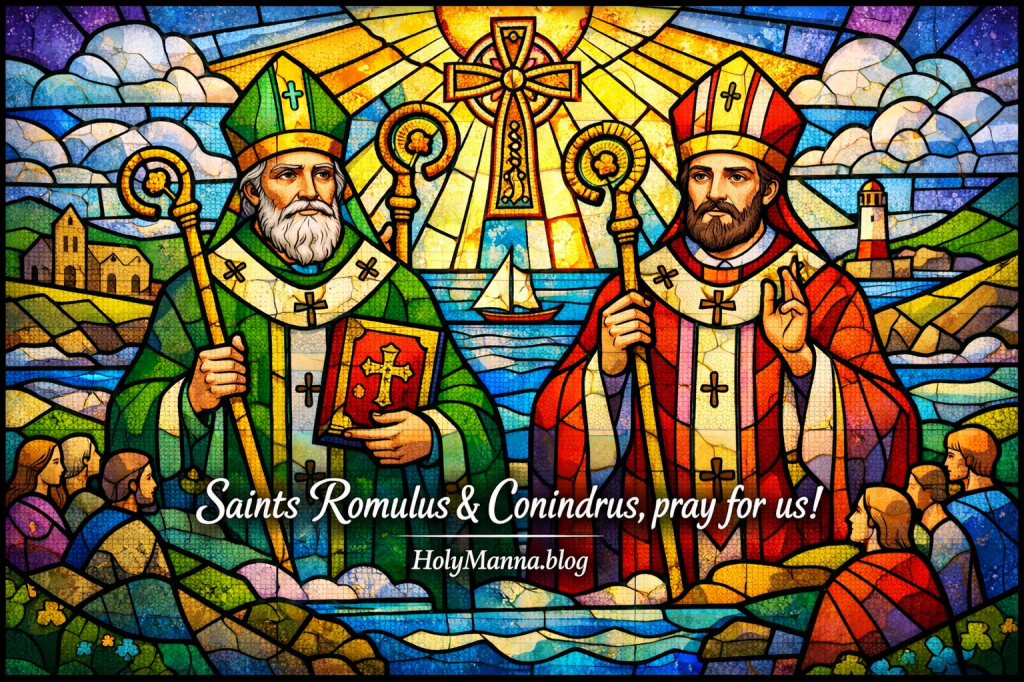
Two Missionary Bishops Who Helped Wake Up an Island
Saints Romulus and Conindrus are remembered by the Church as early missionary bishops connected to the first proclamation of the Gospel on the Isle of Man. They belong to the great missionary age of the fifth century, the same era that gave the Church Saint Patrick and many other apostolic figures who carried Christianity beyond its earliest strongholds. Tradition honors Romulus and Conindrus as among the first to preach Christ on that island, helping to establish Christian belief, worship, and community where it had not previously existed.
Although their lives are not preserved with the rich narrative detail of later saints, their importance lies precisely in their mission. They helped plant the Church in new soil, trusting that God would bring growth long after their own earthly work was finished. Their feast is traditionally observed on December 28, and their memory is tied closely to the earliest Christian identity of the Isle of Man. Their witness reflects what The Catechism teaches clearly: “The Church is missionary by her very nature.” (CCC 850)
Called in the Age of Saint Patrick
Saints Romulus and Conindrus lived during the fifth century, a time when Christianity was spreading rapidly throughout Ireland and into neighboring lands and islands. They are traditionally associated with the missionary movement connected to Saint Patrick, though they are not as well documented historically. What is reliably remembered is that they served as missionaries and bishops, meaning they were entrusted not only with preaching the Gospel but also with shepherding a local Church through teaching, sacramental life, and pastoral care.
Specific details about their early life, family background, or personal conversion experiences have not been preserved with certainty. Rather than diminishing their witness, this highlights a powerful truth about the early Church. Many saints labored faithfully without leaving behind detailed personal records. What endured was their work for Christ and the faith communities they helped establish. They answered the call to serve Christ where the faith was young, fragile, and in need of patient shepherds.
Planting the Church Where Faith Was New
Romulus and Conindrus are most remembered for helping establish Christianity on the Isle of Man in its earliest days. In later Christian memory, they are sometimes described as co-apostles of the island, emphasizing that the evangelization of a people is always a work of the Church rather than the achievement of a single individual. Their ministry helped ensure that Christian teaching, prayer, and sacramental life took root and endured.
There is also a longstanding tradition connecting them to Saint Maughold, a figure closely tied to Manx Christianity. According to that tradition, Romulus and Conindrus played a role in instructing and forming him in the Christian faith after his arrival on the island. While this tradition is devotional rather than strictly historical in the modern sense, it reflects how Christians remembered their role: as teachers, spiritual fathers, and steady guides in the early life of the local Church.
The Quiet Miracle of Evangelization
No specific, widely verified miracle accounts from the lifetime of Saints Romulus and Conindrus have been preserved. Unlike many later saints, there are no detailed stories of healings, prophecies, or dramatic signs attributed to them during their earthly ministry. The absence of such accounts does not lessen their sanctity.
The true miracle of their lives is evangelization itself. Bringing people to faith, forming Christian communities, and sustaining belief in difficult conditions is a work of grace. As The Gospel of Matthew records Jesus commanding the apostles, “Go, therefore, and make disciples of all nations.” (The Gospel of Matthew 28:19) Romulus and Conindrus lived this command concretely through preaching, teaching, prayer, and sacramental ministry. The endurance of Christianity on the Isle of Man stands as a lasting witness to their fidelity.
Hardships of Apostolic Life
The historical record does not describe a martyrdom for Saints Romulus and Conindrus, nor does it provide detailed accounts of specific persecutions they endured. Still, the nature of early missionary life allows no illusion of comfort or ease. Evangelizing in the fifth century involved travel under difficult conditions, cultural resistance, spiritual opposition, and the slow, demanding work of forming believers with little prior exposure to Christian teaching.
Their perseverance reveals the heart of apostolic courage. They labored without guarantees of success, without recognition, and often without visible fruit in their own lifetime. This quiet endurance reflects the example of Christ Himself, who taught that faithfulness matters more than applause and that the seed sown in trust would bear fruit in God’s time.
A Legacy That Outlived Them
No major posthumous miracle accounts associated with Saints Romulus and Conindrus have been securely preserved. Yet their continued veneration speaks volumes. The Church remembered their names, kept their feast, and passed down the conviction that they were among the first true shepherds of Christian life on the Isle of Man.
Their enduring legacy is found in the continued Christian memory of the island and its awareness of apostolic roots. In the life of the Church, such remembrance usually points to a deep and authentic witness. Their holiness is seen not in dramatic legends but in the lasting presence of faith where they once labored.
Ordinary Faith That Builds the Church
Saints Romulus and Conindrus remind Catholics that evangelization is not reserved for famous saints or dramatic personalities. Their lives show that steady, patient faithfulness can change the spiritual history of a place. The Catechism teaches, “The ultimate purpose of mission is none other than to make men share in the communion between the Father and the Son in their Spirit of love.” (CCC 850)
That mission continues today in ordinary circumstances. Evangelization often happens through calm witness, consistent prayer, and a willingness to speak about Christ without embarrassment. It can take shape in family life, friendships, workplaces, and parish communities. Saints like Romulus and Conindrus teach that quiet perseverance, rooted in truth and charity, can bear fruit far beyond what is visible.
How often does fear of awkwardness keep the light of Christ hidden when it should be shared?
Who in life needs steady witness more than dramatic words?
What would change if prayer became normal and visible again in daily life?
Engage with Us!
Share thoughts and reflections in the comments below.
1. Where has God placed you right now that could be your personal mission field, even if it is only your home, friendships, or workplace?
2. What is one simple and honest way to speak about Jesus or the Catholic faith this week?
3. When fear arises around sharing the faith, how can that fear be placed under Christ’s lordship in prayer?
Continue to walk forward in faith with confidence. Choose the good even when it is inconvenient. Live intentionally, pray faithfully, and do everything with the love and mercy Jesus taught us, because that is how saints are formed and how hearts are changed.
Saints Romulus & Conindrus, pray for us!
Follow us on YouTube, Instagram and Facebook for more insights and reflections on living a faith-filled life.

 Holy Manna!
Leave a comment