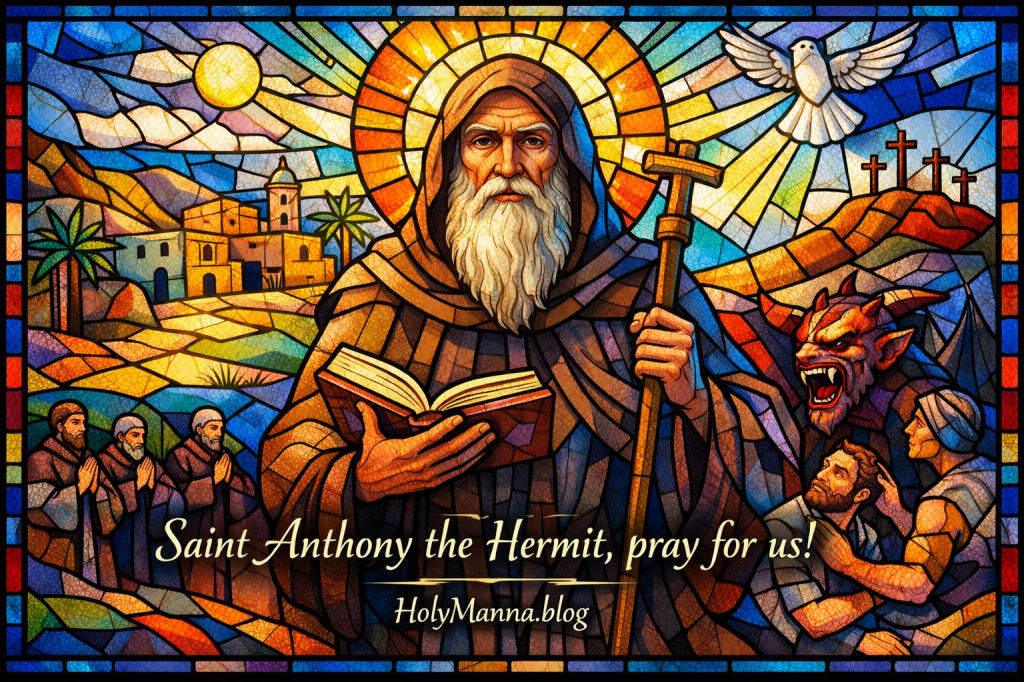
The Man Who Made the Desert a Cathedral
Saint Anthony the Hermit, also called Saint Anthony the Great, is one of the most influential saints in the history of Christian spirituality. Living in Egypt during the late third and early fourth centuries, his radical choice to seek God in solitude helped ignite what later became Christian monastic life. Although he was not the first hermit, the Church remembers him as the true Father of Monks because countless men and women followed his example, learned from his wisdom, and shaped their lives around his understanding of prayer, discipline, and humility.
Anthony’s importance is not limited to history books. His life speaks directly to a distracted and restless world. He reveals that the Christian life is real spiritual warfare and that holiness is formed slowly through perseverance and grace. The desert became his cathedral, not because it was empty, but because it stripped away illusion and forced the heart to choose God alone. His witness reminds the Church that holiness is not about temperament or lifestyle, but about daily surrender to Christ.
When the Gospel Becomes Personal
Saint Anthony was born around the year 251 in Lower Egypt to devout Christian parents of considerable means. After their death, Anthony inherited wealth and became responsible for his younger sister. The turning point of his life came not through emotional excess or mystical experience, but through attentive listening to the Word of God proclaimed at Mass. Hearing the words of The Gospel of Matthew, “If you wish to be perfect, go, sell what you have and give to the poor, and you will have treasure in heaven. Then come, follow me,” he understood this not as a general teaching, but as a personal summons from Christ.
Anthony responded with concrete obedience. He distributed his possessions to the poor, provided for his sister by entrusting her to a community of consecrated women, and embraced a life of asceticism marked by prayer, fasting, and watchfulness of heart. At first he remained near his village, learning from other holy ascetics, but his desire for deeper union with God gradually drew him farther into solitude. His conversion was not a single moment but a lifelong fidelity to the call he had heard.
The Desert Battles
Life in the desert exposed Anthony to intense spiritual combat. Early Christian tradition understood the desert as a place of purification and testing, and Anthony’s experience confirmed this truth. He endured temptations of fear, pride, despair, and distraction, often described by ancient sources as direct assaults from the enemy. Anthony did not overcome these struggles through clever arguments or sheer willpower. He overcame them through humility, prayer, Scripture, and perseverance.
One of his most famous sayings captures the heart of his spirituality: “I saw the snares that the enemy spreads out over the world, and I said groaning, ‘What can get through from such snares?’ Then I heard a voice saying to me, ‘Humility.’” This teaching remains as relevant now as it was in the fourth century. Pride entangles the soul, while humility leaves it free to receive grace.
Anthony also warned against neglecting prayer in favor of constant activity or distraction. He taught, “Just as fish die if they stay too long out of water, so the monks who loiter outside their prayer lose the intensity of their inner peace.” Though directed to monks, the lesson applies to all Christians who allow busyness to suffocate their interior life.
Miracles accompanied Anthony’s life, though he never sought them. He healed the sick, delivered those oppressed by evil spirits, and restored peace to troubled souls through prayer. People traveled great distances to seek his counsel. Though he loved silence, God made him a spiritual father to many, drawing others to holiness through his example of clarity, mercy, and unwavering faith.
A Witness Without Compromise
Saint Anthony did not die as a martyr by execution, but his entire life was marked by daily self sacrifice. He embraced poverty, fasting, solitude, and endurance as a way of uniting himself to Christ crucified. He also endured misunderstanding and criticism, as radical fidelity often unsettles those who prefer comfortable religion. Anthony accepted these hardships quietly, content to be known by God rather than praised by men.
During periods of persecution, Anthony traveled to Alexandria to support imprisoned Christians, desiring to strengthen them in their witness. When martyrdom did not come, he returned to the desert in obedience, accepting that God was calling him to witness through perseverance rather than bloodshed. His life reflects the truth taught by The Catechism: “The way of perfection passes by way of the Cross. There is no holiness without renunciation and spiritual battle” (CCC 2015). Anthony lived this teaching not as theory, but as daily practice.
The Saint Who Refused to Be a Celebrity
Saint Anthony died peacefully around the year 356, having lived more than a century. Before his death, he asked that his burial place remain hidden, revealing once again his humility and detachment. He sought no recognition, only fidelity. Yet devotion to him spread rapidly throughout the Christian world, and many miracles were attributed to his intercession, especially healings and help in spiritual struggles.
His influence endured through the wisdom he passed on to others. One of his most challenging teachings remains a sharp examination of conscience: “Our life and our death are with our neighbor. If we gain our brother, we have gained God; but if we scandalize our brother, we have sinned against Christ.” Even the great hermit insisted that holiness is never isolated from charity. Love of God must always overflow into love of neighbor.
Bringing the Desert Home
Saint Anthony’s life is not an invitation to abandon ordinary responsibilities, but a call to take prayer seriously. He challenges modern Christians to reclaim silence, discipline, and sobriety of mind in a culture addicted to noise. Temptation, he teaches, is not proof of failure but evidence of spiritual awakening. The response is not despair, but humility and perseverance.
Imitating Saint Anthony today can look like faithful daily prayer, disciplined fasting according to the Church’s wisdom, guarding the imagination, and refusing to negotiate with habitual sin. It also looks like patience in family life, honesty at work, restraint in speech, and mercy toward others. His life shows that freedom is not found in indulgence, but in ordered love.
Engage with Us!
Readers are invited to share their thoughts and reflections in the comments below and to join the conversation about how the saints continue to shape everyday Christian life.
- What distractions in daily life make it hardest to hear God clearly?
- How can small acts of silence and prayer be introduced into a busy schedule?
- Where is God inviting greater trust during moments of temptation or struggle?
May the witness of Saint Anthony the Hermit encourage a life rooted in prayer, strengthened by discipline, and animated by love. May every action be done with the mercy, humility, and courage taught by Jesus Christ, who alone leads hearts from the desert into eternal life.
Saint Anthony the Hermit, pray for us!
Follow us on YouTube, Instagram and Facebook for more insights and reflections on living a faith-filled life.

 Holy Manna!
Leave a comment