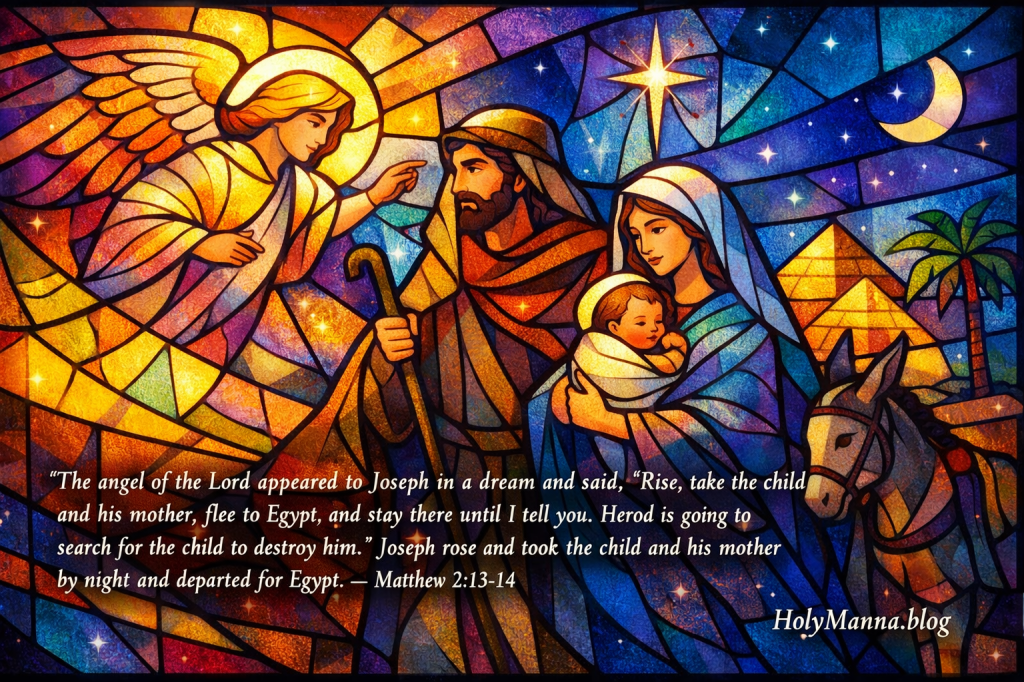
Feast of the Holy Family of Jesus, Mary and Joseph – Lectionary: 17
When God Makes a Home in the Middle of Uncertainty
It is easy to imagine the Holy Family as calm, settled, and untouched by fear, but the Church places today’s feast in the Christmas season to tell a truer story. God did not enter a perfect household with ideal conditions. God entered a family that had to make hard decisions, respond to danger, forgive daily, and trust Him step by step. The Feast of the Holy Family invites every household to see holiness not as something reserved for quiet monasteries or dramatic conversions, but as something forged in kitchens, carpools, hospital rooms, work schedules, and moments of uncertainty.
All of today’s readings revolve around one central truth: God builds holiness through faithful love lived out in ordinary family life, especially when that love demands sacrifice, patience, and trust. Sirach 3:2-6, 12-14 roots holiness in honoring parents, even when age, weakness, or misunderstanding makes that honor costly. It reveals that family relationships are not spiritually neutral territory. They are places where sins are healed and virtue takes lasting root. Psalm 128:1-5 then widens the picture and shows the blessing that flows from a home ordered toward God. The fear of the Lord becomes the foundation for work, marriage, and children, turning the household into a place where life grows slowly but surely. Colossians 3:12-21 moves from vision to practice, naming the virtues that must be deliberately chosen if a Christian home is going to survive real pressure. Compassion, forgiveness, humility, and love are not personality traits. They are habits of discipleship that keep relationships from hardening into resentment. Finally, The Gospel of Matthew 2:13-15, 19-23 grounds everything in action. The Holy Family is forced into flight, guided by God one step at a time, and settled not in a place of power but in quiet Nazareth. Joseph’s obedience, repeated and prompt, becomes the means by which God protects life and fulfills His promises.
Together, these readings remind every believer that the family is not meant to be perfect. It is meant to be faithful. Holiness does not require certainty about the future. It requires trust today. When love is chosen in the middle of risk, when forgiveness replaces bitterness, and when God is allowed to guide decisions step by step, the home becomes what it was always meant to be: a small domestic church where Christ truly dwells.
First Reading – Sirach 3:2-6, 12-14
Sirach belongs to the wisdom books, written in a Jewish world that was trying to stay faithful while surrounded by strong cultural pressures. It was composed in Hebrew and later translated into Greek for Jews living in the wider Hellenistic world. In that environment, honoring parents was not just a private family preference. It was a public act of covenant loyalty, because the family was where faith was handed on and where the commandments were lived before they were ever explained. That is why this reading fits the Feast of the Holy Family so perfectly. Holiness begins at home, and the home becomes holy when love takes the form of honor, patience, and concrete care, especially when aging, weakness, or misunderstanding makes relationships harder. This reading also plugs directly into today’s central theme: God builds holiness through everyday family fidelity, where honor becomes an act of worship and a path of mercy.
Sirach 3:2-6, 12-14 – New American Bible (Revised Edition)
2 For the Lord sets a father in honor over his children
and confirms a mother’s authority over her sons.
3 Those who honor their father atone for sins;
4 they store up riches who respect their mother.
5 Those who honor their father will have joy in their own children,
and when they pray they are heard.
6 Those who respect their father will live a long life;
those who obey the Lord honor their mother.12 My son, be steadfast in honoring your father;
do not grieve him as long as he lives.
13 Even if his mind fails, be considerate of him;
do not revile him because you are in your prime.
14 Kindness to a father will not be forgotten;
it will serve as a sin offering—it will take lasting root.
Detailed Exegesis
Verse 2: “For the Lord sets a father in honor over his children and confirms a mother’s authority over her sons.”
This verse frames family authority as something God establishes, not something invented by human preference. A father and a mother are not competing rulers, but distinct gifts within God’s design for the household. In the biblical vision, honoring parents is not blind obedience to sin, but a reverence for the order God uses to give life, teach wisdom, and pass on faith. When a culture tries to flatten authority into “whoever feels strongest wins,” Scripture reminds believers that authentic authority is meant to serve, protect, and form.
Verse 3: “Those who honor their father atone for sins.”
This is a striking claim, and it is not saying that being nice to dad replaces repentance or the sacraments. It is showing that honoring parents is a real work of justice and charity that disposes the heart toward conversion. When someone chooses humility, gratitude, and restraint in family life, that choice fights the pride that feeds so many sins. In other words, honoring parents can be a genuine act of penance because it trains the soul to love rightly, even when it is inconvenient.
Verse 4: “They store up riches who respect their mother.”
Wisdom literature often speaks about “riches” in a way that goes beyond money. Respecting a mother stores up a kind of spiritual wealth: interior stability, gratitude, and a conscience formed by reverence. A mother’s role in the biblical imagination is deeply tied to nurture, formation, and the daily sacrifices that keep life going. This verse pushes back against the modern temptation to treat those sacrifices as invisible or “just expected.”
Verse 5: “Those who honor their father will have joy in their own children, and when they pray they are heard.”
Here the reading connects family virtue to generational fruitfulness. Honoring a father shapes the kind of adult who can become a patient, stable parent. It also links honor with prayer, because a heart trained in reverence is less likely to approach God with entitlement. The promise that prayer is “heard” points to alignment with God’s will, because obedience and humility tend to remove the inner obstacles that make prayer selfish or shallow.
Verse 6: “Those who respect their father will live a long life; those who obey the Lord honor their mother.”
This echoes the Fourth Commandment’s promise about long life, not as a mechanical guarantee, but as a general truth about how virtue protects a person from self-destructive habits. The second line is especially important because it binds honoring parents directly to obedience to God. Scripture is saying that reverence for parents is not a side quest. It is part of faithful discipleship.
Verse 12: “My son, be steadfast in honoring your father; do not grieve him as long as he lives.”
“Steadfast” means consistent, not occasional. This is not about showing respect only when parents are easy to love. It is about a stable posture of gratitude and restraint. The warning about grieving a father reminds believers that words and attitudes can wound deeply, especially when spoken from pride or impatience. Many people regret harshness only after it is too late. Wisdom steps in now, while there is still time.
Verse 13: “Even if his mind fails, be considerate of him; do not revile him because you are in your prime.”
This is one of the most countercultural lines in the reading. It anticipates aging, dementia, weakness, and dependence. It also names the ugly temptation: treating a struggling parent like an embarrassment or an inconvenience. The phrase “because you are in your prime” exposes the arrogance of youth that forgets its own future fragility. The call is not merely to tolerate, but to be considerate, meaning patient, gentle, and protective of dignity.
Verse 14: “Kindness to a father will not be forgotten; it will serve as a sin offering, it will take lasting root.”
Kindness here is not a soft feeling. It is active mercy. The language of “sin offering” highlights that love in the family can be sacrificial and purifying. When a person chooses kindness instead of contempt, that choice roots the soul in virtue. It “takes lasting root” because it reshapes a person’s character, making the heart more like Christ, who honored His Mother and entrusted Himself to earthly guardianship.
Teachings
The Church connects this reading directly to the Fourth Commandment and the reality that the family is the first place where love becomes duty. The Catechism is blunt and beautiful about why honoring parents matters: CCC 2197 teaches, “The fourth commandment opens the second table of the Decalogue. It shows us the order of charity.” That “order of charity” is not a cold hierarchy. It is the realistic truth that love starts somewhere, and God designed it to begin in the home.
The Church also teaches that this honor does not expire when a person becomes an adult. In fact, it often becomes more demanding. The Catechism speaks to exactly what Sirach emphasizes about weakness and need. In CCC 2218 it says, “The fourth commandment reminds grown children of their responsibilities toward their parents. As much as they can, they must give them material and moral support in old age and in times of illness, loneliness, or distress.” That lines up almost word for word with “Even if his mind fails, be considerate of him” from Sirach 3:13.
Saint John Paul II often described the family as a “domestic church,” meaning the home is a real place of sanctification and discipleship, not just a staging area before “real” spiritual life begins. This is why the Church keeps putting these readings in front of believers: the holiness of the Holy Family is not locked in stained glass. It is meant to be lived in kitchens, living rooms, hospital visits, awkward phone calls, and the humble choice to speak with respect when pride wants to lash out.
Historically, honoring parents in Israel was also tied to preserving the covenant memory. In a world without modern schooling and mass literacy, parents were the primary teachers of faith. To despise them was to risk despising the story of God’s salvation. That is why wisdom literature treats family honor as spiritually serious. It is about justice, gratitude, and fidelity, not just emotional closeness.
Reflection
This reading hits home because it refuses to let family love stay abstract. It pushes toward concrete actions that can feel small but carry real spiritual weight. Honoring parents can look like biting the tongue when sarcasm would feel satisfying, calling more often instead of disappearing into busyness, offering practical help without keeping score, and showing tenderness when a parent repeats the same story for the tenth time. It can also mean setting respectful boundaries when necessary, because honor does not mean enabling sin. It means guarding dignity and refusing contempt.
A good next step is to choose one specific act of honor that can be done this week and actually follow through. That might be a sincere thank you for something that has been taken for granted. It might be asking forgiveness for a past harshness. It might be offering to drive to an appointment, help with paperwork, or simply sit and listen without multitasking. These are not just “nice things.” They are small acts of holiness that train the heart in humility and love.
Where has impatience or pride been turning family relationships into a battleground instead of a place of peace? What would change if honoring parents was treated as a real spiritual discipline rather than an optional courtesy? If a parent is aging, struggling, or difficult to understand right now, what would considerate kindness look like in one concrete action today?
Responsorial Psalm – Psalm 128:1-5
Psalm 128 is one of the “Songs of Ascents,” a collection traditionally associated with pilgrimage to Jerusalem. These were the songs ordinary families would pray as they went up to worship, bringing their work, their relationships, and their hopes into the presence of God. That background matters, because this psalm is not a random inspirational quote about having a nice home. It is a pilgrim song that connects worship with daily life. It teaches that the blessed home is formed by the fear of the Lord, meaning a reverent, obedient love that shapes choices, habits, and priorities. That fits perfectly with today’s theme on the Feast of the Holy Family. Holiness begins at home, but it grows best when the home is oriented toward God, not toward comfort, ego, or control.
Psalm 128:1-5 – New American Bible (Revised Edition)
The Blessed Home of the Just
1 A song of ascents
Blessed are all who fear the Lord,
and who walk in his ways.
2 What your hands provide you will enjoy;
you will be blessed and prosper:
3 Your wife will be like a fruitful vine
within your home,
Your children like young olive plants
around your table.
4 Just so will the man be blessed
who fears the Lord.5 May the Lord bless you from Zion;
may you see Jerusalem’s prosperity
all the days of your life,
Detailed Exegesis
Verse 1: “Blessed are all who fear the Lord, and who walk in his ways.”
The psalm starts with the root, not the fruit. “Fear of the Lord” is not anxiety, and it is not superstition. It is reverence, the kind that takes God seriously enough to obey Him. “Walk in his ways” means faith is lived consistently, not just spoken. A home becomes blessed when God’s ways shape how people speak, forgive, work, and rest. The blessing is not detached from virtue. It flows through it.
Verse 2: “What your hands provide you will enjoy; you will be blessed and prosper.”
This verse honors honest work and the dignity of labor. The psalm assumes a normal life of effort, responsibility, and daily bread. The blessing described here is not about getting everything desired. It is about receiving what is provided with gratitude and peace, instead of constant dissatisfaction. When a home fears the Lord, work is not worshiped and money is not treated like salvation. It becomes a means of serving the household and honoring God.
Verse 3: “Your wife will be like a fruitful vine within your home, your children like young olive plants around your table.”
This imagery is deeply biblical and deeply practical. A vine is a sign of life, joy, and fruitfulness. Olive plants point to endurance and long-term blessing, since olive trees take time to mature and can live for generations. The “table” matters too, because the table is the place of communion, where conversation, formation, correction, laughter, and reconciliation often happen. This verse is not idolizing a perfect family vibe. It is pointing to family life as a place where God’s blessing makes life grow over time, like something cultivated, not instantly produced.
Verse 4: “Just so will the man be blessed who fears the Lord.”
The psalm repeats its main lesson so no one misses it. The family imagery is not a guarantee for every circumstance, and it is not a condemnation of people who carry heavy crosses like infertility, illness, divorce in the family line, or complicated relationships. It is a wisdom pattern that says reverence for God is the stable foundation for a flourishing life. When God is honored, the home is more likely to become a place of peace and endurance even when suffering shows up.
Verse 5: “May the Lord bless you from Zion; may you see Jerusalem’s prosperity all the days of your life.”
Zion and Jerusalem represent the place of God’s dwelling and the center of worship for Israel. This verse links household blessing to the liturgical life of God’s people. A home is not meant to be spiritually isolated. The psalm assumes that families draw strength from worship, from the covenant community, and from God’s promises. The home flourishes when it stays connected to the Lord’s presence and the life of faith.
Teachings
The Church teaches that the Psalms are not only ancient prayers but living prayer for the whole People of God. The Catechism says in CCC 2585, “From David until the coming of the Messiah, the sacred books contain prayer texts that attest how prayer was lived in Israel and how it was reflected upon.” That means Psalm 128 is not merely describing a nice domestic scene. It is showing how God wants faith to touch real life, including marriage, work, and the raising of children.
The Church also teaches that the family is meant to be a “domestic church,” a real place where faith is learned and lived. The Catechism says in CCC 1657, “It is here that the father of the family, the mother, children, and all members of the family exercise the priesthood of the baptized in a privileged way by the reception of the sacraments, prayer and thanksgiving, the witness of a holy life, and self denial and active charity.” That description matches the whole movement of this psalm, because it ties together worship, prayer, thanksgiving, and daily holiness inside the home.
Historically, calling Psalm 128 a pilgrim song also matters because it highlights a rhythm: families go up to worship, then they come back down to live what they prayed. That is how the fear of the Lord becomes a lifestyle. It is learned in worship and practiced in the home. This is also why the feast today is not sentimental. The Holy Family did not live in comfort and stability all the time. They lived in faithful obedience, and that is the true soil where blessing grows.
Reflection
This psalm invites a serious but hopeful examination of what actually sets the atmosphere of a home. Many households run on stress, distraction, and low-grade resentment, and people slowly accept that as normal. Psalm 128 pushes back and says the foundation can be different. Reverence for the Lord can become the anchor that reshapes everything, including how work is approached, how marriage is protected, and how children are formed.
A practical way to live this psalm is to reclaim a few simple habits that make the home more God-centered. Choosing one shared moment of prayer, even brief, can change the temperature of a household because it teaches everyone that God is not an add-on. Practicing gratitude out loud, especially at meals, helps the heart enjoy what the hands provide instead of constantly chasing more. Protecting the family table from constant screens can also be a real act of spiritual leadership, because it restores the table as a place of presence, conversation, and communion.
What is the real “fear of the Lord” in daily life right now, and what would it change in the way decisions are made at home? Is the household more shaped by gratitude or by complaint, and what is one concrete step that could shift that tone this week? If the family table is meant to be a place of communion, what needs to be removed or added so that people can actually be present to one another?
Second Reading – Colossians 3:12-21
Saint Paul’s Letter to the Colossians was written to a young Christian community living in a world full of competing spiritual claims and social pressures. In the Greco Roman culture of the time, households were structured by “household codes,” which often emphasized authority and social order, sometimes with little concern for tenderness or mutual sacrifice. Paul does something radical. He does not merely give advice for keeping peace at home. He roots family life in baptismal identity and the life of grace. This passage fits today’s theme perfectly because it shows how holiness is built in ordinary relationships. The Christian home becomes holy when people “put on” the virtues of Christ, forgive as they have been forgiven, and let the peace of Christ govern the heart. Then Paul gets very concrete about family roles, not as power plays, but as a path of love, unity, and protection of the vulnerable.
Colossians 3:12-21 – New American Bible (Revised Edition)
12 Put on then, as God’s chosen ones, holy and beloved, heartfelt compassion, kindness, humility, gentleness, and patience, 13 bearing with one another and forgiving one another, if one has a grievance against another; as the Lord has forgiven you, so must you also do. 14 And over all these put on love, that is, the bond of perfection. 15 And let the peace of Christ control your hearts, the peace into which you were also called in one body. And be thankful. 16 Let the word of Christ dwell in you richly, as in all wisdom you teach and admonish one another, singing psalms, hymns, and spiritual songs with gratitude in your hearts to God. 17 And whatever you do, in word or in deed, do everything in the name of the Lord Jesus, giving thanks to God the Father through him.
The Christian Family. 18 Wives, be subordinate to your husbands, as is proper in the Lord. 19 Husbands, love your wives, and avoid any bitterness toward them. 20 Children, obey your parents in everything, for this is pleasing to the Lord. 21 Fathers, do not provoke your children, so they may not become discouraged.
Detailed Exegesis
Verse 12: “Put on then, as God’s chosen ones, holy and beloved, heartfelt compassion, kindness, humility, gentleness, and patience.”
Paul starts with identity. Christians are “chosen,” “holy,” and “beloved,” not because they earned it, but because God has claimed them in Christ. Then comes the command to “put on” virtues like clothing. This means virtue is not automatic. It is practiced. Compassion and kindness heal wounds. Humility kills pride. Gentleness keeps strength from becoming domination. Patience gives relationships room to breathe. A family cannot stay healthy without these, because daily life creates friction, and friction reveals character.
Verse 13: “Bearing with one another and forgiving one another, if one has a grievance against another; as the Lord has forgiven you, so must you also do.”
This verse is painfully realistic. Families create grievances because people are close, tired, stressed, and imperfect. Paul’s answer is not denial. It is forgiveness rooted in Christ. The standard is not “forgive if they deserve it.” The standard is Christ’s forgiveness. That is the only thing strong enough to break cycles of resentment. “Bearing with” also matters because it means not every irritation needs a confrontation. Some things need charity, endurance, and a thicker skin formed by love.
Verse 14: “And over all these put on love, that is, the bond of perfection.”
Love is not one virtue among many. It is the bond that holds all the virtues together. Without love, patience becomes mere tolerance and humility becomes performative. With love, everything becomes unified toward communion. “Bond of perfection” means love brings the Christian life to its mature form. In family life, love looks like choosing the good of the other even when emotions are not cooperating.
Verse 15: “And let the peace of Christ control your hearts, the peace into which you were also called in one body. And be thankful.”
Peace here is not conflict avoidance. It is the peace of Christ ruling the heart like an umpire. It decides what wins in moments of tension. When anger rises, peace says, “Do not retaliate.” When pride rises, peace says, “Seek reconciliation.” Paul ties this peace to being “one body,” meaning the Church. A Christian home is strengthened when it remembers it belongs to something bigger than itself. Gratitude is added because thankfulness fights entitlement, and entitlement is poison in family life.
Verse 16: “Let the word of Christ dwell in you richly, as in all wisdom you teach and admonish one another, singing psalms, hymns, and spiritual songs with gratitude in your hearts to God.”
The home is meant to be saturated with the word of Christ, not starved of it. “Dwell richly” suggests abundance and depth, not scraps of inspiration when convenient. Teaching and admonishing are not about nagging. They are about helping one another stay on the path of truth. The mention of psalms and hymns shows that worship is not only for the sanctuary. A household can be shaped by prayer, Scripture, and praise, and that spiritual atmosphere changes how people treat each other.
Verse 17: “And whatever you do, in word or in deed, do everything in the name of the Lord Jesus, giving thanks to God the Father through him.”
This verse is a total life claim. Nothing is outside Christ’s lordship, including how spouses speak, how kids are corrected, and how stress is handled. Doing things “in the name of the Lord Jesus” means actions should be consistent with His character. Thanksgiving shows up again because gratitude keeps the heart anchored in grace instead of constantly reacting from frustration.
Verse 18: “Wives, be subordinate to your husbands, as is proper in the Lord.”
This line is often misunderstood because modern ears hear domination. Paul’s phrase “in the Lord” is crucial. It means this is not servility and it is never a permission slip for abuse. It is a call to an ordered unity rooted in Christ, not in ego. In Catholic teaching, marriage is a communion of persons, and any “subordination” must be understood within mutual self gift and the dignity of both spouses. This verse only makes sense when read with the whole passage, especially the immediate command to husbands.
Verse 19: “Husbands, love your wives, and avoid any bitterness toward them.”
This is the balancing command, and it is demanding. In the ancient world, husbands were not commonly told to love with sacrificial tenderness. Paul commands it. “Avoid bitterness” targets the slow drip of contempt, sarcasm, cold silence, and emotional withdrawal that can destroy a marriage while everything still looks fine on the outside. A husband is called to protect, serve, and love in a way that reflects Christ, not to rule like a tyrant.
Verse 20: “Children, obey your parents in everything, for this is pleasing to the Lord.”
Obedience is framed as an act of faith. It is “pleasing to the Lord,” meaning it is not just about family order but about learning humility and trust. This obedience is not blind compliance with sin. It is obedience within the framework of God’s law. Children learn freedom through the formation of virtue, and that formation often begins with obedience to rightful authority.
Verse 21: “Fathers, do not provoke your children, so they may not become discouraged.”
This verse is a gut check for parents, especially fathers who might be tempted to lead through harshness. Provoking can mean constant criticism, humiliation, unrealistic demands, or discipline without affection. Paul warns that this can crush a child’s spirit into discouragement. The goal of parental authority is not control. It is formation. Discipline should build up, not break down.
Teachings
This passage is a roadmap for how the “domestic church” actually functions. The Church teaches that the family is a privileged place where faith is lived, taught, and practiced daily. The Catechism says in CCC 1657, “It is here that the father of the family, the mother, children, and all members of the family exercise the priesthood of the baptized in a privileged way by the reception of the sacraments, prayer and thanksgiving, the witness of a holy life, and self denial and active charity.” That is basically Colossians in one paragraph. Prayer, thanksgiving, holy life, self denial, and charity are not extra credit. They are the normal fabric of a Christian household.
Paul’s focus on forgiveness also connects to how the Church understands mercy. Forgiveness is not pretending the wound did not happen. It is choosing not to become the kind of person who lives on revenge and resentment. The Lord’s Prayer itself ties forgiveness to daily life, and the Church teaches that mercy is not optional for disciples. The Catechism says in CCC 2840, “Now and this is daunting, this outpouring of mercy cannot penetrate our hearts as long as we have not forgiven those who have trespassed against us. Love, like the Body of Christ, is indivisible; we cannot love the God we cannot see if we do not love the brother or sister we do see.” That is Paul’s logic in Colossians 3:13 in a very direct form.
When it comes to marriage, the Church is clear that spouses are called to mutual self gift. Any reading of Colossians 3:18-19 that turns into domination is a betrayal of the Gospel. The Catechism says in CCC 1641, “By reason of their state in life and of their order, Christian spouses have their own special gifts in the People of God.” Those gifts are meant to serve holiness, not power. The model is Christlike love, especially for husbands, because Paul’s command to husbands is not “be in charge.” It is “love your wives, and avoid any bitterness”.
Saint John Chrysostom, famous for preaching on Christian family life, constantly pushed husbands toward tenderness and sacrifice, reminding them that leadership in the home must resemble Christ. His tone was not about winning arguments. It was about winning souls through love. That is the spirit Paul is commanding here, and it remains countercultural because it requires real self control and humility.
Reflection
This reading is like a mirror held up to the living room. It exposes how quickly a home can become spiritually messy when people stop “putting on” the virtues of Christ and start putting on entitlement, sarcasm, and unforgiveness. A practical way to live this passage is to pick one virtue Paul names and treat it like a deliberate daily assignment. Patience can look like slowing down responses when irritated. Humility can look like admitting fault without excuses. Kindness can look like speaking gently when stress is high. Forgiveness can look like refusing to rehearse a grievance for the hundredth time.
A second practical step is to let “the peace of Christ” actually control decisions in conflict. That means avoiding the cheap thrill of the last word. It means choosing reconciliation sooner instead of waiting for the other person to crawl back first. It also means building a home where the word of Christ “dwells richly,” which can be as simple as making room for Scripture, prayer, and gratitude in the normal rhythm of the week.
Which virtue from this reading is most missing in the home right now: compassion, humility, gentleness, patience, or forgiveness? What would it look like to “put on love” in one specific conflict that keeps repeating? If a child is discouraged or a spouse feels bitterness rising, what honest change needs to happen so that peace can govern the heart instead of pride?
Holy Gospel – The Gospel of Matthew 2:13-15, 19-23
This Gospel reading completes the full arc of the Holy Family’s early trials. The Church places this passage on the Feast of the Holy Family to make something very clear: holiness inside the family does not mean a lack of danger, uncertainty, or change. It means living under God’s guidance one step at a time. Matthew presents Joseph as a man who listens, discerns, and acts, not once but repeatedly. The Holy Family survives not because circumstances become easy, but because God speaks and Joseph obeys. This fits today’s theme perfectly. The home becomes holy when faithful love responds to God promptly, protects life courageously, and trusts divine guidance even when the future remains unclear.
Matthew 2:13-15, 19-23 – New American Bible (Revised Edition)
The Flight to Egypt. 13 When they had departed, behold, the angel of the Lord appeared to Joseph in a dream and said, “Rise, take the child and his mother, flee to Egypt, and stay there until I tell you. Herod is going to search for the child to destroy him.” 14 Joseph rose and took the child and his mother by night and departed for Egypt. 15 He stayed there until the death of Herod, that what the Lord had said through the prophet might be fulfilled, “Out of Egypt I called my son.”
The Return from Egypt. 19 When Herod had died, behold, the angel of the Lord appeared in a dream to Joseph in Egypt 20 and said, “Rise, take the child and his mother and go to the land of Israel, for those who sought the child’s life are dead.” 21 He rose, took the child and his mother, and went to the land of Israel. 22 But when he heard that Archelaus was ruling over Judea in place of his father Herod, he was afraid to go back there. And because he had been warned in a dream, he departed for the region of Galilee. 23 He went and dwelt in a town called Nazareth, so that what had been spoken through the prophets might be fulfilled, “He shall be called a Nazorean.”
Detailed Exegesis
Verse 13: “When they had departed, behold, the angel of the Lord appeared to Joseph in a dream and said, ‘Rise, take the child and his mother, flee to Egypt, and stay there until I tell you. Herod is going to search for the child to destroy him.’”
This moment follows immediately after the Magi depart. Celebration gives way to threat. God speaks to Joseph in a dream, emphasizing again Joseph’s role as guardian of the Child. The command is urgent and protective. “Flee to Egypt” signals real danger, not symbolic fear. Egypt, once a land of slavery for Israel, becomes a place of refuge for the true Son. God is already rewriting history through this family.
Verse 14: “Joseph rose and took the child and his mother by night and departed for Egypt.”
Joseph’s response is immediate. There is no recorded hesitation or complaint. The phrase “by night” highlights both urgency and risk. Travel at night in the ancient world was dangerous, yet Joseph chooses action over comfort. This verse reveals that obedience is often quiet, unseen, and costly, but it is decisive.
Verse 15: “He stayed there until the death of Herod, that what the Lord had said through the prophet might be fulfilled, ‘Out of Egypt I called my son.’”
The Holy Family does not merely pass through Egypt. They remain there until the threat is gone. Matthew then ties this event to prophecy, showing that Jesus relives the story of Israel. Israel, God’s son, was called out of Egypt in the Exodus. Jesus, the true Son, fulfills that pattern. Salvation history moves forward through family obedience and endurance.
Verse 19: “When Herod had died, behold, the angel of the Lord appeared in a dream to Joseph in Egypt.”
God speaks again, showing that guidance is ongoing, not a one time instruction. Joseph remains attentive even in exile. This verse highlights trust and vigilance. Joseph does not decide on his own when it is safe to return. He waits for God’s word.
Verse 20: “Rise, take the child and his mother and go to the land of Israel, for those who sought the child’s life are dead.”
The command mirrors the earlier one almost word for word, reinforcing Joseph’s role and God’s consistency. The danger has passed, and God signals that it is time to move again. Obedience is not static. It adjusts as God reveals the next step.
Verse 21: “He rose, took the child and his mother, and went to the land of Israel.”
Once again, Joseph obeys without delay. His repeated obedience shows a pattern of trust. Each decision builds on the last. The Holy Family lives in motion, guided not by certainty, but by faith.
Verse 22: “But when he heard that Archelaus was ruling over Judea in place of his father Herod, he was afraid to go back there. And because he had been warned in a dream, he departed for the region of Galilee.”
This verse shows discernment, not reckless courage. Joseph recognizes danger and listens again for God’s guidance. Fear here is not a failure of faith. It becomes the occasion for deeper listening. God’s warning redirects the family away from Judea toward Galilee, shaping where Jesus will grow up.
Verse 23: “He went and dwelt in a town called Nazareth, so that what had been spoken through the prophets might be fulfilled, ‘He shall be called a Nazorean.’”
Nazareth was small, unimpressive, and overlooked. Yet this is where God chooses the Holy Family to settle. Matthew again emphasizes fulfillment of prophecy. God’s plan unfolds not through power centers, but through humility and obscurity. The Savior grows in a quiet town because holiness often develops far from applause.
Teachings
This Gospel shows that God’s providence works through ordinary family decisions guided by faith. The Church teaches that Jesus’ hidden years are essential to understanding the Incarnation. The Catechism teaches in CCC 530, “Jesus’ infancy, from the visit of the shepherds to the adoration of the Magi and the flight into Egypt and the massacre of the innocents, shows Christ’s confrontation with the powers of darkness.” Evil is real, but it does not win. God protects salvation history through humble obedience.
Joseph emerges as a powerful model of fatherhood and discernment. He listens, acts, waits, and listens again. The Catechism highlights the sanctifying value of Jesus’ hidden life in CCC 533, “The hidden life at Nazareth allows everyone to enter into fellowship with Jesus by the most ordinary events of daily life.” Nazareth matters because it proves that God works through routine faithfulness, not dramatic recognition.
This Gospel also reveals that God does not usually give the entire roadmap at once. The Holy Family moves from Bethlehem to Egypt, from Egypt toward Israel, and finally to Nazareth. Each step depends on trust. That is deeply relevant for family life, vocation, and discipleship. God’s will is often revealed gradually, requiring patience and courage.
Saint Joseph’s silence in Scripture makes his actions speak louder. He protects life, responds quickly to God, and chooses humility over visibility. The Church honors him as a model of obedience because he shows that holiness is not loud, but it is strong.
Reflection
This Gospel offers real comfort for families living in uncertainty. The Holy Family did not know how long exile would last or where they would finally settle. They only knew the next right step. God did not remove danger immediately. He guided them through it. That same pattern continues today. God often protects not by eliminating hardship, but by directing faithful hearts through it.
A practical way to live this Gospel is to cultivate attentiveness to God’s guidance in daily decisions. That means prayerfully discerning choices about work, family, relationships, and protection of the home. It also means being willing to change direction when circumstances shift, without bitterness or fear. Obedience is not weakness. It is strength under God’s authority.
This passage also calls families to trust God in seasons that feel like exile, instability, or obscurity. Nazareth was not glamorous, but it was where Jesus grew in wisdom and grace. God can use quiet seasons to form deep holiness.
Where is God inviting trust instead of control right now? What step of obedience feels uncomfortable but necessary for the protection of the family? If life feels uncertain or direction keeps changing, what would it look like to believe that God is still guiding each step with purpose and love?
Bring Nazareth Home
The Feast of the Holy Family does not ask anyone to pretend that family life is easy. It asks everyone to take it seriously as a place where God actually saves, heals, and sanctifies. Today’s readings come together like one clear message: holiness is built through faithful love in the home, and that love is proven most when life feels uncertain, relationships feel stretched, or sacrifice is required.
Sirach 3:2-6, 12-14 calls the household back to the Fourth Commandment with a kind of blunt mercy. Honoring father and mother is not a sentimental throwback. It is a spiritual path that trains humility, heals pride, and forces love to become concrete, especially when parents grow weak or difficult. Psalm 128:1-5 then shows what a blessed home looks like from God’s perspective. It is not a perfect aesthetic or a stress free routine. It is a household rooted in the fear of the Lord, where work is received with gratitude and the family table becomes a place of life and communion. Colossians 3:12-21 moves from the big picture to the daily grind and insists that Christian family life only holds together when people actually put on Christ. Compassion, patience, forgiveness, and love are not optional upgrades. They are the necessary clothing of a home that wants the peace of Christ to rule rather than resentment. Finally, The Gospel of Matthew 2:13-15, 19-23 delivers the reality check that makes this feast powerful. The Holy Family is not sheltered from danger. They flee, they wait, they return, they discern, and they settle in Nazareth, guided by God step by step through dreams and obedience. Joseph’s quiet decisiveness protects the Child. Mary’s faithful trust remains steady. Jesus grows in the hiddenness of an ordinary town, proving that God loves to do extraordinary things in ordinary places.
Now the call to action is simple, but it is not soft. Let the home become a small domestic church by choosing one concrete act of honor that repairs what has grown cold. Let bitterness die by choosing one real act of forgiveness that breaks a cycle. Let the peace of Christ govern the next hard conversation instead of pride. Let God guide decisions with trust instead of control, especially in seasons that feel like exile or uncertainty. The Holy Family is not held up today to shame anyone. The Holy Family is held up to show what faithful love looks like when God is at the center.
What would change if Nazareth was treated as the goal, not a consolation prize? A quiet home, rooted in reverence, strengthened by forgiveness, and guided by obedience, is not small in God’s eyes. It is exactly where Jesus loves to dwell, and it is exactly where holiness can take lasting root.
Engage with Us!
Take a moment to share reflections in the comments below, because faith grows stronger when it is spoken, shared, and lived together, especially in the ordinary realities of family life.
- First Reading, Sirach 3:2-6, 12-14: Which phrase from this reading stirred the heart most deeply, especially “Kindness to a father will not be forgotten”? Where might God be inviting greater patience, respect, or mercy toward a parent or elder right now, even if that relationship feels heavy or unresolved?
- Responsorial Psalm, Psalm 128:1-5: What does “Blessed are all who fear the Lord, and who walk in his ways” look like in the daily rhythm of work, rest, and relationships? What small change could help the home become more rooted in gratitude, presence, and reverence this week?
- Second Reading, Colossians 3:12-21: Which virtue needs to be intentionally “put on” right now: compassion, humility, gentleness, patience, or forgiveness? Where might love need to become more than a feeling and instead become the deliberate bond that holds a strained relationship together?
- Holy Gospel, The Gospel of Matthew 2:13-15, 19-23: Where is God asking for trust one step at a time instead of certainty all at once? What situation feels like an “Egypt” or a “Nazareth” season right now, and how might God be using it quietly to protect, form, or prepare the heart?
Keep choosing faith in the small things. Let daily decisions be guided by trust instead of fear and let every word and action be shaped by the love, mercy, and obedience Jesus lived within the Holy Family.
Sacred Heart of Jesus, we trust in You!
Immaculate Heart of Mary, pray for us!
Saint Michael the Archangel, defend us in battle!
Follow us on YouTube, Instagram and Facebook for more insights and reflections on living a faith-filled life.

 Holy Manna!
Leave a comment