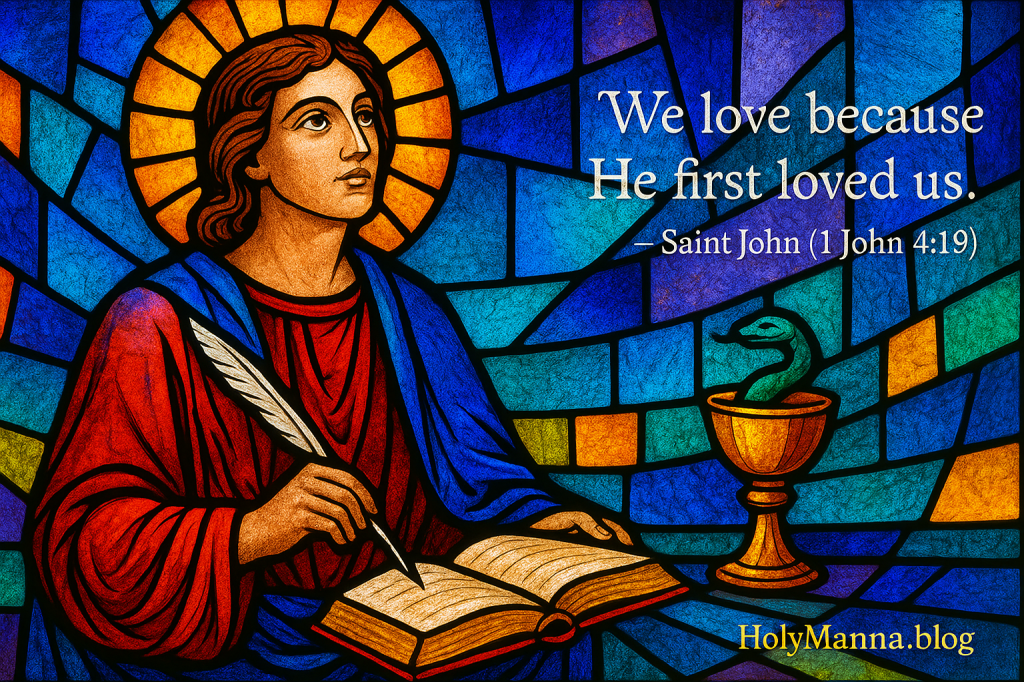
The Beloved Disciple
Saint John, Apostle and Evangelist, stands at the very center of the New Testament and of Christian memory. The Church honors him as the beloved disciple, the one who rested on the heart of Christ at the Last Supper, who stood faithfully at the foot of the Cross, and who cared for the Blessed Virgin Mary after Jesus entrusted her to him. His feast in the Roman Rite is celebrated on December 27, within the octave of Christmas, which is fitting because his writings help believers grasp the mystery of the Word made flesh in a uniquely deep way. Tradition recognizes John as the human author of The Gospel of John, The First Letter of John, The Second Letter of John, The Third Letter of John, and The Book of Revelation. These inspired writings form a powerful symphony around a few burning themes: the eternal divinity of Christ, the call to live in the light, the absolute centrality of love, and the victory of the Lamb. In Christian art, John’s symbol is the eagle because his Gospel soars to the heights of divine mystery from its very first line: “In the beginning was the Word, and the Word was with God, and the Word was God.” Saint John is cherished because he reveals the heart of Jesus in an intimate way. His Gospel is full of personal conversations, deep theological reflections, and powerful signs that illuminate Christ’s identity. His letters express a spiritual father’s tender love, constantly addressing believers as little children. His theology remains living and warm, centered on the proclamation that “God is love.”
From Galilee’s Shores to the Heart of the Church
Saint John was born in the region of Bethsaida in Galilee, the son of Zebedee and Salome. He worked alongside his brother James as a fisherman, likely in partnership with Saints Peter and Andrew. His humble origins matter because they show that the Lord chose ordinary men for extraordinary missions. Before following Jesus, John appears to have been a disciple of John the Baptist. In The Gospel of John, two of the Baptist’s disciples hear him proclaim “Behold, the Lamb of God” and immediately follow Jesus. Tradition identifies one of these two with John the Evangelist. From the moment he encountered Christ, John displayed the humility and spiritual hunger that would define his discipleship. When Jesus called John and James from their boat, they left their nets and their father without hesitation. Jesus nicknamed them “Sons of Thunder,” revealing their fiery temperaments. Over time, grace transformed John’s intensity into steadfast love. He became part of Jesus’ inner circle with Peter and James. He witnessed the Transfiguration, the raising of Jairus’s daughter, and the agony in Gethsemane. His closeness to these mysteries shaped him into a contemplative apostle who could later write with such profound insight. John is most known for his theological depth, especially in his proclamation of Jesus’ divinity. He begins his Gospel not with the manger but with eternity, revealing Christ as the eternal Word. His writings continually invite believers to remain rooted in love, as seen in his beautiful declaration: “We love because he first loved us.”
Walking With the Word Made Flesh
John’s life in the early Church reveals a man consumed by love for Jesus and shaped by profound intimacy with the mysteries of salvation. At the Last Supper, he reclined near Christ’s heart, receiving the Lord’s final teachings about the Eucharist, the new commandment of love, and the coming of the Advocate. His Gospel preserves Jesus’ words, “I give you a new commandment: love one another as I have loved you.” These words echo throughout everything John later wrote. At Calvary, John remained with Mary and the holy women while the other apostles fled. From the Cross, Jesus said to him “Behold, your mother” and entrusted the Blessed Virgin into his care. This moment has always been treasured in Catholic tradition as a sign that Mary becomes the spiritual mother of every disciple. John’s ministry continued with boldness in the Acts of the Apostles. He and Peter healed a crippled man in the Temple and preached fearlessly in the face of persecution. After the Resurrection, John became a guiding light for the early Christian communities, especially in Ephesus. Tradition recounts miracles associated with him, such as the time he was given a poisoned cup and, after blessing it, caused the poison to depart in the form of a serpent. The cup did not harm him, and many were moved to believe in Christ upon witnessing this sign. Although these miracles are part of the Church’s tradition rather than Scripture, they express the deep reverence the early Church had for Saint John and the powerful ways God worked through him.
Oil, Exile, and Unshakable Hope
Saint John endured profound trials for his faith. Tradition holds that during the reign of the Emperor Domitian, he was arrested and brought to Rome, where he was condemned to death by being plunged into a cauldron of boiling oil. Miraculously, he emerged unharmed. When his execution failed, he was exiled to the island of Patmos. Exile meant isolation, hardship, and the painful separation from the communities he loved, yet it was precisely on Patmos that God granted him the astonishing visions recorded in The Book of Revelation. There he saw the risen Christ, the heavenly liturgy, the Lamb who was slain yet lives, and the promise that God will one day make all things new. Revelation is not meant to inspire fear but to strengthen hope. It assures believers that, despite the turmoil of history, Christ remains sovereign. After Domitian’s death, John was allowed to return to Ephesus, where he lived to an advanced age. According to a beloved tradition preserved by Saint Jerome, John in his final years was so frail that he had to be carried into the assembly of believers. When invited to speak, he repeated only one message: “Little children, love one another.” When asked why he always said the same thing, he responded that if this commandment were lived perfectly, it would be enough. His final words summarize the entire Gospel: a life rooted in self giving love.
Manna From the Tomb
After Saint John’s death, devotion to him flourished throughout the Christian world. His tomb in Ephesus became a major place of pilgrimage, and early Christian writers describe a miraculous phenomenon associated with it. On one particular day each year, a fine dust appeared to rise from his tomb. This dust, known as manna, was collected by the faithful who believed it brought healing and spiritual protection. Writers such as Saint Augustine and Saint Gregory of Tours mention this miracle, which shows that the tradition was widely known and deeply cherished. Churches and basilicas dedicated to Saint John were built in Ephesus and later across Europe. His symbols, the eagle and the chalice with a serpent, remain familiar images in Christian art. Yet the most enduring miracle associated with Saint John is the spiritual power of his writings. Every time someone encounters Christ more deeply by reading his Gospel, every time a heart is moved by the words “God is love” or “The light shines in the darkness, and the darkness has not overcome it”, Saint John continues his mission. Through Scripture, he still leads believers into deeper intimacy with the Lord.
Living as Beloved Disciples
The life of Saint John offers a profound path for discipleship in a world that often feels restless and distracted. His example teaches that holiness begins with closeness to Jesus. He stayed near Christ from the first moment of his calling until the final moments of the Lord’s earthly life. Making space in daily life for prayer, silence, Scripture, and adoration becomes the modern way of resting on Christ’s heart as John once did. John also teaches that authentic love is concrete and sacrificial. He urges believers not to love merely in words but in deeds and in truth. This means forgiving when it is difficult, serving when it is inconvenient, and choosing charity over resentment. His exhortation “Little children, love one another” challenges today’s Christians to resist the anger and division that dominate so much of contemporary life. His perseverance through suffering shows that trials do not weaken the love of God. Instead, they deepen faith when united with Christ. John’s years of exile and the miraculous survival from attempted execution demonstrate that God continues to guide His servants even in darkness. His relationship with Mary also offers essential insight for modern disciples. Just as John welcomed Mary into his home, every Christian is invited to welcome her into their life. She leads hearts to Jesus and intercedes for strength, purity, and peace. Walking in the footsteps of Saint John means living as a beloved disciple, confident that Christ knows each heart personally. It means allowing His light to illuminate every part of life so that His love can be seen in our patience, courage, compassion, and joy.
Engage with Us!
Share your thoughts and reflections in the comments below.
- Where in your life is Jesus inviting you to deepen your understanding of divine love, as Saint John did?
- How does Saint John’s fidelity at the foot of the Cross inspire you to remain steadfast in your own challenges?
- What part of his Gospel or writings has spoken most powerfully to your heart, and why?
May each reader walk in the light, strengthened by the witness of Saint John the Apostle and Evangelist. May every action be rooted in the love and mercy that Jesus taught so that His light may shine through our lives each day.
Saint John, pray for us!
Follow us on YouTube, Instagram and Facebook for more insights and reflections on living a faith-filled life.

 Holy Manna!
Leave a comment