A Patron for the Wounded and the Weary
Saint Fabiola of Rome stands as one of the Church’s most radiant reminders that God’s mercy can transform even the most painful past into a life overflowing with love. Born into the noble Fabia family in the fourth century, she lived at the center of Roman wealth and privilege, yet she is remembered not for her status but for her astonishing humility and her works of compassion. She is honored today as a patron for those who have endured difficult marriages, for the divorced, for widows, and for those who serve the sick and dying. Her legacy shines brightest in the founding of Rome’s first public Christian hospital for the poor, a groundbreaking act of charity that forever changed the way Christians understood the call to heal and serve. Saint Jerome, who knew her personally, described her as “the praise of the Christians, the marvel of the gentiles, the sorrow of the poor, and the consolation of the monks.” His words reveal the profound impact her conversion and charity had on the early Church.
A Broken Marriage and a Radical Conversion
Fabiola was born into the prestigious Roman gens Fabia, a family known for its influence and high standing. She grew up in a world of wealth, culture, and social refinement. Like many aristocratic young women of her time, she entered marriage early, but her first marriage brought her deep suffering due to her husband’s violent and immoral behavior. According to Roman civil law, she was permitted to divorce him. Eventually, she entered a second union while her first husband was still alive. Although this second marriage was socially acceptable according to Roman custom, it was not in harmony with Christian teaching, and this inner conflict later weighed heavily on her conscience.
After the death of her second husband, Fabiola experienced a powerful conversion shaped by deep repentance and the desire for reconciliation with God. Her penance was striking in its humility. On the vigil of Easter, she stood publicly at the doors of the Lateran basilica, clothed in penitential garments, and confessed her past with sincerity and sorrow. The pope received her back into full communion, and the Christian community was moved by her honesty and the authenticity of her conversion. From that moment forward, she devoted herself entirely to a new way of life. She gave up luxuries and redirected her immense wealth toward works of mercy. Her transformation was so complete that her earlier mistakes became the rich soil from which a life of heroic charity blossomed.
The Hospital of Christ
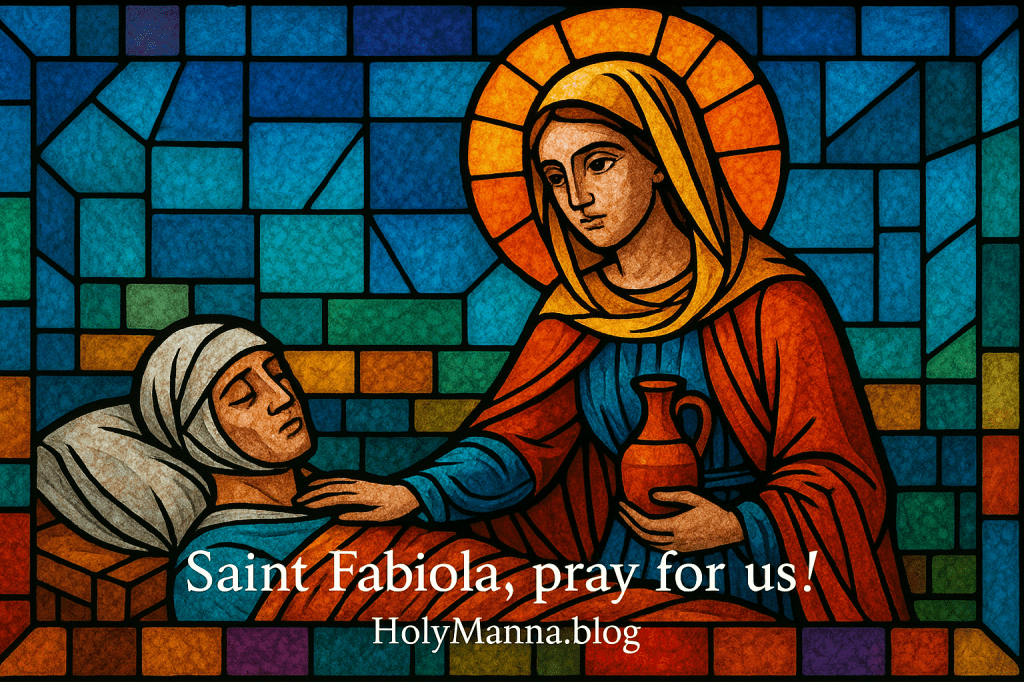
Once reconciled with the Church, Saint Fabiola dedicated herself wholly to caring for those whom the world neglected. She used her fortune to build what is recognized as the first public Christian hospital in Rome. This hospital welcomed all who suffered, especially the poor and the outcast. It provided not only shelter but also medical care, nourishment, and dignity. Fabiola did not limit herself to funding the facility. She served within its walls, tending to patients whose illnesses frightened others. She carried the weak, washed infected wounds, comforted the dying, and offered water to parched lips with her own hands.
Saint Jerome records the astonishing tenderness with which she served the sick. He describes her caring for patients afflicted with severe diseases that many could not bear to look upon. Her compassion transformed the hospital into a place where the love of Christ became visible in every act of service. Later in life, she traveled to Bethlehem, where she lived near Saint Paula and Saint Jerome. In Bethlehem she deepened her commitment to prayer, Scripture, and ascetical living. Jerome guided her as she studied Sacred Scripture, helping her cultivate a contemplative heart that fueled her active charity. Her time in the Holy Land strengthened her resolve to live a life that reflected the mercy she herself had received.
Trials that Purified a Penitent Heart
Although she did not suffer martyrdom, Saint Fabiola’s life was shaped by real hardship and spiritual struggle. Her early experiences of marital suffering and the moral complexity of her past left deep marks on her soul. Her public penance required immense courage. Very few people would ever have the humility to stand before an entire city and confess their faults openly, especially someone of her noble rank. Yet she trusted in the mercy of God more than she feared public shame, and that trust became the foundation of her sanctity.
Her later years were also marked by political unrest and ecclesiastical conflict. During her time in Bethlehem, tensions related to theological disputes and the threat of invasion created instability, eventually forcing her to return to Rome. Even amid these challenges, she remained steadfast in her penitential way of life. She collaborated with Pammachius, a Roman senator turned ascetic, and together they expanded charitable works throughout the city. The trials she faced did not harden her heart. They softened it, making room for greater compassion and a deeper desire to serve.
A Legacy of Healing
Saint Fabiola died on December 27, likely in the year 399 or 400. By the time of her death, the transformation of her life had become widely known. Crowds from every social class filled the streets of Rome for her funeral. The poor mourned the loss of their caregiver, clerics honored her as a model of repentance and charity, and Rome’s nobility paid tribute to the woman who had used her status not for self advancement but for the service of Christ. Saint Jerome later wrote a moving tribute to her in a letter to her relative Oceanus. In it, he praised her penitence, her radical generosity, and her total commitment to the works of mercy.
Although specific miracles after her death are not widely recorded, her spiritual legacy is unmistakable. The model of Christian charity she established laid the groundwork for centuries of Catholic involvement in health care. The Church’s commitment to hospitals, hospices, and the care of the poor owes much to the example she set. Her memory continued to be honored in Rome and throughout the Christian world. Over time, she came to be recognized officially as a saint. Her witness still inspires the faithful today, especially those who seek healing from past mistakes or who serve the sick and the dying.
A Saint Who Teaches Hope, Repentance, and Love
Saint Fabiola’s life offers timeless lessons for anyone seeking to live more faithfully. Her conversion reminds believers that no past is beyond redemption. Even places of deep regret can become places where God’s grace writes a new story. Her example encourages Christians to approach the Sacrament of Reconciliation with honesty and hope. Her hospitality to the sick challenges every follower of Christ to practice charity that costs something. True love, as she lived it, requires stepping into the discomfort of another’s suffering and offering compassion without hesitation.
She also teaches the importance of prayerful grounding. Her years of studying Sacred Scripture in Bethlehem show that works of mercy are most fruitful when they flow from a heart rooted in God’s Word. Her life encourages every Christian to cultivate both contemplation and action and to recognize that holiness is found not only in the prayer cell or in the church pew but also in the hospital room, the nursing home, and the streets where the poor seek comfort.
By looking to Saint Fabiola, readers can discover a renewed sense of purpose. Her story makes clear that God delights in using imperfect instruments to accomplish extraordinary works. Her witness invites everyone to embrace mercy, to seek healing, and to imitate Christ by pouring themselves out in love for others.
Engage with Us!
Share your thoughts and reflections in the comments below. This saint’s journey is a powerful reminder of what God can do with a willing heart.
- How does Saint Fabiola’s repentance inspire deeper trust in God’s mercy in your own life?
- Where is God calling you to serve the sick, the poor, or the forgotten in practical ways?
- What obstacles in your life might Jesus be inviting you to surrender so that He can transform them into grace?
May every reader be strengthened to live a life of faith and offer every action with the love and mercy Jesus taught us. Saint Fabiola’s radiant charity reminds all that each moment is an opportunity to love more deeply and to walk more closely with Christ.
Saint Fabiola, pray for us!
Follow us on YouTube, Instagram and Facebook for more insights and reflections on living a faith-filled life.

 Holy Manna!
Leave a comment