A Dawn of Courage
Saint Stephen stands at the very beginning of the Church’s story as the first Christian martyr, the protomartyr. His life blazes like a bright flame after Pentecost, when the Holy Spirit ignited the hearts of the first believers. The Acts of the Apostles describes him as “a man full of faith and of the Holy Spirit” and “full of grace and power”, someone through whom God worked “great wonders and signs among the people” (Acts of the Apostles 6). He is not a quiet background character. He is front and center in charity, in preaching, and in bold witness. The Church honors Saint Stephen with a special place in the liturgical year. His feast in the Roman Rite falls on December 26, right in the glow of Christmas. The newborn Christ is barely placed in the manger before the Church shows what following this Child really looks like when lived to the end. Stephen reminds believers that the Incarnation is not a cozy story but a call to heroic, sacrificial love. Tradition also remembers him as a patron of deacons, altar servers, bricklayers, and stonemasons, and he is invoked against headaches. His martyr’s crown is literally written into his name, since the Greek word Stephanos means “crown,” and he receives the crown of life from the Lord by offering his entire life for Him. Across East and West, Saint Stephen is honored as a model of mercy and courage. His life is not simply remembered for how he died, but for how he lived, serving the poor, defending the truth, loving his enemies, and fixing his eyes on Christ no matter the cost.
From Greek Name to Gospel Zeal
Scripture does not tell us where Stephen was born or who his parents were, and the Church does not fill in those gaps with legend. What is known is drawn from the Acts of the Apostles. His Greek name, Stephanos, and his role among the Greek speaking believers suggest that he belonged to the Jewish community that moved comfortably between Jewish tradition and Hellenistic culture. In the early Church, tensions arose because the Greek speaking widows were being overlooked in the daily distribution of food. To preserve unity and ensure fairness, the Apostles instructed the community to choose seven men to serve as deacons. These men were tasked with caring for the poor so that the Apostles could focus on prayer and the ministry of the word. Stephen is the first of the seven named and is singled out as “a man full of faith and of the Holy Spirit” (Acts of the Apostles 6:5), which signals the deep spiritual maturity that already marked his life.
As a deacon, Stephen embraced both service and evangelization. He cared for the vulnerable with compassion and preached the Gospel with clarity and conviction. He is most known for his powerful, Spirit filled defense of the faith in Acts of the Apostles 7, where he retells the entire history of Israel to show that Jesus is the fulfillment of God’s promises. In Stephen, the Church sees the pattern described in the Catechism of the Catholic Church, which teaches that martyrdom is the “supreme witness to the truth of the faith” (CCC 2473). His story demonstrates what it looks like when a heart is completely surrendered to Christ.
Deacon, Preacher, and Wonderworker
Once ordained, Stephen’s ministry flourished visibly. The Acts of the Apostles testifies that “Stephen, full of grace and power, did great wonders and signs among the people” (Acts of the Apostles 6:8). Although individual miracles are not described one by one, Scripture clearly indicates that God’s power flowed through him in ways that strengthened the faith of the community and drew others toward Christ. His ministry involved intense public dialogue, especially with Greek speaking Jews who challenged his message. Yet the sacred text says they could not withstand “the wisdom and the Spirit with which he spoke” (Acts of the Apostles 6:10), which reveals that Stephen’s preaching was not about rhetorical skill but about divine inspiration.
His long discourse in Acts of the Apostles 7 is one of the most profound teachings in the New Testament. Stephen traces salvation history from Abraham through Moses and the prophets, showing that God has always been leading His people forward and that Jesus is the Righteous One sent by God. His way of interpreting Scripture reflects what the Church teaches today: that the Old Testament finds its fullest meaning in Christ. As the CCC explains, Christians read the Old Testament in the light of Christ crucified and risen (CCC 129). Stephen lived this truth with conviction. Pope Benedict XVI once reflected that Stephen’s life beautifully unites charity with proclaiming the faith, showing that authentic Christian service always flows from a heart grounded in the Gospel. Stephen’s life encourages every believer to live the fullness of faith through both action and truth.
A Crown Won in Stones
Stephen’s bold proclamation of Christ provoked strong hostility. Members of certain synagogues stirred up accusations of blasphemy, claiming he spoke against Moses, the Temple, and the Law. These charges mirrored those brought against Jesus. As Stephen stood before the Sanhedrin, something remarkable happened. His face appeared like that of an angel (Acts of the Apostles 6:15), reflecting peace and God’s presence in the middle of danger. Filled with the Holy Spirit, Stephen delivered his sweeping speech in Acts of the Apostles 7, confronting the leaders with their resistance to God’s messengers throughout history.
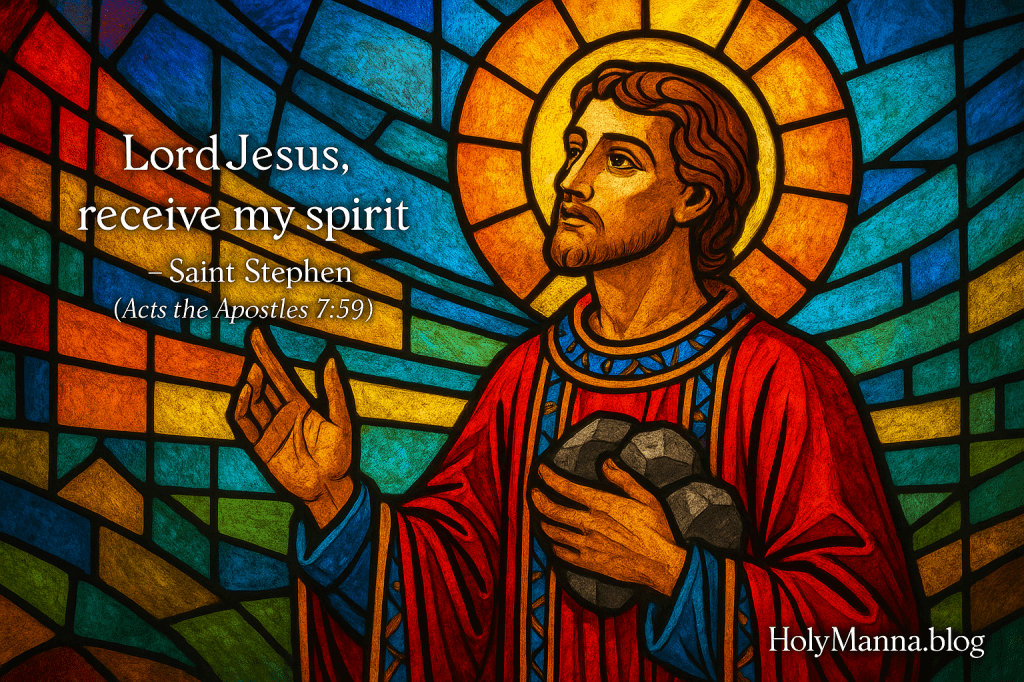
This tension reached its breaking point when Stephen was granted a heavenly vision. Scripture says “he, full of the Holy Spirit, gazed into heaven and saw the glory of God and Jesus standing at the right hand of God” (Acts of the Apostles 7:55). Then he proclaimed, “Behold, I see the heavens opened and the Son of Man standing at the right hand of God” (Acts of the Apostles 7:56). The crowd erupted in fury, dragged him out of the city, and stoned him. Even as stones shattered his body, Stephen imitated Christ with astonishing love. He prayed, “Lord Jesus, receive my spirit” (Acts of the Apostles 7:59), echoing Jesus’ words on the Cross. Then he cried out, “Lord, do not hold this sin against them” (Acts of the Apostles 7:60), offering forgiveness in the very moment of his death.
One of the witnesses present was a young man named Saul. Scripture notes that Saul consented to Stephen’s execution. Stephen’s prayer of forgiveness is often seen as planting a hidden seed that would later bloom in Saul’s dramatic conversion into Saint Paul. In this way, Stephen’s martyrdom becomes not an end but the beginning of the Church’s worldwide mission. The CCC affirms that martyrdom bears witness to the truth of the faith even unto death (CCC 2473), and Stephen becomes the model for every martyr who follows.
A Saint Who Would Not Stay Hidden
After Stephen’s death, the Acts of the Apostles simply tells us that devout men buried him with great sorrow (Acts of the Apostles 8:2). Over time, the exact location of his grave faded from memory, but in the early fifth century the Lord allowed it to be rediscovered. A priest named Lucian in the village of Caphargamala reported receiving dreams in which Gamaliel, the respected Pharisee mentioned in Acts of the Apostles, revealed where Stephen’s remains had been buried. Following the instructions given in these visions, Lucian and others uncovered a tomb believed to contain the relics of Stephen, as well as those of Gamaliel, Nicodemus, and Gamaliel’s son.
The translation of Stephen’s relics to Jerusalem and later to other parts of the Christian world sparked an extraordinary wave of healings and conversions. Saint Augustine, writing in City of God and in his sermons, testified to numerous miracles attributed to Saint Stephen’s intercession. Blind men recovered their sight, the paralyzed walked, illnesses vanished, and people oppressed by evil spirits found freedom. Augustine noted that there were more miracles connected to Stephen than he could possibly record. These events strengthened devotion to the protomartyr and deepened the Church’s understanding of the communion of saints. Stephen’s presence remained active, powerful, and fatherly, as Christians sought his intercession for courage, healing, and mercy. Churches and chapels dedicated to him multiplied, and the feast of the Finding of the Relics of Saint Stephen became a beloved celebration in many communities. His legacy lives on as a reminder of how God continues to work through His saints to bring healing, unity, and grace.
Living Stephen’s Fire Today
Saint Stephen’s life is not merely an inspiring story from long ago. It is a personal invitation for every believer to live with courageous love. His heart was formed by prayer, strengthened by Scripture, and poured out in service. He challenges us to let our faith be visible in the decisions we make, the conversations we have, and the compassion we extend. In a culture that often treats religion as a private preference, Stephen reminds us that the Gospel is a truth that shapes every part of life. His confidence came not from personality but from the Holy Spirit dwelling in him.
Stephen also models forgiveness in a way that stuns the modern heart. Forgiving small matters is challenging enough. Stephen forgave while stones were ending his life. His prayer, “Lord, do not hold this sin against them”, becomes a roadmap for anyone carrying hurt, resentment, or betrayal. The CCC teaches that intercession includes praying for those who harm us and those who persecute the Church (CCC 2635). Stephen shows that this is not only possible but transformative.
In practical terms, Stephen’s witness can shape daily life today. Spending time with Acts of the Apostles 6 and 7 in quiet prayer allows hearts to absorb the same courage and clarity he carried. Serving in parish ministries, especially those connected to charity, honors Stephen’s diaconal heart. Choosing forgiveness, even before emotions fully agree, opens the soul to grace. And speaking about faith with calm confidence in moments when silence feels easier imitates Stephen’s boldness. Holiness does not begin with dramatic gestures. It begins with small acts of fidelity that accumulate into a life fully surrendered to Christ. Stephen shows that any believer who allows the Holy Spirit to guide their steps can become a powerful witness of the Gospel.
Engage with Us!
Share your thoughts and reflections in the comments below.
- Where in your life do you feel called to witness more boldly to the truth of the Gospel?
- How does Stephen’s prayer of forgiveness challenge and inspire your understanding of mercy?
- What practical steps can you take this week to serve others with the same charity that defined Stephen’s ministry?
May every reader be strengthened by Saint Stephen’s courageous example and encouraged to live with a faith that burns brightly and a heart shaped by the love and mercy Jesus taught us.
Saint Stephen, pray for us!
Follow us on YouTube, Instagram and Facebook for more insights and reflections on living a faith-filled life.

 Holy Manna!
Leave a comment