A Quiet Giant in a Time of Upheaval
Pope Saint Dionysius may not be the most widely known of the early popes, but his quiet strength carried the Church through one of its most fragile and wounded eras. Elected Bishop of Rome around July 22, 259, he stepped into leadership immediately after the horrific persecution under Emperor Valerian, a persecution that left the Christian community traumatized, scattered, and grieving the martyrdom of beloved leaders such as Pope Sixtus II. When Dionysius assumed the papacy, he found himself guiding a flock still reeling from violence and deep loss.
Providentially, the new emperor Gallienus issued a rare edict of toleration that granted the Church freedom and restored its property. Dionysius seized that moment of peace not for comfort but for rebuilding. He reorganized the clergy, restored the structures of the Church in Rome, and provided pastoral care for communities still suffering from the wounds of persecution. His letters and actions reveal a leader rooted in wisdom, charity, and theological precision.
He is especially remembered for clarifying early Trinitarian teaching when confusion and controversy had taken hold in Alexandria. His clear articulation of the unity of the Father, Son, and Holy Spirit prepared the way for the later dogmatic definitions of the Council of Nicaea. In the preserved fragments of his teaching, Pope Saint Dionysius insists that Christians must remain faithful to the apostolic proclamation of the Triune God, saying that believers “must believe in God the Father Almighty, and in Christ Jesus His Son, and in the Holy Spirit.” His papacy became a turning point in stabilizing doctrine and strengthening unity, which is why the Church remembers him as a shepherd of peace and orthodoxy in an age marked by turmoil.
Formation in the Heart of Rome
The early years of Pope Saint Dionysius remain mostly hidden from history, which is often the case for many early Christians whose lives were lived under threat of persecution. Some traditions suggest he may have been of Greek background, possibly from the regions influenced by Magna Graecia in southern Italy, though nothing definitive is recorded. What is clear is that he lived and served within the Christian community of Rome during a period when following Christ carried significant risk.
Before becoming pope, Dionysius was already a respected presbyter during the pontificate of Pope Stephen I. His reputation for prudence and learning became evident when he corresponded with Saint Dionysius of Alexandria regarding the controversial question of whether baptisms performed by heretics were valid. Being consulted directly by major Eastern bishops shows the trust and esteem he enjoyed even before taking the Chair of Peter.
The persecutions under Decius and Valerian shaped the environment in which he matured spiritually. Many believers were exiled, imprisoned, or martyred, and Christian leadership was often under threat. This environment forged in Dionysius a deep commitment to the unity and healing of the Church. When the faithful finally had the opportunity to elect a new pope after the martyrdom of Sixtus II, they chose Dionysius because he had already demonstrated balanced judgment, doctrinal soundness, and a gentle but firm pastoral spirit. His early life may not be richly documented, but the fruit of his formation is unmistakable in the years that followed.
A Pastor Who Rebuilt
Once elected, Dionysius inherited a Church in desperate need of restoration. The persecution had left many communities without priests, deacons, or safe places to gather. Buildings were damaged or confiscated. Believers were spiritually shaken. Instead of being overwhelmed by the magnitude of the task, Dionysius became a true builder. He reorganized the Roman clergy, restored ecclesial order, and ensured that the Church’s sacred properties were reclaimed and repaired. His leadership reflects the pastoral truth found later in The Catechism that the pope serves as the visible source and foundation of unity for the whole Church.
His pastoral care extended far beyond Rome. When the Christians of Cappadocia were devastated by Gothic invasions, churches were destroyed and many believers were taken as captives. Dionysius responded not with mere words but with sacrificial charity. He sent help, including funds for ransoming captives and rebuilding churches. These actions were not simply administrative duties but expressions of a heart profoundly shaped by Christ’s compassion.
Although he is not associated with dramatic physical miracles, Dionysius performed the quiet miracles of healing a wounded community, restoring order after chaos, and uniting Christians who had been divided by fear and confusion. His actions demonstrate the power of Christ working through a shepherd who remained faithful in the ordinary yet essential tasks of service, governance, and love.
Defender of the Trinity
One of the greatest challenges of Dionysius’ pontificate emerged from theological confusion in Alexandria. In combating the errors of Sabellius, who blurred the distinction between the divine Persons, the Alexandrian bishop Dionysius used language that risked reducing the Son to a mere creature. Concerned Christians appealed to Rome. The issue was serious, because misunderstandings about the Trinity can distort the entire Christian faith.
Pope Saint Dionysius convened a Roman synod and wrote an important doctrinal letter insisting on the unity of the divine nature while upholding the real distinction of the Persons. In his preserved words, he condemns both the error of collapsing the Father and the Son into one Person and the opposite tendency of treating the Father, Son, and Spirit as three separate gods. He insisted that Scripture presents one divine Monarchy and one Triad, a mystery that must be professed with reverence and precision. His teaching anticipates what The Catechism of the Catholic Church later describes as the “central mystery of Christian faith and life” found in the doctrine of the Trinity.
Although he did not die as a martyr, Dionysius lived a form of white martyrdom. He carried the weight of controversy, the ongoing wounds of persecution, and the responsibility of rebuilding the Church during a fragile era. His leadership required sacrifice, humility, and courage. He died on December 26, 268, and was laid to rest in the papal crypt within the catacombs, joining the company of many popes who had given their lives for Christ. His death marked the close of a papacy defined by peace, clarity, and deep pastoral love.
Quiet Legacy
The surviving records do not describe specific miracles attributed to Pope Saint Dionysius after his death, yet his legacy remains deeply meaningful within the life of the Church. The faithful honored him almost immediately after his passing. His feast on December 26 became an opportunity to reflect on a pope who guided the Church from chaos into stability. His burial among the martyrs in the Catacomb of Callixtus symbolizes how Christians viewed him: a shepherd who gave his life through service rather than bloodshed.
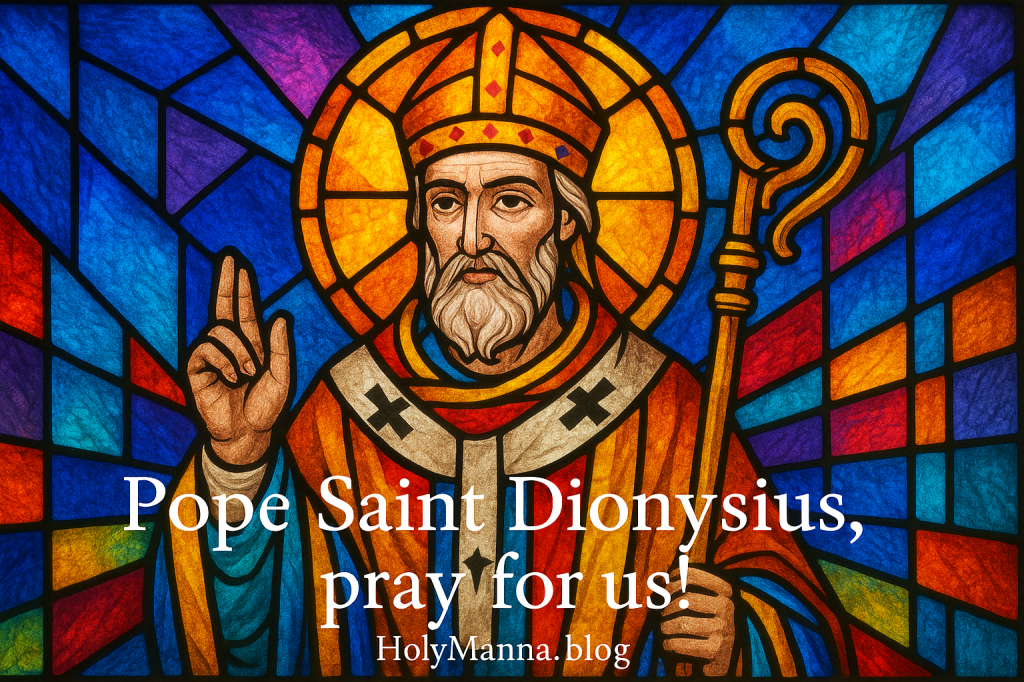
In art, he is often depicted wearing papal vestments and holding a book or crozier, symbols of his role as teacher and shepherd. Some traditions, especially in parts of southern Italy such as Terranova da Sibari, honor him as a patron, illustrating the widespread affection held for him across centuries.
Even without dramatic posthumous miracles, his memory continues to inspire. His theological clarity helped prepare the way for future councils. His pastoral charity shaped how the Church responds to communities in distress. His commitment to unity remains a model for every generation. In a spiritual sense, these fruits endure as miracles of grace that continue to strengthen the faith of the Church.
Living the Faith Like Dionysius
The life of Pope Saint Dionysius offers a grounded and relatable model of holiness for today. His sanctity was expressed not in dramatic martyrdom or spectacular wonders but in the steady, faithful, day by day work of rebuilding the Church and defending her doctrine. His example reminds Christians that God often works quietly through perseverance, charity, and fidelity to the truth.
He teaches the importance of sound doctrine. Dionysius knew that confusion about the Trinity would eventually shape how Christians live and pray. By articulating the apostolic faith clearly, he lived the truth found in The Catechism that right belief and right living go hand in hand. His life encourages believers to understand the faith deeply so they can share it confidently and lovingly.
He also models pastoral charity. His support for the suffering Church in Cappadocia and his attentiveness to the wounds left by persecution reveal a heart attuned to the needs of others. His legacy calls all Christians to show compassion not only in words but in concrete actions.
Finally, he teaches resilience. Many people today live with wounds from past experiences, personal struggles, or scandals within the Church. Dionysius shows that healing is possible when believers commit themselves to rebuilding with patience, humility, and trust in Christ. He invites Christians to examine where God may be calling them to restore unity, offer forgiveness, or strengthen their community.
How might Christ be calling you to rebuild something broken in your life or in your parish today?
What part of the faith do you feel drawn to understand more deeply so that you can defend truth with clarity and charity?
Where might the Lord be inviting you to bring peace into situations marked by division or fear?
Engage with Us!
Share your thoughts and reflections in the comments below. Then consider these questions prayerfully as you continue your journey of faith.
- What part of Pope Saint Dionysius’ life speaks most strongly to your current season of faith?
- Where do you see a need for rebuilding in the Church, your family, or your own heart, and how might God be inviting you to respond?
- How can you grow in both love for sound Catholic doctrine and practical charity toward those who are suffering or confused?
May the example and prayers of Pope Saint Dionysius inspire you to live a life grounded in faith, strengthened by love, and guided by the mercy of Jesus Christ.
Pope Saint Dionysius, pray for us!
Follow us on YouTube, Instagram and Facebook for more insights and reflections on living a faith-filled life.

 Holy Manna!
Leave a comment