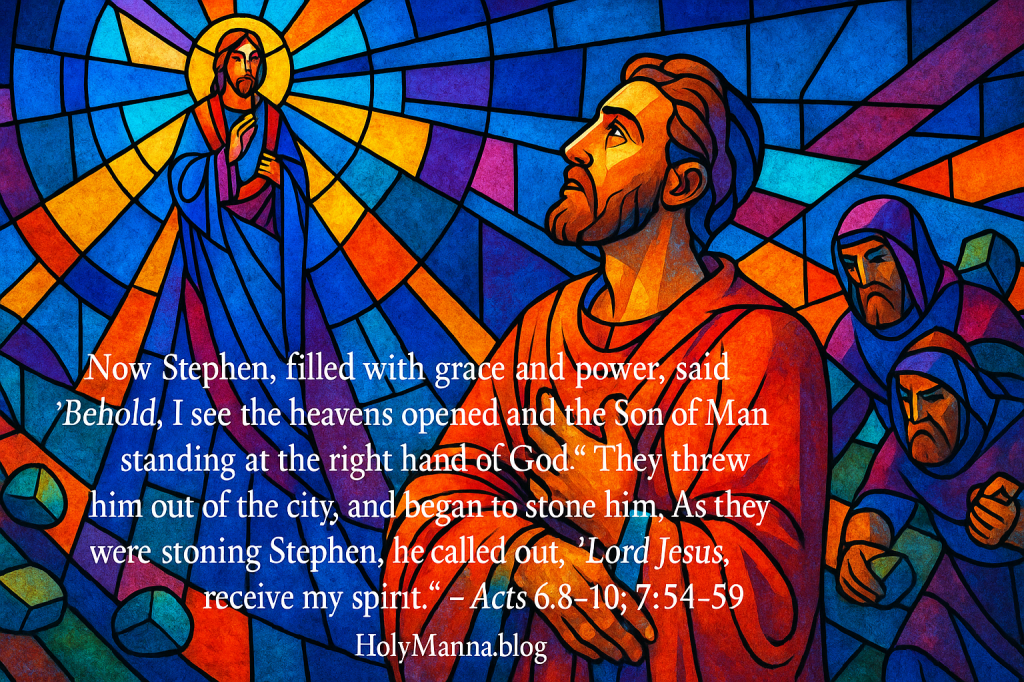
Feast of Saint Stephen, First Martyr – Lectionary: 696
When Following Christ Costs Everything
Some days in the liturgical year feel gentle and quiet, like a soft sunrise. The Feast of Saint Stephen is not one of those days. This feast drops the believer right into the heart of the battle between the kingdom of God and the hardness of the human heart, and it shows what happens when the Holy Spirit fills a disciple with a love for Jesus that is stronger than the fear of suffering or death.
The readings for the Feast of Saint Stephen, the first martyr, revolve around a single burning theme: the Spirit-filled disciple who endures hatred and violence, entrusting everything to God, even life itself. In Acts 6:8-10; 7:54-59, Saint Stephen stands before hostile accusers, “filled with grace and power,” speaking with a wisdom that his opponents cannot defeat. As stones begin to fly, he looks to heaven and sees “the glory of God and Jesus standing at the right hand of God,” and he dies with the prayer “Lord Jesus, receive my spirit.” His story is not just a tragic ending; it is the Church’s first great witness that union with the Risen Lord is worth any cost.
Psalm 31 gives words to the interior posture that carries a martyr through the storm. The psalmist cries out, “Into your hands I commend my spirit; you will redeem me, Lord, God of truth.” This is the same prayer Jesus makes on the Cross in Luke 23:46, and Saint Stephen echoes it as he gives up his life. The psalm reveals the heart of someone who knows that destiny, safety, and identity are not in the hands of persecutors but in the hands of a faithful God.
In Matthew 10:17-22, Jesus warns His disciples that real discipleship will collide with real opposition. Believers will be dragged before courts, betrayed even by family, and hated because of His name. Yet in the same breath, Jesus promises that “it will not be you who speak but the Spirit of your Father speaking through you,” and He seals it with this hope-filled line: “Whoever endures to the end will be saved.” This Gospel is not abstract teaching today; it is the lens through which Saint Stephen’s martyrdom is understood.
Historically, Saint Stephen’s witness belongs to the very earliest days of the Church, when followers of Christ were still seen as a dangerous sect within Judaism. The mention of the Synagogue of Freedmen and the young man named Saul in Acts anchors this scene in a real community wrestling with the explosive claim that Jesus of Nazareth is the Messiah and the Son of God. Religiously, the Church recognizes in Stephen the first of countless martyrs who will imitate Christ by forgiving enemies and handing their spirit into the Father’s care. As CCC 2473 teaches, martyrdom is the supreme witness given to the truth of the faith.
All of this comes together in a single invitation for today: persecution, rejection, and misunderstanding are not signs that God has abandoned a disciple; they are often the very places where the Holy Spirit speaks most powerfully and where trust in the Father is purified. Where might God be inviting you today to trust Him more deeply, to speak with courage, and to place your spirit, your reputation, and your future into His hands?
First Reading – Acts 6:8-10; 7:54-59
A Spirit Filled Witness Who Refuses To Back Down
In Acts 6:8-10; 7:54-59, the Church remembers Saint Stephen at the very beginning of Christian history, when believers were still within the Jewish religious world and the proclamation of Jesus as Messiah was explosive. Stephen is one of the first deacons, chosen in Acts 6 to serve the community, yet his ministry quickly becomes more than practical service. Filled with the Holy Spirit, he preaches Christ with such clarity that opposition hardens into rage. This passage shows what happens when the Spirit strengthens a disciple to speak truth in love and to entrust everything to Jesus, even life itself. It fits today’s theme perfectly: real discipleship sometimes leads into real persecution, and in that moment the Spirit provides both the courage to witness and the grace to surrender.
Acts 6:8-10; 7:54-59 – New American Bible (Revised Edition)
Accusation Against Stephen. 8 Now Stephen, filled with grace and power, was working great wonders and signs among the people. 9 Certain members of the so-called Synagogue of Freedmen, Cyrenians, and Alexandrians, and people from Cilicia and Asia, came forward and debated with Stephen, 10 but they could not withstand the wisdom and the spirit with which he spoke.
Stephen’s Martyrdom. 54 When they heard this, they were infuriated, and they ground their teeth at him. 55 But he, filled with the holy Spirit, looked up intently to heaven and saw the glory of God and Jesus standing at the right hand of God, 56 and he said, “Behold, I see the heavens opened and the Son of Man standing at the right hand of God.” 57 But they cried out in a loud voice, covered their ears, and rushed upon him together. 58 They threw him out of the city, and began to stone him. The witnesses laid down their cloaks at the feet of a young man named Saul. 59 As they were stoning Stephen, he called out, “Lord Jesus, receive my spirit.”
Detailed Exegesis
Verse 8 – “Now Stephen, filled with grace and power, was working great wonders and signs among the people.”
Stephen is not acting on his own strength. The phrase “filled with grace and power” points to the Holy Spirit at work in him. His miracles confirm the Gospel and echo the ministry of the apostles and of Jesus Himself in Acts and the Gospels, showing that the risen Lord continues His work through the Church.
Verse 9 – “Certain members of the so-called Synagogue of Freedmen, Cyrenians, and Alexandrians, and people from Cilicia and Asia, came forward and debated with Stephen,”
This synagogue likely included Jews who had once been slaves and were now free, as well as Jews from different regions of the Roman world. The mention of multiple groups highlights cultural diversity and also hints at tension. Stephen’s preaching confronts deeply held beliefs and identities, so opposition arises from within a religious setting rather than from obvious enemies.
Verse 10 – “But they could not withstand the wisdom and the spirit with which he spoke.”
Here the promise of Matthew 10:20 comes alive. The opponents cannot refute Stephen because his words are not merely human argument. The text links his speech to “wisdom and the spirit”, pointing to the Holy Spirit giving him insight and courage. This models how Christian witness is meant to rely on divine wisdom rather than clever rhetoric.
Verse 54 – “When they heard this, they were infuriated, and they ground their teeth at him.”
Stephen has just delivered a long speech in Acts 7, tracing Israel’s history and accusing his hearers of resisting the Holy Spirit. The violent reaction shows hearts closed to conversion. The grinding of teeth recalls biblical images of rage and stubbornness, a tragic contrast to Stephen’s serenity.
Verse 55 – “But he, filled with the holy Spirit, looked up intently to heaven and saw the glory of God and Jesus standing at the right hand of God,”
Again Stephen is “filled with the holy Spirit”. In the very moment of danger, the Spirit lifts his gaze from the mob to the throne of God. Seeing Jesus standing at the right hand of the Father confirms the confession of the early Church in Psalm 110 and in the Creed. Christ is alive, reigning, and actively attentive to His suffering servant.
Verse 56 – “and he said, ‘Behold, I see the heavens opened and the Son of Man standing at the right hand of God.’”
Stephen uses the title “Son of Man”, echoing Jesus’ own words in Matthew 26:64 and Daniel 7. He publicly witnesses that the crucified Jesus is the exalted Son of Man who shares God’s authority. This vision strengthens Stephen and at the same time intensifies the rage of his accusers, since they hear it as blasphemy.
Verse 57 – “But they cried out in a loud voice, covered their ears, and rushed upon him together.”
This detail is heartbreaking. They literally cover their ears to block out the testimony. The loud cry and rush show a mob driven by passion rather than reason. The scene reveals how sin rejects both the Word of God and the witness of the Spirit.
Verse 58 – “They threw him out of the city, and began to stone him. The witnesses laid down their cloaks at the feet of a young man named Saul.”
Being cast outside the city recalls how Jesus suffered outside the gate as described in Hebrews 13. Stoning is the punishment for blasphemy in the Law. The cloaks at Saul’s feet introduce the future apostle Paul, who at this point consents to the killing. This small detail quietly shows how God will later transform a persecutor into an apostle through the very prayers of this martyr.
Verse 59 – “As they were stoning Stephen, he called out, ‘Lord Jesus, receive my spirit.’”
These are deeply significant words. Stephen speaks directly to Jesus in a way that echoes Psalm 31:6 and the words of Christ on the Cross in Luke 23:46: “Father, into your hands I commend my spirit.” By saying “Lord Jesus, receive my spirit”, Stephen bears witness to the divinity of Christ and entrusts his entire being to Him. His death is an act of faith, hope, and love, not despair.
Teachings
This passage is one of the clearest biblical foundations for the Church’s understanding of martyrdom. The Catechism teaches in CCC 2473: “Martyrdom is the supreme witness given to the truth of the faith: it means bearing witness even unto death.” Stephen embodies this completely. He proclaims Christ, suffers unjustly, and hands over his life in trust.
Martyrdom is not just about heroic courage; it is about union with Christ. CCC 2474 explains: “The martyr bears witness to Christ who died and rose, to whom he is united by charity.” Stephen’s vision of Jesus and his prayer “Lord Jesus, receive my spirit” show exactly that union. His death is configured to the Passion of Christ, right down to the echo of the words from Psalm 31.
There is also a strong teaching here about reliance on the Holy Spirit in persecution. CCC 692 reminds the faithful that “The Holy Spirit is the Paraclete or ‘He who is called to one’s side,’ ‘advocate.’” Stephen’s wisdom, courage, and peace flow from this divine Advocate at his side. This is the concrete fulfillment of Jesus’ promise in Matthew 10:19-20 that disciples should not worry about what to say when handed over, since the Spirit of the Father will speak through them.
The mention of Saul highlights another important truth from CCC 852: “The Holy Spirit is the principal agent of the whole of the Church’s mission.” The same Spirit who strengthens Stephen to die will later move Saul to convert, be baptized, and become Saint Paul. The blood of Stephen’s martyrdom becomes a seed of the Church’s mission, echoing the often attributed saying of Tertullian that the blood of the martyrs is the seed of Christians.
Saint Augustine reflects beautifully on this connection between Stephen and Paul, commenting that Stephen’s prayer at his death helped win Paul’s conversion. A well known line attributed to Augustine captures it simply: “If Stephen had not prayed, the Church would not have had Paul.” The reading therefore reveals how the suffering and prayer of one faithful disciple can bear immense fruit for the whole Church.
Reflection
This reading speaks into every situation where speaking or living the truth of the faith feels costly. Stephen shows that the measure of Christian success is not human approval but fidelity to Christ and openness to the Holy Spirit. The world may misunderstand, mock, or even punish those who remain faithful. Yet the destiny of a disciple is not in the hands of persecutors but in the hands of the Lord who receives the spirit of His servants.
In daily life, this might not look like literal stoning. It can be the quiet pressure at work to hide moral convictions, the awkward silence in a family conversation when faith comes up, or the internal fear of being labeled rigid, naive, or extreme. In those moments, Stephen’s example encourages believers to ask for the same grace: to look up to Christ rather than down at the reactions of others, and to let the Spirit guide their words and actions.
Practical steps could include short prayers during the day such as “Lord Jesus, receive my spirit” said before a difficult conversation, or a deliberate decision to learn the faith more deeply so that confidence in Christ grows stronger than fear. Interior surrender to Jesus in prayer prepares the heart to witness to Him in public.
Where might God be inviting you to trust Him with your reputation, your relationships, or your future, even if others react badly to your faith? How could the Holy Spirit be asking you to speak with courage, not harshness, in a specific situation this week? What would it look like for you to quietly echo Stephen’s prayer today and place your whole life in the hands of the Lord who sees you, loves you, and waits to receive your spirit?
Responsorial Psalm – Psalm 31:3-4, 6, 8, 16-17
Trusting God In The Middle Of The Storm
Psalm 31 is a classic Old Testament prayer of trust prayed in the middle of real danger. It has been used for centuries by Israel in times of persecution and distress, and it becomes deeply Christian when Jesus takes its words on His lips on the Cross in Luke 23:46, and Saint Stephen echoes the same trust in Acts 7:59. On the Feast of Saint Stephen, this psalm gives language to the believer who is misunderstood, attacked, or afraid, yet chooses to place everything in God’s hands. It perfectly fits today’s theme of Spirit filled witness in persecution: the disciple does not cling to control, but abandons destiny, reputation, and even life to the Lord who saves.
Psalm 31:3-4, 6, 8, 16-17 – New American Bible (Revised Edition)
3 incline your ear to me;
make haste to rescue me!
Be my rock of refuge,
a stronghold to save me.
4 For you are my rock and my fortress;
for your name’s sake lead me and guide me.6 Into your hands I commend my spirit;
you will redeem me, Lord, God of truth.8 I will rejoice and be glad in your mercy,
once you have seen my misery,
[and] gotten to know the distress of my soul.16 My destiny is in your hands;
rescue me from my enemies,
from the hands of my pursuers.
17 Let your face shine on your servant;
save me in your mercy.
Detailed Exegesis
Verse 3 – “incline your ear to me; make haste to rescue me! Be my rock of refuge, a stronghold to save me.”
The psalmist cries out with urgency, asking God to listen and act quickly. Calling the Lord a “rock” and “stronghold” shows that God is seen as a secure, unshakable place of protection, stronger than any human fortress. For someone like Stephen, this is the inner posture: help is not expected from the crowd or the court but from God alone.
Verse 4 – “For you are my rock and my fortress; for your name’s sake lead me and guide me.”
Here the psalmist shifts from request to affirmation. God already is the rock and fortress. Asking to be led and guided “for your name’s sake” means the believer wants God’s own glory and faithfulness to be shown through their life. Even in persecution, the deepest desire is that God’s name be honored.
Verse 6 – “Into your hands I commend my spirit; you will redeem me, Lord, God of truth.”
This is the heart of the psalm and the line that Jesus and Stephen both make their own. To commend the spirit into God’s hands is to entrust one’s entire life, future, and identity to Him. Calling God “God of truth” affirms that He is faithful, reliable, and just, even when human judges are not.
Verse 8 – “I will rejoice and be glad in your mercy, once you have seen my misery, and gotten to know the distress of my soul.”
The psalmist looks forward with confidence. God does not ignore misery or remain distant from inner anguish. He “sees” and “knows” the distress of the soul. The promise of rejoicing is not naive optimism. It is a conviction that God’s mercy will have the final word over suffering.
Verse 16 – “My destiny is in your hands; rescue me from my enemies, from the hands of my pursuers.”
Here the psalmist recognizes that the future is not controlled by enemies, bosses, governments, or even personal plans. Destiny belongs to God. Asking for rescue from “pursuers” acknowledges real threats, but it also declares that these threats do not get to write the last chapter.
Verse 17 – “Let your face shine on your servant; save me in your mercy.”
This verse echoes the priestly blessing in Numbers 6, where the Lord’s face shining on someone is a sign of favor and peace. To ask for God’s face is to ask for His presence and blessing. Salvation here is rooted in mercy, not in the psalmist’s strength or perfection.
Teachings
This psalm reveals the core of biblical trust: placing one’s life and spirit into the hands of the Father. The Catechism describes Christian prayer as a response of faith and trust to God’s initiative. It reminds believers that in Jesus, the Psalms become the prayers of Christ Himself, and in Him the Church learns how to pray in every situation. When Jesus says “Father, into your hands I commend my spirit” in Luke 23:46, He is praying Psalm 31 and teaching disciples to face suffering and death in the same trust.
The Church also teaches that divine providence embraces all things, including trials and persecutions. God is not the author of evil, but He truly is Lord of history and of each person’s destiny. This psalm supports that teaching by repeating that destiny and rescue are in God’s hands, not in the hands of enemies. Saints through the centuries have loved this psalm as a way to surrender control. Many have used “Into your hands I commend my spirit” as a final prayer at the hour of death, uniting themselves to Christ and to martyrs like Stephen.
Reflection
This psalm speaks very directly into modern anxiety. There are many enemies today that do not throw stones but still feel like pursuers: fear about the future, pressure at work, tensions in family, hostility toward the faith, or the weight of personal sin and shame. The psalm invites believers to stop trying to manage everything alone and to say with the heart: “My destiny is in your hands.”
In practice, this might look like taking a moment before a difficult conversation, a stressful meeting, or a painful situation and quietly repeating “Into your hands I commend my spirit” or “Let your face shine on your servant.” It can also mean choosing to act with integrity and charity even when that choice might cost popularity or comfort, because confidence rests in God’s mercy rather than in human approval.
Where is there a situation right now that feels out of control, that needs to be placed consciously into God’s hands? What would it look like to trust that your destiny really is in His hands and not in the hands of those who oppose you or misunderstand you? How could this psalm become a short daily prayer that slowly shapes your instinct from fear toward surrender and peace in the Lord?
Holy Gospel – Matthew 10:17-22
The Cost of Witness and the Promise of The Spirit
In Matthew 10:17-22, Jesus speaks very honestly to His apostles about what faithful discipleship will cost. He sends them into a real world of synagogues, courts, governors, and even family divisions, not a protected spiritual bubble. This teaching sits inside the missionary discourse in The Gospel of Matthew, where Jesus prepares His followers for their mission and makes clear that sharing His life also means sharing His rejection. On the Feast of Saint Stephen, this Gospel reads almost like a script for what Stephen lives in Acts 6–7: being dragged before authorities, hated for the name of Jesus, yet strengthened by the Spirit and saved through perseverance. Here Jesus does not promise an easy life, but He does promise that in the very moment of trial the Father’s Spirit will speak through His disciples and that those who endure to the end will be saved.
Matthew 10:17-22 – New American Bible (Revised Edition)
17 But beware of people, for they will hand you over to courts and scourge you in their synagogues, 18 and you will be led before governors and kings for my sake as a witness before them and the pagans. 19 When they hand you over, do not worry about how you are to speak or what you are to say. You will be given at that moment what you are to say. 20 For it will not be you who speak but the Spirit of your Father speaking through you. 21 Brother will hand over brother to death, and the father his child; children will rise up against parents and have them put to death. 22 You will be hated by all because of my name, but whoever endures to the end will be saved.
Detailed Exegesis
Verse 17 – “But beware of people, for they will hand you over to courts and scourge you in their synagogues,”
Jesus begins with a sober warning. The danger comes not just from obvious enemies, but from “people,” including religious leaders. “Courts” and “synagogues” show that persecution can arise in places that should be dedicated to justice and worship. For the early Christians, and for Saint Stephen in particular, this became literally true. Followers of Christ should not be naive about opposition, yet they are called to be wise and faithful, not fearful.
Verse 18 – “and you will be led before governors and kings for my sake as a witness before them and the pagans.”
Here Jesus widens the horizon from local religious settings to civil power. Being led before governors and kings “for my sake” turns persecution into a stage for evangelization. The disciple stands there “as a witness,” which in Greek is the root of the word “martyr.” The suffering believer becomes a living testimony to Christ in front of both Jews and Gentiles, showing that the Gospel is meant for all nations.
Verse 19 – “When they hand you over, do not worry about how you are to speak or what you are to say. You will be given at that moment what you are to say.”
Jesus moves from warning to reassurance. He does not say “if” they hand you over, but “when,” yet He forbids anxiety about self defense or eloquence. The promise that “you will be given” what to say shifts the focus from human preparation to divine provision. This does not discourage learning the faith, but it frees the heart from the burden of controlling every outcome.
Verse 20 – “For it will not be you who speak but the Spirit of your Father speaking through you.”
This is the heart of the passage. In the most intense moments of witness, the disciple is not abandoned or left to improvise alone. The Holy Spirit, called here “the Spirit of your Father,” takes up the tongue and uses it for God’s purposes. This is exactly what happens with Stephen in Acts 6:10, where opponents cannot withstand the wisdom and the Spirit with which he speaks. Christian courage in persecution is not just human bravery; it is the fruit of the indwelling Spirit.
Verse 21 – “Brother will hand over brother to death, and the father his child; children will rise up against parents and have them put to death.”
Jesus does not romanticize the effects of the Gospel. The call to follow Him can cut across the deepest natural bonds, even within families. The image of family members betraying one another shows how serious the choice for or against Christ can become. Loyalty to Jesus may require painful division when loved ones reject the faith. At the same time, this verse reminds believers to pray and suffer with love for their families, without compromising the truth.
Verse 22 – “You will be hated by all because of my name, but whoever endures to the end will be saved.”
The Lord summarizes the cost and the promise. Hatred “because of my name” means that the very identity of belonging to Jesus can provoke rejection. Yet hatred is not the final word. The decisive line is “whoever endures to the end will be saved.” Salvation is attached to perseverance, not to popularity or visible success. This verse frames the entire life of the martyr and every hidden act of fidelity in daily life.
Teachings
This Gospel shows clearly that persecution is not an accident in Christian life but part of following a crucified Lord. The Catechism teaches that the Church is born and grows through witness and suffering. In CCC 852 it states: “The Holy Spirit is the protagonist, ‘the principal agent of the whole of the Church’s mission.’” This matches Jesus’ promise that the Spirit of the Father will speak through the disciples when they are handed over.
Jesus’ words also highlight the role of the Holy Spirit in prayer and proclamation. CCC 741 explains: “The Holy Spirit, whom Christ the head pours out on his members, builds, animates, and sanctifies the Church.” The courage to witness, the patience to endure, and the wisdom to speak are all gifts of this same Spirit poured into believers.
The theme of enduring hatred for the sake of Christ connects directly with martyrdom. CCC 2473 defines it like this: “Martyrdom is the supreme witness given to the truth of the faith: it means bearing witness even unto death.” Saint Stephen embodies this definition, and his story shows that the Gospel of Matthew 10 is not theory but lived reality.
Saint John Paul II often reminded the Church that modern times have seen a new springtime of martyrs. He pointed out that many believers in recent history have faced courts, dictators, and hostile systems, yet remained faithful to Christ. Their lives echo this Gospel and reveal that the promise of Jesus, “whoever endures to the end will be saved,” remains active in every generation.
Reflection
This Gospel can feel intense because it exposes a truth that many would rather avoid: following Jesus deeply may lead to conflict, misunderstanding, and even hatred. That tension can show up today in more subtle ways. It may look like being sidelined at work for holding to Catholic moral teaching, facing arguments at home over the practice of the faith, or feeling pressure to stay silent about Christ in social circles.
The Lord does not ask anyone to seek conflict on purpose, but He does ask for steady fidelity when it appears. The key is His promise of the Spirit. Instead of obsessing over clever arguments or rehearsing every possible conversation, a disciple can ask for the Holy Spirit to guide words and attitudes. Simple, honest prayer before a hard moment, such as “Holy Spirit, speak through me,” can open the heart to that promise in verse 20.
Endurance in this context means daily perseverance: staying close to the sacraments, remaining rooted in Scripture, and choosing charity even when others react with hostility. Over time, this steady faithfulness shapes a heart that is more concerned with pleasing God than with chasing approval.
Where might the Lord be inviting you to stop running from the possibility of being misunderstood for His sake and instead to trust the Holy Spirit more deeply? Is there a particular relationship or setting where you feel pressure to hide your faith, and how could this passage encourage you to stand firm with humility and love? What concrete step could you take this week, even a small one, to endure a little more faithfully for the name of Jesus, confident that He sees, remembers, and promises to save those who persevere?
Hearts On Fire
The Feast of Saint Stephen brings together a powerful harmony of Word and witness. In Acts 6:8-10; 7:54-59, a Spirit filled disciple stands firm as the first martyr, seeing “the Son of Man standing at the right hand of God” and praying “Lord Jesus, receive my spirit.” In Psalm 31, the Church answers with the same trust from the depths of the heart: “Into your hands I commend my spirit; you will redeem me, Lord, God of truth.” In Matthew 10:17-22, Jesus prepares His followers for this exact path, warning of hatred and division, yet promising that “it will not be you who speak but the Spirit of your Father speaking through you” and that “whoever endures to the end will be saved.”
Together, these readings paint a clear picture. The Christian life is not built on comfort or approval, but on a deep, unshakable trust that the Father holds every moment, that the Son stands beside His disciples in their trials, and that the Holy Spirit speaks and strengthens from within. Stephen’s courage is not reserved for extraordinary saints only. It is the same grace offered to every baptized believer who chooses fidelity in small, hidden battles: staying honest when compromise is easier, remaining chaste when temptation screams loud, defending the dignity of the vulnerable, and quietly confessing the name of Jesus when silence would be safer.
Today’s call to action is simple and bold. Let the words of Psalm 31 become a daily prayer and a way of life. Before a difficult conversation, a stressful decision, or a moment of pressure, whisper from the heart: “Into your hands I commend my spirit.” Ask the Holy Spirit to speak through every word and choice. Trust that Christ, who stood to receive Stephen, also stands with every disciple who clings to Him in love.
Where is the Lord inviting a deeper surrender of control and fear into His hands today? What concrete step of courageous faithfulness can be taken this week, even if no one else sees it but God? How might the Holy Spirit be asking for permission to turn ordinary moments of discomfort into quiet acts of martyr like love?
May the example of Saint Stephen, the words of Psalm 31, and the promise of The Gospel of Matthew ignite a steady, real, and courageous love for Jesus that endures to the end.
Engage with Us!
Share your reflections in the comments below and let these readings stir real conversation, real questions, and real growth in Christ.
- First Reading – Acts 6:8-10; 7:54-59: How does Saint Stephen’s courage and his prayer “Lord Jesus, receive my spirit” challenge the way you handle criticism, rejection, or misunderstanding for your faith today?
- Responsorial Psalm – Psalm 31:3-4, 6, 8, 16-17: Which line of this psalm speaks most deeply to your current situation, and how could repeating “Into your hands I commend my spirit” become a practical way to trust God in your daily struggles?
- Holy Gospel – Matthew 10:17-22: Where do you feel the most pressure to hide your faith, and how might Jesus’ promise that “it will not be you who speak but the Spirit of your Father speaking through you” give you confidence to witness with love and clarity?
Keep moving forward with a brave and trusting heart, choosing each day to live a life of faith, doing everything with the love and mercy that Jesus has taught and poured out for all.
Sacred Heart of Jesus, we trust in You!
Immaculate Heart of Mary, pray for us!
Saint Michael the Archangel, defend us in battle!
Follow us on YouTube, Instagram and Facebook for more insights and reflections on living a faith-filled life.

 Holy Manna!
Leave a comment